Monday, August 7, 2023

The Canary is now available


By Kristy McCaffrey

Paleontologist Jack Brenner enters a fake marriage with Sarah Ryan to protect her in the Arizona wilderness ...

The Canary is Book Nine in the Wings of the West series but it can be read as a standalone.


Read now in eBook or paperback at Amazon, Apple Books, Nook, Kobo, and Google Play Books.

Read Chapter One and find buy links here.

*****

Arizona Territory
1899

Sarah Ryan grew up in Texas digging up animal bones and potsherds, but she always dreamed of searching for the extraordinary dinosaur fossils in the American West. When a wealthy benefactress gives her the opportunity to join the team of esteemed paleontologist Dr. Allan Brenner, she eagerly accepts. But when she arrives in the wild and wooly town of Holbrook, Arizona Territory, ready to start digging, she’s faced with the very real obstacle of being a female in a world dominated by men.

Dr. Jack Brenner is looking for his father who disappeared into the Painted Desert two months ago. Mounting an expedition to find him, Jack is suddenly saddled with Sarah Ryan, a young paleontology student hired as an intern to his father. When Jack’s guide refuses to let Sarah accompany them into the wilderness without a chaperone—and a colleague threatens her—he finds himself in a pretend marriage to protect the determined woman whose passion for paleontology was something he once possessed. But he has bigger problems than his beautiful new wife—his father is pursuing a controversial theory about the origin of birds, and it’s attracted the attention of men who would rather destroy evidence than excavate it. 

Sarah is the daughter of Logan and Claire from THE DOVE.

The Wings of the West Series Reading Order

Book One: The Wren
Book Two: The Dove
Book Three: The Sparrow
Book Four: The Blackbird
Book Five: The Bluebird
Book Six: The Songbird (Novella)
Book Seven: Echo of the Plains (Short Story)
Book Eight: The Starling
Book Nine: The Canary
Book Ten: The Nighthawk (Coming Soon)

*****


Read an excerpt

Sarah hadn’t expected Dr. Brenner to be so young. Or tall, his stance beneath his hat and duster exuding self-assurance. She had never met the esteemed paleontologist in person, but he was … different than she had imagined. Her smile slipped a bit. Could he possibly have written all those papers in the last four or five years he was credited with? He appeared to be around thirty years old, and that would mean he’d been doing extensive field work while earning his doctorate. It stretched credibility.

Dr. Brenner was looking at her as if he didn’t know who she was. Well, obviously he didn’t, since they had never met, but it appeared he hadn’t been expecting her.

“Did you get the letter from Mrs. Parks?” she asked.

“Yes.”

“Oh, good. Then you knew I was coming.” He was here, so he was awaiting someone. She relaxed a little. Traveling alone from Boston had a been a bit nerve-wracking, but she had kept reminding herself that she was made of sterner stock than most. She was a Ryan after all. A daughter and niece of the well-known Texas Ryans, Blackmores, and Walkers.

“You’re a woman,” Dr. Brenner stated, his brows furrowed in a way that reminded her of her favorite horse, Chip, when he wanted another carrot, but she wouldn’t give him one.

“Last time I looked,” she replied cheerfully. She’d been given the break of a lifetime when Mrs. Parks had hired her for this dig. She wasn’t going to let anything get her down.

When consternation remained on his quite-handsome face, she added, “Is that a problem?”

“I was told to meet an S. Ryan. I’d assumed you were ….”

When he paused, she waited, but when he didn’t finish the sentence, it became clear what he was going to say. “A man,” she said.

He sighed and looked away. “Yes.”

Copyright © 2023 K. McCaffrey LLC


Friday, August 4, 2023

Traditional Publishing versus Self-Publishing ~ Raine Rochelle


courtesy City of Boise
This is a subject which often comes up among authors, and is often discussed at large writing events. Amazon has now made it easier than ever to self-publish, which can be seen as both an advantage and a disadvantage for many reasons.

With no gatekeeper in place, such as an agent or publisher, it is possible to just write a book and publish it straight away. Of course, if the job is to be done properly an author will want to hire at least one proofreader, a qualified editor and a cover designer. I personally prefer to also add to the mix a formatter, too.

Self-publishing used to get a bad rap for producing sub-standard material, but most authors now agree that it is only fair (both to the reader and to the author’s reputation) to spend money on expert help in order to release a book which they can be proud of.

The cost of author services can vary greatly, but a general rule is that you get what you pay for, and who doesn’t think their author brand is something worth investing in? Although I am well on my way to getting my editing qualifications, I still hire an editor for my books, as it is often harder to notice one’s own mistakes.

As the author of over 40 novels, in different genres and three different pen-names, I’m what’s known as a hybrid author, meaning that some of my books have been traditionally published and some I self-publish. In all honesty, I don’t think I would ever have had the confidence to self-publish without first taking the traditional route. I have signed contracts with four publishers now, and each have their own ways of doing the job, which means I have a lot more experience than I ever would have had if I’d only ever self-published.

Traditional publishers will usually pay for several rounds of edits, formatting and cover design, all of which can save an author a heap of money. They also take a large percentage of the royalties to cover said costs, and make most of the decisions about your work’s presentation, price and format. Marketing and advertising are more often the responsibility of the author, nowadays, especially outside of the ‘big five’ publishers. However, if all you want to do is write, this may be the ideal route for you.

Self-publishing requires a much broader skill set. As well as knowing your craft and audience, you will need to negotiate your own deals with proofreaders, editors, cover designers and formatters. Marketing and advertising are crucial in order to make any money from your work (and to pay those you hire to present it) and you will be required to organise your own signing obligations and expenses. The pay-off here, though, is that you can set your own price for your book, have sales when you want to (though be mindful if you enrol your books in KDP), decide where and how you prefer to sell your work and in which formats. You can even give away free copies of your book if you want to!

There is a lot to consider, but mostly it comes down to the author and how they wish to run their business.

Raine

Wednesday, August 2, 2023

Pennsylvania Hospital and The Apothecary ~ Julie Lence

wikipedia

           Ye olde Apothecary. Alan Jackson mentions it in his song, Little Man, referring to something from yesteryear that’s no longer in existence today. For many of us, the term ‘yesteryear’ hints to the 1700 or 1800’s, but the first apothecary originated in 754 AD in Baghdad and was operated by chemistry founder, Jaber Ibn Hayyan. Fast forward to the Grocers, a delivery company in London, whose roots extend back to the Guild of Pepperers circa in 1180. The Spicers joined the Guild of Pepperers in 1316, and by 1428, the Pepperers were wholesale merchant traders dealing en gros (where we get the term grocer), and established the Worshipful Company of Grocers.  (During the thirteenth century, apothecary acquired another definition as the person who sold these items from his shop or street cart. The term en gros describes a person or company who buys in bulk.)

The Grocers were located in Bucklersbury. They had plenty of shops to store and sell their spices, confectionery, perfumes, wines, herbs and drugs. The spice trade and the development of the pharmacy were dependent on each other, leading to the opening of spicer apothecaries. By the mid-16th century, the spicer apothecaries were today’s version of a Walgreen’s pharmacy, with each shop owner regarded as a highly valued medical professional.

Pennsylvania Hospital
wikipedia

One of the first apothecaries in a United States hospital was created at the nation’s first hospital, Pennsylvania Hospital (PAH). In order to better serve their patients medicinal needs, PAH looked for ways to expand, which included incorporating their own apothecary. Founded in 1751, construction of the 3 sections in the Pine Building depended solely on donations from the wealthy, and took roughly 50 years to join the east wing to the west wing and to the dome shaped center where surgeries were performed on the upper floor. The main floor of the dome was the Great Court, housing administrative offices, living quarters for employees and servants, and the Apothecary. PAH co-founder, Thomas Bond, petitioned the Board of Managers for the Apothecary, urging them to contact their associates in England for a person highly qualified in Chemistry and able to manage a small laboratory but not required to diagnose illness or treat wounds, and bring him to the hospital as quickly as possible. The board approved Bond’s request for an apothecary, and by the end of the 18th century, they expanded the apothecary to keep up with an influx of patients by hiring William Gardner as an apprentice in the lab. (It is worth noting that many apothecaries did not attend medical school. They learned their job through apprenticeships.)  In 1808, another request was sent to the board to further expand the apothecary, this time explaining surgeons required another person to help because of another increase in patients. The request was honored, with the board relocating the apothecary to a bigger area, and later expanding the dispensing of medicine to employees as well as patients.

Other well-known cities to house apothecaries were Boston, New York, Philadelphia, and what is now Kingston, New York where Gysbert van Imbroch had a general store that sold medicine from 1663-1665. As with the earlier shops in London, many of these stores also sold general goods, perfumes, cosmetics, and assorted drinks.  But while the apothecary was fast gaining ground in eastern U.S.A., it wasn’t until the late 1840’s that ‘druggists’ and apothecaries hit the western part of the country. Most of them had never studied science or medicine, and doctor was not their only profession. Dr. William B. Osborn is credited with opening the first ‘drug store’ in Los Angeles, but he handed the business to Dr. James McFarland and John Gately Downey. McFarland and Downey’s store was actually run by Dr. Alexander Hope, another ‘druggist’, as Downey had previously apprenticed in Washington, D.C, and upon arriving in California turned his attention to politics. By 1856, both Downey and McFarland had left their store.             

PAH Pharmacy
Pennmedicine.org

  As was the practice of other apothecaries, PAH’s apothecary not only gave out medicines to patients, but also sold soaps, candles and tobacco, and continues to sell a variety of items, with the apothecary ( pharmacist) more essential to a patient’s care than in the past. Today, PAH’s Outpatient pharmacy is located in a different building and has a team of 15 members to fill more than 72,000 prescriptions yearly, as well as provide follow-up calls, give immunizations shots, and ensure patients are comfortable with their medication regimens. The original apothecary had been renovated into office space for hospital administrator and president Robert Cathcart until his 1991 retirement. Today, it’s a conference room with a view of the hospital grounds.  In 1997, the board decided to merge with the University of Pennsylvania Health System. In 200, the hospital celebrated it’s 250th anniversary and on June 22, 1965, it was dedicated a National Historical Landmark.    


Tuesday, August 1, 2023


It's amazing, isn't it, where we land when we take big leaps of faith. 

Ten years ago, my husband nudged (or gave me a big shove), to take a leap of faith and pursue my dream of becoming a full-time author. 

I was working crazy hours at a job that no longer held any joy for me, for a boss with unrealistic, ever-increasing demands. 

Although we'd talked many times about where we needed to be financially before I could quit, one morning Captain Cavedweller (my hubby) called and told me it was time to quit and chase after my dreams. 

It required a huge leap of faith to let go of the security my job offered, but I did it. And I haven't regretted it. Not a single day. 

Dreams don't chase you back. The only way to make them come true is to go after them. 

And I've been incredibly blessed in this adventure of writing. I've met amazing people, made so many wonderful friends, and my readers make me smile every single day with their kindness, encouragement, and support. 

As a thank you, and to celebrate this ten-year milestone, I invite you to join me for a party on Facebook in my Hopeless Romantics group.


I hope to see you August 11 for a day of fun, games, and giveaways!

Also, I have one of my favorite sweet western romances on sale this week for just 99 pennies!


Be sure to get your digital copy of The Cowboy's Summer Love while it's on sale!

Wild and unpredictable, Travis doesn't want tied down
Until he encounters the girl who gives him roots...

After six years in the service and two tours of duty in the middle of a war zone, Travis Thompson eagerly returns home to Grass Valley, ready to resume his life on the Triple T Ranch with his two older brothers. Ever the wild-child, Travis doesn’t disappoint as he rolls from one adventure to another in his quest to keep his adrenaline pumping. He needs a release for the tension constantly building inside him, especially after he discovers the girl he’s loved his entire life just moved back to Grass Valley.

In love with Travis Thompson since she was old enough to notice boys, Tess Morgan can’t stay away from him no matter how hard she tries. Convinced Travis sees her only as his best friend’s sister, she wants him to realize she is the woman who could love him deeply and passionately.

Will the two of them finally surrender to love? Anything is possible as summer spins its spell at the Triple T!


After spending her formative years on a farm in Eastern Oregon, hopeless romantic Shanna Hatfield turns her rural experiences into sweet historical and contemporary romances filled with hope, humor, and hunky heroes.

When this award-winning author isn’t writing or covertly seeking dark, decadent chocolate, Shanna hangs out with her beloved husband, Captain Cavedweller.


Saturday, July 29, 2023

Buffalo Bill Dam by Zina Abbott


While visiting the fantastic Buffalo Bill Center of the West in Cody, Wyoming, and the eastern entrance of Yellowstone National Park, a must-see stop on the highway between the two is the Buffalo Bill Dam and its attached visitors’ center just west of Cody.
 

William F. Cody and George W.T. Beck (above, also with sheep rancher, Henry J. Fulton) officially became business partners in 1895 with the founding of Shoshone Land and Irrigation Company, later known as Shoshone Irrigation Company. they also founded the town of Cody. Buffalo Bill served as president of the new company with Beck as general manager. This company planned to irrigate more than 400,000 acres along the Stinking Water River, today’s Shoshone River.


Construction of what was the known as the Shoshone Dam, six miles west of Cody, Wyoming, was the key that opened about 90,000 acres in northwestern Wyoming to irrigated farming. So dry and forbidding was this part of the state that it was one of the last regions in the United States to be settled. It wasn’t until the 1890s, with dreams of irrigating the region and turning it into productive farmland, that a significant number of people began to settle there.


Shoshone Canyon is a gorge cut through the Rattlesnake Mountains, a northwest trending uplift in the earth’s crust that rises 3,700 above the surrounding terrain.

D.W. Cole with wife and three daughters

In early 1904, Buffalo Bill transferred his water rights to the Secretary of the Interior, and that July exploratory drilling began for Shoshone Dam. The structure was designed by engineer Daniel Webster Cole, who stayed near the dam site during construction, which took place between 1905 and 1910.


Starting in July 1904 and continuing for ten months, work began with drilling for geologic investigation. At the same time, construction of an access road up the narrow canyon from Cody began.

The chosen contractor for the dam itself was Prendergast & Clarkson of Chicago, which started work in September 1905. The company built a camp for workers. It also started on a diversion dam designed to divert the river into a wooden flume, through a tunnel, and out through another flume to rejoin the river bed. Two men were killed in the construction of the tunnel.

A June 1906 flood destroyed the flume. The delay caused the Bureau of Reclamation to suspend the contractor's contract and to call upon the contractor's bonding company, U.S. Fidelity and Guaranty Company to ensure the completion of the work. Little work was done until March 1907. Another flood in July damaged the diversion dam again.


Working conditions were harsh, leading to the first strike in Wyoming's history in November, in which workers demanded and received three dollars a day from U.S. Fidelity and Guaranty Company.


In March 1908, the bonding company delegated responsibility for the work to two new contractors, Locher and Grant Smith and Company. Work progressed more quickly, with the first concrete pours in April. 


Spring floods set the project back once again, causing concrete work to be suspended. Concrete work started again in March 1909, and despite more spring flooding that suspended work from July to September, work moved quickly. Another threatened strike was broken when Italian laborers were replaced with Bulgarian workers. Final concrete was poured in January 1910, with a final cost of $1.4 million. Seven construction workers were killed on the project.


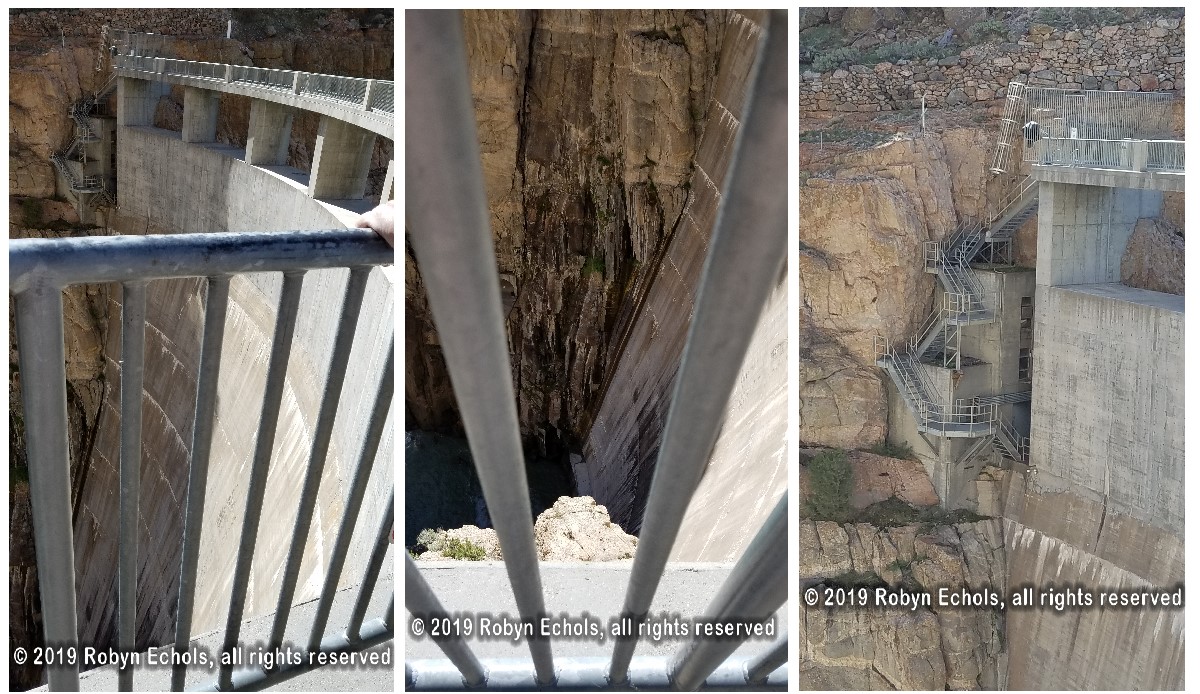
When completed in 1910, Shoshone Dam, one of the first concrete arch dams built in the United States, was considered an engineering marvel. The concrete structure measures 108 feet (33 m) deep at the base, tapering to 10 feet (3.0 m) at the crest, with a volume of 82,900 cubic yards (63,400 m3) of concrete. The dam was part of the Shoshone Project, which comprised a system of tunnels, canals, diversion dams, and Buffalo Bill Reservoir.

Artist rendition showing relative height as compared to U.S. Capitol

At 325 feet high, the Shoshone Dam also was the highest dam in the world, surpassing New York’s Croton Dam. During construction, a certain competitive spirit existed to exceed Croton Dam’s height, as noted in this photograph. 

Courtesy Buffalo Bill Dam Visitors Center

The height of the rival dam was written on the side of Shoshone Dam.


It is anchored into Pre-Cambrian granite rock on either side.


The spillway is an uncontrolled overflow weir on the south side, 298 feet (91 m) wide, dropping through a tunnel in the left abutment.

Visitors to completed dam about 1910

 The dam ended up costing $929,658 to build, a tremendous sum in those days. Immediately after completion the dam suffered from leakage through the outlet works, leading to low water elevations that exposed mudflats, which soon produced dense blowing dust. Corrective work to valves took until 1915.                   


Problems with the right abutment's outlet works led to their abandonment in 1959. They were sealed in 1961.

The reservoir began to lose capacity immediately as a result of the Shoshone's heavy silt load, and the material deposited at the head of the reservoir continued to blow when the reservoir was drawn down. Work continued on silt dikes and reforestation into the 1950s, but the reservoir's capacity is reduced from initial projections.

1926 visitors to Shoshone Dam

In spite of these difficulties, along with completion of the Panama Canal, Buffalo Bill Dam was considered an American triumph. Both construction projects were featured at the 1915 Panama-Pacific International Exposition in San Francisco. To represent the dam project, the U.S. Reclamation Service, barely a dozen years old, erected an exhibit featuring an idyllic forty-acre irrigated farmstead set in a desert valley rimmed by beautiful mountains—part of Wyoming’s Bighorn Basin.


The Buffalo Bill Dam was considered a significant enough structure that it was listed on the National Register of Historic Places within the first five years of the register’s creation.

Today, the Buffalo Bill Reservoir and Dam irrigates more than 93,000 acres, where principal crops are beans, alfalfa, oats, barley, and sugar beets.

Again, I encourage all who visit either Cody, Wyoming, or Yellowstone National Park to take the time to visit this landmark dam, one of the earliest of its kind. 


My most recent release is Eleanor, part of The Switchboard Sisterhood. Although set in 1925 Anchorage, Alaska, like the Buffalo Bill Dam, it tells of moving into modern technology. to find the book description and purchase options, please CLICK HERE.


Sources:

https://www.wyohistory.org/encyclopedia/buffalo-bill-dam-wyoming

https://en.wikipedia.org/wiki/Buffalo_Bill_Dam#

https://digitalcollections.uwyo.edu/luna/servlet/uwydbuwy~35~35

http://www.waterarchives.org/

Buffalo Bill Dam Visitors Center https://bbdvc.com/

https://centerofthewest.org/2018/01/12/points-west-buffalo-bill-town-1/

https://exploringwitheriks.wordpress.com/2018/08/25/forged-in-ice-snow-the-buffalo-bill-dam/