This is my third
post on the Sierra Railway, which connected Oakdale in the San Joaquin Valley
to the gold fields and lumberyards of the Sierra Nevada Motherlode region. You
may find my other two posts by clicking HERE
and HERE
 |
| Jamestown after Hotel Nevills burned
in 1915. Mainline passenger train 2 on left with 4-4-0 No.6. Angels mixed
22, (without any freight cars), on right with Shay No.11. |
The Angels Camp
branch of the Sierra Railway brought freight and passenger service to the
bustling gold mines in Calaveras County. Construction began in 1897, the
year the tracks reached Jamestown. Unlike the eight months needed to construct
the 40 miles of track between Oakdale and Jamestown, construction of the 19.3
miles of the Angels Branch took four years to complete. This was due to the elevation
changes and resulting steep grades.
A system of four
switch back spur tracks were designed to bring the Sierra Railway nineteen
tortuous miles over trestles and bridges from Jamestown to Angels
Camp. The Angel’s branch was completed September 15, 1902 and operated until
1935.
|
| No. 10 at Melones water tower 1903 |
The route was designed by a
young and ambitious civil engineer named William Hamilton Newell. the Angels Branch developed Passing through
areas with such colorful names as Table Mountain, Tuttletown, Jackass Hill and
Gee Whiz Point.
 |
| Gee Whiz Point in 1916 |
Gee Whiz Point refers to
the exposed precipice at the end of pair of switchbacks reached after the train
worked its way up Indian Gulch after crossing the Stanislaus River to Calaveras
County north of Tuolumne County. From here, a thousand feet above the river
rapids, the entire expanse of the canyon came into view. Trains would often
stop here to let passengers drink in the awe-inspiring vista that gave this
location its name.
 |
No. 9 with mixed cars on Tuttletown trestle
|
Because of right of way acquisition problems with the
gold mines and the engineering challenges of the Stanislaus River canyon, track
laying stopped at Tuttletown till March 1901.
 |
|
McArdle
switch 2. Right side is the reverse track. |
To get through the canyon two switchbacks were
constructed. The McArdle switchback on the south side and the Pendola
switchback on the north side. To
find a hand-drawn map of the switchbacks on the Angels Branch, please the check
out the blog post on “Angels Branch-Sierra Railway of California 1912 by CLICKING HERE
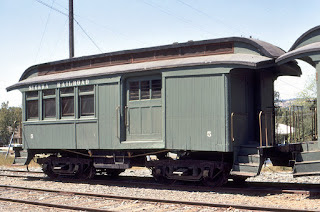 |
| Combine 5 built 1902 by Holman and
Co. in San Francisco |
.
This 19-mile
long branch line of the Sierra Railway ran from the Sierra's main yard at
Jamestown to the mining community of Angels Camp. In addition to commercial
uses, this train was used as a commuter train for workers and school students,
who traveled from other parts of the county to Sonora.
Completed in
September of 1902, the line here utilized many unconventional elements in its
design including multiple switchbacks, curves of nearly 30 degrees, and
gradients that hit 4.26 percent in some locations.
 |
No.10 pulls first excursion
September 15, 1902. |
With a
reputation for daring construction and rugged beauty, this route became a
favorite for sightseeing and excursion trains as well as the normal passenger
and freight traffic for which the line was built.
 |
No.30 pulling train Mixed 22 with combine
5 |
Near the town of
Melones, the Sierra encountered the Stanislaus River Canyon, which necessitated
the use of four switchbacks to keep grades at a minimum. This required the use
of a shorter locomotive than used on other lines, which led to the purchase of
the 2-6-2 Baldwin No. 30, which was specifically built for the steep and
crooked Angels Branch. Until the No. 30’s arrival, the line had operated solely
using geared locomotives.
Baldwin
Locomotive Works completed locomotive number 30 in May, 1922 for the Sierra
Railway Company of California. She is slightly smaller than the common
Baldwin-built logging 2-6-2. The locomotive was built for service on the
railroad’s branch line to Angels Camp in Calaveras County, which opened for
service in September, 1902.
 |
Angels Camp Depot 1905
|
It was difficult
to find a single straight section of track on the entire 19.3 miles from
Jamestown to Angels Camp. In some places, curves reached a maximum of 29
degrees, while grades topped out at 4.26 percent. Major stops were Jamestown
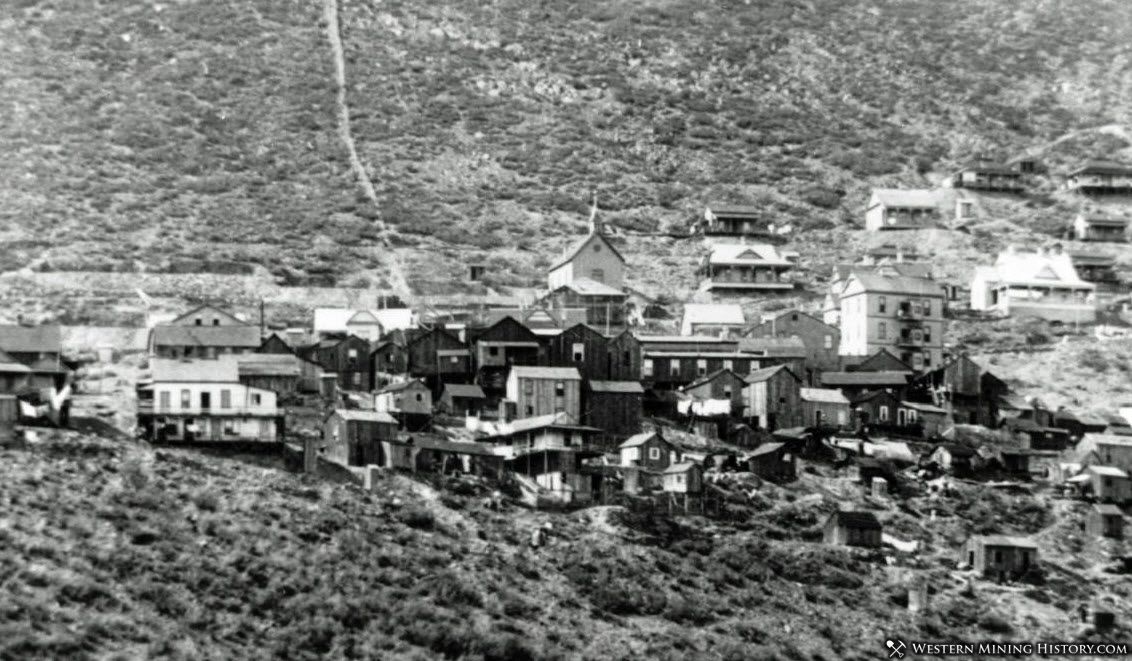
Yard, Omega, Tuttletown, El Rico, McArdles, Melones, Carson Hill, and Angels
Camp.
 |
Bridge over Stanislaus River-now under water due to New Melones Dam
|
Part of the route included crossing the Stanislaus
River. A 300 foot trestle and bridge crossed fifty feet above the river. Due to
the construction of the New Melones Dam in 1976, the old bridge and town of
Melones is now covered by water.
 |
Carson Hill Crossing
|
Unfortunately,
completion of the line coincided with the decline of California’s Gold Rush,
including the “second gold rush,” which began in the late 1880s. As the mining industry slowly collapsed, the need for the railroad faded. Declining profits
coupled with the development of paved roads and automobiles led to the Angels
Branch line being abandoned in March 1935. Within two years the rails were
gone, and a year after that the entire company filed for bankruptcy and entered
receivership, eventually re-organizing itself as the Sierra Railroad.
Many sections of
the Angels Branch route remain visible today. Grab a snack and something to
drink, then settle in to watch this You-Tube which will take you on the
remnants of the Angels Branch of the Sierra Railway. Please CLICK HERE
My latest release is my Christmas Quilt Brides romance,
Beulah.
To find the book description and purchase options, please
CLICK HERE
My other
Christmas romance this year is Vinegar Pie by Varinia from the Old
Timey Holiday Kitchen series. To find the book description and
purchase options, please CLICK HERE
My most recent romance set in Tuolumne County, the home of the Sierra Railway, is A Watchman for Willow. To find the book description and purchase options, please CLICK HERE
Sources:
Tuolumne
County Historical Museum
https://angelsbranch.com/
https://angelsbranch1912.blogspot.com/2018/08/welcome-to-my-railway.html
https://angelsbranch1912.blogspot.com/2018/08/short-history-and-rolling-stock.html
https://www.abandonedrails.com/angels-branch
https://www.ncry.org/about/collection/steam/sierra-railway-30/
https://tchistory.org/railroad-transportation/
https://angelsbranch1912.blogspot.com/2018/08/hereis-program-im-using-for-train.html


.jpg)

.png)


