Showing posts with label 1890-1910. Show all posts

Tuesday, June 7, 2016

Prohibition in Pendleton

by Shanna Hatfield

The latest installment in my Pendleton Petticoats series releases this week. In the story, Millie Matlock is leading the local Women's Christian Temperance Union to drive the saloons out of town. Gideon McBride is a saloon owner who also happens to be the one man who turns Millie's head.


http://amzn.to/1SzeYoO
 The story is set in 1908, when the citizens of Pendleton, Oregon (along with the rest of the county) voted to go "dry" and bring prohibition to the area.

As I started digging into the research, I couldn't help but question why a town that boasted more than thirty saloons and nearly 18 bordellos would suddenly decide to go dry.

In truth, I never found the exact reason why prohibition became an issue. Although Pendleton had a population of 4,406 and was the fourth-largest city in Oregon in 1900, it  catered to the surrounding communities as an "entertainment hub." Cowboys, wheat harvesters, sheepherders, railroad workers, miners, and crews of men who descended on the town to work could find quite an assortment of places to drink, play cards and visit soiled doves.

In late spring of 1908, articles began popping up in the newspaper about the possibility of prohibition. A special voter’s edition of the Pendleton newspaper was published May 22, 1908. It urged voters to consider the financial impact prohibition would have on the town. 


According to the article, the city would lose more than $23,000 in liquor licenses alone if prohibition came to town. With rent, salaries, and other expenses, it was estimated the abolition of liquor business would leave a deficit of approximately $270,000 (around $6.6 million in today's economy). Not only would prohibition create a significant loss of income, it would leave thirty businesses empty and a few hundred people seeking a new means of support.

When ballots were cast in the June 1 election, prohibition passed in Umatilla County, but also in three neighboring counties as well.

The saloon owners had until June 30 to close their businesses. According to newspaper articles, the saloons went out of business without much fanfare on June 30, 1908 (several closing at midnight) and only one man was arrested that night.

A group of saloon owners did their best to have the vote declared illegal, citing an improper navigation of voting protocols. Other than running up attorney's fees, nothing came of their efforts.

Although Pendleton went "dry," twelve saloons were allowed to retain their liquor licenses and remain in business. The how and why those twelve were given special treatment is lost to history.

In years between then and the time when prohibition officially ended across the nation in 1933, many underground drinking rooms and escape tunnels popped up throughout Pendleton.


~*~
http://amzn.to/1SzeYoO


He watched as Millie sipped her hot chocolate. As soon as she lowered the cup from her mouth, he took it from her, placing his lips in the exact spot hers had been. While he tasted the rapidly cooling drink, he stared at her over the rim of the cup. His green eyes locked on hers as he handed the cup back to her. “That’s not bad, but I like a pinch of cinnamon and a dollop of whipped cream in mine.”

In a huff, she scowled at him. “I don’t recall offering to share my chocolate with you.”

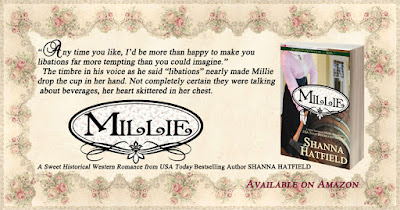
“Oh, what’s one little sip between friends, Miss Matlock?” Gideon laid on his charm, smiling in such a way it did great justice to the dimples in his cheeks. Ever so slightly, he bent closer to her and lowered his voice. “Any time you like, I’d be more than happy to make you libations far more tempting than you could imagine.”

The timbre in his voice as he said “libations” nearly made Millie drop the cup in her hand. Not completely certain they were talking about beverages, her heart skittered in her chest.

Unsettled, her gaze shot to his, yet he continued to smile in an amiable, almost boyish manner, appearing innocent of any indecent implications.


~*~
Shanna Hatfield 2Convinced everyone deserves a happy ending, USA Today best-selling author Shanna Hatfield is out to make it happen, one story at a time. Her sweet historical and contemporary romances combine humor and heart-pumping moments with relatable characters. When this hopeless romantic isn’t writing or indulging in rich, decadent chocolate, Shanna hangs out with her husband, lovingly known as Captain Cavedweller.
Find Shanna’s books at:
Shanna loves to hear from readers. Follow her online at:  

Friday, May 17, 2013

Going Dancing by C.K. Crigger


Note from Ginger: Today is Meg's usual day, but she's asked C.K. to fill in for her.  I know you'll enjoy her interesting contribution and we hope she'll be back as a regular guest.  

Going Dancing

Dancing has not always been considered respectable, but Westerners loved to cut a rug. Barn dances, elegant parties, the notorious dance hall girls. Ooh la la! And then came the gay 90s. This is the era when Ragtime--you know--JAZZ, began. And while it may have originated in the southeast, it quickly spread across not only this country, but also into Europe. 

With the music, came the dance. The Cakewalk, newly originated, was based on black people poking fun at the way white folks moved. Very soon whites loosened up and adopted the new fad as their own.

Dance tunes had provocative titles like I Can’t Give You Anything But Love, Baby, Ta-ra-ra Boom-de-ay, & A Hot Time in the Old Town Tonight. Sometimes the lyrics were a little risque. Who knew? This was still the Victorian age, after all. Dance bands might also be playing songs like The Band Played On, The Sidewalks of New York, Daisy Bell, or After the Ball. A country style song going the rounds was The Cat Came Back. Even I remember hearing this one, and believe me, I wasn’t around in 1893, the year the song came out.

The waltz, as it had been since the early 19th century, was still one of the most popular dances, only now it had variations--sometimes named for the place where some inventive person created new steps and they caught on. The two-step, the polka, the schottische, mazurka, galup, and quadrille were others one might see. The two-step, polka and schottische survive; I don’t know about the others. The tango also began in the 1890s. I’m pretty sure it isn’t the Argentine tango you’ll see on So You Think You Can Dance or Dancing With the Stars! Oddly enough, even in the finest ballrooms in New York City, an evening  likely would end with the last dance being an old time reel. Another interesting point is the length of time allotted for a dance. Dance cards of the day show them lasting ten to fifteen minutes. I suspect ladies might have very sore feet after an evenings entertainment. One hopes she chose her partners well.

Informal dances were held in many different venues, including country barns. Furniture might be cleared from a home’s parlor to make space; hotels often held afternoon tea dances. Not far from where I live is a well-preserved, stately four-story home of the 1890 - 1910 era where the entire top floor is given over to a private ballroom. 

High in popularity with the young set, dance pavilions built out over the water at various lakes drew large crowds. Can’t you just imagine the music floating out over the gently lapping water, stars shining overhead, soft night air brushing the lady’s bare arms lifted to embrace her partner? Gentlemen’s cigar smoke would waft in from the darkness to mingle with the women’s perfume. Bliss.

It is at one such pavilion that China Bohannon and Gratton Doyle, the main actors in my historical mystery series, trip the light fantastic. China is in heaven--until one of Grat's cases intrudes.

Excerpt from Three Seconds to Thunder in which China and Grat are attempting to get evidence in a cheating wife case:

The band, made up of horn, strings, and percussion, broke into a lively waltz as Gratton and I entered the pavilion. We walked our own slow promenade around the dance floor perimeter before Grat swept me into the waltz. He was a good dancer. I might have known, having seen his grace in other, more dire circumstances—like fights. And baseball games. 
He smiled down into my eyes, holding me a little closer than is exactly proper, and bent his head so he could speak without shouting. His mouth touched my ear. “Did you see her anywhere?”
I missed a step. “No. Did you?”
“No. She’ll be here though. Her husband said he found a note making the assignation.”
“Then I guess we’ll have to wait until she—or they—arrive.” 
He chuckled, warm against my ear. “I guess we will.”
The next hour was tremendous fun. I enjoyed the froth of my skirt around my ankles, the twirling to the music, the lights, the people’s laughter—all right, and being in Grat’s arms—right up until he stiffened.
“Look. That’s her, isn’t it?” He nodded towards a statuesque blonde hovering at the pavilion entrance and spun me in her direction for a better view. 
“I think so,” I said, breathless. The blonde certainly wore her hair in the same style as the woman in the picture. In person her face was softer, more relaxed, but really, there was no mistaking the slide of her nose and her wide-spaced, light-colored eyes. Ice blue, as it turned out, which I hadn’t been able to tell from the photo. Her head was thrown back, laughing at something the man with her said.
Then I gulped, missed a step, and trod on Grat’s toe. “Oh, no,” I moaned. “No!”
“What?” 
Grat hadn’t yet seen what I had. Or who I had, I should say. As he turned me in order to see the woman, the other couple had also rotated and brought Alice Pemburton’s dance partner into view.  I recognized that partner all too well. 
“Hell and damnation,” I said.
Gratton made a clicking sound with his tongue. Disapproval. As if I hadn’t learned such language from him. On second thought, perhaps I’d learned it from the man dancing with our quarry. His name was Porter Anderson, and he was my good friend.

http://www.youtube.com/watch?v=9PzG0P4FqxA (Notable events of the 1890s, accompanied by music of the day.)

A gown (the blue one) such as China might wear. The one with big sleeves is a little extreme for the occasion as I've described.