Showing posts with label Dead Set Delphinia. Show all posts

Friday, October 27, 2017

Bombazine and the 19th Century Widow by Zina Abbott


In my most recent novel, Dead Set Delphinia, my heroine in the fall of 1881 finds herself involved with the furniture store owner in the relatively new mining town of Jubilee Springs. Since he has the skills to nail together a pine box, he has also become the coffin-maker and, by default, the town mortician. This was not all that unusual. While researching Lundy, California for the Eastern Sierra Brides 1884 series I wrote, I found in real life the furniture store owner, Andrew Barnes, was also the coffin-builder and mortician for that community.

1870-1880's
As part of the plot, in Dead Set Delphinia, when Bennett Nighy asks for Delphinia’s help to act as a hostess at the viewing of one of the town’s beloved deceased citizens, she decides it is time to visit the seamstress in order to see if the woman can help her put together an appropriate gown in black bombazine.

I sew, and I have been known to frequent fabric stores. However, my first recollection of being exposed to the fabric bombazine came about as I read The Widow of the South by Robert Hicks. This novel, based on a true story, tells about Carnton Plantation, the scene of a horrific Civil War battle in 1864, how the land became a cemetery for the multitude of Confederate dead. It continued to be watched over by the widow of the plantation owner who, until her death, wore nothing but black bombazine mourning dresses.
 
Mary Todd Lincoln in mourning bombazine
The word “bombazine” struck me as unusual. The way my crazy mind works, it put me in mind of cabaret music – you know: bomba-bomba-bomba.

Exactly what is bombazine?
bom·ba·zine
[ˈbämbəzēn]

NOUN:  a twilled dress fabric of worsted and silk or cotton.

Bombazine, or bombasine, is a fabric originally made of silk or silk and wool, and now also made of cotton and wool or of wool alone. Quality bombazine is made with a silk warp and a worsted weft. It is twilled or corded and used for dress-material. Black bombazine was once used largely for mourning wear, but the material had gone out of fashion by the beginning of the 20th century. In the nineteenth century, the fabric was mostly made in Norwich, England.

Bombazine is said to have originated in the United Kingdom in the early 18th century but quickly spread across Europe and eventually called bombazine from the old French word bombasin. Interestingly enough, it first found use as a cloth ideal for mourning widows although subsequent growth of the fashion industry allowed it to flourish towards other uses. 

Bombazine was also used to make the black robes worn by judges.

Here are some interesting facts about bombazine:

• Bombazine used to be exclusively made from silk. However, the subsequent need to make it affordable to the masses necessitated the shift from silk to cotton and wool. In many societies in olden times, the price of silk was too exorbitant to merit buying bombazine. However, because bombazine cannot compete with velvet as a luxury material, it was forced to find another niche in a more affordable price range.

• Twilling or cording are the only known methods known for making bombazine. Twilling is process of weaving where cloth strands are pushed through other cloth strands positioned lengthwise on a weaving machine. The resulting cloth has a characteristic diagonal pattern that is highly resistant to ordinary wear and tear. More modern incarnations of twilled fabric include denim which is used for making jeans.

• The use of bombazine as a mourner’s cloth was precipitated by the observation that the fabric has just enough sheen and sparkle for a mourning widow. Too much sparkle would have been construed as a blatant display of disrespect to the dead while cloth with less shine would have been a symbol of low status in society which was not ideal in an era where Victorian affluence was the prevailing theme.
Mary Wylie King, widow 1920

• While bombazine can be made in a variety of colors, it is predominantly manufactured and sold in black. This is consistent with its status as the cloth of choice for mourner’s dresses.

• Today, bombazine no longer has the same status as it once had in Victorian times. Bombazine is still sold in many shops but in substantially lower volumes. The values of the modern times has pushed the material to relative obscurity so much so that not many people are familiar with this type of fabric.

• Modern applications of bombazine include lining material in caskets and jewelry boxes. The next time you see a casket, check out the inner lining so you’ll know firsthand what bombazine looks like.


Sources:
Wikipedia
http://www.typesofclothingfabrics.com/bombazine.shtml
avictorian.com


Dead Set Delphinia is a full novel and the fourth of Zina Abbott's books in the Sweethearts of Jubilee Springs series. You may read more about it by CLICKING HERE.

Her fifth book, Evasive Eddie Joe, is scheduled for publication October 31st.


Zina Abbott has available three other novellas in the Sweethearts of Jubilee Springs series.

Book 6:  Cat's Meow
Book 7:  Bargain Bessie
  ~o0o~ 
To read and enjoy all of the books in the Sweethearts of Jubilee Springs series, please sign up and follow us on Amazon by CLICKING HERE.


Friday, September 22, 2017

FROU-FROU HAIR by Zina Abbott


Whoa! 

What, you say? 

This is a Western blog. Out west, people, including the ladies, weren't big into frou-frou like they were back east. 
1880's Fall Outdoors Fashion Plate

In the West, women had to be tough. They had to work hard. They had to be practical.

They also were the civilizers of the West. Many of them came from the East. They brought their religious and character values, and their social skills, and their fashions with them.

In the 1870's and 1880's, that included not only bustles, but frou-frou.

Frou-frou, as in lace and buttons and ribbons and feathers and ruffles and ruching and pleats and fancy hair combs and a host of other gew-gaws -- personal decorations to boggle the Western male mind.

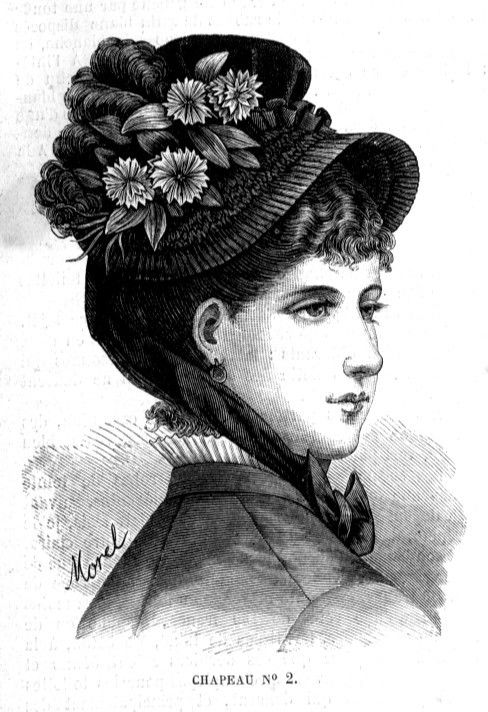
In the 1870's and 1880's, they brought frou-frou hair. Not just hair piled up on their head in curls or braids, but also covered with a hat intended to entertain the eye of the beholder for hours. Please notice the hair curled in a high chignon behind the lovely bonnet:


And for special occasions, such as a dinner with the town mayor--whether he wore a stylish plaid business suit and derby, or dusty cowboy boots and a Stetson--the piled-up hair of the hostess emulated Eastern designs found in the latest issue of Godey's Magazine, and was decorated with frou-frou. 

 
What prompted my interest in hair and all its frou-frou was the cover reveal of my latest novel that will be released next week, Dead Set Delphinia:

I received many positive comments about the cover, although a couple of readers noted the dress looks like it is from the 60's. Actually, as a ballroom gown, it's not far off for being typical of either the 1860's or 1960's. Yes, it is on the cover of a book set in 1881. However, in order for an author to not use an image of the same model wearing the same outfit you see on every other historical western romance book, sometimes an author has to fudge a little.

The hair drew the most negative comments: "Disconcerting." 
"Helmet hair."

Yup! It does look a little like the good ol' beehive of my salad years. Not really late 1870's-early 1880's style. 

Or is it? 
1870-1880 hair accessories


Add some frou-frou, and whallah! Period-correct hair.

I pay attention to constructive criticism. After doing a little photoshopping and pulling from the frou-frou on my heroine's skirt, here is my REVISED cover reveal:

No more helmet hair. No more looking like a football landed on her head.

This fancy outfit, complete with frou-frou from her hair to her toes, is just right for my recently "from back East" Delphinia who shows up at the harvest dance held in Jubilee Springs, a backwoods Western mining town, especially when she thinks she has deliberately worn an outdated and understated gown to the event.

Dead Set Delphinia is not on preorder, but is scheduled to be released next Tuesday, September 26th. On that day it will be available at the release day price of $.99. After release day, the price will be raised to its usual amount. It will also be available for Kindle Unlimited. This is Book 11, and my fourth book, in the Sweethearts of Jubilee Springs series.

Here is an excerpt:


         Bennett raised his eyes from her boots with their two inch high heels to her face only to discover her attention had focused on him. “Good morning, ma’am. May I help you with something?”
         “It’s Miss. This store has some lovely pieces. Too bad your employer has not required you to better maintain the showroom. These sets would be far more appealing to potential buyers if they were arranged by wood type and style in a manner that would allow a person to visualize them in a home setting. And although I’ve noticed there is an inordinate amount of dust in this town, perhaps more frequent use of a broom and dusting cloth would also help.”
         Bennett tipped his head and raised an eyebrow as he watched her once again focus on a dining room sideboard made of walnut and stained dark. He knew all these things. He had particularly been painfully aware of every failing she had mentioned, especially once Gerald Shumaker had warned him he would be bringing in his wife to look at dining sets in the next few days. However, who did this woman he had never seen around town until now think she was, waltzing into his store and telling him how to manage this showroom?
         “I’m not the clerk; I’m the owner, Bennett Nighy.


I have three novellas in the Sweethearts of Jubilee Springs series available.
 

Book 6:  Cat's Meow
Book 7:  Bargain Bessie
  ~o0o~ 
To read and enjoy all of the books in the Sweethearts of Jubilee Springs series, please sign up and follow us on Amazon by CLICKING HERE.