

For those who read historical Westerns, Abilene is often thought of as a cow town—the end of the Chisholm Trail where long horn cattle was brought up from Texas, loaded onto rail cars, and shipped to the East. However, that is not how the town started.

The first white family to take up residence in the immediate vicinity of Abilene was that of Timothy F. Hersey in 1856. He staked out a claim on the west bank of Mud creek about two miles north of where it empties into the Smoky Hill river.

Hersey Cabin ctsy oldabilenetown.org
When the Butterfield Overland Despatch stage line was being formed at the end of the Civil War, he was given a contract to provide a home station. He provided two log houses and a log stable and corral for horses. He agreed to feed the passengers and employees who came over the trail in the six-horse Concord coaches. Part of his advertisement to west-bound travelers was they would find at his station the "last square meal east of Denver." Food at some of these stations consisted of bacon and eggs, hot biscuits, green tea, coffee, dried peaches and apples, and pies. Beef was served occasionally, as were canned fruits and vegetables.
The next building in the area was a dwelling known as "the Hotel," owned by C. H. Thompson. It was located opposite Hersey’s station on the east bank of Mud Creek. Thompson also used his business as a way station for the Short Line Stage Company.
In 1864, a city block east from the creek, W. S. Moon built the Frontier Store. In it, he offered for sale a small stock of widely assorted general merchandise. Mr. Moon also served as the postmaster and register of deeds. His store later served as a meeting place for the sessions of district court.

Prairie Dog Town near Abilene, Kansas - 1867
Away from the trail and in the midst of a prairie dog town was "Old Man Jones' " saloon . Over the years, as emigrants followed the Smoky Hill Trail west, some were attracted by the rich growth of prairie grass on the Smoky Hill river bottom land. They decided to go no farther. From these settlers, about a dozen scattered log houses sprang up on the east side of the creek.

In 1860, the counties of Kansas foresaw coming statehood for the territory, and the momentum to organize grew. The community along Mud Creek was part of Dickinson County. The residents recognized the value of living in the county seat. However, to have a chance against the other communities in the county, they knew they had work to do. C. H. Thompson laid out a townsite on his land east of Mud creek. He quickly constructed several makeshift log houses to give it some semblance of a town.
The community needed a name. Mr. Thompson went to the first inhabitant, Tim Hersey, and asked him to give the new town a name. Mr. Hersey turned the issue over to his wife. Mrs. Hersey found a reference in the first verse of the third chapter of Luke in the Holy Bible which spoke of the "tetrarch of Abilene." She "Abilene," which meant "city of the plains," would be appropriate name, and the decision was made.
A county-seat election was held in the spring of 1861. Union City, Smoky Hill (now Detroit), Newport, and Abilene were all contenders. Abilene, by securing the support of the Chapman creek settlers, won the election.
There is very little recorded of the events in Abilene from 1861 to the coming of the railroad in 1867. No doubt its development during this period was much the same as other Western frontier towns during the Civil War period. The town was rustic—still comprised mainly of log buildings. There were no streets. Spaces between the houses were overgrown with prairie grass. The frontier stores were cluttered and dirty, which created a problem in sanitation.
The arrival of a stage or the passing of an emigrant party down the trail brought out the whole populace to find out who was aboard, whence they came, and whither bound, eager for any bit of rehashed or revised news from some other point. Eastbound travelers brought news of some late Indian depredation, and those who were westbound brought word of some more or less recent happening of the war which was then in progress. The summers brought out the loiterers. The winters were largely open and agreeable, but there were frequent bleak winds and occasional blizzards. The hunting expeditions after buffalo, antelope, wild turkey, and prairie chicken served the double purpose of providing a diversion and a source of meat.

Loading cattle on the Kansas Pacific in Abilene - 1867
This was the Abilene that Joseph G. McCoy found when he came west on the Kansas Pacific railway in 1867 in search of a spot on that line which could be used as a shipping point for the herds of Texas cattle being driven north. He wrote:
“Abilene in 1867 was a very small, dead place, consisting of about one dozen log huts, low, small, rude affairs, four-fifths of which were covered with dirt for roofing; indeed, but one shingle roof could be seen in the whole city. The business of the burg was conducted in two small rooms, mere log huts, and of course the inevitable saloon, also in a log hut, was to be found.”

Drovers Hotel - 1867
That same year, Joseph G. McCoy bought 250 acres of land north and east of the town. On his land, he built a hotel, the Drovers Cottage (also known as Drover’s Cottage, although the name painted on the side of the building did not include an apostrophe).

Mr. McCoy also built stockyards large enough to hold 2,000 heads of cattle and a stable for the drover’s horses. The Kansas Pacific put in a switch at Abilene that enabled the cattle cars to be loaded and sent on to their destinations. He encouraged Texas cattlemen to drive their herds to his stockyards.
The first twenty carloads left September 5, 1867, en route to Chicago, Illinois. McCoy being familiar with the meat market. The stockyards shipped 35,000 head that first year.
From there, the town grew quickly and became the first cow town of the West. It became the largest stockyards west of Kansas City, Kansas.

1873 Chisholm Trail
The herds of cattle were driven from Texas north on the Chisholm Trail. From 1867 to 1871, the north end of the trail ended in Abilene. Abilene became the largest stockyard and cattle shipping point west of Kansas City, Kansas. The Chisholm Trail also brought other travelers, which made Abilene one of the wildest towns in the West.
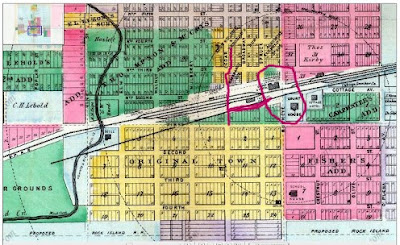
(This 1887 Map of Abilene shows a more-developed town that what existed in 1867-71. The black wavy line on the left is Mud Creek. The vertical red line shows Cedar Street, the section north of the tracks not being very developed and the saloon district being south of the tracks . Texas Street ran parallel to the railroad tracks. The circle shows the general area of the Drovers Cottage on the south of the tracks and the stockyard on the north of the tracks.)
At first, the section of Abilene along Cedar and Texas Streets that catered to the Texas cowboys had no law enforcement, to speak of. The more stable residents of the original town of Abilene did not consider it their problem. However, by 1869, it became apparent to the law-abiding citizens that municipal organization was necessary to bring order to the unruly blocks east of their city in order for the violence not to spill over and disrupt their lives. On September 3, I869, a group of citizens bearing a petition signed by forty-three citizens appeared before the court of Cyrus Kilgore, probate judge of Dickinson County, Kansas, "praying for incorporation." The petition was granted, and the citizens chose a group of trustees to manage the city until elections could be held.
This took place toward the end of the 1869 cattle season. Other than pass a few basic ordinance, the town did little as far as enforcing law and order.
In the spring of 1870, the board of trustees met again. Thirty-two saloons were licensed, closing hours were established, houses of ill-fame in the city limits were outlawed, and an attempt was made to recognize and enforce laws against the more serious crimes. City offices, including the city marshal position, were created. Ordinances were published.
Next month, my post will be about law enforcement in Abilene during the days of the cattle drives.

On April 3, I871, the first charter election was held to elect a mayor and council. J. G. McCoy, the cattle magnate in Abilene, was elected mayor. The main issue in the election revolved around the degree of control that should be attempted over the vice and immorality brought into Abilene by the Texas cattle trade.
Joseph McCoy
On May 1, 1871, a comprehensive plan of licensing all business houses in Abilene was included in an ordinance by the city council. This was an attempt to force the transient businesses that catered to and thrived from the Texas cattle trade to help defray the high cost of law enforcement. The city council became deadlocked over the amount of the fee they should charge, which led to several disputes among them.
In 1871, more than 5,000 cowboys herded between 600,000 and 700,000 cows through town. However, other forces in the town and county would soon spell the end for this as a cattle shipping point.

Farmers, who had homesteaded the land around Abilene and who were a more stable, year-round population, opposed the Texas Longhorns from entering Dickenson County. The Longhorns brought with them a tick that was deadly to their domestic cattle. Increasingly, they began to dominate the politics. In February 1872, a petition was circulated and signed by about 80% of the population who wanted an end, not only to the dangers of the tick infestation, but to the evils brought by the Texas cowboys and the saloons, gamblers, and prostitutes who catered to them. They were requested to take their cattle elsewhere.
McCoy could see the writing on the wall. Although in 1872, it was the town of Ellsworth who enjoyed being the biggest Texas cattle drive destination, Mr. McCoy dismantled his Drovers Cottage and rebuilt it in the town of Newton, which became the preferred destination after Ellsworth.
Abilene did not die with the loss of the cattle trade. The agriculture trade grew and stabilized the town. However, its days as a rowdy and lawless cow town were at an end.

I included Abilene, Kansas, in several of my books.

In Mail Order Lorena, the time period is 1865-66 and the setting is primarily the Butterfield Overland Despatch stage station in Ellsworth, Kansas. However, my hero often rides the stagecoach east to stay at the station in Abilene and spend time in a fictional town saloon, where he meets Lorena. You may find the book description and link by CLICKING HERE.

My most recent book, Abilene Gamble, is set in the summer of 1871 Abilene, after the town has experienced a great deal of growth and settlement. As a lawyer and investigator/bounty hunter who carries the scars from his time fighting in the Civil War, my hero, Harry Bradford, found his niche in this rough-and-tumble town. You may find the book description and link by CLICKING HERE. (Much of this blog post was taken from the Author Notes at the back of this book.)

Sources:
https://abilenekansas.org/abilenes-history
https://oldabilenetown.org/tim-hersey
https://www.kshs.org/p/abilene-first-of-the-kansas-cow-towns/12833
https://abilenekansas.org/blog/2019/12/18/area-history
http://en.wikipedia.org/wiki/Abilene,_Kansas


