Showing posts with label Texas Ranger. Show all posts

Monday, October 7, 2013

Fort Martin Scott


Fort Martin Scott was the first frontier fort built in Texas. For me the fort holds special meaning as it’s part of my heritage, but more on that later.  The fort has a long and interesting history, one that surprised even me when I began doing more research.
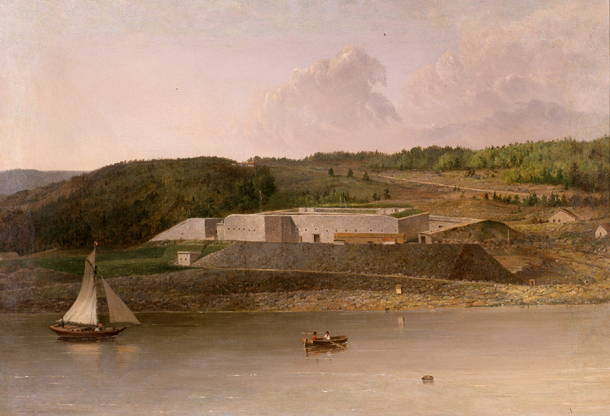
File:Fort knox maine painting.jpg
Fort Knox, Maine by Seth Eastman Oil on canvas, 1870-1875
Behold a painting of an early American scene. The depiction of Fort Knox was rendered by Brigadier General Seth Eastman sometime between 1870 – 1875 and about twenty-two years after he is believed by many to have established Camp Houston in Fredericksburg, Texas in 1847. Some believe the fort to have its original roots in 1845 when Texas Rangers patrolled the area. In 1849 the camp would be called Fort Martin Scott. Though Seth was an artist at heart and gave America many such wondrous scenes of life on the frontier, he was also an officer in the United States Army. Prior to his time in the hill country of Texas, he served at Fort Snelling where he married a Dakota chief’s daughter who bore him a daughter.  When he was asked to return to West Point in 1832, he had his marriage annulled. Later he would marry Mary Eastman.

Of interesting note, his grandson from his first marriage, Dr. Charles Eastman, became the first Native American to become a certified doctor and was also the co-founder of the Boy Scouts of America. Seth’s second wife, Mary Eastman is also well known for her literary works. She authored Aunt Phillis's Cabin: or, Southern Life As It Is (1852), one of the most popular of the anti – Uncle Tom’s Cabin books.
But let’s get back to Fort Martin Scott. The Fort served as a base of operations for troops serving the Perdernales, Guadalupe, Llano and San Saba River Basins. While there existed a very important treaty between the German community and the Penaketas Comanches, other Native Americans in the vicinity, including other Comanches, Apaches and Tenawas, did not recognize the document and proved a serious threat to the settlers. Originally established to help protect settlers in the surrounding area against Indian problems, the fort was deemed unnecessary as a troop post in 1853. This was due in part to the peaceful nature of the Germans who lived in Fredericksburg, their willingness to get along with the Native Americans in the area and the Fort Martin Scott Treaty (1850), an unratified treaty between several Indian tribes and the U.S.  However, the fort became a supply depot for government trains travelling westward to other forts as they made regular stops in need of corn and hay.
After 1853, the Texas Rangers would also use the fort’s facilities when needed and when the Civil War broke out, confederate troops would also make use of the property on occasion though they never officially occupied the fort. Darkness hovered over the establishment when Quantrill’s  men and Duff’s Partisan Rangers operated out of the fort for a short time. Both entities were bent on “discouraging” Union sympathizers by often cruel and violent methods. After the Civil War, the army saw a need to protect the nearby citizens from Indian difficulties and occupied the fort for a short period of time during 1866 but by December of that year, the fort was once again abandoned. Some of the buildings were torn apart to provide materials for other settlers.
The original deed. Note the lined paper.
Interestingly, it is thought that the property on which the fort was built was never owned by the army but was instead leased from a Mr. Twohig which makes sense because Twohig’s name is on the bill of sale. On March 12, 1870, papers were filed, the sum of $1600 in gold paid, and Johann Braeutigam took possession of the fort properties. He, his wife and nine children moved into one of the two remaining buildings. He then built a store and saloon. Braeutigam’s Gardens also boasted grapevines, hackberries, native trees and a racetrack for horses. He’d turned the property into a place to come “play” and in 1881, the first Gillespie County Fair was held on these grounds. The property served as a huge entertainment center where weddings took place, dances occurred in the dance hall and horse races commenced.
On September 3, 1884, four men came into the saloon and demanded the owner turn over his cash box. Johann took exception and went for his musket. The shots from Colts could be heard all the way to the main house. The men took off after stealing only a small amount of cash from the cash box. Johann’s ten-year-old son, Henry discovered the body. The townsfolk of Fredericksburg were outraged, Johann and his wife being well loved by all. Texas Ranger, Ira Aten and his men began a hunt that resulted in the apprehension of three suspects and then, later a fourth. However, the man suspected of firing the killing shot, James “Jim” Fannon (or Fannin), alluded authorities and was never apprehended.  To hear more about Ira Aten’s involvement in bringing the murders to justice, come visit my blog post on Sweethearts of the West.
Of course, in researching this part of the story, author Bob Alexander offered another version, one I'd never heard. In the footnotes of his book, Rawhide Ranger; Ira Aten: Enforcing Law on the Western Frontier, Alexander found a written version that differs from the one the family always told. Since the property had horse racing, Wes Collier from a neighboring town decided to try his luck. He supposedly won the race and a huge pot of money which made the locals upset. Since it was late, the locals decided to put the money in Braeutigam's store for safe keeping until they could figure a way  from having to give it all to Collier. The next morning, he went to retrieve the money, an argument ensued and Braeutigam was killed. The family has always maintained that it was Fannin who did the actual killing so who knows which version is more factual.  
The Guardhouse, one of the only original structures left.
This became the living area from the Braeutigams.
After the tragedy, Christine continued to raise her eleven children at the homestead. When he came of age, Henry took over the running of the farm. He married Clara Gold (yeah, she was the inspiration for my pen name, she and my daughter’s friend, Ciara) and together they had seven children. Their oldest child, Hortense, was born at the fort and lived there until she married. Her two sons, Edward and John, spent summers staying with their grandparents and playing on the old fort site.
And now as Paul Harvey would say, for the rest of the story; Johann Braeutigam was my great, great grandfather. Henry was my great grandfather. When I was just out of college, my father and I snooped about the property before the city started reconstruction. This past fall, my mom and I went to the site and gathered pictures though at the time, the buildings weren’t open for us to look inside.
My father and me in front of one of the buildings, circa 1980.
The top photo is circa 1908, the Braeutigam family with Henry on the left, Christine Braeutigam in the center with Hortense behind her. The photo was taken in front of the smokehouse/cellar, the building with the wagon in front.


Wednesday, January 4, 2012

Welcome Kristy McCaffrey

My special guest today is Kristy McCaffrey.  I'm so pleased she agreed to join me today and share an excerpt from her latest release from Whiskey Creek Press.  She's given us a bio so we can get to know her a little better.

Author Bio

Kristy McCaffrey has been writing since she was very young, but it wasn’t until she was a stay-at-home mom that she considered becoming published. A fascination with science led her to earn two engineering degrees—she did her undergraduate work at Arizona State University and her graduate studies at the University of Pittsburgh—but storytelling was always her favorite hobby. Born and raised in Arizona, and recently returned after a 20 year absence in Pittsburgh, she writes Old West romances to capture the landscapes that were such a big part of her childhood. Her first novel The Wren was a CAPA winner for best new author traditional, a Texas Gold finalist, and a HOLT Medallion finalist for best first book. She lives in Scottsdale, Arizona with her husband, four children, and two chocolate labs, Ranger and Lily. Visit her online at www.kristymccaffrey.com.
            
Blurb:
In 1877 Emma Hart comes to Grand Canyon, a wild, rugged, and until recently undiscovered area. Plagued by visions and gifted with a second sight, she searches for answers—about the tragedy of her past, the betrayal of her present, and an elusive future that echoes through her very soul. Joined by her power animal Sparrow, she ventures into the depths of Hopi folklore, forced to confront an evil that has lived through the ages.
Texas Ranger Nathan Blackmore tracks Emma Hart to the Colorado River, stunned by her determination to ride a wooden dory along its course. But in a place where the ripples of time run deep, he’ll be faced with a choice. He must accept the unseen realm, the world beside this world, that he’d turned away from years ago or risk losing the woman he has come to love more than life itself.

Excerpt:
Using desert brush as cover, Nathan approached the confluence of the Paria and Colorado Rivers, his ivory shirt clinging to his shoulders and back as the sun singed anything not protected by precious shade. He estimated he'd gone about a quarter mile when more gunfire pierced the late afternoon atmosphere. He sidled up behind a large willow tree and cradled the rifle in his left arm.
Looking across the Paria he caught sight of the mighty Colorado and for a moment couldn’t breathe. The expanse of water flowed with an undeniable dominion, the strong current kicking whitecaps along the surface. There was no doubt that the river spoke of danger to any who breached it, but the longing that slammed into Nathan nearly knocked him to his knees. He wanted to be on that river.
The gunfire stopped, but Nathan remained concealed.
Three men faced away from him, standing on the sandy banks of the Colorado River. All carelessly held guns in their hands, old revolvers or pistols, and waved them around as they yelled to someone in the water. They weren't particularly fit men, and Nathan knew he could use this to his advantage. They started shooting again, and one of them slowly began to run downstream, his gait awkward, as if the man had only discovered yesterday his legs could perform such a task.
Moving to gain a better view of whom or what might be in the river, Nathan backtracked out of sight to wade across the Paria then approached the Colorado behind the two men remaining. A glance beyond stopped him cold in his tracks.
A woman—as evidenced by a braid of chestnut hair resting across one shoulder—sat in a large wooden skiff, rowing frantically, leaning down whenever a bullet flew past her head. A wide-brimmed hat shadowed her face but he had no doubt of her identity.
Miss Emma Hart. The woman he had been tracking for the last three weeks, a woman he had only seen in a faded photograph, a photograph he'd stared at far too much recently.
Satisfaction mixed with urgency.
Miss Hart was headed down river. Alone.
He didn't have much time. If one of these three idiots didn’t shoot her first she would quickly disappear.
Nathan rushed the two men on shore and knocked one out with the butt of his rifle. As the other man swung an arm around in retaliation, Nathan kneed him in the groin then pinned him to the ground with the Winchester lengthwise across his throat. The man began to sputter, his arms flailing in all directions, and Nathan rendered him unconscious with a well-placed blow to the head.
The third man shuffled toward him. Nathan rolled to the side and avoided the bullet discharged from the man's gun. Not wanting to kill his attacker, he pulled a six-shooter from the holster strapped to his right leg and shot him in the shoulder. His target fell to the ground.
“I’m shot! Oh God!” The man cried in agony. “Please don’t kill me! Reggie? Hersch? Help me!”
Nathan stood, removed the firearms from the two unconscious men then threw the weapons into the river. As he approached the man writhing in the sand, he felt the heat in his boots and could imagine how uncomfortable it was lying on the ground. Nathan almost felt sorry for him and his buddies; almost, but not quite. A stray bullet could have easily hit Miss Hart.
He swung the man’s gun into the water. Glancing down river he saw the woman watching as her boat moved further and further away, her expression and features difficult to discern from the distance.
Nathan moved past the man on the ground, who moaned in short gasps. “You won’t die. Make sure you stop the bleeding and clean the wound.” He ran along the river's edge, waving his arms above him, and yelled toward the woman. “Stop! Come to shore!” He hoped she had the strength to guide the boat against the current and return to him.
She stared but did nothing, except to occasionally turn her head to check the direction of the skiff.
Nathan climbed over and around a cluster of rocks then ran along a beach before coming to a rocky ledge, unable to follow her downstream any further.
“Miss Hart! Emma Hart! I need to talk to you!”
She took both oars in hand and Nathan breathed a sigh of relief that she had finally come to her senses, only to swear under his breath when she began paddling in the opposite direction. He glanced back to the general location of Black.
A man should never have to choose between a horse and a woman.
You really owe me, Matt.
In disgust he threw his hat to the ground, then his Winchester into thick underbrush to hide it. Snapping his revolver into its holster, he hoped he wouldn’t have to lose it as well before reaching the boat. Of course, it would be wet and useless for a day or two, but it went against every instinct he had to be weaponless. Before he could think twice about it, he stepped into the river and dove, immersing his body.
The shock of the cold water rendered his muscles useless for a moment and he struggled to stay afloat as the current carried him. Focusing on his arms, he swam forward. Warmth began to seep into his limbs and his strokes broadened, moving him toward Miss Hart and her boat. The mule-headed woman, however, kept trying to paddle away from him.
“I just need to talk to you,” he shouted. He also needed to get out of the water before the current did him in.
“Stay away from me.” Her voice sounded strong, firm, with only the slightest edge of panic.
He continued swimming toward her. Peripherally he noticed the name on the stern of her boat—Paradise. Wondering if it would prove to be true he quickly grabbed the side before she could maneuver away from him. She released one oar from its lock, swung it around, and hit him square on the head as he attempted to pull himself on board.
“Sonofabitch!” Nathan fell into the water, barely managing to maintain a grip on the gunwale. This sure as hell wasn’t paradise. What made him think chasing this woman was a good idea? Rubbing his head in a useless effort to stop the pain, he said through clenched teeth, “Miss Hart, I have news of your sister.”
That, at least, stopped the oar mid-air as the woman prepared to pound him again. Nathan took advantage of her hesitation and with a quick jerk on the boat he knocked her off-balance. She screamed as she landed with a thud in the wobbly dory and without delay he swung himself over the edge and quickly readjusted his weight.
Miss Hart regained her balance and grabbed the oar, but Nathan easily yanked it from her hand. Her eyes betrayed her next move as she lunged for the other paddle—hanging over the side of the boat and resting in its lock. Nathan swung it out of reach.
“Get out of my boat.” She faced him across the small expanse of the unsteady skiff.
Nathan contemplated the fierce creature before him, her blue eyes flashing with fear and determination. He was in trouble, and from far more than the mighty Colorado.
“I’m not going to hurt you,” he said with more irritation than intended, his head still pounding. “Why don’t you sit down before you fall overboard.”
Instead, she leaned down and began to rummage inside a rawhide knapsack. Nathan noticed several such bags tied snuggly to the floor of the wooden structure—it was apparently well-stocked for river running. Watching Miss Hart as she doggedly searched for something, Nathan realized too late what his fascination cost him.
Pulling an old Remington revolver from where she’d stashed it, she cocked the gun and pointed it at him. She struggled to stand in the boat as the river continuously pulled them further into the canyon, but the gun she held with confidence. Nathan's gut told him she had some inkling how to use it. He had to give her high marks for tenacity. Clearly, he’d underestimated this woman.
“Gimme your gun,” she said.
“It’s wet. It won’t work anyway.”
Without words she aimed her weapon between his legs.
A man had to know when to cut his losses. Nathan unbuckled the holster and set it at the bottom of the boat between them.
“Who are you?” she asked.
“Nathan Blackmore.”
“How do you know who I am?”
“I’ve been looking for you. I have news of your sister.”
The woman paused. “I never told her where I was going. How did you find me?”
Nathan realized her confusion, but hesitated to offer an explanation while she pointed a potentially loaded gun at a portion of his body he’d rather keep. She might not have ammunition in the weapon, but he didn’t think it would be wise to take chances.
“I give you my word. I won’t harm you in any way, but would you please put the gun down so I can explain it all to you?”
Miss Hart wavered and uncertainty played across her face. Nathan had memorized that face during his long journey from Texas, but the photograph hardly did justice to the reality of the woman before him. While she was comely—something any man alone in the wilderness for days would notice—it was her eyes that surprised him the most. They conveyed a seriousness and depth missing from her photo. The picture was that of a young girl entering womanhood, but the female before him had matured beyond that stage already, in some intangible way more than she should have. The high canyon walls dwarfed them on the tiny boat, bringing a certain insignificance to their showdown, but Nathan sensed there was nothing insignificant about Emma Hart.
Slowly she lowered the gun.
Nathan let out a breath he wasn’t aware he’d been holding.
They both watched the other as the boat continued its slow trek down river, the sun moving behind the western canyon wall, illuminating the rocky pillars to the left. On the outskirts of his vision he noticed the stunning scenery, but Nathan wasn’t sure if he was thinking of this amazing place borne from the natural processes of wind and water or of the woman facing him.
Everything’s different now.
The thought came out of nowhere.
Copyright © 2011 K. McCaffrey LLC