Showing posts with label halloween. Show all posts

Thursday, October 15, 2026

Halloween In The Old West


Halloween in the Old West was a far cry from the candy-filled celebrations we know today. During the late 1800s, the holiday was still finding its footing in America, and how folks celebrated depended a great deal on where they lived. Back East, Halloween traditions brought parties, ghost stories, fortune-telling, and games meant to predict a young person's future. As these customs traveled westward with settlers, they found their way into frontier towns, where folks were always ready for a little excitement after a long day of hard work. In mining camps, cattle towns, and farming  communities, October 31 might bring a gathering around a stove or campfire,with neighbors swapping spooky tales of restless spirits, mysterious riders, and strange happenings on the lonely prairie. 

For the young folks, Halloween could be a night for mischief, practical jokes, and harmless tricks, though frontier celebrations were often simpler than those back East. Children might dress in makeshift costumes, play traditional games, or go about causing a little trouble for unsuspecting neighbors. in some communities, youngsters took part in pranks that involved moving gates, decorating outhouses, or rearranging whatever wasn't nailed down.  Meanwhile, cowboys out on the open range were unlikely to find much time for Halloween festivities. A rider standing night guard over a herd beneath a cold October moon might have had little company beyond the coyotes and the wind.  Still, there was no shortage of ghost stories around the chuck wagon, where one good tale of a phantom rider or a haunted trail could make even the toughest cowhand glance twice into the darkness.

Whether celebrated with a barn dance, a gathering in the local saloon, or nothing more than a frightening story told beneath a star-filled sky, Halloween offered frontier folks a welcome break from the daily grind. Life in the Old West could be lonely, dangerous, and unforgiving, but its people knew how to make their own entertainment. And on a dark Halloween night, with the wind rattling the shutters and the shadows stretching across the street, even the bravest cowboy might have wondered what was lurking just beyond the lamplight. 


 https://cowboytrivia.blogspot.com/


Sandra 

Thursday, October 16, 2025

Halloween in the Old West


Out on the frontier, Halloween came quietly, riding in on the chill of late October winds that swept across dusty plains and through the cracks of lantern-lit cabins. It wasn't the lively, pumpkin-filled spectacle of later years, but a night marked by whispered tales, superstitions, and the occasional mischief cooked up by bored cowhands or daring town kids. Settlers, often isolated by miles of open land, brought their own old-country traditions, blending Irish Samhain customs with the stark reality of frontier life. A carved turnip or gourd might flicker in a window to ward off restless spirits, while stories of haunted mines and ghostly riders were passed around the campfire with low voices and wary eyes. 

 In small, dusty towns where lawmen walked the boardwalk and saloons swung open to gamblers and drifters, Halloween was more than just spooky--it was a rare excuse to gather. A barn dance might be thrown, lanterns strung from rafters, and fiddlers playing into the night. Wives and sweethearts would sew makeshift costumes from scraps, while rugged cowboys--more comfortable in spurs than masks--might tip their hats and offer a grin to a shy schoolteacher dressed as a gypsy or a ghost. And for a few stolen hours, under a harvest moon, hardened hearts softened. Even the toughest wrangler might find himself drawn into a waltz, the scent of hay and cinnamon in the air, a little closer to love than he'd ever admit by daylight.


But Halloween in the Old West was never far from the shadows. Folks believed the veil between worlds thinned on that night, and  some swore they'd seen strange lights out by the buttes or heard phantom hoof beats on the wind. In a land where danger lurked behind every canyon wall and justice often rode on horseback, a night like Halloween gave life to old fears--and new hopes. For lovers meeting in secret, for outlaws hiding from the law, or for a widow lighting a candle in memory, it was a night where the past met the present, and sometimes, even the dead seemed to dance.

Wednesday, October 1, 2025

Emma Crawford and the Coffin Races ~ Julie Lence


Manitou Springs/Pikes Peak
 At the base of Pikes Peak (America’s Mountain in Colorado Springs, Colorado) sits the small town of Manitou Springs. Restaurants ranging from 5 Star dining to a candy & hotdog stand line the streets. Shops hawking anything from Christmas baubles to cowboy décor entertain tourists almost year round, and locals know the hot springs put Manitou on the map. While I won’t say for sure that many come to town for a dip in the springs today, I can say there is one attraction that draws the crowds, both locals and tourists alike, every year and that is the Emma Crawford Coffin Races.


Born March 24, 1863 in Massachusetts, Emma Crawford realized her talent for music at a young age. Her mother was a pianist and music teacher and is credited with helping Emma nurture her talent. By the age of 12, Emma was giving her own piano lessons and public recitals. By 15, she rendered the music of great masters with perfection and was also skilled in playing the violin, viola, cello and the mandolin. But all wasn’t sunshine and happiness for Emma. She developed an illness believed to be tuberculosis before the age of seven, and in 1889, she and her mother moved to Manitou Springs in the hopes the mountain air and hot springs would benefit Emma’s condition. At the time, Emma was engaged to New York engineer, William Hildebrand, who was working on the Pikes Peak Cog Railroad.

Nature was Emma’s second greatest interest, with spirituality close on its heels. Reports indicate Emma (wearing a red dress) climbed Red Mountain, which she nicknamed Red Chief to honor the American Indians, Like other spiritualists in her day, she believed a spirit guide from the Indian world would protect her and that a spirit guide had the power to heal her health problems. Most didn’t believe that in her condition she could climb the mountain, but she swore she did and even left her scarf tied to a small pine tree at the summit. Her friend Bill Crosby is reported to have climbed the mountain the following day to find Emma’s scarf footprints.


Emma succumbed to her health problems on December 4, 1891. Before that, she made it clear she wished to be buried on the mountain’s summit.  William Hildebrand tried to get a deed for the burial site but was denied. Emma was buried on the mountain only in a different location. Afterward, her grave was moved to the west side of the mountain and covered with a concrete slab; this was during the time Red Mountain incline built a power house and depot on the summit. Over time, the slope eroded and Emma’s coffin slid down the mountain into the canyon. In August 1929, human remains and a handle to a coffin were found. It was later determined the remains were Emma. At this time, the authorities were unable to locate any of Emma’s relatives, so Bill Crosby took responsibility for her. She was buried in an unmarked grave. In 2004, Historic Manitou Springs, Inc. finally erected a headstone near the unmarked grave.


In 1994, Manitou Springs was looking for new ways to promote tours and decided to incorporate Emma into their Halloween promotions, thus the coffin races began. Held on a Saturday close to Halloween, a parade kicks off the race. Teams consisting of five members (Emma and 4 mourners in costume), have to push a coffin down the street, all vying for ‘Coffin Race Winner’,  ‘Best Emma’, ‘Best Coffin’, ‘Best Entourage’, and the recently added, ‘Coffin Cup’.  The event is a lot of fun and one I hope to someday attend.

Friday, October 14, 2022

The black cauldron

When I was a kid, we used to visit my maternal grandmother's farm for a week every summer. I was a 'city mouse,' so there were many interesting things to see that we didn't have at our house.

Nanny had a peach orchard in her side yard. She had a huge garden in back, a long line she hung clothes on, a pasture with cows, and a chicken coop with a very mean rooster. She also had a little wash house a few yards from the main house that housed an old laundry machine. 

Between that and the door to the storm cellar, a black cauldron sat on a bare spot in the yard. She didn't use it anymore, but in decades past, it was where she boiled laundry. Nanny would collect ashes from the fires she built beneath it, until she had enough to make the lye she needed to make soap. 

I can't imagine the time and work it took to do nearly everything from scratch. We have a far easier life these days than we realize.

Soapmaking is one thing that's on my list of things to do. 


My mom, a retired English teacher, wrote a companion workbook to a novel that one of her friends wrote. In it, she included a lye soap recipe. If you have kids, especially if you homeschool, you might want to check it out. The title of the book is When the Cowboy Rides Away. It was written by Molly Noble Bull, a woman who grew up around ranchers in Texas.


The novel can be found here, and the workbook can be found here.

If you want something spooky, try the novel and workbook combo titled Gatehaven. It's not western, but it is historical.


Those are available on Amazon, too.

###

Before I go, I want to leave you with one more spooky thing so my post's title won't be a total Halloween bait and switch. This isn't western either, but it does support a great cause. 

FULL DARK's 5th anniversary is this month. It's a benefit anthology, and all proceeds go to help veterans and first responders.


What happens in the dark will come to light.

FULL DARK is a collection of eleven short works with impressive depth and range. Twisted tales of ghosts, villains, and the paranormal await you—mystery, heinous fantasy, and pure suspense. Acclaimed and award-winning authors as well as a few talented newcomers have joined forces to be your guide. Venture into the dark if you dare.
Just A Matter Of Time by Loni Townsend
Forerunner by David Powers King
Taking Care Of You by Carrie Butler
The Apartment by Lisa Buie-Collard
The Caricature by Nick Wilford
Shifting Sands by Elizabeth Seckman
Shadows Falling On Rainbows by Celeste Holloway
Meringue, Murder or Marzipan by Tonja Drecker
Haunted Lake by Michelle Athy
Soul Coin by Laura Rich
Retribution by Melissa Maygrove
FULL DARK is a benefit anthology. 100% of the proceeds will be donated to the Gary Sinise Foundation, an organization that does many wonderful things for our country's active military, its veterans, and the countless first responders who sacrifice so much to keep us safe.

Available in Kindle e-book and paperback at Amazon.


Tuesday, October 11, 2022

GHOST RIDERS


 Post by Doris McCraw aka Angela Raines

Photo (c) and Property of Doris McCraw

Halloween = Ghosts, Goblins, and all things scary. Since I love music, comics, and history who knows where this post will end up.

History: Let's start with the 'Wild Hunt'. Wild Hunt is a folklore tail, popularised by Jacob Grimm, who coined the term 'Wild Hunt', which is a part of many northern European cultures. The story typically involves a chase led by a mythologic,  historic, or biblical figure. This leader is usually followed by a ghost or supernatural band of hunters. The hunters were usually composed of the souls of the dead, possibly ghost dogs, or in some cases depending on the composition of the believers could've been fairies, valkyries, or even elves.

In those cultures seeing the Wild Hunt was usually thought to presage some catastrophic event such as a war, a plague, or possibly the death of the person who witnessed it. For some people there was the belief that if you encountered the hunt you could be abducted and taken to the underworld or a fairy kingdom or your spirit was pulled away while you were sleeping to join the hunters behind the leader.

Comics: 'Ghost Rider'. Anyone who has read comic books has probably heard of Ghost Rider. This comic debuted in 1967 and was put out by the Marvel Comics Group. The original comic was actually a Western with the title character named Carter Slade. This particular series with Slade as the rider only lasted seven issues.

The next time we see Ghost Rider the title character had the name, Johnny Blaze. This character rode a motorcycle. Some of you may remember the movie of the same name that starred Nicholas Cage.

I believe the original seven Ghost Rider comic stories may have been renamed Phantom Rider, but I can't verify that.

And this brings us to the music part of the post.

Music: The song "Ghost Riders in the Sky" was written in 1948 by songwriter and actor Stan Jones. This song has been recorded by numerous singers, including Jones. According to Wikipedia, Jones claims that he was told the story,  at the age of twelve, of ghost riders by a Native American who was living near his hometown of Douglas, Arizona. The story was that when the soul left the physical body it resided in the sky as a spirit. To Jones, the cloudy shapes that he saw when he looked up in the sky resembled the "Ghost Riders".

The song reached number one on Billboard magazine's chart as recorded by Vaughn Monroe in 1949. It also made the charts when sung by, The Outlaws, Bing Crosby, Frankie Laine, Peggy Lee, two different versions by Burl Ives, Marty Robbins, The Ramrods, and Johnny Cash. Even Lawrence Welk recorded the song. 

Western Writers of America chose it in 2010 as the Greatest Western Song of all time.

Peggy Lee Version


So as the season progresses you can always take a trip down the rabbit hole that is YouTube and listen to all the versions of this song you can find.  Have a wonderful October.

For those who wonder what I've been up to, I've released two non-fiction works under the name Doris McCraw:

"Under the Stone: EarlyWomen Doctors in Evergreen Cemetery" and "52 Haiku: Reflections From Life in Colorado"

Amazon
Amazon


Doris McCraw


Monday, October 3, 2022

Ghosts and Spirits and The Crow Collection


By Kristy McCaffrey

It’s October, my favorite time of year, and naturally all thoughts turn to thrills and scares and supernatural happenings.

I’ve had a few encounters with apparitions. Several years ago my youngest daughter came to my bedside in the middle of the night, which she often did, so at first I wasn’t concerned. But as I began speaking to her, her appearance faded away in a rippling wave. It kinda freaked me out! Thinking on it later, I decided she had somehow projected an astral image of herself while she dreamt in the room beside ours, however when I asked her about it the next day, she had no recollection of it.

Have you ever seen ghost? I’d love to know! Drop your experience in the comments if you’d like to share.


If you’re looking for western reads that takes place during Hallowtide, I hope you’ll check out The Crow Brothers Collection.

Don’t miss these short stories filled with chills and romance.

It’s Hallowtide in the Old West. Join three bounty hunters fighting dark magic and the women destined to love them.

The Crow and The Coyote

Among the red-rock canyons of the Navajo, bounty hunter Jack Boggs—known as The Crow—aids Hannah Dobbin in a quest to save her pa's soul during Hallowtide.

The Crow and The Bear

When no one will help Jennie Livingstone enter a haunted ravine to find her papa, she must accept the aid of enigmatic bounty hunter Callum Boggs, sometimes called The Crow.

A Murder of Crows

Eliza McCulloch is determined to reclaim her family book of spells and her only hope is Kester Boggs, a manhunter named The Crow.

(These stories were previously published separately. Heat level: steamy)

Available in ebook and paperback at Amazon, Apple Books, Kobo, Nook and Google Play. Find all the links here.

Excerpt from The Crow and the Coyote

Jack Boggs came upon the camp in the blackness of night. A form lay near a smoldering fire. A quick perusal told him it was female. Disappointed, he rested his gun against his thigh from where he crouched. 

He'd followed these tracks all day, but instead of leading him to Ignacio Lopez, they ended here. He had no interest in befriending anyone, but perhaps the woman might have seen Lopez in the area.

The end of a barrel jammed hard between his shoulder blades. “Do not move.”

Shocked by the sound of a gravelly, Indian-inflected voice, he couldn't believe a woman had crept up on him.

He let the Colt slide to the ground before him, then slowly raised his arms.

“Stand, and move away from that gun,” she said.

Hopefully, she wouldn't notice the second one still holstered. He stood. The metal dug into his back again—from the feel of it, likely a double-barreled shotgun—prompting him forward. He stepped over his weapon, and heard the Indian woman retrieve it.

“Hannah, wake up,” the woman said as they approached.

Jack chanced a glance over his shoulder. A short, elderly Navajo woman eyed him with suspicion.

The female on the ground stirred, then sprang to her feet.

With a gasp, her hand came to her chest. “Oh, my word, Sani.”

Forced closer by the persistent Sani, he could see Hannah's disheveled dark hair framed a youthful complexion.

“I told you we were followed,” the old woman said.

Hannah's gaze shifted to him. “Who are you, sir?”

“The name's Jack. I'm in pursuit of bounty.” He ceased inching forward, and the shotgun dug into his back once again.

“What bounty would that be?”

“A bandito by the name of Ignacio Lopez. I mean no harm to you and soft shoes back there.” He nodded over his shoulder.

Hannah considered him, then agreed. “Sani, put the gun down.”

To Jack's surprise, the Indian woman acquiesced. Carefully, he lowered his arms. “Would either of you by chance know anything about Lopez?”

Sani came to stand beside Hannah, gripping the shotgun in one hand and his weapon in the other. Even in the dark, he sensed her brittle glare.

“We might,” Hannah answered. “Would you care to join us at our fire?” She scanned behind her. “At what is left of our fire?” she amended.

He gave a curt nod. “Might I trouble you for the return of my gun?”

Hannah motioned for Sani to give it back, which the old woman did, her features schooled in a skeptical frown.

He wasted no time holstering the weapon, hoping to gain their trust.

They all settled around the barely-glowing embers.

Hannah stoked the fire, re-igniting a small blaze, then spoke in soft undertones to Sani. Jack caught snippets of Spanish mixed with a dialect he assumed to be Navajo. He knew only a smattering, the Navajo language far more complex than any he'd encountered in the past few years of hunting bounties in Texas and the territories.

Hannah turned her gaze upon him, now viewing him as sternly as old Sani. After a moment of contemplation, she murmured again to the Navajo woman.

“It's rude to talk behind someone's back,” he said, removing his hat and running fingers through shoulder-length hair.

“I agree,” Hannah replied. “Are you called Crow?”

Even in the darkness, his jet-black hair was hard to miss. That had to account for why she guessed the moniker frequently attributed to him.

“Yeah,” he replied.

Hannah took a deep breath. “Well, then, Sani and I would ask for your assistance—in exchange, of course—for our help in locating Señor Lopez.”

“You know his whereabouts?”

She nodded, but then amended, “Well, maybe not his location precisely, but we've some idea who he might be with.”

“And who's that?”

She regarded him in silence. For such a young and pretty thing, she was turning out to be a shrewd negotiator. “Do we have a deal?”

“I've no idea what you're asking me to do.”

“You tell him,” Sani said.

“We're after a Navajo called Hastin Yazhe.” Hannah spoke quietly. “He has something I want returned, a silver cross that belonged to my pa. If the man you trail is in these canyons, Yazhe will get him—if not now, then eventually.”

Pinpricks pierced the back of Jack’s neck, bringing his attention fully to the young woman across from him.

“Who is this Yazhe?” he asked.

“A sorcerer. A demon. Depends on your religious leanings, I suppose. I believe him to practice evil.”

“Why would you come after him alone? Are there no men aiding you? Where are your husbands?”

“I've no husband,” Hannah replied, “and Sani has long been without her love. I wouldn't pursue this man if it wasn't of utmost importance.”

“And why is that?”

“He murdered my pa and left his spirit in limbo. When I get that cross back, I'll be able to undo the dark works that have imprisoned my pa's soul. I'll be able to set him free.”

A foreboding of apprehension caught Jack by surprise, sending a shiver down his spine. He knew something of spirits and superstitions, but he also knew that men begat violence for no other reason than that they could.

He also knew that the two women before him, while spouting paranoia, were entirely lucid—and deadly serious.

That concerned him most of all.


Tuesday, October 20, 2020

FALL CELEBRATIONS By Kathleen Lawless @kathleenlawless


Halloween is just around the corner and I expect it will look different from past years for everyone.  Several of my historical western books are set in the fall, and Halloween figures into the story line—because, of course it does. 

In ANORA’S PRIDE, As part of his plan to properly woo Anora, Jesse stops by her home with a pumpkin they carve together as he regales her with tales of the history of All Hallow’s Eve. 

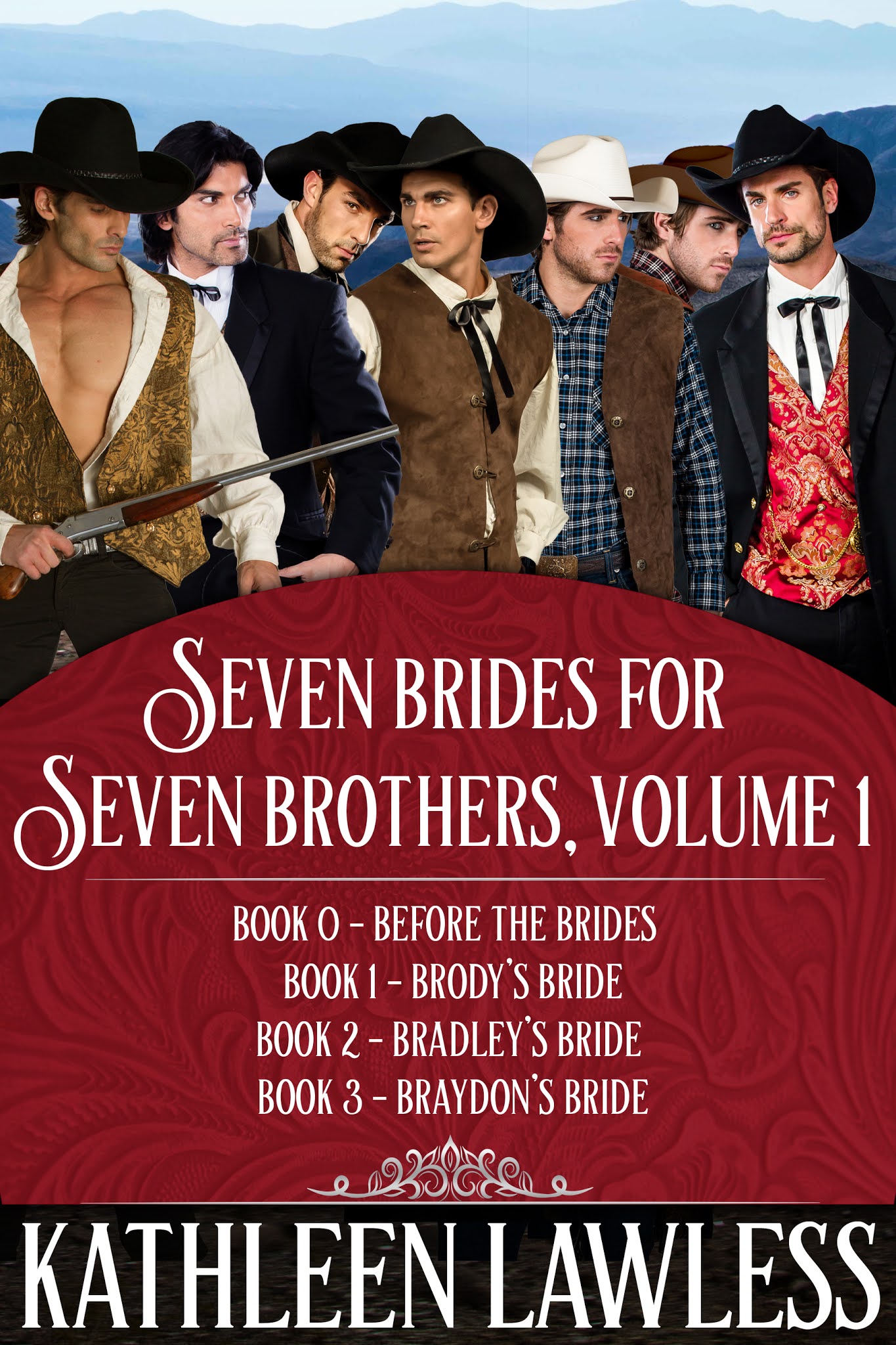
The lighting of bonfires and donning of costumes as a means to ward off evil spirits are activities the entire town of my SEVEN BRIDES FOR SEVEN BROTHERS characters gets behind in BISHOP’S BRIDE, where the citizens of Bullet gather together for a night of celebration, complete with costumes, a bonfire, taffy pulls and apple bobbing.  The party is interrupted by an intruder being killed—but I digress.

Rose, the heroine, is new to what her missionary father considered a “pagan celebration” and takes to heart the myth that whoever bites their apple first will be the first to marry.  She’s intrigued with the notion that by placing her bitten apple under her pillow, she will see her soulmate in her dreams.  Of course, like any true heroine, much as Rose might try to deny her heart, she already knows the identity of her soul mate.

Historians credit Irish immigrants for the North American tradition of carving pumpkins and placing a light inside, a tribute to “Sting Jack”, a mythical trickster.  Back in Ireland, they carved potatoes or turnips which were in abundant supply, but when they arrived in the new world pumpkins were more readily available and no doubt more fun to carve.

I’m Canadian, so October is a double celebration month with first Thanksgiving, then Halloween, and an excuse to decorate and celebrate all month long, which I love.

Wishing everyone a safe and Happy Halloween,

Kathleen

You can learn more about my books here.  https://www.amazon.com/Kathleen-Lawless/e/B001IXS2SA


The first 3 books in the Seven Brides Series are available in a box set which includes a bonus novella you can’t get anywhere else.  https://www.amazon.com/dp/B07ZW9SVZK

Sign up here for my VIP Readers Group to receive a free book and be the first to hear about contests, new releases and fan-priced specials.  http://eepurl.com/bV0sb1

WEBSITE | FACEBOOK | TWITTER | BOOKBUB

Monday, October 5, 2020

Hallowtide by Kristy McCaffrey


Halloween is near, but it wasn’t always a one-day celebration. It evolved from a triduum called Hallowtide (derived from halig, meaning saint, and tide, meaning season). While many cultures celebrate the dead from October 31 to November 2, the most notable contributions to our westernized celebration of Halloween come from the Roman Catholics, the Mexicans, and the Celts.


In Catholic theology, November 1 is All Saints’ Day and commemorates those who have reached perfect salvation. The following day, November 2, is All Souls’ Day, devoted to those who have not reached a beatific vision. It stands as a day of prayer for the dead, and lighting a fire or lantern was often done to provide guidance to the souls of the dead. Public worship, or liturgy, would begin on the eve of All Saints’ Day, thus making Halloween All Saints’ Eve or Hallows Eve.

In Mexican culture, celebrations of the dead can be traced back thousands of years. Giant skulls, sugar skulls, shrines, decorated rabbits, poems and dancing with colorful costumes and devil masks in the town center are all part of Day of the Dead (October 31 – November 2) celebrations, and are thought to bring good luck and peace. It encompasses All Hallows’ Eve, when spirits of dead children are welcomed with the presence of a children’s altar; All Saints’ Day, when adult spirits are invited; and All Souls’ Day, when families visit cemeteries.

In ancient Gaelic culture, the end of harvest season was celebrated with the festival of Samhain, beginning at sunset on October 31 and lasting until sunset on November 1. This is a liminal period for the spirits, or aos sí, to enter our world. Lighting bonfires served as protection from the spirits and costumes were thought to help in appeasing them. Divination and feasting rituals were also practiced.

Don't miss these short reads featuring three bounty hunting brothers and the women who capture their hearts!

The Crow and the Coyote
The Crow Series: Novella 1
Among the red-rock canyons of the Navajo, bounty hunter Jack Boggs faces Navajo sorcery to aid Hannah Dobbin in a quest to save her pa's soul.

The Crow and the Bear
The Crow Series: Novella 2
When no one will help Jennie Livingstone enter a haunted ravine to find her papa, she must accept the aid of enigmatic bounty hunter Callum Boggs.

A Murder of Crows
The Crow Series: Novella 3
Eliza McCulloch is determined to reclaim her family book of spells and her only hope is Kester Boggs, a manhunter called The Crow.

AVAILABLE AT AMAZON and KINDLE UNLIMITED

Visit Kristy's website for her latest book news!

Friday, October 2, 2020

Not Your Dimestore Scarecrow

 by Patti Sherry-Crews

It’s that time of year when the colorful, round-faced, smiling scarecrows are everywhere. Decorating the neighbors’ porches. Maybe sitting on a bale of hay. In shop windows. Aren’t they cute?


I’ve been thinking a lot about pests this year because hordes of chipmunks, rabbits, raccoons, possums, and squirrels have been destroying both my vegetable and our newly planted pollinator gardens. Plenty of skunk too, who I don’t think are bothering my plants, but nonetheless, they're skunks. Everyday, looking out at my yard it looks like a scene from Bambi with all the happy critters cavorting in my garden. We’ve tried everything: coyote urine, chunks of a well-known pungent soap, chicken wire, and sprinkling cat and human hair around the plants. But every morning I wake up to the destruction of half-eaten tomatoes and flowers nibbled down to their roots.


I’ve been imagining what a failure my we'd make as homesteaders. I’ve been looking back to see what ways the old timers used to deter pests--scarecrows being one of them. Only not the cheerful kind we see around our neighborhoods. 


Scarecrows, it turns out, have an interesting history. They emerged in the ancient world, Egypt, Japan, and Greece, at about the same time. And there was nothing cute about them.


The Greeks modeled their scarecrow on the son of Dionysus and Aphrodite, Priapus, who was said to be so ugly he scared birds. These wooden statues were painted purple and put in fields. Priapus had a club and a sickle in each hand and a large….you can look that one up yourself. His name is a clue to his other signature feature.


The Romans borrowed the Priapus scarecrow and spread it all over the Roman Empire extending into Europe.


Later in medieval Europe, it was the task of children to guard the fields and chase away pests. Sadly, the plague diminished the population to the point there weren’t enough bodies to patrol the fields, soooo, back to scarecrows. Old clothes stuffed with rags or straw with an animal skull or a gourd for a head, maybe stick some putrid meat in there for that olfactory defense.


Native Americans also needing to protect their crops, used both human guards and scarecrows. Zuni children held contests to see who could make the scariest scarecrow.


European immigrants to America brought their tradition of scarecrows, though they were called different names by different cultures. For instance, in Germany they are called Bootzamon, which later became the Bogyman.


There was a time when the American landscape was dotted with scarecrows. Then they disappeared in a puff of DDT. After DDT was found to be harmful, farmers developed new, higher tech ways to scare off pests, and scarecrows were regulated to a peaceful retirement as holiday decorations.


In many farming cultures around the world, it was traditional to burn the scarecrow at the end of harvest and return it to the earth. That is why scarecrows, like snowmen, are classified as “ephemerals”--creations not meant to spend much time on earth.


As old as scarecrows themselves, are the stories of them coming to life. For instance, a Japanese story in the year 712 features a scarecrow, Kuebiko, who can’t walk but knows everything. And arguably the most famous animated scarecrow, is the scarecrow from the Wizard of Oz. He only wanted a brain, and discovered he had wisdom after all. 

There’s something about a scarecrow.


Here is my own living scarecrow, my husband, armed with a slingshot to scare of Bambi's little friends away from his bird feeders. Don't worry, he slinging crabapples and no animals were injured, just startled.

And to get everyone in the spirit of Halloween, fellow Cowboy Kisses author, Andrea Downing, and I have put together a scary twofer for you. Two novellas from a collection of stories connected by a paranormal detective agency set in the old west for only $0.99!


About From the Files of Nat Tremayne:


The Wild West gets even wilder when Nat Tremayne sends out his agents from Psychic Specters Investigations offices in St. Louis and Denver. Across country and across time, these agents will stop at nothing to unravel the mysteries that beset poor unsuspecting ranchers and cowboys who have no idea what they’re seeing . . .or not, as the case may be.
In The Ghost and The Bridegroom, P.S.I. Agent Healy Harrison is sent to Tucson to rid a rancher of the ghost in the bedroom interfering with his marriage to a mail-order bride. Healy doesn’t think she’s destined for romance—until she meets Pinkerton detective Aaron Turrell. But when their two cases dovetail, will their newfound love survive the ultimate showdown the between mortal and immortal.

In Long A Ghost and Far Away, agent Dudley Worksop aims to unravel the mystery of Colby Gates’ dead wife. Lizzie not only seems to have reappeared as a ghost, but has time traveled from 2016 to the 1800s. Can revenge be had for her murder? And can the couple be reunited across country and across time?
These stories originally appeared in The Good, The Bad, and The Ghostly.

Monday, October 7, 2019

Tommyknockers


By Kristy McCaffrey

A Tommyknocker is a type of troll spirit who lives underground and was therefore of great concern to miners. The term originated in the British Isles, but superstitions surrounding the beings filtered into other places. Miners in Colorado took great care to appease the Knockers by leaving a bit of their lunch out for the sprites.

 
Standing about two feet tall with a grizzled appearance, many believe that Snow White’s dwarves were Tommyknockers. They usually wear standard miner’s garb and are responsible for any mischief that might befall a miner, such as losing tools and food.

The name derives from the knocking on mine walls that precedes a cave-in, which is usually just the creaking of earth and timbers before failing. Some miners believed the Knockers were malevolent beings, but others took them to be practical jokers.

In Cornish folklore, the Knockers were spirits of those who had died in previous mine accidents and were now trying to help the living by warning of impending dangers. As an offering of thanks, miners usually cast the last bite of their lunch pastie (a type of meat pie) into the mines for the Knockers.


In the 1820’s, Welsh immigrants to Pennsylvania brought tales of the Knockers with them and their presence soon spread all the way to California. Belief in the Knockers remained well into the 20th century. During the closing of a mine in 1956, a petition was circulated by the miners to set the Knockers free (so they could move to another mine) before sealing the entrances, and the owners complied.

If you're in the mood for a spooky western romance this Halloween month then you might enjoy my Crow series, a collection of short novellas. (The second novella features a tommyknocker.)


The Crow and the Coyote
Volume 1

Among the red-rock canyons of the Navajo, bounty hunter Jack Boggs aids Hannah Dobbin in a quest to save her pa's soul.

"With just the right amount of mystic and adventure, this novella packs a punch, delivering a charming love story." ~ Michelle Reed, Sunshine Lake Reviews


The Crow and the Bear
Volume 2

When no one will help Jennie Livingstone enter a haunted ravine to find her papa, she must accept the help of enigmatic bounty hunter Callum Boggs.

“With some surprising twists and lots of unnerving second guesses, The Crow and the Bear is sure to do the trick for a short, easy, sweet and fun Halloween story!” ~ Michelle Reed, Sunshine Lake Reviews


A Murder of Crows
Volume 3

Eliza McCulloch is determined to reclaim her family book of spells and her only hope is Kester Boggs, a manhunter called The Crow.

“A suspenseful ride into the supernatural with a western twist. This is a must read!”  ~  Devon McKay, author of Lead Me Into Temptation, Gold Dust Bride Series


An excerpt from A Murder of Crows
Kit Boggs downed the last of his rye whiskey and settled into the wooden chair, the supports creaking loudly. He fully expected the contraption to give out at any time. He usually kept his liquor intake to a minimum when on a hunt, but the firewater was so watered down that he indulged his thirst.

From his vantage point outside the Wild Dog Cantina, the midday bustle of La Noria buzzed like a bee’s nest. The border town—straddling Mexico and the Arizona Territory—was occupied by mostly local white and Hispanic farmers, but the streets were also swarming with the hungry and savage looks of men who had arrived in search of work in the nearby Patagonia Mountains. With their eyes clouded with dreams of riches, these desperados were no doubt intent on striking it big with copper or silver. But that wasn’t what had brought Kit so far south, farther than the usual region he and his manhunting brothers patrolled.

As he watched the main street, his gaze was drawn to a woman riding a lathered red Indian pony. Both exhibited a stubborn bearing. The woman stopped before the mercantile and slid from the horse, tying the reins to the hitching post, her clothing covered in dust and the hem of her skirt frayed. Pausing, she removed her hat and wiped sweat from her forehead. She gripped the wooden support and appeared to take a fortifying breath, then leaned her head back to read the overhead sign. Her dark hair spilled down her back, loosened from the pins of the bun at the base of her neck, and Kit’s eyes were drawn to the outline of her feminine curves.

“Kester Boggs?”

Reluctantly, Boggs turned to the scrawny Mexican beside him. “Nobody uses that.” He planted all four legs of the chair to the ground. “Call me Kit.”

“Like a kitten?” The gaunt man was also missing a few teeth.

“No.” Kit’s voice was resolute. “Do you have news for me?”

“Sí. They will see you tomorrow in an abandoned smithy at the far end of town.”

“What time?”

“Ten o’clock.”

“Gracias.” Kit tossed a coin at the man, then turned back to the woman. She was gone.

Damn.

He searched up and down the street for her horse, but both animal and female were nowhere in sight.

Had he imagined her?


Connect with Kristy