Monday, June 10, 2013

Paper, Pen and the Pony Express

Cowgirl hat banner

Pony Express poster

Communication was difficult on the western frontier, especially in the early days. Mail delivery was a slow, undependable process fraught with danger from nature and Indian attack. From Apr. 1860 until Oct. 1861, the Pony Express tackled the problem with a relay system of horseback riders who covered the distance between St. Joseph, Missouri and Sacramento, California in about 10 days.

Famous for their bravery and riding skills, the famous Pony Express riders have been immortalized in countless books, movies and TV productions. The Young Riders, a series focusing on the daredevils who signed on for the hazardous job ran from 1989 through 1991. It was a hit at my house!

The Pony Express National Museum, located in St. Joseph, MO, commemorates the iconic mail service, and if you’re ever in Jacksonville, Oregon, be sure to see this dramatic statue of a hell-bent-for-leather rider. My author friend Rain Trueax took these photos and kindly gave me permission to post them. She says Jacksonville is a very historic town, probably explaining the statue’s presence there.

Pony express rider combo

The legendary mail delivery system was replaced by the telegraph, making it far easier and faster to send important messages across the rolling plains and mountains. However, letters to friends and family weren’t, in most cases, such a high priority. Dependent upon horse-drawn stagecoaches, riverboats and rail service, it could still take weeks, even months for a letter to reach its destination, if it wasn’t lost or destroyed along the way.

What about pen and paper to write those letters? Did you ever wonder how easy, or difficult, it was to obtain such items in isolated western towns, ranches and farms? Prior to the 1840s in the United States, paper was made from recycled rags. The process was slow, tedious and expensive, making paper beyond the means of many people.

In 1840 Friedrich Gottlob Keller invented wood pulp paper, much less expensive to create and purchase. However, it still cost money to transport paper journals and stationary to far-flung western locals. Pioneers didn’t scribble on a sheet of paper and toss it out the way we do in out throw-away society. When they wrote a letter, they took their time composing it. The same undoubtedly applied to those who kept diaries, such a valuable resource for historical researchers.

Pens were also precious possessions for our pioneer ancestors. Steel pens were introduced in France, in 1748, and cylindrical steel pens cut like quills in 1780. The first plunger-filled fountain pen was invented in 1833, but the first practical version didn’t come along until the 1880s. You can be sure if a frontiersman or woman owned one, it was well guarded.

Pencils evolved later than pens. Not until 1795 did a graphite pencil come into existence. How easy they were to come by on the frontier, I haven’t yet discovered, but I suspect they, too, were horded as long as possible.

All of which just reminds us how lucky we are today. A century or two ago computers and the internet would have been seen as fanciful dreams, possibly even works of the devil.

http://www.amazon.com/author/lyn.horner.award-winning.books

http://lynhorner.blogspot.com

Wednesday, June 5, 2013

Texas State Penitentiary, Huntsville


By:   Julie Lence 

Hello everyone. I'm western historical romance author Julie Lence. This is my first time blogging on Cowboy Kisses, and I thank the ladies here for inviting me to join their group.  
I've always had a love for cowboys, horses, and anything to do with the 'old west'. I also had a love for the television show, Dallas, and still do. I couldn't get enough of the back-stabbing, the glamour, and the family saga. When I began writing romance, I started with the contemporary genre and soon switched to writing western historical romance, because someone once told me to write what I know and what I love. I know cowboys and horses, but writing about them wasn't enough. I wanted more. After further thought, I incorporated Dallas' family saga element into my work and The Weston Family Series was born. 
The series was, by no means, easy to write. Many things, I knew. A lot of things I didn't. It was those missing elements, particulars that I wanted to be as true to the genre and era as possible, that led me to research. One subject kept me engrossed for the better part of a morning: The Texas State Penitentiary, Huntsville, Texas. 


One might ask why I was researching a prison. Well, my love for the 'old west' doesn't stop with the cowboy. Outlaws played an important role back then and I had one from my first two books who desperately needed a story of his own. Buck is ornery and temperamental, and had always escaped the law in his looting, raiding, and shooting. He was also in need of a good eye-opener as to why he should settle down with the woman he loves, and what better reason could there be than having been sent to the calaboose for a crime he didn't commit, with a sentence to be hung? I'd figured out his escape, but the prison itself kept bugging me. Or rather, what prison I could place him in. Since his story, Zanna's Outlaw, takes place in Texas, I wanted him somewhere close to that state. My first thought was Yuma, but for the year of the story, Yuma didn't exist. Thanks to the internet, I discovered that the Huntsville State Penitentiary in Texas did.  
While researching the penitentiary, I'd hoped to find a photo of what the inside looked like back then. I didn't, and had to take liberty with that. But I did learn a few fascinating facts that I incorporated into the story. For instance, the prison was Texas' first enclosed penitentiary for convicted felons and nicknamed, 'The Walls'. For some reason, this term spoke to me. Maybe it was because I could imagine Buck calling the calaboose just that, 'The Walls'. He did, and so did my other outlaws in the Revolving Point, Texas Series. Another interesting fact about Huntsville was that it was a working prison, so the cost of housing the inmates wouldn't be a burden to the state's taxpayers. The inmates planted, grew, and harvested cotton and sold it to the army during the Civil War for a profit. Of course, Buck wouldn't have anything to do with picking and seeding cotton; hence one of the reasons he ended up in solitary. The last thing I incorporated into Zanna's Outlaw was the bell tower. To me, that seemed to make the institution stand out, something people would notice and remember throughout their lives. 
  The Huntsville State Penitentiary is still in existence today, and still in use. It has been modernized, to include a museum featuring the history of the penitentiary. If I ever get to Texas, I plan on visiting 'The Walls' and seeing firsthand where my ornery outlaw spent six months of his life.   

If you'd like information on my Zanna's Outlaw, you can find the description on Amazon


Exterior of the prison museum


Monday, June 3, 2013

Ciara Gold Heats things up - for cooking


Yesterday morning around 6:30 AM, I woke to discover my block surrounded by fire engines, police and ambulances. Our good friends lost their home in a blaze that rose at least eight feet above the roof. So yesterday, when I’d planned to craft a really neat blog post, I was down the street with my other neighbors trying to figure out how we were going to support our friends in their time of need. Thankfully, they were on vacation so no one was hurt. But the house is a total loss. The fire fighters were incredible, however.

Anyway, my first thought was to write on the history of fire fighting and how it evolved from neighbors passing buckets of water to organized teams paid by the city, but it required more research than my tired brain could handle after the day I'd encountered, so that may be a post idea for later. In the meantime, I’d written an article several years back on how to start a fire out in the open (for cooking purposes, of course) and thought I’d rework it for this post.

In 1800s, they didn't have the convenience of stovetop cooking or a microwave and while most kitchens boasted a wood-burning stove, cooking outdoors for a crew of hungry cowboys would look a lot different than what it might today.  
 
For the few scenes I’ve written involving cooking outdoors, I drew on my own experiences camping as a girl scout. We always had what was called a fire circle, a cleared place encircled with rocks. To begin, we dug a pit and fashioned what is called a key hole, a large groove that angled from the ground surface to the pit and provided air to the fire. My favorite style of fire was the A frame where we'd fashion an A with three smaller logs, then set the tinder and kindling against the horizontal crossbar of the A.

I remember one particular fire that I was trying to build. It was dusk and difficult to see, but we wanted roasted marshmallows. I fanned it until I was blue, determined to light it with only one match. The wood was damp and not cooperating, but I could see the glow of one spark and just kept fanning. Finally, we determined that the glow was a piece of orange yarn. Too funny.

After the fire is lit and coals begin to form, a grate is placed over the hole. Coals provide the most heat for cooking. We have in our possession a very large, flat griddle that is about twenty inches by twenty. My husband’s uncle made the griddle in the early to mid 1900s. I can just imagine the many meals cooked on it. We cooked a variety of foods from chicken and rice to chili to flapjacks to cake on the open flames. It was a fond time and one I hold dear.

For the cowboy with minimal supplies, he’d have to resort to using flint. Dried grass and leaves would allow for good starter material. The modern cowboy would probably have dryer lint with him as this is very flammable and an excellent starter. Starters are slow to medium burning items that will smolder until the wood catches.

If no cook wagon was around to carry Dutch ovens or grates, a spit could be fashioned from green wood. Yaupon is a native tree of Texas and grows in the Southeastern states. Green branches from this tree make excellent skewers for roasting meats. When wood was scarce for those crossing the plains, pioneers resorted to burning buffalo chips. It always amazes me the resourcefulness of our forefathers.

In my story, Once Jilted, Shauna takes the job of crew cook and has to learn to cook on an open fire. I used a lot of my own experiences as resource for this scene:

Though it took a while to scrounge all the ingredients, she decided on flapjacks for the morning meal. Lefty had shown her a four-legged flat griddle that was large enough to cover the fire pit. She dragged and situated the large cast iron plate over the glowing coals, leveling it with a rock under one corner.

After putting on a pot of coffee, she made sure she had all the ingredients she needed then mixed a large bowl of batter. Testing the griddle, she pronounced it hot enough and poured several spoonfuls of batter onto the sizzling surface. Next to the frying cakes, the water in the coffee pot began to boil. She smiled, pleased with her efforts.

"Ach, woman. Have you noo sense?"

She dropped the spatula, fell back on her bottom, and met the angry glare of Kane. "I’m cooking. Isn’t that why I’m here?" She righted herself and picked up the spatula, dusting off the grains of dirt.

"Aye, I can see that you’re cooking." He squatted beside her and placed one knee on the ground. "Has noo one ever taught you how to cook over open flames afore?"

She shook her head.

“Ne’er bend over like you were doing, lass. You’ll end up with your skirts ablaze or your palms burned. You have noo balance perched as you were.”

“I thought I was doing just fine.”

“Stubborn bird. Always put one knee to the ground like so,” he said, indicating his own position. “This will force your skirts oot of the way and give you the balance you need. Try it.”

She did as requested and found he was right. She flipped a perfect flapjack onto a plate and forgetting her annoyance, beamed at him. “Want to be the first to sample my cakes?”

An odd expression stole over his features. He rose without comment and walked away. She stared, dumbfounded. What had she said?


Wednesday, May 29, 2013

Cover Reveal for Outlaw's Gamble by Kharisma Rhayne


Welcome Kharisma to Cowboy Kisses and learn more about her upcoming release:


TAG:
Slade is a half Native American man with nothing to lose and wants to sell his ranch. Jess is a stubborn, resourceful woman with everything to lose who is determined to buy it. What neither expected was to face was the biggest gamble of their lives.

BLURB:
Slade Blackclaw was a drifter with no desire to settle down and even less to become a rancher. However, with the death of his father he inherited the ranch that his cherished mother had adored until her death. Being half Native American afforded Slade no luxury in life and he's learned to take what he needs when he has to.
Jess Logan needed to work. Her father, William "Sly Bill" Logan, was growing deeper in gambling debt as each day passed. The last beating left him bedridden for more than a week. Though she hated him for all but selling her off to pay his latest debt, losing her mother at the age of six made Sly Bill her only remaining family and someone she would not turn her back on. She had less than three months to come up with the money owed or she'd have to marry the dirty, foul smelling Otis Grayson in order to settle her father's debt.
After returning to Blueridge, Montana to survey the ranch, Slade decided he wouldn’t stay. Having a permanent home was not in his cards. Taking out an ad at the local saloon, he acquiesces and meets the only person who replied. Little did he know, Jess was nothing like what he expected.

Jess knows she isn't what Slade had hoped for...let alone what he wanted. But with debtors closing in on her father, and very possibly her virginity, Jess will do anything or be anyone for Slade to save her father and, more importantly, herself.

You can enter to win a copy of the book at Rafflecopter.

Release is scheduled for late October with a full book tour beginning in November. To keep up on Slade, Jess, Sly Bill and the release of Outlaw’s Gamble, please visit any or all of the following: WebsiteBlogFacebook - Twitter


AUTHOR BIO: 
Years ago, Kharisma traded in snow, ice and tornadoes for sun, heat, sand and mountains. She now lives in beautiful Arizona with her husband, kids & rescue dogs and goats.

Now, in her eleventh year in Arizona, she is once again braving new terrain and has moved up into the White Mountains.  This will be the first year that she will see freezing temperatures and snow.

Her love for nature and animals is well known and she gets to indulge it in her new home with wolves, coyotes, snakes, and various other creatures as her nearest neighbors. Living in the middle of nowhere is something she wouldn’t change for the world.

Dabbling in writing through Junior High and High School, Kharisma officially got her start writing LGBT, BDSM and erotica. Never one to slow down, she started writing several additional genres including crime, medical, historical and paranormal. Her latest adventure is a dark horror. Her Highlander Mine serial is an unexpected success of which she hopes to have more of.

When you pick up one of her books, she wants you to walk away turned on and inspired! Come take a stroll into Kharisma’s worlds of ecstasy, love, adventure and fear. Her website is here: http://www.kharismarhayne.com/ and you can also find her on Facebook: https://www.facebook.com/KharismaRhayne?ref=hl


Monday, May 27, 2013

MEMORIAL DAY TRIBUTE TO AMERICAN HERO AND WESTERN STAR, AUDIE MURPHY


Who better to honor this Memorial Weekend than Audie Murphy? Through LIFE magazine's July 16, 1945 issue ("Most Decorated Soldier"/cover photo), Audie Leon Murphy became one the most famous soldiers of World War II and widely regarded as the most decorated American soldier of the war. After the war he became a celebrated movie star for over two decades, appearing in 44 films. He later had success as a country music composer. And how appropriate that we honor him this weekend. In addition to be America’s Most Decorated Soldier, Audie Murphy died in a plane crash on Memorial Day Weekend, May 28, 1971.
 
Audie Murphy Official Portrait with Medals

Audie Leon Murphy was born to sharecroppers near the community of Kingston in Hunt County, Texas. His parents were of Irish descent, Emmett Berry Murphy (February 20, 1886–September 20, 1976), and his wife, Josie Bell (née Killian (1891–1941). He grew up on farms in Hunt County and has several memorials there. He was the sixth of twelve children, two of whom died before reaching adulthood.

In 1933, Emmett and Josie Murphy with their 5 children June, Audie, Richard, Gene, and Nadine moved to Celeste, Texas with the primary purpose of enrolling the children in school. They lived in an abandoned railroad boxcar on the southern end of the small community for several months before renting a rundown home in Celeste until 1937. The railroad car no longer exists.
 
Audie Murphy as a boy
While the family lived in Celeste, the two remaining Murphy children, Beatrice and Joseph, were born. It was here that Audie befriended the Cawthon family who played a prominent role in his life. In 1937, the Murphy family moved back into the abandoned railroad car for several weeks and then moved to a farm near Floyd, Texas located just west of Greenville. Audie finally moved out on his own in 1939 at the age of 15 after finding a job with Haney Lee, who had a farm nearby

Audie Murphy spent a lot of time with his grandparents, Jefferson D. and Sarah Elizabeth Killian, at their hope in Farmersville, Texas. In fact, the Killian’s was a place of refuge for the Murphy children when times were difficult during the years of the depression. At the height of the depression, around 1929 or 1930, Audie's oldest sister, Corrine, left the Murphy family and moved in with the grandparents in their Farmersville home to help relieve some of the financial stress burdening the Murphy family.

As the family moved from community to community over the years, they never strayed too far from the Killian home. Around 1933-36 (depending on the account), Emmett Murphy, who was known to disappear for weeks at a time while apparently seeking employment, finally vanished permanently. He had attempted to convince his wife and family to move with him to West Texas where he hoped to find work in the oil fields. Unconvinced that this was a wise move, Mrs. Murphy did not want to leave the area where her parents and lifelong friends lived.

At the time of their mother's death, Audie was approximately 17 years old and was declared by the county to be old enough to take care of himself. The placement of his siblings in the Boles Childrens Home in Quinlan was an event that Audie vowed to correct. On more than one occasion during the war, he told his buddies that he hoped to someday earn enough money to reunite what remained of his family. As it turned out, Audie was able to keep his promise.

Audie attended elementary school in Celeste, Texas until his father abandoned the family. Audie dropped out to help support the family. He worked for one dollar per day, plowing and picking cotton on any farm that would hire him. Murphy became very skilled with a rifle, hunting small game like squirrels, rabbits, and birds to help feed the family.

One of his favorite hunting companions was neighbor Dial Henley. When Henley commented that Murphy never missed what he shot at, Murphy replied, "Well, Dial, if I don't hit what I shoot at, my family won't eat today."

On May 23, 1941, his mother died. He worked at a combination general store, garage and gas station in Greenville. Boarded out, he worked in a radio repair shop. Later that year, with the approval of his older, married sister, Mrs. Elizabeth Corinne Burns (usually referred to as "Corrine"), who was unable to help, Murphy placed his three youngest siblings in an orphanage to ensure their care. He reclaimed them after World War II.

He had long dreamed of joining the military. After the attack on Pearl Harbor on December 7, 1941, Murphy tried to enlist in the military, but the services rejected him because he was underage. In June 1942, shortly after what he and his sister Corrine believed was his 17th birthday, Corrine adjusted his birth date so he appeared to be 18 and legally able to enlist. His war memoirs, TO HELL AND BACK, maintained this misinformation, leading to later confusion and contradictory statements about his year of birth.

Murphy was small, only 5 ft 5 inch and 110 pounds, but he tried once again to enlist and was declined by both the Marines and Army paratroopers as too short and underweight. The Navy also turned him down for being underweight. The United States Army finally accepted him and he was inducted at (some reports say Dallas) Greenville, Texas and sent to Camp Wolters near Mineral Wells, Texas for basic training. During a session of close order drill, he passed out. His company commander tried to have him transferred to a cook and bakers' school but Murphy insisted on becoming a combat soldier, and after 13 weeks of basic training, he was sent to Fort Meade, Maryland for advanced infantry training.

Murphy was awarded 33 U.S. decorations and medals, five medals from France, and one from Belgium. He received every U.S. decoration for valor available to Army ground personnel at the time. He earned the Silver Star twice in three days, two Bronze Star Medals, three Purple Hearts, the Distinguished Service Cross, and the Medal of Honor.


After seeing the young hero's photo on the cover of the July 16 edition of Life Magazine and sensing star potential, actor James Cagney invited Murphy to Hollywood in September 1945. Despite Cagney's expectations, the next few years in California were difficult for Murphy. He became disillusioned by the lack of work, was frequently broke, and slept on the floor of a gymnasium owned by his friend Terry Hunt. He eventually received token acting parts in the 1948 films “Beyond Glory” and “Texas, Brooklyn and Heaven.” His third movie, “Bad Boy,” gave him his first leading role.

He also starred in the 1951 adaptation of Stephen Crane's Civil War novel, “The Red Badge of Courage,” which earned critical success. Murphy expressed great discomfort in playing himself in “To Hell and Back.” In 1959, he starred in the western “No Name on the Bullet,” in which his performance was well-received despite being cast as the villain, a professional killer who managed to stay within the law.


After returning home from World War II, Murphy bought a house in Farmersville, Texas for his oldest sister Corrine, her husband Poland Burns, and their three children. His three youngest siblings, Nadine, Billie, and Joe, had been living in an orphanage since Murphy's mother's death, He intended that they would be able to live with Corrine and Poland. However, six children under one roof proved difficult for Corrine and Poland to parent, and Murphy took his siblings to live with him.

Despite a lot of post-war publicity, his acting career had not progressed and he had difficulty making a living. Buck, Murphy's oldest brother, and his wife agreed to take Nadine in, but Murphy could not find a home for Joe. He approached James "Skipper" Cherry, a Dallas theater owner who was involved with the Variety Clubs International Boy's Ranch, a 4,800 acres ranch near Copperas Cove, Texas. He arranged for Joe to live at the Boy's Ranch. Reportedly, Joe was very happy there and Murphy was able to frequently visit his brother as well as his friend Cherry. In a 1973 interview, Cherry recalled, "He was discouraged and somewhat despondent concerning his movie career."


Variety Clubs International was financing “Bad Boy,” a film to help promote the organization's work with troubled children. Cherry called Texas theater executive Paul Short, who was producing the film, to suggest that they consider giving Murphy a significant role in the movie. Murphy performed well in the screen test, but the president of Allied Artists did not want to cast someone in a major role with so little acting experience. Cherry, Short, and other Texas theater owners decided that they wanted Murphy to play the lead or would not finance the film. The producers agreed and Murphy's performance was well-received by Hollywood. As a result of the film, Universal Studios signed Murphy to a seven-year studio contract. After a few box-office hits at Universal, the studio bosses gave Murphy increased scope in choosing his roles.

Murphy's 1949 autobiography TO HELL AND BACK became a national bestseller. The book was ghostwritten by his friend, David "Spec" McClure, already a professional writer. Murphy modestly described some of his most heroic actions—without portraying himself as a hero. He did not mention any of the many decorations he received, but praised the skills, bravery, and dedication of the other members of his platoon. Murphy even attributed a song he had written to "Kerrigan".


Murphy portrayed himself in the 1955 film version of his book with the same title, “To Hell and Back.” Murphy was initially reluctant to star in the movie, fearing it would appear he was cashing in on his war experience. He suggested Tony Curtis for the role. Unlike in most Hollywood films, where the same soldiers serve throughout the movie, Murphy's comrades are killed or wounded as they were in real life. At the film's end, Murphy is the only member of his original unit remaining. At the ceremony where Murphy is awarded the Medal of Honor, the ghostly images of his dead friends are depicted. This insistence on reality has been attributed to Murphy and his desire to honor his fallen friends. Audie Murphy's oldest son, Terry, portrayed Audie's younger brother Joseph Preston "Joe" Murphy (at age four).

The film grossed almost $10 million during its initial theatrical release, and at the time became Universal Studios's biggest hit of the studio's 43-year history. The movie is thought to have held the record as the company's highest-grossing motion picture until 1975, when it was surpassed by Steven Spielberg's “Jaws.”

In the 25 years he spent in Hollywood, Murphy made 44 feature films, 33 of them Westerns. He played outlaws Billy the Kid, Jesse James, and Bill Doolin. His films earned him close to $3 million in his 23 years as an actor. He also appeared in several television shows, including the lead in the short-lived 1961 NBC western detective series “Whispering Smith,” set in Denver, Colorado. For his contribution to the motion picture industry, Murphy has a star on the Hollywood Walk of Fame at 1601 Vine Street.

Audie Murphy in one of his many western roles

In addition to acting, Murphy also became successful as a country music songwriter. He teamed up with musicians and composers including Guy Mitchell, Jimmy Bryant, Scott Turner, Coy Ziegler, Ray and Terri Eddlemon. Murphy's songs were recorded and released by well-known artists including Dean Martin, Eddy Arnold, Charley Pride, Jimmy Bryant, Porter Waggoner, Jerry Wallace, Roy Clark, and Harry Nilsson. His two biggest hits were "Shutters and Boards" and "When the Wind Blows in Chicago".

Murphy was reportedly plagued by insomnia, bouts of depression, and nightmares related to his numerous battles throughout his life. His first wife, Wanda Hendrix, often talked of his struggle with this condition, even claiming that he had held her at gunpoint once. For a time during the mid-1960s, he became dependent on doctor-prescribed sleeping pills called Placidyl. When he recognized that he had become addicted to the drug, he locked himself in a motel room where he took himself off the pills, going through withdrawal for a week.

Always an advocate of the needs of America's military veterans, Murphy eventually broke the taboo about publicly discussing war-related mental conditions. In an effort to draw attention to the problems of returning Korean and Vietnam War veterans, Murphy spoke out candidly about his own problems with PTSD, known then and during World War II as "battle fatigue". He called on the United States government to give increased consideration and study to the emotional impact that combat experiences have on veterans, and to extend health care benefits to address PTSD and other mental-health problems suffered by returning war veterans.

Murphy married actress Wanda Hendrix in 1949; they were divorced in 1951. He then married former airline stewardess Pamela Archer, by whom he had two children: Terrance Michael "Terry" Murphy (born 1952) and James Shannon "Skipper" Murphy (born 1954). They were named for two of his most respected friends, Terry Hunt and James "Skipper" Cherry, respectively. Murphy became a successful actor, rancher, and businessman, breeding and raising Quarter Horses. He owned ranches in Texas, Tucson, Arizona and Menifee, California.

On May 28, 1971, Murphy was killed when the private plane in which he was a passenger crashed into Brush Mountain, near Catawba, Virginia, 20 miles west of Roanoke, Virginia in conditions of rain, clouds/fog and zero visibility. The pilot and four other passengers were also killed. In 1974, a large granite marker was erected near the crash site. On June 7, 1971, Murphy was buried with full military honors at Arlington National Cemetery. A special flagstone walkway was later constructed to accommodate the large number of people who visit to pay their respects. It is the second most-visited grave site, after that of President John F. Kennedy.


The headstones of Medal of Honor recipients buried at Arlington National Cemetery are normally decorated in gold leaf. Murphy previously requested that his stone remain plain and inconspicuous, like that of an ordinary soldier. An unknown person maintains a small American flag next to his engraved Government-issue headstone, which reads as follows:

Audie L. Murphy, Texas. Major, Infantry, World War II. June 20, 1924 to May 28, 1971. Medal of Honor, DSC, SS & OLC, LM, BSM & OLC, PH & 2 OLC.

Murphy’s diverse honors are far too numerous to list here so I’ll mention only those in the county of his birth, Hunt County, Texas. From the mid-1990s through the present, an annual celebration of Murphy and other veterans in all branches of service has been held on the weekend closest to Murphy's birthday at the American Cotton Museum, renamed The Audie Murphy/American Cotton Museum (in Greenville, Texas), which houses a large collection of Murphy memorabilia and personal items. His statue stands in front of the museum. 

A monument in his honor stands in Celeste, the small town where he attended school for five years. Farmersville also claims Audie Murphy, since that is where his sister Corinne lived and the address on his draft information. 

Highway 69 from Greenville to Fannin County is the Audie Murphy Memorial Highway, and Highway 34 crosses the railroad tracks in Greenville on the Audie Murphy Memorial Overpass. 

Mark your calendar for the annual Audie Murphy Day celebration in Farmersville, Texas with a Military flyover at 10 am followed by parade downtown and program under the Onion Shed.

Audie Murphy statue at Greenville, Texas Museum
As we remember those who have gone before us this weekend, let’s remember soldiers like Audie Leon Murphy and his comrades.


Thanks to Wikipedia, www.audiemurphy.com, and the Chambers of Commerce of Greenville, Celeste, and Farmersville, Texas.

Friday, May 24, 2013

140 Year Old Icon of the Canadian West


In 1873, Canada's first Prime Minister, John A. MacDonald, saw the need to wave the flag in our western territories lest they be taken over by the United States. His first thought was to create a cavalry regiment, but there was some concern that our neighbour might take that too personally. Instead he created the North West Mounted Police.

This could well have been one of the defining moments in Canadian history since we are probably the only country whose most famous national symbol is a police force.

The "new" red serge uniform with Stetson.
A small force of 300 men went west to bring peace, order and good government to the territory that would become the provinces of Manitoba, Saskatchewan and Alberta. Later, Sam Steele and his contingent of the NWMP would do the same in the Yukon during the gold rush.

As respected as the NWMP were in the Prairies and Klondike, in Ottawa there was a push to disband the force as the west became more settled. This movement ended in 1897, at Queen Victoria's Jubillee parade in London.
"A contingent from the North West Mounted Police (NWMP) was rear guard to the Canadian section. This sparked a number of unfavourable comments from the London press. Placing them at the rear must have been a blunder, reported one paper, as they were a star attraction, resplendent in their red serge uniforms and western-style Stetson hats. The British and Canadian press praised their physical appearance, their riding, and their general demeanour. The NWMP, by their mere presence, had captured the imagination of Londoners."
  ("A Glorious Moment" The Popular Hero, Collections Canada)

What London discovered in 1897 had already been gleened by novelist Gilbert Parker in 1893. His The Patrol of the Cypress Hills, set the standard for descriptions of the NWMP in literary and movie fiction

Hollywood loved the Mounties, from Tom Mix in the silent films, to Rose-Marie and it's famous "Indian Love Call" duet. However, as film critic Don Miller observed:
"Hollywood never did right by the mounties. The challenge was there, with unlimited opportunities for adventure with fresh, picturesque locales; a group of law enforcers with a noble, proud and inspiring tradition, not to mention their distinctive redcoats; and the potential of blending rugged, Western-type action with, to non-Canadians, a tinge of the exotic allure of a foreign country. With everything at their disposal, the movies generally blew it."
("Trails North" Hollywood Corrals, 1976)

Flawed as they were, those movies are as much a part of the "Mountie" mystique as the more accurate, albeit tongue in cheek portrayals in Due South and Gunless. The fictional stories - whether in print or film -  are as much part of the heritage of the RCMP as Sam Steele and almost as iconic as the Musical Ride.


Monday, May 20, 2013

Butch Cassidy's Gun and Auctions


www.laurirobinson.blogspot.com
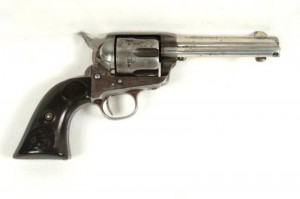
Butch Cassidy’s gun, the Colt .45 he’d surrendered to the governor of Utah while seeking amnesty sold last fall at auction for $175,000. 

Robert Leroy Parker, better known as Butch Cassidy was born in April 1866 and robbed his first bank in his early twenties. I took this picture of a plaque on the door a very old building in Telluride, Colorado. It says: “Mahr Building 1892 Site of the San Miguel Valley Bank Butch Cassidy’s first bank robbery. June 24, 1889”


Butch’s gun, a .45 caliber Colt Single Action Army Revolver, known as the ‘amnesty colt’ intrigued collectors. Along with a strong paper trail proving it was the famous outlaw’s gun, numbers scratched inside the gun’s grip are said to have been the combination for a safe in a bank in Denver.

It’s said Butch was getting tired of living on the run and in 1899 or 1900 turned his gun over to Sheriff Parley P. Christison. Huber Wells, the Governor of Utah, considered granting Butch amnesty until he discovered one of Butch’s crimes had been murder. When all else failed, Butch and his side kick, The Sundance Kid, escaped to South America. The gun however, remained with the local sheriff and along with receipts of authenticity, was passed along to associates over the years. Butch had also surrendered a Winchester rifle and his holster.   

Auctions date back to 500 B.C. and all sorts of unique and historical items come up for auction around the world regularly. 

Right now there is a large online auction happening in the romance writing world. Brenda Novak’s Annual Online Auction for Diabetes Research

I'm part of Sweethearts of the West which has a category that includes several items. If you have a chance, please check it out at: 
 http://brendanovak.auctionanything.com/AuctionHelp.taf?S=N&R=2&C=2&m=3&sort=1&ST=1&days=10&category_id=14289&skipkw=1&status=&_start=1