Showing posts with label African American Cowboys. Show all posts

Thursday, December 16, 2021

AFRICAN AMERICAN COWBOYS IN THE WILD WEST by Lianna Hawkins


The image of the 1800’s American cowboy isn’t typically thought of having an African American ethnic background. Recently I stumbled across a few tidbits of historical information on black cowboys and the important role these men played in the Wild West. I was bothered by the lack of images of these men in our history books, movies, and lack of attention placed on this part of our American story.

Black cowboys worked on ranches, handled cattle, tamed horses, and encountered outlaws. There were approximately 5,000 to 8,000 black cowboys in the Wild West that were part of the legendary cattle drives of the 1800’s.

Many were born into slavery and after emancipation continued to work on ranches. Thousands rode the cattle trails heading to the north.

They had to face bigotry, however, some found that they experienced less discrimination on the open range. Cowboys depended on each other regardless of their ethnic background.

I listed some of the famous African
American men who made a name for themselves as cowboys in the 1800’s.

Bill Pickett – Born in 1870 near Taylor, Pickett was one of 13 children. He worked as a ranch hand at a young age and went on to be a successful cowboy. He invented “bulldogging,” and became a star at Wild West shows. Pickett died in 1932. In 1971, he became the first African American inducted into the Rodeo Hall of Fame.

Nat Love – Born a slave on a Tennessee plantation in 1854, Love eventually became a cowboy in Dodge City and the Texas Panhandle. He possessed excellent horse riding and shooting skills. In 1876, after winning several contests at a rodeo in Deadwood, South Dakota, he was given the nickname “Deadwood Dick.” In 1907, he wrote an autobiography titled, “Life and Adventures of Nat Love.” He died in 1921.

Bose Ikard – Born a slave in Mississippi in 1847, Ikard was brought to Texas when he was five. Growing up, he learned to rope and ride. He later rode with well-known cattlemen like Charles Goodnight and John Chisum. Ikard inspired the character portrayed by Danny Glover in Lonesome Dove. He died in 1829.

Addison Jones – Uncertainty surrounds Jones’ exact birthplace and birth date, but he was born around 1845 in Gonzales or Hays County. An experienced range boss, he was skilled at roping and breaking horses, and was described as “the most noted Negro cowboy that ever ‘topped off’ a horse.” He died in 1926.

Today, black cowboys and cowgirls continue the western tradition as ranch owners and workers, preserving a way of life in American history. This is only the tip of a long, rich tapestry of history, so I encourage you to find more information on this seldom talked of part of history.

See you next month,

Lianna

Note: I was unable to find a picture of Addison Jones.

NAT LOVE


BILL PICKETT


BOSE IKARD


                                         BUY NOW ON AMAZON  OR BARNES & NOBLE             


Visit my website Lianna Hawkins.com

Subscribe to my newsletter Subscribe Here

Follow me on 

FACEBOOK/INSTAGRAM/AMAZON/BARNES & NOBLE/BOOKBUB/GOODREADS/COFFEE WITH LIANNA

Wednesday, February 20, 2019

Black History Month:African American Cowboys of the Old West by Andrea Downing


A friend and I were recently discussing the fact that between one quarter and one third of all cowboys in the old west were African American.  It’s not a fact widely known, of course, because at the time that television evolved presenting us with a host of westerns and thereby making the history of the Old West something of interest to the general public, segregation and its accompanying prejudices were still in place. It was the money of white Americans that advertisers were after and so, to appease the audience, a whole section of this post Civil War history was neglected. Likewise with the written word; westerns were written by whites for whites. For instance, The Lone Ranger is said to have been inspired by black lawman Bass Reeves.  Alan Le May’s book, The Searchers, was at least partly inspired by the life of African American Britt Johnson, whose family was kidnapped by Comanche.
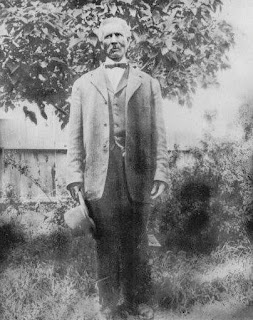
Britt Johnson
It’s therefore somewhat contrary that
 the Library of Congress saw fit to note the subsequent John Wayne/John Ford film as being “culturally, historically or aesthetically significant” with its all-white cast. Since it is Black History Month, I thought I’d take this opportunity to have a brief look at the contributions made by black cowboys.
African American men, like their white counterparts, sought to depart a South decimated by war. Indeed, they had even more reason to want to migrate:  the Black Code laws put in place by the southern states limited their new-found freedoms, and subsequent Jim Crow laws instilled even further restrictions. They couldn’t own land in many places and jobs were ill-paid for these former slaves. The so-called Exodusters—African Americans who were now free—began migrating to Colorado, Oklahoma, and most especially Kansas in 1879 (see https://andreadowning.com/2017/04/02/nicodemus-african-american-icon-of-the-old-west/ )  As slaves, many of these men, however, had handled cattle and horses while others had worked as cooks and could therefore continue to serve in those capacities on the trail rides from Texas to the north.
While there was a certain amount of equality on the range since men had to be both independent—going out on the range for days at a time without any overseer as they would have done as slaves—but also dependent on each other in times of trouble, racism was still present. African American men were given the most menial jobs and the worst horses, apparently often being the ones to break broncos.  At branding, they were the ones to hold down the calf—a dusty, dirty job—while it was a white man who did the actual branding. African Americans were not permitted in the bordellos, although welcome to gamble. And when rodeos began, there were separate rodeos for blacks and whites, as well as separate state fairs; blacks often did not perform in front of a white audience. The term ‘cowboy’ purportedly was originally used for the black men only, as a pejorative term; they had been called ‘boy’ throughout their slavery years and so it continued.  White men were called ranch hands or cow hands, and cowpunchers were the men who prodded the cattle onto the trains.  Eventually, of course, all these terms became more or less interchangeable.
Bass Reeves
Yet, this did not stop these men from being good at what they did and accomplishing great things. The aforementioned Bass Reeves (1838-1910), originally from AR but later living in TX, escaped his master and lived with Native Americans, learning several of their languages, until the end of the Civil War. He was recruited as the first African American deputy marshal in AR where he later lived.  He also served in Indian Territory and through his career was never wounded, bringing in a purported 3,000 felons and shooting fourteen outlaws in the process. When OK became a state, he served in the police department until he retired. (also see https://cowboykisses.blogspot.com/search?q=Bass+Reeves by Zina Abbott)
Jesse Stahl (1879-1935) was a legendary rodeo star as a saddle bronc rider.  He also
Jesse Stahl
invented the rodeo technique of ‘hoolihanding’—leaping from a horse onto the back of a bull, taking hold of its horns, and wrestling it to the ground! This stunt eventually was banned and gave way to steer wrestling, but that wasn’t the end of Stahl.
  He and fellow rodeo star, Ty Stokes, would headline at rodeos for riding a bucking horse back-to-back. Stahl was inducted into the Rodeo Hall of Fame in 1979.
Another inductee was Bill Pickett (1860-1932) who reputedly ‘invented’ bulldogging, or steer wrestling, with the Miller Bros. 101 Ranch Real Wild West Show. This involves leaping from your galloping horse onto the steer, twisting its head so that you can bite its upper lip, and wrestling it to the ground.
Nat Love
Nat Love (1854-1921) taught himself how to read and write and wrote his own exploit-filled autobiography. He fought cattle rustlers in Dodge City, KS, and met both Pat Garrett and Billy the Kid as well as Bat Masterson. At a Deadwood, SD, rodeo, he won six of the contests and became known as Deadwood Dick after a character in a story. Eventually, Love moved to CA and became a Pullman porter and subsequently a security guard.
These are but a few of the men who have been long neglected in the history of the west. Hopefully, with changing times will come a change in the presentation of the American West in both cinema and literature.

http://andreadowning.com

Photo of Britt Johnson from BBC Magazine, original source unknown.  All other photos public domain via WikiMedia