Showing posts with label Wild West History. Show all posts

Thursday, December 16, 2021

AFRICAN AMERICAN COWBOYS IN THE WILD WEST by Lianna Hawkins


The image of the 1800’s American cowboy isn’t typically thought of having an African American ethnic background. Recently I stumbled across a few tidbits of historical information on black cowboys and the important role these men played in the Wild West. I was bothered by the lack of images of these men in our history books, movies, and lack of attention placed on this part of our American story.

Black cowboys worked on ranches, handled cattle, tamed horses, and encountered outlaws. There were approximately 5,000 to 8,000 black cowboys in the Wild West that were part of the legendary cattle drives of the 1800’s.

Many were born into slavery and after emancipation continued to work on ranches. Thousands rode the cattle trails heading to the north.

They had to face bigotry, however, some found that they experienced less discrimination on the open range. Cowboys depended on each other regardless of their ethnic background.

I listed some of the famous African
American men who made a name for themselves as cowboys in the 1800’s.

Bill Pickett – Born in 1870 near Taylor, Pickett was one of 13 children. He worked as a ranch hand at a young age and went on to be a successful cowboy. He invented “bulldogging,” and became a star at Wild West shows. Pickett died in 1932. In 1971, he became the first African American inducted into the Rodeo Hall of Fame.

Nat Love – Born a slave on a Tennessee plantation in 1854, Love eventually became a cowboy in Dodge City and the Texas Panhandle. He possessed excellent horse riding and shooting skills. In 1876, after winning several contests at a rodeo in Deadwood, South Dakota, he was given the nickname “Deadwood Dick.” In 1907, he wrote an autobiography titled, “Life and Adventures of Nat Love.” He died in 1921.

Bose Ikard – Born a slave in Mississippi in 1847, Ikard was brought to Texas when he was five. Growing up, he learned to rope and ride. He later rode with well-known cattlemen like Charles Goodnight and John Chisum. Ikard inspired the character portrayed by Danny Glover in Lonesome Dove. He died in 1829.

Addison Jones – Uncertainty surrounds Jones’ exact birthplace and birth date, but he was born around 1845 in Gonzales or Hays County. An experienced range boss, he was skilled at roping and breaking horses, and was described as “the most noted Negro cowboy that ever ‘topped off’ a horse.” He died in 1926.

Today, black cowboys and cowgirls continue the western tradition as ranch owners and workers, preserving a way of life in American history. This is only the tip of a long, rich tapestry of history, so I encourage you to find more information on this seldom talked of part of history.

See you next month,

Lianna

Note: I was unable to find a picture of Addison Jones.

NAT LOVE


BILL PICKETT


BOSE IKARD


                                         BUY NOW ON AMAZON  OR BARNES & NOBLE             


Visit my website Lianna Hawkins.com

Subscribe to my newsletter Subscribe Here

Follow me on 

FACEBOOK/INSTAGRAM/AMAZON/BARNES & NOBLE/BOOKBUB/GOODREADS/COFFEE WITH LIANNA

Friday, February 12, 2021

The Wild Woman Sculptor of European Elite & Texas Heroes

Sculpting Austin and Houston in Texas

By Jacqui Nelson

Life can take us down many paths. How does a German stone carver's daughter go from sculpting the European elite to sculpting Texas heroes? First came tenacity, then talent, then tuberculosis. 

Around the turn of the 19th century, the tuberculosis death rate worldwide was estimated at 7 million people a year, so tuberculosis definitely could be a life-changer. Even though Elisabet Ney never had tuberculosis, it resulted in her leaving her birthplace of Germany and eventually living in Texas sculpting Stephen F. Austin and Sam Houston. 

Franzisca Bernadina Wilhelmina Elisabeth Ney
( born 1833 in Münster, Germany ) 

Elisbet Ney

Elisabet (the spelling without the "h" seems to be the name most often used when referring to her by one name) grew up assisting her father in his stone-carving business. When her parents later opposed her becoming a sculptor, she went on a hunger strike. That's tenacity. 

Statue of King Ludwig II of Bavaria
King Ludwig II
In 1852, Elisabet became the first female sculpture student at the Munich Academy of Art under professor Max von Widnmann. 

In 1857, she set up her own studio in Berlin and sculpted portraits of philosopher Arthur Schopenhauer, composer Richard Wagner, folklorist Jacob Grimm, Chancellor Otto von Bismarck, General Giuseppe Garibaldi, King George V of Hanover, and King Ludwig II of Bavaria. That seems like a dual talent: getting the job done and pleasing those elite figures.  

In 1853, Elisabet met Edmund Montgomery, a Scottish medical student, scientist, and philosopher. They kept in touch and, although she viewed the institution of marriage as a state of bondage for women, she married Edmund in 1863. 

Marriage did not change Elisabet's views on the role of women. She refused to take her husband's name, chose to wear trousers and a black artist frock coat, and rode horses astride. 

What changed Elisabet—at least as far as where she went next—was tuberculosis. The same year that she was married, her husband was diagnosed with the deadly disease. 

In 1871, Elisabet and Edmund immigrated to the United States to join a colony in Georgia that was promoted as a healing resort for those afflicted with tuberculosis. When that didn't work out, they searched for a new home. Elisabet traveled alone to Texas to see the Liendo Plantation in Waller County. When her husband was finally able to join her, they purchased the plantation. 

For the next ten years, Elisabet concentrated on running the plantation and raising a son while her husband focused on his research. Only in the early 1880s, did Elisabet restart her artistic career—after being invited to Austin by Governor Oran M. Roberts.

In 1891, the Chicago World's Fair Association's Board of Lady Managers commissioned Elisabet to create life-size marble figures of Sam Houston and Stephen F. Austin for the Woman's Building at the 1893 World's Columbian Exposition World's Fair. 

Austin & Houston sculptures
Stephen F. Austin and Sam Houston

Despite the supplement of $32,000 from the Texas state legislature, Elisabet missed her deadline and the Houston and Austin sculptures couldn't be shown at the Exhibition. They can now be seen in the Texas State Capitol in Austin and in the National Statuary Hall Collection in the U.S. Capitol in Washington, D.C.
 
Elisabet kept sculpting and died in her Texas studio in 1907. 

Elisabet Ney in her Texas studio
 
Elisabet Ney traveled far and immersed herself in several careers, but she always came back to sculpting. Writing, I think, is like sculpting or painting or any creative endeavor. People start with a blank page or block of stone and shape something (after heading down a creative path) that other people will hopefully connect with. 

If you'd like to see where my creative endeavors have taken me, head to MY BOOK PAGE on my website where you'll find links to read excerpts from (and view picture inspiration boards for) all of my stories. 

~ * ~

Jacqui's author photo
Download MY FREE STORY Rescuing Raven (Raven & Charlie's story in Deadwood 1876) 

Read more of my 
Join me on 
Follow me on 

Friday, January 8, 2021

The Wild Woman Sculptor of President Lincoln

The 17-year-old who Sculpted Abraham Lincoln
By Jacqui Nelson

Happy New Year...one week after the day! The start of a New Year (or even the start of a new month or week) is a great time to make resolutions or create lists of dreams/goals we want to achieve. I believe that planning how I will achieve my dreams/goals is essential. So is embracing (as much as I can without exhausting myself completely) the mindset of a go-getter. 

What or who is a go-getter? Well, I think Vinnie Ream definitely was one. Read on and be inspired (as I was) by the go-getter who was the daughter of a land surveyor but still found a way to sculpt Abraham Lincoln when she was only seventeen...

Lavinia Ellen "Vinnie" Ream
( born 1847 in Madison, Wisconsin ) 

As a child, Vinnie Ream moved frequently due to her father's job as a land surveyor. When she was seven, her family moved to Kansas, and she was sent to school in St. Joseph, Missouri. Three years later, she attended Christian College in Columbia, Missouri. In 1858, she rejoined her parents in Fort Smith, Arkansas. 

In 1861, her family moved to Washington, D.C. in search of new employment. As her father's health continued failing, Vinnie started working to support her family. 

She was one of the first women employed by the U.S. federal government. From 1862 to 1866, she processed undeliverable mail in the U.S. postal system's dead letter office. She also sang in church and in hospitals and spent the rest of her time studying statues at the U.S. Capitol and in public squares—while dreaming of becoming a sculptor.

Vinnie with her bust of Lincoln

In 1863, she used a contact from her Christian College days (who was now a U.S. Congressman) to gain an introduction to the sculptor Clark Mills. The following year, at the age of seventeen, she became an apprentice in Mills' studio.

That same year, President Lincoln agreed to model for her in the mornings for five months. During this time, she created a bust of Lincoln's figure and also (as a marketing strategy) sold photographs of herself and solicited newspaper attention.

A year later in 1865, she became the youngest artist and first woman to receive a commission from the U.S. government for a statue. She used her bust of Lincoln as her entry into the selection contest for a full-size statue of Lincoln. 

Significant debate ensued over her selection due to her inexperience and the slanderous accusations that she was a woman of questionable reputation—known for her beauty, conversational skills, and zest for public relations.

In 1871 when she was 23 years old, her Carrara marble statue of President Lincoln was unveiled in the U.S. Capitol rotunda. 

Vinnie and her Lincoln statue

In 1875, George Armstrong Custer sat with her for a portrait bust. In 1876, she exhibited at the Centennial Exposition. In 1877, she produced a model for a Lee statue in Richmond. And, after lobbying William Tecumseh Sherman and Mrs. Farragut, she won a competition to sculpt Admiral David G. Farragut. 

She designed the first free-standing statue of a Native American (Sequoyah, the inventor of the Cherokee alphabet) to be placed in Statuary Hall at the Capitol. The town of Vinita, Oklahoma (established by the Cherokee attorney and politician, Elias Cornelius Boudinot) was named in her honor. 

Yup, Vinnie Reams definitely is my idea of a go-getter. Of course, going after (and getting) what you want helps if you have the gift of the gab, which it sounds like Vinnie definitely had as well. 

I'd love to hear your dreams/goals for this year. Hope you'll share ❤️

Three of my dreams/goals for 2021 are... 

1) take a walk at least every second day, so that (if the world allows) I can go on the Kenya/Tanzania safari camping trip (I had to postpone last year) and be fit enough to really enjoy it 

2) let go of what I can't control (just say no to negative thoughts) 

3) keep my mind focused on finishing writing my story-in-progress, A Bride for Griffin 🙂

~ * ~

Jacqui's author photo
Download MY FREE STORY Rescuing Raven (Raven & Charlie's story in Deadwood 1876) 

Read more of my 
Join me on 
Follow me on 

Friday, August 14, 2020

The Wild Woman Lawyer who made history in Tombstone

 Practicing law in lawbreaking Tombstone. Wild Woman Lawyer

By Jacqui Nelson


Towns like Tombstone have histories full of gunfighters and gamblers, but what about lawyers? With all the lawbreaking going on, there must have been a few law practitioners. In fact, during its heyday, Tombstone had more attorneys than any other city in the Arizona Territory. 

One of them was Sarah Herring Sorin, a New York City native who traveled to Tombstone with the intention of becoming a teacher. She accomplished that swiftly and thoroughly. She taught in Tombstone for ten years. She also became the first woman admitted to the Arizona Territory Bar and the first woman to argue on her own before the U.S. Supreme Court. 

Sarah Herring Sorin  
( born 1861 in New York City, NY ) 

Sarah attended high school, earned her teaching credentials, and taught school in New York City. In 1882, she moved to Tombstone to join her family. 

Four years earlier, her father (who’d been a successful lawyer in New York) had traveled to Arizona to settle an estate but then stayed to try his hand at mining before finally settling on opening a law practice in Tombstone. 

Sarah’s father was Wyatt Earp's attorney during the trials for the 1881 shoot-out at the O.K. Corral. Earp was acquitted of murder, but due to the volatile and polarized atmosphere surrounding all of these events, Sarah's father had to be armed at all times (even in the courtroom) and was often under the protection of hired gunmen.

Sarah steered clear of the rowdy areas of Tombstone with saloons and entertainment businesses like the infamous Birdcage Theater (where Doc Holliday, Virgil Earp, Wyatt Earp, and Morgan Earp could be found). Instead, she focused on being the first woman schoolteacher in Tombstone. She taught here for ten years while also sometimes serving as the school librarian and principal. 

Sarah’s sister and brother worked at their father's law firm as an assistant and attorney respectively. Tombstone had more attorneys than any other city in the Arizona Territory. 

Tombstone around 1881

In 1886, the water levels in Tombstone's mines rose (due to seepage) and ruined their potential for mining. Many people left town, but Sarah's family stayed. She enjoyed teaching, and her father's law firm still thrived. 

In 1891, Sarah's brother died during a dental procedure at the age of 27. Sarah decided to take her brother’s place in her father’s law firm. Two years earlier, a census listed only 208 women in the U.S. as attorneys.

She applied for a license to practice law and unanimously passed her oral examination in open court. After being admitted to the Bar, she went to New York University's School of Law. NYU was one of the first law schools in the U.S. to actively recruit women. 

In 1894, Sarah graduated with an L.L.B. and a rank of fourth in her class of eighty-six graduates. She returned to Tombstone to practice law in her father's firm. 

In 1896, she represented a mining company in her first case before the Arizona Supreme Court and won. Ten years later, she became the 24th woman to be admitted to the U.S. Supreme Court. 

In 1913 during her fourth case before the U.S. Supreme Court, Sarah became the first woman to argue a case unassisted and unaccompanied by a male attorney. The written brief presented to the court was solely in her name. The final arguments were hers.

Sarah was admitted into the Arizona Women's Hall of Fame in 1985. And in 1999, the Arizona Women Lawyers Association created an annual award in her name. 

~ * ~

Sarah Herring Sorin was an inspiration both during her lifetime and afterward. She left an intriguing legacy for us to discover today. Stories like hers are one of the many reasons why I love history.

How about you? Got a favorite historical profession or person? Hope you’ll share with us because if we all share what inspires us, then we can inspire each other. 

~ * ~

Jacqui's author photo
Read more of my Cowboy Kisses Wild Women blog posts 

Join me on… 
Follow me on… 

Don't forget to download my FREE story Rescuing Raven (Raven & Charlie's story in Deadwood 1876) 

Friday, July 10, 2020

The Wild Woman who entered a burning building to save plants

Historic Adventures in Collecting and Cataloging with Alice Eastwood

By Jacqui Nelson

Prepare to get flowery or...plant-y! I love flowers, plants, trees, and— Well, maybe I should just say, I love botany. And I also love reading about real-life Wild Women of the West who pursued their love for botany ❤️

Alice Eastwood was one of those women. She lived in Canada, Colorado, and California...traveled from Alaska to Arizona to collect plants...and even entered a burning building to rescue her collection.

~ * ~

Alice Eastwood  
( born 1859 in Toronto, Canada ) 

Alice Eastwood in 1910
Alice in 1910
In 1873, Alice moved with her family from Canada to Denver, Colorado. Six years later, she graduated as valedictorian from Shawa Convent Catholic High School. For the next ten years, she taught students at Shawa instead of pursuing her own college education. During this time, she taught herself botany by reading publications such as Grey's Manual and The Flora of Colorado.

In 1887, her growing reputation in botany led to her being suggested as the only person in Denver who could competently guide Alfred Russel Wallace up Grays Peak to collect alpine flowers. Wallace was a seasoned explorer and talented naturalist from England who independently conceived the theory of evolution through natural selection and then jointly published it with Charles Darwin. 

Alice was a publishing powerhouse in her own right. She published over 310 scientific articles and authored 395 plant species names (the fourth-highest number of such names authored by any female scientist). Seventeen species are named for her as well as the genera Eastwoodia (in the sunflower family) and Aliciella (in the phlox family).

In San Francisco, Alice not only built the California Academy of Sciences’ botanical collection but saved it during the 1906 earthquake. Ignoring her era’s curatorial conventions, she stored her specimens by type and not scattered throughout the main collection. This system allowed her to enter a burning building and swiftly retrieve nearly 1500 of her specimens.

California Academy of Sciences in 2008

Alice continuously added to the California Academy of Sciences’ collection by going on numerous plant collecting vacations in Alaska, Arizona, Utah, and Idaho. From 1891 to 1894, she worked at the Academy as an assistant and then a joint curator. After 1894 and until her retirement in 1949, she served as its Head of the Department of Botany.

~ * ~

Wow! That’s a busy life. Tending the germanium “jungle” on my balcony (and strolling by the beautiful gardens in my neighborhood) is as much as I feel I’m capable of doing at the moment. But if I could go on a plant exploration trip with someone like Alice, I’d jump at the chance.

How about you? 
Would you venture far from home to collect plants? 

And if you know a present-day botanist like Alice (who likes to guide people to see plants), then let me know. One day soon, I'm hoping to go beyond my germanium “jungle” and explore the vast world of plants...like a Wild Woman of the West 🤠

~ * ~

Jacqui's author photo
Read more of my Cowboy Kisses Wild Women blog posts 

Join me on… 
Follow me on… 

Don't forget to download my FREE story Rescuing Raven (Raven & Charlie's story in Deadwood 1876) 

Friday, June 12, 2020

The Wild Woman who made History with a Mountain, a Flower & More


By Jacqui Nelson

Can you imagine having a mountain named after you? Or being responsible for a flower becoming a state flower? Sara Plummer Lemmon accomplished both feats with no formal training in botany. Here's how she made history...

~ * ~

Sara Plummer Lemmon 
( born 1836 in New Gloucester, Maine ) 

Sara in 1865
Sara was educated at the Female College of Worcester in Massachusetts, taught art in New York City, and served as a nurse during the Civil War.

In 1869 (after becoming ill and hearing that California’s weather could help one’s health), she moved to Santa Barbara.

She established the Lending Library and Stationery Depot and charged $5 membership or 10 cents for borrowing books, sold art and music supplies, hosted lectures and exhibits, and while out walking acquired an interest in botany and began painting botanical illustrations.

In 1876, she met John Gill Lemmon (a Civil War veteran, former Andersonville prisoner, and fellow self-trained botanist) while he was giving a lecture.

In 1880, they married and honeymooned in Arizona’s Santa Catalina Mountains where they cataloged a number of species unique to the mountain. Sara was the first white woman to ascend the mountain's tallest peak and it was named Mount Lemmon in her honor.

Sara & John camping during their honeymoon on Mount Lemmon
(photo LocalWiki Contributors)

Mount Lemmon, Santa Catalina Mountains, Arizona

Sara and John continued traveling and cataloging botany but also developed the Lemmon Herbarium at their home in Oakland (which they later donated to UC Berkeley). 

In 1882, Sara discovered a new genus of plants called Plummera floribunda. From 1888–1892, she worked as the California State Board of Forestry’s official artist. In 1893, she lectured on forest conservation at the World’s Columbian Exposition in Chicago.

During the 1890s, she advocated for the adoption of the golden poppy as California’s state flower and wrote the bill eventually signed by the California Legislature in 1903.


I love California/golden poppies! ❤️ 

I see them everywhere here on British Columbia's southwest coast. I also remember them from the farm in Alberta where I grew up. They are an old and dear friend.


What's your favorite state or provincial flower?

Here are the lists of America's state flowers and Canada's provincial flowers (plus more).

I love the wild rose which is the provincial flower of Alberta and (which I've just learned while researching this blog) is the state flower of North Dakota and Iowa too!

Although, scientifically I guess they are different...or at least they would be to a botanist like Sara who'd call them Rosa arkansana and Rosa acicularis. Attention to details like this is probably why she got a mountain named after her 🙂

~ * ~

Jacqui's author photo
Read more of my Cowboy Kisses Wild Women blog posts 

Join me on… 
Follow me on… 

Don't forget to download my FREE story Rescuing Raven (Raven & Charlie's story in Deadwood 1876) 

Friday, May 8, 2020

The Wild Women who wore Bloomers

Making history in bloomers - two wild women reformers

By Jacqui Nelson

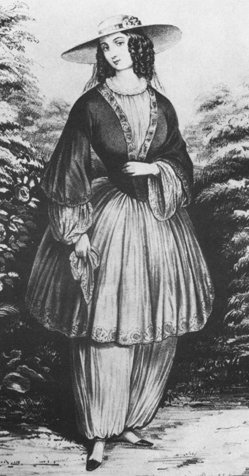
When women started wearing bloomers (loose trousers gathered at the ankle and worn under a below-the-knee-length skirt) in the 1850s, it was considered a scandalous mode of dress. What bloomers replaced seems beyond scandalous by today’s standards.

1850s fashion bloomers
1850s fashion bloomers with corset
If women wanted to be deemed fashionable in the 1850s, they wore…

1) a skirt that dragged several inches on the ground
2) layers of starched petticoats stiffened with straw or horsehair sewn into the hems
3) a whale-bone corset that pushed one’s internal organs out of place

As one medical professor warned his students, the result was “a feminine population which was of no use as cadavers for studying human anatomy.”

But bloomers (also known as the Reform Dress) resulted in warnings as well. Public meetings were called to stop the change. Some women were denied church membership for wearing bloomers.

So now it's time to meet Amelia Bloomer and Lucy Stone, two Wild Women reformers and fashionistas who helped shape a new fashion…instead of having it shape them.

~ * ~

Amelia Jenks Bloomer
( born 1818 in Homer, New York )

1851 drawing of Amelia wearing bloomers
1851 drawing of Amelia
At age 17, Amelia became a schoolteacher. When she was 22, she married Dexter Bloomer and started writing for his newspaper, The Seneca Falls County Courier.

Eight years later in 1848, she attended the Seneca Falls Convention (the first women's rights convention) and was inspired to start her own newspaper, The Lily (the first American newspaper published by and for women).

In 1851, Amelia introduced suffragettes Elizabeth Cady Stanton and Susan B. Anthony to each other.

That same year, temperance activist Libby Miller started wearing bloomers. Libby’s cousin showed them to Amelia who began wearing them as well. Amelia promoted her bloomers in her newspaper as a change in dress standards that allowed less restriction in women’s regular activities. Her articles were picked up by The New York Tribune, and this new fashion was dubbed the Bloomer Costume or just bloomers.

In 1854, Amelia sold her newspaper and moved with her husband to Council Bluffs, Iowa, where she wrote periodicals and led suffrage campaigns. From 1871 until 1873, she served as president of the Iowa Woman Suffrage Association.


Lucy Stone
( born 1818 in West Brookfield, Massachusetts )

1853 drawing of Lucy wearing bloomers
1853 drawing of Lucy
At age 16, Lucy (like Amelia) became a schoolteacher. When she was 25, she traveled by train, steamship, and stagecoach to attend Ohio’s Oberlin College (America’s first college to admit both women and African Americans).

In 1847 (after becoming the first woman from Massachusetts to earn a college degree) she began a career as a women's rights lecturer—during a time when women were discouraged from public speaking.

In 1850 while traveling for her work, Lucy contracted typhoid fever and nearly died. During the winter of 1850–51, she began wearing bloomers as a health measure to help her recuperate.

For the next four years, while speaking for women's rights and against slavery, Lucy helped popularize bloomers by wearing them exclusively as she addressed huge audiences in over twenty states and in Canada as well.

Called the “heart and soul” of the women's rights movement, Lucy not only influenced Susan B. Anthony to take up the suffrage cause, but Elizabeth Cady Stanton wrote that Lucy was “the first person by whom the heart of the American public was deeply stirred on the woman question”…all while wearing bloomers 🙂

~ * ~

I love fashion that's comfortable...and doesn't push my internal organs out of place. There's nothing like writing in your pajamas! ❤️

What's your favorite work or relaxation clothing? 


Jacqui's author photo
Read more of my Cowboy Kisses Wild Women blog posts 

Join me on… 
Follow me on… 

Don't forget to download my FREE story Rescuing Raven (Raven & Charlie's story in Deadwood 1876) 

Friday, April 10, 2020

Two Wild Women Doctors who Changed California


By Jacqui Nelson

The times they are a-changing, but the special place in our hearts, hopes, and memories for healthcare professionals is timeless. Calfornia was often called a land of gold and opportunity. Meet Mariana and Charlotte, two wild women doctors and reformers who helped the Golden State find something greater than gold for its people. 

Dr. Mariana Bertola
( born 1865 in Pacheco, California ) 


Mariana’s parents were Italian immigrants. In 1852, her father came to California as a miner but soon became a grocer and a vineyard operator. Mariana went to school in San Jose. She was a teacher first and then a school principal for seven years in Martinez, California. In 1899, she graduated from Cooper Medical College at Stanford University. 

As a doctor, Mariana supported the "California Plan" for every county hospital to offer a maternity ward and a children's ward. In 1903, she completed her obstetrics internship and became the college physician at Oakland’s Mills College. 

Mariana arranged for translators for Italian-speaking patients at San Francisco-area hospitals and gave lectures on health topics in the Italian community and to women's groups throughout the city. She was the president of San Francisco’s Travelers’ Aid Society and the Woman's Vigilant Committee (WVC). The WVC formed in 1921 to protect girls from criminal activity. 

In 1926 and 1927, Mariana was president of the California Federation of Women's Clubs and remained active with women's clubs well into her eighties.

Dr. Charlotte Johnson Baker 
( born 1855 in Newburyport, Massachusetts ) 


After graduating from Newburyport High School and teaching for a year, Charlotte attended Vassar College. In 1877, she graduated with a Bachelor of Arts. From 1879 to 1881, she attended the medical department of the University of Michigan and received her M.D.

In 1882, she married fellow doctor Frederick Baker and the couple practiced medicine in Ohio, New Mexico (where their two children were born), and then San Diego, California. In 1888, she received an A.M (or Master of Arts) from Vassar College for special work in optics and ophthalmology completed after graduation.

In 1898, Charlotte was the first woman president of the San Diego County Medical Society. In other years, she was vice president of the Southern California Medical Society, co-founder of the San Diego YWCA (and its president for three years), and president of the Equal Suffrage Association.

Charlotte spearheaded the San Diego Women's Vote Amendment campaign, worked to eliminate prostitution, and advocated a shorter workweek for laborers.

~ * ~

I love the notion that a doctor can not only mend our bodies but our societies. Because if either is broken, how can our futures be healthy? Thank goodness for all of the doctors (past, present, and future) who do so much for us ❤️ 


Read more of my Cowboy Kisses Wild Women blog posts 

Join me on… 
Follow me on… 

Don't forget to download my FREE story Rescuing Raven (Raven & Charlie's story in Deadwood 1876) 

Friday, March 13, 2020

The Wild Woman who was called Peculiar


By Jacqui Nelson

It's Friday the 13th. It’s a day that some might call “peculiar.” I think the Wild West was probably shaped by many “peculiar” and “headstrong” people, so...it's time to meet the minister’s daughter who was called both of those words.

Meet the woman who, at age fifteen, left home to attend church but instead took the train to St. Louis to make her own fortune…only to be “persuaded” to return home one week later and conform to the current image of a 1860s woman…until her “removal to” California 22 years later when she finally found a way to write freely under her own name.

Alice Moore McComas
( born 1850 in Paris, Illinois )  

Alice Moore was born into a prestigious family with traditional views of women. Her father was a Methodist minister and a representative in Congress. From the age of eight, her opinions on society and religion resulted in her being labeled "peculiar" and as she grew older "headstrong.”

In school, she traded compositions she'd written for worked-out mathematical problems. She averaged six to ten compositions weekly on different subjects while changing her style to escape detection. When her male relatives and friends enlisted with the Union during the American Civil War, she began studying politics and the woman's rights movement.

When Alice was fifteen, she left home to attend church but instead took the train for St. Louis to make her own fortune. She secured a job in a dry goods store for $8 a week, but after one week of successful self-reliance, she was “persuaded” to come home. She took solace in writing stories and poems (many of which were destroyed as soon as written) and attended to the social duties demanded of a daughter of a prominent family. In 1870, she married Judge Charles C. McComas and took up the duties of wife, mother, and housekeeper.

After the panic of 1876’s financial disaster, Alice’s husband lost their home and property. Believing he could swiftly retrieve his lost fortune in a new place, Charles went to Kansas. Alice resumed writing and earned a small income while concealing her identity under a pen name. In 1877, she and her two daughters joined Charles in Kansas.

In 1887, after Alice’s “removal to” Los Angeles, California, she began writing under her own name. I couldn’t discover what “removal to” meant, so we’ll just have to guess….while remembering this is a word used when women were “persuaded” and labeled “peculiar” and “headstrong” for having an opinion.

Alice served as associate editor of the Pacific Household Journal and wrote Under the Peppers (a book on child life in California) plus many short stories and articles on politics and economics.

In 1891 and 1893, she was vice-president of the National Woman Suffrage Association, the first vice-president of the Ladies' Annex to the Los Angeles Chamber of Commerce, and a member of the board of directors of the Women's Educational and Industrial Union. During her term as president of the California suffrage society, the first county suffrage convention was held in the state. Alice contributed to over 70 newspapers on the suffrage question.

Alice also secured the promise of a land donation for a public park in her neighborhood -- on condition that the city would improve it. She took the matter before the city council, urging them in a stirring speech to accept the gift. Only by diligent and persistent work (aka by being “peculiar” and “headstrong”) did she finally secure $10,000 to fund the land's improvement and complete the project.

~ * ~ 

This blog post is dedicated to all the “peculiar” and “headstrong” people out there—past, present, future. May all of your days be happy and safe ❤️❤️

~ * ~ 

Join me on… 
Follow me on… 

Don't forget to download my FREE story Rescuing Raven (Raven & Charlie's story in Deadwood 1876) 

Friday, January 10, 2020

The Wild Woman who Championed the Rescue of Trafficked Women


By Jacqui Nelson

Brave and determined spirits always changed the Wild West. Meet the Wild Woman journalist who fought for change by championing the rescue of trafficked women in California and everywhere. 

Mary Grace Charlton Edholm
( born 1854 in Freeport, Illinois ) 


Mary Charlton’s passion for journalism was inherited from her father and mother who wrote about the temperance movement, women's suffrage, and the abolition of slavery. 

At Illinois’ Monmouth College her exhibition essay on the subject "Shall our Women Vote?" was published in the Woman's Journal of Boston. After this, she wrote continuously and her articles appeared in the New York World, the Chicago Tribune, St. Louis Post-Dispatch, Republican, and Chicago Inter Ocean. In 1878, she married fellow journalist Osborn L. Edholm.

In 1886, Mary and her husband moved to Oakland, California where she was unanimously elected official reporter for the Woman's Christian Temperance Union (WCTU). In 1891, she was named superintendent of press. 

Annually, Mary wrote about 250 columns of original temperance matter for over 200 papers, including the dailies of San Francisco, Oakland, Portland, New Orleans, Boston, and New York City. She also conducted three WCTU excursions across the United States, served as secretary for the International Federation Women's Press League, and was editor of Oakland's The Christian Home. 

For years, Mary championed the rescue of trafficked women. She wrote hundreds of articles in the Woman's Journal, the Women's Tribune, and the California Illustrated Magazine revealing the horrors of the slave traffic in Chinese women for immoral purposes. During an evangelistic meeting in Oakland, she met the millionaire evangelist, Charles Nelson Crittenton (the founder of Florence Crittenton Missions for the rescue of trafficked women) and began writing articles about the Florence Crittenton Missions' work with such enthusiasm that Mr. Crittenton made her a reporter for the missions. 

In 1893, Mary's book The Traffic in Girls and Florence Crittenton Missions (about the horrors of the traffic in women and their redemption through the missions) was published under the name Charlton Edholm. In 1895, Mary was made superintendent of the Florence Crittenton Missions. 

In 1901, Mary used her own home in Oakland to create the Lucy Charlton Memorial (named after her mother) as a home for unfortunate women and children. She supported the charity from the proceeds of her lectures and the sale of her book. 

~ * ~ 

After I read about Mary's life I was reminded of an Orpah Winfrey quote that I recently shared on Instagram. "Cheers to a New Year and another chance for us to get it right."


I think Mary Charlton Edholm was a true champion for getting it right. She spent her life reporting what she saw and standing up for others. 

For me, being an author means writing about characters trying to "get it right" not just for themselves but those around them. Their struggle is never perfect because that's life. We often try only to fail. But as long as we keep trying, isn't that what truly matters?

Time to seize the day and every chance to try to do better. Wishing you all the best this new year ❤️

~ * ~ 

Join me on… 
Follow me on… 

Don't forget to download my FREE story Rescuing Raven (Raven & Charlie's story in Deadwood 1876)