
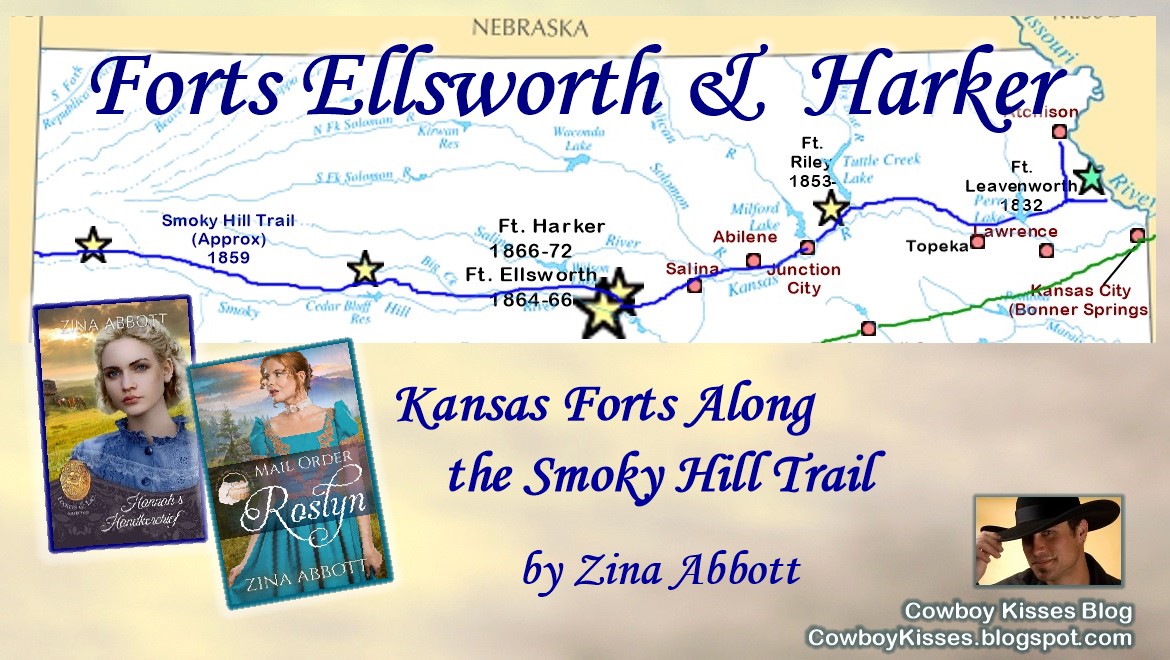
One of the frustrating aspects of researching frontier
forts is that there were often several military camps, cantonments, posts, and
forts in the same general area, all with different names. If that were not confusing
enough, when it came to Fort Ellsworth, there were two of them, and their
existences overlapped.
The first Fort Ellsworth was constructed during the American
Civil War in the weeks following the Union defeat at Bull Run. It was
located west of Alexandria, Virginia and was part of the defenses of Washington
D.C. It was in operation between 1861 and 1865.
The Fort Ellsworth this blog post focuses upon was Fort
Ellsworth in Kansas. Built along the Smoky Hill River and Smoky Hill Trail, it
served to protect the military road that ran from there to Fort Zarah located
along the Santa Fe Trail near the big bend in the Arkansas River.
 |
| Fort Ellsworth by Mathew Brady |
The camp occupied the same general site as a stagecoach station
and a hunting and trading ranch. It was also the point where the Fort Riley-Fort Larned
Road crossed the Smokey Hill River in the present Ellsworth County in Kansas.
Daniel Page and Joseph Lehman established the hunting
camp and trading ranch in 1860. The men gathered wolf and buffalo hides for
trade. In 1862 the ranch became
a station for the Kansas Stage Company.
The station kept and fed mules that were changed when stagecoaches came
through. The station was raided by Confederate soldiers in September of that
year. [I also suspect those were the same Confederate raiders that in September
1862 descended upon Salina less than fifty miles to the east and stole most of
the livestock, food, tobacco, weapons, and destroyed any firearms that they did
not wish to take with them.]
 |
| Maj. Gen. Samuel R. Curtis |
In August 1864, Maj. Gen. Samuel R. Curtis, the department commander, established a military camp four miles southeast of the stage and hunting ranch site. The fort's mission was to protect
the area settlers from hostile indians. Soldiers from the 7th Iowa Cavalry, under the command of 2nd Lt. Allen Ellsworth, set up the fort. They built a
two-story blockhouse using logs already cut and hewn on two sides found at the abandoned
Page-Lehman ranch. The blockhouse became the nucleus of the fort. Other than that,
since the fort was intended to be temporary, it consisted of
hastily-constructed dugouts and log structures, which served as quarters for
the soldiers. Other structures included a commissary, an officers' mess, and a
makeshift shelter for the horses. Based on the descriptions, all of these
structures were made largely from materials on hand--logs, sod, and brush. Maj. Gen. Curtis named
the post Fort Ellsworth for Lt.
Ellsworth.
The 7th Iowa Cavalry no sooner arrived at the
site than on August 7, 1864,
Indians drove off and captured about fifty of the post's horses—most of what they had—and five mules belonging to the Kansas Stage Company. For some time, the post had only two horses. Col. James H. Ford, who visited Fort Ellsworth in January 1865, noticed the post still only possessed nine horses.
Ford, in charge of the district that included the post, ordered an additional company of cavalry to garrison it.
Even though some buildings were constructed by the end of
the Civil War, the men still lived in primitive housing. M. Wisner wrote his
company arrived in January 1865 and
had to build dugouts with mud chimneys. He also noted these dugouts were
comfortable in the severe cold weather.
 |
| Gen Winfield S. Hancock |
New man in charge, new changes. General Orders No. 22
issued on November 17, 1866 by
General Winfield S. Hancock, commander of the Division of the Missouri, changed the name of the post to Fort Harker. It was named after General Charles Garrison Harker, who was killed in
action at the Battle of Kennesaw Mountain in the American Civil War.
In 1867, the
original Fort Ellsworth site was abandoned when a new site about a mile--(1.6 km or 0.99 mi) to the northeast was chosen for Fort Harker. Fort Harker, located in Kanopolis, Kansas, was an active military
installation from November 17, 1866 to October 5, 1872.

Construction
on the new fort may have begun before the official order. Records show Fort Ellsworth had
a master carpenter, a master mason, five carpenters, and fourteen masons on
staff as early as September 1866. Based on the number of civilian contractors
on the fort's payroll, major construction of the facility was likely completed
by the summer of 1867. In June 1867, orders were given to tear down the remainder
of the buildings at old Fort Ellsworth. Fort Ellsworth was sold to land
developers and became part of the town of Ellsworth, Kansas.
 |
| Guardhouse |
Soon
after the completion of major construction, the railroad arrived at Fort
Harker. The Union Pacific Eastern Division completed a line to
Fort Harker in July 1867. The rail line ran through the fort, and a depot was
established just outside the fort. Two large warehouses were built next to
the line, which became the principal resupply route for the fort. By the end of
1867, the fort supported a four-company garrison, the supply depot and over 75
buildings.
 |
| Junior Officers' quarters |
In
the summer of 1867, an Asiatic cholera outbreak began
amongst the soldiers of the four companies of the 38th Infantry stationed at the
fort. The disease may have arrived with the men of the 38th, who traveled to
the fort from St. Louis, Missouri where a cholera
outbreak was also occurring. The first case of cholera at the fort was
diagnosed on June 28. Within days, one civilian and one soldier had died from
the disease, and the epidemic had spread to other soldiers and civilians at the
fort, as well as settlers in the surrounding area. The post quartermaster
reported that 58 citizens were buried during the month of June. The epidemic
continued through the remainder of 1867, and by the end of the year the
official report shows 392 cases with 24 deaths among the white troops and 500 cases
with 22 deaths among the black troops stationed at
or near the fort.
 |
| Fort Harker |
Although
no battles were ever fought at the fort itself, troops stationed at Fort Harker
were involved in the ongoing Indian Wars between the United States Army and the
natives of the Great Plains. In 1867, the troops
stationed at Fort Harker performed more escorts of wagon trains (possibly oxen-pulled freight trains) in one year than
troops stationed at any other frontier fort in the post-Civil War era.
 |
| Railroad bridge near Fort Harker |
Once the
railroad arrived at the fort in 1867, the need for escort patrols began to
shift to the west. By 1868, the primary role of Fort Harker changed to that of
a supply depot and troop staging site.
Fort Harker was a major distribution point for all
military points farther west and was one of the most important military
stations west of the Missouri River.
- In the fall of 1868, General Philip Henry Sheridan moved his command headquarters from Fort Leavenworth to Fort Harker, from where he commanded the campaigns against the Native Americans in the winter of 1868-1869.
- On August 25, 1869, Brevet Colonel Joseph G. Tilford was sent to Fort Harker, where he commanded two troops of General George Armstrong Custer's 7th Cavalry. After wintering at the fort, Tilford and the cavalry set out on a campaign in February 1870.
- In May 1870, General Custer and the remaining troops of the 7th Cavalry passed through Fort Harker on their way from Fort Leavenworth to Fort Hays to engage the Native Americans farther west.
According
to an 1870 military report, both
Fort Ellsworth and the later military post Fort Harker were established to
furnish a point from which operations could be carried on against the Indians,
who were very troublesome during this time in Kansas History.

By
1871, Fort Harker had declined in importance in the Indian Wars. Native
Americans living in the area of the fort had been displaced by white settlers,
and the scene of conflicts had shifted to the west. An expanding railroad
network diminished the importance of the fort as a distribution point for
supplies. In March 1872, the 15th Infantry stationed at Fort
Harker redeployed to Fort Union. On April 5, the remaining companies
of the 5th Infantry departed from the
fort as well. Official orders to abandon Fort Harker were received on April 8,
1872. Soldiers of the 5th Cavalry left Fort Harker on
May 7, leaving behind a small garrison of two officers and five enlisted men
from the 5th Infantry. The base was completely abandoned by October 5, 1872.
Fort
Harker was located at the site of the present-day town of Kanopolis. The
Ellsworth County Historical Society maintains three of the original buildings
of Fort Harker as a museum commemorating both
Fort Ellsworth and Fort Harker. These include the guardhouse, Commanding Officer's
Quarters, and Junior Officer's Quarters. The museum also features a train depot
with salt mine and later 19th-early 20th Century exhibits.

~o0o~
I have two books so far in which Fort Ellsworth serves as part
of the setting. In Hannah’s Handkerchief, book 24 in the Lockets & Lace series
set in 1865, Jake Burdock often finds his quartermaster duties take him to Fort
Ellsworth. Hannah’s Handkerchief is
now available. To find the book description and purchase link, PLEASE CLICK HERE.
~o0o~

In Mail Order Roslyn, book 9 in the Widows, Brides & Secret Babies series set in 1866, my
heroine finds herself and her baby in the Ellsworth Stage Station near the town and Fort
Ellsworth. At that time, hostile tribes, particularly the Cheyenne, frequently
attacked stagecoaches and stations in an attempt to capture livestock and
either kill or drive away the white Americans invading their favored hunting
grounds. This book is not on preorder, but is due to be published next week.
Please look for it.
Sources:
https://kshs.org/kansapedia/fort-ellsworth/17158
https://www.santafetrailresearch.com/spacepix/fort-ellsworth.html
Wikipedia
