Showing posts with label stagecoach. Show all posts

Sunday, June 29, 2025

The Other Monitors by Zina Abbott


As the Black Hills gold rush attracted more gold miners and fortune-seekers, the amount of gold, coins, and valuable paperwork being shipped between Deadwood and the railroad at Cheyenne reached record levels. They attracted numerous gangs of road agents determined to rob the coaches along the remote sections of the route.


Johnny Slaughter, murdered by road agent, Robert McKimie, on March 25, 1877, became the first Cheyenne and Black Hills Stage Company driver killed while operating the stagecoach along the Deadwood to Cheyenne Trail. Not long after, the company built two steel-plated treasure coaches called Monitors after the Civil War ironclad, USS Monitor. One was named “Old Ironsides,” which was designed and constructed by A.D. Butler of Cheyenne at the cost of $31,000. A few months later, a second coach, the “Johnny Slaughter” to honor the company’s late driver, was built and delivered by the same company.

The "Salamander"

The stagecoach company commissioned a treasure box especially designed to thwart road agents. Manufactured in Cincinnati, the chest was lined with three-inch, thick steel and was bolted to the floor. It was secured with a Yale lock guaranteed to befuddle thieves for “six days.” Due to the coating of green paint on the outside, it quickly earned the nickname of “the salamander.”

Labeled a treasure coach, but does not show iron plating.

Both stagecoaches were lined with steel plates 5/16th inches thick. Each door had a porthole for two shotgun messengers to shoot out. In addition to the structural reinforcements, armed guards, or “outriders” were added. Some scouted the terrain ahead and others escorted the coach itself.

Since large quantities of wealth were at stake, the road agents responded accordingly. Gangs grew larger and more violent.

In May 1878, the first Monitor coach, “Old Ironsides,” went into service. It was put to the test in what became known as the Canyon Springs Robbery.

1914 recreation of "Old Ironsides" 

On September 26, 1878, Lame Johnny’s gang of outlaws ambushed the Monitor, starting with a hail of gunfire as it pulled into Canyon Springs Station thirty-seven miles south of Deadwood. The driver Gale Barnett and two shotgun messengers, Gale Hill and Eugene Smith, were wounded; and a telegraph operator named Hugh Campbell was killed.


Canon Springs Station 37 miles south of Deadwood

This robbery was well planned out. The gang knew the timing of the stagecoach’s arrival at the station, which was thirty-seven miles south of Deadwood. One gang member approached the station and asked for a drink of water. As soon as the stock attendant, William Miner, started for the water, the outlaw attacked and locked him in a prisoner in the stable grain room. Before the coach arrived, other gang members knocked spaces out of the stable walls to use as gun ports.

As the stagecoach approached, they followed their usual procedure. The driver sounded a horn to alert the attendant to bring out a fresh team of horses. When no one appeared, two men in front dismounted to check for the attendant. Those road agents waiting in the barn opened fire. The driver returned fire, and then took cover after being wounded. There were dead and wounded on both sides.

Robbers took the driver as prisoner, using him as a shield. This made it impossible for Davis to continue firing for fear of hitting Barnett. He abandoned the fight, which left the robbers free to work on opening the salamander. They tied up the survivors and within two hours, they broke into the “break-proof” safe and escaped with valuables totaling $27,000.

Miner, the station attendant, eventually freed himself and walked to the next station to alert them to the robbery. It didn't take long for the story of the robbery to make its way around the Hills, and a posse was formed to regain the treasure and capture Lame Johnny's gang.

The Monitors continued to be used to transport large cargoes of valuables for three years before their use was discontinued.


In my most recent release, Hal’s Lucky Escape, my hero finds work as a security guard for the Cheyenne and Black Hills Stage Company. His first escape was an entanglement with a mail-order bride with questionable intentions. The second was a robbery attempt on one of the coach runs. To find the book description and purchase options,

Please CLICK HERE


Sources:

https://truewestmagazine.com/article/surviving-a-stagecoach-robbery/

https://www.bhpioneer.com/opinion/robbing-the-monitor/article_5e7ab954-9e7f-11e0-a3b8-001cc4c002e0.html

https://www.historyisnowmagazine.com/blog/2023/8/9/stagecoach-robberies-in-the-american-west

https://truewestmagazine.com/article/the-original-war-wagon/

https://shipwrecklibrary.com/deadlands/deadwood-stage/

Wednesday, August 7, 2024

The Cliff House at Manitou Springs, Colorado ~ Julie Lence

courtesy TheCliffHouse.com 
  A handful of miles west of Colorado Springs lies Manitou Springs, a small mountain community at the base of Pikes Peak Mountain and known for its mineral springs. Within Manitou Springs lies The Cliff House, a 125 year old hotel that has stood the test of time. Built in 1873, The Cliff House, known then as The Inn, was a 20 room boarding house along the stagecoach route to Leadville, Colorado. Guests flocked to the inviting parlors and porches, and as the mines continued to pan out, more and more investors stayed at the boarding house. In some instances tents had to be set up to accommodate everyone.  Eventually the gold mines began to dwindle and by 1876, The Inn barely had guests. But in the ensuing years, interest in the mineral springs rose. American Indian tribes had been drinking from the springs for years, and with the water cool and good tasting, many believed the high concentration of minerals benefited the body. Edward E. Nichols was one of those believers. Battling tuberculosis, he came west in 1870 and beat the disease. He took up permanent residence in Manitou Springs, became mayor, and bought The Inn in 1886. He renamed it The Cliff House and joined forces with the governor in 1914 to build the Manitou Bath House Company.

Bath House; Pinterest
   The Manitou Bath House is located across from The Cliff House and aided in making Manitou Springs and The Cliff House a profitable resort area specializing in water therapies, with the wealthy flocking to the Cliff House into the 20th century. During that time, Nichols expanded The hotel from 20 rooms to 56 rooms, and then to 200 rooms; the result a four-and-a-half story grand building. Guests included Teddy Roosevelt and P.T. Barnum, and each night after a formal dinner, everyone was invited across the street to Soda Springs for a glass of mineral water before turning in for bed. Tunnels were built underground connecting the hotel to the spa. A bath house followed, and bell boys filled bottles and glasses at the springs for guests.    

In 1921, a flash flood roaring down from nearby Williams Canyon washed through The Cliff House’s Grill Room (a sandwich and soda shop) in the rear of the east wing. Hymn books were destroyed and the floor buckled up to the ceiling. James S. Morley, a real estate developer from California, bought the hotel in 1981 and turned it into an apartment building, which caught fire in March of 1982. The 4th floor roof had so much damage that it had to be replaced. Inside, all plumbing, plaster, and floor coverings were removed. The water damage from putting out the fire threatened the existence of the building that action was immediately taken to keep it standing. But with the economy not good, it stood vacant until 1997 when Morley vowed to restore it to its original grandeur, to include preserving the Rocky Mountain Victorian architecture of the 1800’s. He invested 10.5 million dollars and incorporated 21st century technology to make this happen.

courtesy www.booking.com
  In September 2007, Gal-Tex Corporation bought The Cliff House and added on to the hotel. Along with 1859 Historic Hotels L.L.C, they have kept the core staff and continue to improve the hotel’s reputation, including an East Addition housing a full bar, fitness room, garden patio, meeting room in what was Williams Canyon, and a 3rd level outdoor atmosphere space that can be turned into an indoor area as needed. Today,  The Cliff House is on the National Registry of Historic Places and is both a grand hotel and restaurant.  

Wednesday, October 7, 2020

Female Outlaw Pearl Hart By: Julie Lence

Pearl Hart was born in 1871 in Canada, with the birth name of Pearl Taylor. One of several children, and her parents of French descent, she was raised in a middle class home and sent to boarding school when she was 16. While at school, she met smooth talker Frank Hart, who filled her head with romantic tales of an exciting life in the wild west. In reality, he was nothing more than an abusive drunk, but Pearl fell in love with him and married him. The two left Canada and eventually landed in Chicago.
Women's Bldg at the Fair, Pinterest
Chicago was a changing point for Pearl. She attended the 1893 World’s Fair, featuring a Women’s Pavilion. A large array of females spoke on the Women’s Suffrage topic and Pearl took to heart that she could be more than just a wife, as her upbringing taught her. She also attended a Wild West show featuring Annie Oakley. Pearl was in awe of Annie’s shooting skills, and accompanied with the what she learned at the fair, she got up the gumption and left her abusive, unable-to-hold-a-job husband. She landed in Trinidad, Colorado, but soon found out she was pregnant and went back to Canada. After giving birth, she realized the lure of the west still beckoned and lit out for the states, leaving her son with her parents.
Pearl met up with her husband again and took him back on his promise that he was a changed man and capable of holding a job. For a while he held a maintained the positions of bartender and manager at a hotel, but all too soon, he and Pearl began partying, with Pearl learning to drink and smoke and use drugs. Problems arose between them again, and Frank left shortly after she gave birth to their daughter and joined Roosevelt’s Rough Riders, stating home life wasn’t for him. Pearl traveled back to Canada again and left her second child with her parents.
Courtesy of American Cowboy 
She found her way to Arizona and worked the mining camps as a cook, taking up drinking and opium use and not finding the romance and excitement of the west she longed for. Rumors suggested she tried to commit suicide several times, but was always saved by the miners, one of whom she formed a partnership with. Joe Boot was from German descent and he and Pearl began working their own claim when Pearl received a letter that her mother was gravely ill and needed money for the doctor’s bills. To acquire the money, Pearl and Joe thought to rob a train but decided to rob a stagecoach instead. Pearl cut her hair, dressed in Joe’s clothes, and together, they held up a stage. They came away with over $400 and the guard’s revolver and took off on their horses. But not knowing the land, they rode for two days then made camp and fell asleep, and woke to a posse surrounding them.
Courtesy of Pinterest
In Jail, Pearl became an instant celebrity. A lady bandit was rare. Remembering everything she learned from the Women’s Suffragette talks in Chicago, she began spouting she wouldn’t be tried in a court of law under rules men made and not women. Signing autographs and posing for pictures from her cell, the press loved her, and so did civilians. Ed Hogan was so smitten with her, he helped break her out of jail. She was found and brought back, and eventually went to trail. The jury found her innocent, especially after her defense lawyer brought into play she’d never been in trouble in the past and the only reason she robbed the stage was because of her mother’s health. The judge was furious with the decision and tried her on charges of stealing the guard’s gun and unlawfully carrying of a weapon. She was found guilty and sentenced to 5 years in Yuma. Joe received a 30 year sentence to Yuma.
Pearl became an even bigger celebrity and legend while in Yuma, earning the nickname Lady Bandit. The warden liked her and gave her a larger cell, and she again posed for pictures and signed autographs. She was released after serving 18 months and moved to Kansas City. Her sister wrote a production based on Pearl’s ‘Lady Bandit’ persona of which Pearl was to star in, but it never really caught on and Pearl disappeared from the public eye. A few years later, she was arrested for purchasing a stolen can of food. After that, she disappeared again and surfaced in 1924 at the Arizona courthouse she was tried in. She remarked to the attendant that nothing had changed since her last visit. He asked who she was and she replied, Pearl Hart, the lady bandit.
Rumors have abounded as to what happened to Pearl after this. Some say she died in Kansas City after operating a cigar shop. Others hint she lived in San Francisco until her death in 1952. A third suggests she married a rancher in Arizona and died under the name Pearl Bywater in 1956. She is wrongly credited with being the last person to rob a stage. The last stagecoach robbery was in 1916 in Jarbridge, Nevada. She is also not the only woman to ever rob a stage. Jane Kirkham was killed robbing a stage between Leadville and Buena Vista, Colorado in March 1879.
Such and interesting woman, and such a hard life Pearl led. 

Friday, April 24, 2020

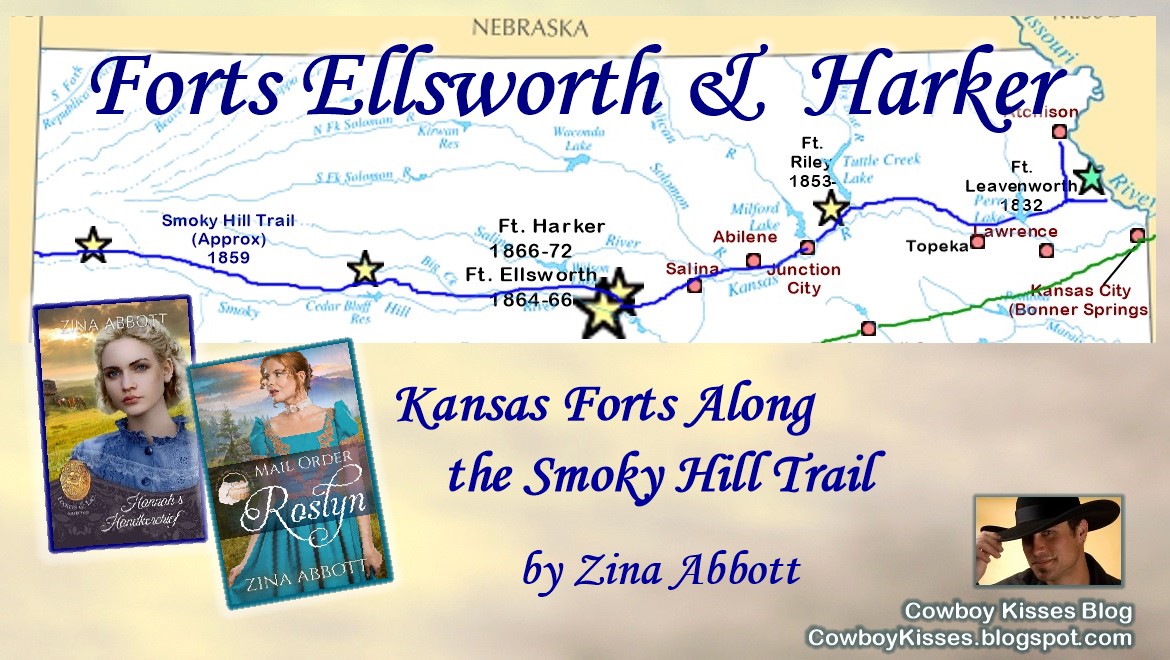
Forts Ellsworth & Harker by Zina Abbott


One of the frustrating aspects of researching frontier forts is that there were often several military camps, cantonments, posts, and forts in the same general area, all with different names. If that were not confusing enough, when it came to Fort Ellsworth, there were two of them, and their existences overlapped.

The first Fort Ellsworth was constructed during the American Civil War in the weeks following the Union defeat at Bull Run. It was located west of Alexandria, Virginia and was part of the defenses of Washington D.C. It was in operation between 1861 and 1865.

The Fort Ellsworth this blog post focuses upon was Fort Ellsworth in Kansas. Built along the Smoky Hill River and Smoky Hill Trail, it served to protect the military road that ran from there to Fort Zarah located along the Santa Fe Trail near the big bend in the Arkansas River.

Fort Ellsworth by Mathew Brady

The camp occupied the same general site as a stagecoach station and a hunting and trading ranch. It was also the point where the Fort Riley-Fort Larned Road crossed the Smokey Hill River in the present Ellsworth County in Kansas.

Daniel Page and Joseph Lehman established the hunting camp and trading ranch in 1860. The men gathered wolf and buffalo hides for trade. In 1862 the ranch became a station for the Kansas Stage Company. The station kept and fed mules that were changed when stagecoaches came through. The station was raided by Confederate soldiers in September of that year. [I also suspect those were the same Confederate raiders that in September 1862 descended upon Salina less than fifty miles to the east and stole most of the livestock, food, tobacco, weapons, and destroyed any firearms that they did not wish to take with them.] 

Maj. Gen. Samuel R. Curtis
In August 1864, Maj. Gen. Samuel R. Curtis, the department commander, established a military camp four miles southeast of the stage and hunting ranch site. The fort's mission was to protect the area settlers from hostile indians. Soldiers from the 7th Iowa Cavalry, under the command of 2nd Lt. Allen Ellsworth, set up the fort. They built a two-story blockhouse using logs already cut and hewn on two sides found at the abandoned Page-Lehman ranch. The blockhouse became the nucleus of the fort. Other than that, since the fort was intended to be temporary, it consisted of hastily-constructed dugouts and log structures, which served as quarters for the soldiers. Other structures included a commissary, an officers' mess, and a makeshift shelter for the horses. Based on the descriptions, all of these structures were made largely from materials on hand--logs, sod, and brush.  Maj. Gen. Curtis named the post Fort Ellsworth for Lt. Ellsworth.

The 7th Iowa Cavalry no sooner arrived at the site than on August 7, 1864, Indians drove off and captured about fifty of the post's horses—most of what they had—and five mules belonging to the Kansas Stage Company. For some time, the post had only two horses. Col. James H. Ford, who visited Fort Ellsworth in January 1865, noticed the post still only possessed nine horses. Ford, in charge of the district that included the post, ordered an additional company of cavalry to garrison it.

Even though some buildings were constructed by the end of the Civil War, the men still lived in primitive housing. M. Wisner wrote his company arrived in January 1865 and had to build dugouts with mud chimneys. He also noted these dugouts were comfortable in the severe cold weather.

Gen Winfield S. Hancock
New man in charge, new changes. General Orders No. 22 issued on November 17, 1866 by General Winfield S. Hancock, commander of the Division of the Missouri, changed the name of the post to Fort Harker. It was named after General Charles Garrison Harker, who was killed in action at the Battle of Kennesaw Mountain in the American Civil War.

In 1867, the original Fort Ellsworth site was abandoned when a new site about a mile--(1.6 km or 0.99 mi) to the northeast was chosen for Fort Harker. Fort Harker, located in Kanopolis, Kansas, was an active military installation from November 17, 1866 to October 5, 1872.  


Construction on the new fort may have begun before the official order. Records show Fort Ellsworth had a master carpenter, a master mason, five carpenters, and fourteen masons on staff as early as September 1866. Based on the number of civilian contractors on the fort's payroll, major construction of the facility was likely completed by the summer of 1867. In June 1867, orders were given to tear down the remainder of the buildings at old Fort Ellsworth. Fort Ellsworth was sold to land developers and became part of the town of Ellsworth, Kansas.

Guardhouse

Soon after the completion of major construction, the railroad arrived at Fort Harker. The Union Pacific Eastern Division completed a line to Fort Harker in July 1867. The rail line ran through the fort, and a depot was established just outside the fort. Two large warehouses were built next to the line, which became the principal resupply route for the fort. By the end of 1867, the fort supported a four-company garrison, the supply depot and over 75 buildings.
 
Junior Officers' quarters
In the summer of 1867, an Asiatic cholera outbreak began amongst the soldiers of the four companies of the 38th Infantry stationed at the fort. The disease may have arrived with the men of the 38th, who traveled to the fort from St. Louis, Missouri where a cholera outbreak was also occurring. The first case of cholera at the fort was diagnosed on June 28. Within days, one civilian and one soldier had died from the disease, and the epidemic had spread to other soldiers and civilians at the fort, as well as settlers in the surrounding area. The post quartermaster reported that 58 citizens were buried during the month of June. The epidemic continued through the remainder of 1867, and by the end of the year the official report shows 392 cases with 24 deaths among the white troops and 500 cases with 22 deaths among the black troops stationed at or near the fort. 

Fort Harker

Although no battles were ever fought at the fort itself, troops stationed at Fort Harker were involved in the ongoing Indian Wars between the United States Army and the natives of the Great Plains. In 1867, the troops stationed at Fort Harker performed more escorts of wagon trains (possibly oxen-pulled freight trains) in one year than troops stationed at any other frontier fort in the post-Civil War era. 

Railroad bridge near Fort Harker
Once the railroad arrived at the fort in 1867, the need for escort patrols began to shift to the west. By 1868, the primary role of Fort Harker changed to that of a supply depot and troop staging site.

Fort Harker was a major distribution point for all military points farther west and was one of the most important military stations west of the Missouri River.

  • In the fall of 1868, General Philip Henry Sheridan moved his command headquarters from Fort Leavenworth to Fort Harker, from where he commanded the campaigns against the Native Americans in the winter of 1868-1869. 
  • On August 25, 1869, Brevet Colonel Joseph G. Tilford was sent to Fort Harker, where he commanded two troops of General George Armstrong Custer's 7th Cavalry. After wintering at the fort, Tilford and the cavalry set out on a campaign in February 1870.
  •  In May 1870, General Custer and the remaining troops of the 7th Cavalry passed through Fort Harker on their way from Fort Leavenworth to Fort Hays to engage the Native Americans farther west.
According to an 1870 military report, both Fort Ellsworth and the later military post Fort Harker were established to furnish a point from which operations could be carried on against the Indians, who were very troublesome during this time in Kansas History.


By 1871, Fort Harker had declined in importance in the Indian Wars. Native Americans living in the area of the fort had been displaced by white settlers, and the scene of conflicts had shifted to the west. An expanding railroad network diminished the importance of the fort as a distribution point for supplies. In March 1872, the 15th Infantry stationed at Fort Harker redeployed to Fort Union. On April 5, the remaining companies of the 5th Infantry departed from the fort as well. Official orders to abandon Fort Harker were received on April 8, 1872. Soldiers of the 5th Cavalry left Fort Harker on May 7, leaving behind a small garrison of two officers and five enlisted men from the 5th Infantry. The base was completely abandoned by October 5, 1872.

Fort Harker was located at the site of the present-day town of Kanopolis. The Ellsworth County Historical Society maintains three of the original buildings of Fort Harker as a museum commemorating both Fort Ellsworth and Fort Harker. These include the guardhouse, Commanding Officer's Quarters, and Junior Officer's Quarters. The museum also features a train depot with salt mine and later 19th-early 20th Century exhibits.

~o0o~

I have two books so far in which Fort Ellsworth serves as part of the setting. In Hannah’s Handkerchief, book 24 in the Lockets & Lace series set in 1865, Jake Burdock often finds his quartermaster duties take him to Fort Ellsworth. Hannah’s Handkerchief is now available. To find the book description and purchase link, PLEASE CLICK HERE.

~o0o~

In Mail Order Roslyn, book 9 in the Widows, Brides & Secret Babies series set in 1866, my heroine finds herself and her baby in the Ellsworth Stage Station near the town and Fort Ellsworth. At that time, hostile tribes, particularly the Cheyenne, frequently attacked stagecoaches and stations in an attempt to capture livestock and either kill or drive away the white Americans invading their favored hunting grounds. This book is not on preorder, but is due to be published next week. Please look for it.


Sources:
https://kshs.org/kansapedia/fort-ellsworth/17158
https://www.santafetrailresearch.com/spacepix/fort-ellsworth.html
Wikipedia