Showing posts with label Navajo. Show all posts

Monday, April 1, 2019

Navajo Spirits

By Kristy McCaffrey

The Navajo, from the southwestern region of the United States, believe a chindi is the ghost of an individual who has died. It is the part of that person that was imbalanced, or unreconciled, with the Universe. The Navajo believe that it’s best for death to occur outdoors, since this was the best way to disperse the chindi. If a person died within a homestead, or hogan, it was abandoned after the death; the chindi would likely be trapped inside the dwelling.

A skinwalker, or yee naaldlooshii, is a medicine man who has chosen to use his powers for evil. Navajo don’t like to speak of them for fear of retribution, believing them to move among their people undetected. Skinwalkers have the ability to transform into animals or other people. They often take the form of coyote, owl, fox, wolf or crow.

Some Navajo taboos:

Do not mention a dead person’s name or the ghost may come and haunt you.

Do not say chindi (evil spirit) or one will come to you.

Do not let a strange dog follow close behind or you may turn into a wolf man. The dog might be a skinwalker.

In my historical western romance novel, INTO THE LAND OF SHADOWS, Kate Kinsella and Ethan Barstow are forced to confront a chindi.


For the month of April, I'm offering a print copy of this book to one lucky winner. Hop over to my website to enter. No April Fools!!


Excerpt
Kate wondered how far she’d get on foot before the man standing a few feet away caught her and did God-knew-what.

Ethan Barstow.

Of all her bad luck. She had never met the man, but Charley’s recollections of his brother filled her head. Liar. Swindler. Killer.

“You must be Charley’s fiancée,” he said, watching her closely, his gaze dark.

Swell. He knew who she was. She nodded, deciding now wasn’t the time to share the truth about her and Charley's relationship. Instinct told her she needed to ditch Mister Barstow, but losing the donkey was a bit of a problem. Maybe she could find the animal herself on foot. But what if the three buffoons who’d stolen her horse were still out there?

“I arrived in Flagstaff three days ago looking for Charley,” Ethan said. “I was told he’d left town unexpectedly so I’ve been trailing him. I take it you don’t know where he is, either?”

She cleared her throat. “No, I don’t.”

“Is there some reason why he wouldn’t tell you where he was going?”

Well, it’s not me, but Agnes he didn’t tell. It was far too complicated to explain, least of all to this man, so she uttered, “We’ve had a bit of a misunderstanding.”

“Yeah, Charley and I’ve had a bit of a misunderstanding as well,” Ethan said quietly, almost to himself.

Kate plastered the biggest smile she could onto her face. “I think I’ll just go look for that donkey myself. I really don’t want to be a bother to you.”

She moved past the man who was a dead ringer for Charley, possessing the same angular cheek bones and long nose, the same dark hair, the same lean build as her fiancé. Her fiancé! What a ridiculous mess that was. There had been a time, far back in the beginning of her acquaintance with Charley, when she’d found him attractive and fun. It had been short-lived, especially once Agnes entered the picture. Now, she was face-to-face with a man much like Charley, but while his eyes had been green and his demeanor inviting, Ethan’s eyes were blue, almost gray, like a lake frozen over.

There were other differences, as well, and none of them flattered Ethan. He was a man who had killed other men, and Kate knew she would never find anything appealing in that.

“Hang on a minute,” he said. His hand wrapped around her forearm to stop her—a large, warm hand. “I don’t suppose you have any idea who I am since Charley and I haven’t spoken in over five years, but I came to Flagstaff to hopefully put the past in the past. I came to see if Charley and I could bury our differences. The least I can do is to help you find him, especially since we’ll be kin one day.”

She made the mistake of looking into his eyes. Up close, she could see flecks of gold buried within the blue, and a few wrinkles in the skin around the edges of his eyes. It must be her imagination that he seemed the slightest bit more friendly. Charley had charm and it would seem Ethan did as well, although Kate sensed it wasn’t without shadows.

A killer of men would undoubtedly have many shadows to keep him company. She couldn’t think of how to reply. The last thing she wanted was company, and least of all Ethan’s company. She’d find her damned fiancé herself.

“Yes, it would make sense to look together.” So much for thinking fast on her feet. Her brother, Owen, had always said she was a little slow off the mark. It would seem he was right.

“You can ride Brandy,” Ethan said as he released her arm.

He moved to his other horse and began untying the bags of supplies he’d brought with him. He moved the largest satchel to his horse and tied several knots swiftly to anchor it in place. Kate chewed her lip. She could just make a run for it. The only after-effect of her fall from the donkey was a splitting headache—her legs were perfectly fine. But Ethan would probably chase her down. And then, he’d wonder what was wrong with her. And then, maybe he’d just shoot her in the back if he decided she wasn’t worth the trouble.

The image horrified her. Perhaps she should at least be civil to the man, to ward off her immediate murder. An opportunity for escape would surely present itself.

She had a plan. This was good. Her plan was to make small talk with Charley’s brother, then run for her life when she got the chance.

Copyright © 2013 K. McCaffrey LLC


Connect with Kristy


Monday, November 2, 2015

#NewRelease ~ THE CROW AND THE BEAR by Kristy McCaffrey

I'm so excited to share a BRAND NEW, never-before-published short novella ~ The Crow and the Bear. If you read The Crow and the Coyote, a spooky Old West romance that was released last Halloween (in the Cowboys, Creatures and Calico Vol. 2 anthology and more recently as a single sell), then you might remember that hero Jack Boggs had two brothers, Callum and Kit. This tale features Cal. I'm still brewing a story for Kit.


The idea for The Crow and the Bear came to me during the summer when my family and I visited Silverton, Colorado, an old mining town situated in an imposing valley of the Rocky Mountains. While touring the local museum I became fascinated by the Tommyknockers.

Silverton, Colorado
A Tommyknocker is a type of troll spirit who lives underground and was therefore of great concern to miners. The term originated in the British Isles, but superstitions surrounding the beings filtered into other places. Miners in Colorado took great care to appease the Knockers by leaving a bit of their lunch out for the sprites.


Standing about two feet tall with a grizzled appearance, many believe that Snow White’s dwarves were Tommyknockers. They usually wear standard miner’s garb and are responsible for any mischief that might befall a miner, such as losing tools and food.

The name derives from the knocking on mine walls that precedes a cave-in, which is usually just the creaking of earth and timbers before failing. Some miners believed the Knockers were malevolent beings, but others took them to be practical jokers.


In Cornish folklore, the Knockers were spirits of those who had died in previous mine accidents and were now trying to help the living, by warning of impending dangers. As an offering of thanks, miners usually cast the last bite of their lunch pastie (a type of meat pie) into the mines for the Knockers.


In the 1820’s, Welsh immigrants to Pennsylvania brought tales of the Knockers with them and their presence soon spread all the way to California. Belief in the Knockers remained well into the 20th century. During the closing of a mine in 1956, a petition was circulated by the miners to set the Knockers free (so they could move to another mine) before sealing the entrances, and the owners complied.


The Crow Series: Book 2
Short Novella
Bounty hunter Callum Boggs—sometimes called Crow—arrives in the mining town of Silverton on a cold October day in search of a man who has committed unspeakable crimes. Skilled in the technique of dream scouting, Crow has narrowed the location of the criminal to Silas Ravine. No normal man would dare to venture into this region, where so many gruesome and unexplained murders have taken place—a piece of land forever haunted where Death still walks. But Crow is no normal man...

Jennie Livingstone knows her papa is in trouble. When none of the local men will come to her aid, she must accept a newly-arrived stranger—a half-Comanche bounty hunter—as her only ally. As they head into the mountains to track Jennie’s father, she can hear more than the whispers of man. The mines carry spirits, and her only hope in navigating the living and the dead lies with the Crow.

But is Jennie prepared for the consequences of where her fate with Callum Boggs may lead? And is she the woman who can hold fast to the Crow’s heart after all his years alone? Bewitched by the beautiful young woman, Callum must do everything he can to stay one step ahead of the spirits that can’t rest—just to keep Jennie and himself alive.


Don't miss the first one!!

The Crow Series: Book 1
Short Novella
In Arizona Territory, Hannah Dobbin travels through Cañon de Chelly, home to the Navajo, in search of a sorcerer who murdered her pa. Only when she retrieves the silver cross taken from her father's corpse will she be able to free her pa's spirit, and allow him to be at peace.


Bounty Hunter Jack Boggs—known as Crow—is on the trail of a vile Mexican bandito when he discovers Hannah and her companion, a superstitious old Navajo woman. He knows he must protect them, but with the shadows of Hallowtide descending, more dark magic is at hand than any of them know.


Monday, March 2, 2015

Cannibalism: U.S. Southwest Region

By Kristy McCaffrey

Pueblo Bonito, Chaco Canyon, New Mexico.
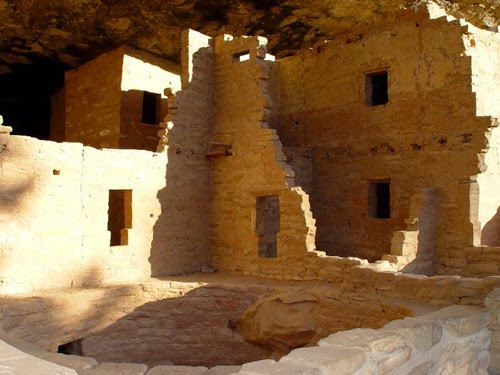
Why did the Anasazi start building massive stone pueblos around A.D. 900 at Chaco Canyon in New Mexico—a barren gorge in the desert of the San Juan basin—and within 250 years suddenly abandon them? Pueblo Bonito contained over 650 rooms and its construction required more than 30,000 tons of shaped sandstone blocks. Hundreds of miles of roads were created that stretched out from Chaco Canyon in arrow-straight lines, an engineering marvel achieved without compass, wheel, or beast of burden. Shrines, irrigation systems, and a network of signaling stations were erected. These structures aligned with the sun, the moon, and each other.

Physical anthropologist Christy Turner, professor emeritus at Arizona State University, and others have detected traces of extreme violence and cannibalism on human bones unearthed at 40 different Ancestral Puebloan sites in the southwestern United States.

The earliest locations with cannibalized human remains date around A.D. 900. Turner identified 72 Anasazi sites at which violence or cannibalism may have occurred. He estimated that at least 286 individuals were butchered, cooked, and eaten. After the Chaco civilization collapsed around A.D. 1150, many Anasazi moved into deep and remote canyons, living in dwellings hugging the sides of cliffs on high, fortified mesas. The Anasazi had been seized with paranoia, or, perhaps more simply, fear.

Anasazi Ruin.
There are roughly six criteria for determining whether human remains have been cannibalized—breakage, cut marks, abrasion from being smashed against an anvil, burning, missing vertebrae, and “pot polish” created by stirring bones in a pot. Opponents to the cannibalism theory argue that the condition of remains can also be caused by the chewing of a carnivorous animal, re-burial, or witch executions, in which the victim was cut up to locate the witch’s evil heart, anywhere from the head to the big toe. Dismembering was the only way to prevent the witch from wreaking revenge after death.


In the 1990’s definitive proof arrived when a group of archaeological sites were excavated at the base of Sleeping Ute Mountain in southern Colorado. Within the first kiva was found a pile of chopped-up, boiled, and burned human bones. In the second kiva were found the remains of five people in which evidence suggested they had been roasted, then the bones defleshed and split open for the marrow. The skulls of at least two people had been placed upside down on the fire, roasted, and broken open, and the cooked brains presumably scooped out. Tools for chopping were found with traces of human blood on them.

Sleeping Ute Mountain.
In the third kiva, however, was the most unusual find. In the ashes of a central hearth was found a nondescript lump. Further analysis revealed it was a coprolite—desiccated human feces. Testing revealed that the feces contained human myoglobin, a protein found only in skeletal and heart muscle. The only way it could get into the intestinal tract was through eating. Based on the evidence at hand it was clear the community had been attacked. The people had been killed, cooked, and eaten. Then, in an ultimate act of contempt, one of the killers defecated in a hearth, the symbolic center of the family and the household.


Turner found that most deposits of cannibalized bones were often situated near Chaco Great Houses, spread across the Four Corners region, and that most dated from the Chaco period. The eating of human flesh seems to have begun as the Chaco civilization began, around A.D. 900; peaked at the time of the Chaco collapse and abandonment, around A.D. 1150; and then all but disappeared. Turner theorizes that cannibalism might have been used by a powerful elite at Chaco Canyon as a form of social control. Ancient terrorism.

Toltec civilization.
And who were these powerful elite? Most likely the Toltecs—precursors of the Aztecs. The Toltec empire in Mexico lasted from about A.D. 800 to 1100. It’s possible a heavily armed group of these “thugs” infiltrated into the southwestern part of the U.S. and found a suspicious but pliant population whom they terrorized into reproducing the theocratic lifestyle they had previously known in Mesoamerica. This involved heavy payments of tribute, constructing the Chaco system of great houses and roads, and providing victims for ceremonial sacrifice. The Mexicans achieved their objectives through the use of warfare, violent example, and terrifying cult ceremonies that included human sacrifice and cannibalism.


The Navajo have stories in their folklore that reveal aspects of Chaco Canyon that are very different from the Anglo view. Elder Navajo say that Chaco was a place of hideous evil. The people there abused sacred ceremonies, practiced witchcraft and cannibalism, and made a dreaded substance called corpse powder by cooking and grinding up the flesh and bones of the dead. Their evil threw the world out of balance, and they were destroyed in a great earthquake and fire.

The final truth is that the Anasazi, around A.D. 1150, abruptly fled their homes in the Chaco region to live in remote cliff sides, behaving as if chased by a formidable opponent. When the evidence of cannibalism is presented, the motivation for this departure can be understood under a different light.


In my book, THE SPARROW, I’ve weaved the idea of cannibalism into my story, not only through the Anasazi ruins that lay within the Grand Canyon—showcasing the peoples who strove to live in such a hard-to-reach place—but also through the folklore of cannibalism that exists in the Hopi heritage as well.


In 1877, Emma Hart comes to Grand Canyon—a wild, rugged, and, until recently, undiscovered area. Plagued by visions and gifted with a second sight, she searches for answers about the tragedy of her past, the betrayal of her present, and an elusive future that echoes through her very soul. Joined by her power animal Sparrow, she ventures into the depths of Hopi folklore, forced to confront an evil that has lived through the ages.

Texas Ranger Nathan Blackmore tracks Emma Hart to the Colorado River, stunned by her determination to ride a wooden dory along its course. But in a place where the ripples of time run deep, he’ll be faced with a choice. He must accept the unseen realm, the world beside this world, that he turned away from years ago, or risk losing the woman he has come to love more than life itself.


Works Cited

Hartigan, Rachel. “Dying for dinner? A debate rages over desert cannibalism.” U.S. News Magazine. July 2000.  <http://www.usnews.com/usnews/doubleissue/mysteries/anasazi.htm>

Preston, Douglas. “Cannibals of the Canyon.” The New Yorker Magazine. November 1998.

Pringle, Heather. “Were Some Ancestral Puebloan People the Victims of Ethnic Conflict?” Archaeology Magazine. September 2010. <http://archive.archaeology.org/blog/were-the-ancestral-puebloan-people-victims-of-ethnic-cleansing/>

Turner, Christy G. and Turner, Jacqueline A. Man Corn: Violence and Cannibalism in the Prehistoric American Southwest. University of Utah Press, 1998.

Witze, Alexandra. “Researchers Divided Over Whether Anasazi Were Cannibals.” National Geographic Magazine. June 2001. <http://news.nationalgeographic.com/news/2001/06/0601_wireanasazi.html>


Monday, November 3, 2014

Native Americans: The Navajo

By Kristy McCaffrey

The Navajo have been located in the Four Corners region of the American Southwest since the 12th century. Primarily hunters and gatherers, they were forced to fight—along with many other Indian tribes—the progression of the white population during the early 1800’s, which eventually led to the Long Walk. This arduous journey, which encompassed well over 50 separate treks led by the U.S. Army to the Bosque Redondo in New Mexico Territory, occurred from 1863 to 1866. The accounts of death by starvation, sickness, or violence left an indelible trauma on the people. Although they were allowed to return to their land in 1868, they would never forget this painful period of their history.

The Long Walk
Known for their weavings, Navajo textiles are highly regarded and have been traded for over 150 years. Initially, weavings were used for cloaks, saddle blankets, sashes and other similar items, but after the 1880’s the Navajo began making them for tourists. Strong geometric patterns are an earmark of their work.
Navajo weaver
If a Navajo should become ill, it's customary to consult a medicine man. A typical ceremony lasts for four days, and involves chants and specific herbs that have been collected for the patient. Sometimes a sand painting is utilized, which is later destroyed. The premise of the work of the medicine man is to restore balance to an individual’s spirit.
Navajo sand painting
When I was nine years old, my parents moved my sister and myself to the Navajo Indian Reservation. Needless to say, I very much did not want to go. My dad, who has long had a deep and abiding respect for Native Americans, saw this as a chance to give back with his life. He took a job as an accountant with an arts and crafts store in Window Rock, Arizona. We obtained a house just across the border in New Mexico, in a small town aptly called “Navajo.”

It was 1975 and we lived in a neighborhood that consisted of generic, government housing. We weren’t rich by any means, but when we moved in, it became quickly known that we had a working telephone and my mother was generous in sharing kitchen items. After a time, she had to start saying no. The charity was simply getting out-of-hand. Unfortunately, many of the Navajo were complacent and drank too much. Even as a child, it struck me as a rather depressing place to live.
The view from our front door while living on the Navajo
Indian Reservation, 1975.
I developed a panic-filled fear of AIM walkers, fueled by stories heard from classmates. I now know that this acronym stands for the American Indian Movement, a group dedicated to addressing the issues of present-day Native Americans, but in my scared mind they were ghost-like shape shifters that prowled the wash behind our house. There were many nights I literally shook in terror while trying to sleep, fearing they would snatch me from my bed.

But there were intriguing aspects. A hex was placed on the chain of craft stores where my dad worked. Since it involved all of the employees, he was allowed, despite being a white man, to participate in the ceremonies conducted by a medicine man. Some of his experiences I incorporated into my novel, Into The Land Of Shadows, when the main characters find themselves under the shadow of a curse. During one of the ceremonies at which my dad was present, the medicine man burned a piece of human skull. Two female employees reported instant relief from a terrible headache that had suddenly besieged them. Back at home, at the same time, my mother said I’d been distraught and crying for hours from pains in my head, which immediately stopped when the bone was destroyed. We were all tied to this land in ways none of us quite understood.

Today, the Navajo are the largest federally recognized tribe of the United States.


INTO THE LAND OF SHADOWS
Ethan Barstow has come to Arizona Territory to search for his younger brother, Charley. It’s been five years since a woman came between them and it’s high time they buried the hatchet. He soon learns that his brother has broken more than one heart in town, has mysteriously and abruptly disappeared, and that an indignant fiancée is hot on his trail.

Kate Kinsella pursues Charley Barstow when he skips out of town without a second thought. Not only has he left Agnes McPherson alone and pregnant, but everyone still believes that he and Kate are engaged, a sham from the beginning. An ill-timed encounter with a group of ruffians has her suddenly in the company of Ethan Barstow, Charley’s brother and a man of questionable repute. As they move deeper into the shadows of the Arizona desert, family tensions and past tragedies threaten to destroy a relationship neither of them expects.


Connect with Kristy
Blog ~ Pathways


Sign up for my newsletter and be eligible for monthly giveaways.