By
Kristy McCaffrey
 |
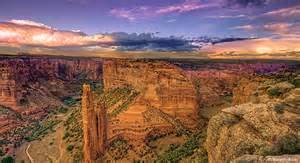
| Pueblo Bonito, Chaco Canyon, New Mexico. |
Why did the Anasazi start building massive stone pueblos
around A.D. 900 at Chaco Canyon in New Mexico—a barren gorge in the desert of
the San Juan basin—and within 250 years suddenly abandon them? Pueblo Bonito
contained over 650 rooms and its construction required more than 30,000 tons of
shaped sandstone blocks. Hundreds of miles of roads were created that stretched
out from Chaco Canyon in arrow-straight lines, an engineering marvel achieved
without compass, wheel, or beast of burden. Shrines, irrigation systems, and a
network of signaling stations were erected. These structures aligned with the
sun, the moon, and each other.

Physical anthropologist Christy Turner, professor emeritus
at Arizona State University, and others have detected traces of extreme
violence and cannibalism on human bones unearthed at 40 different Ancestral
Puebloan sites in the southwestern United States.
The earliest locations with cannibalized human remains date
around A.D. 900. Turner identified 72 Anasazi sites at which violence or
cannibalism may have occurred. He estimated that at least 286 individuals were
butchered, cooked, and eaten. After the Chaco civilization collapsed around
A.D. 1150, many Anasazi moved into deep and remote canyons, living in dwellings
hugging the sides of cliffs on high, fortified mesas. The Anasazi had been
seized with paranoia, or, perhaps more simply, fear.
 |
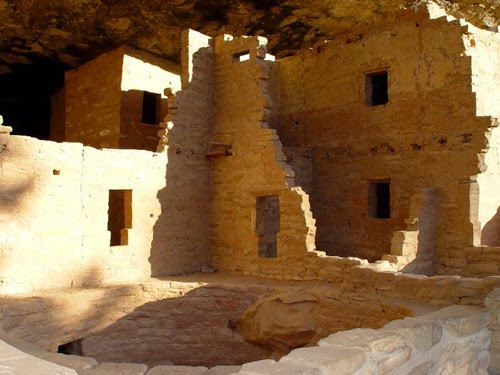
| Anasazi Ruin. |
There are roughly six criteria for determining whether human
remains have been cannibalized—breakage, cut marks, abrasion from being smashed
against an anvil, burning, missing vertebrae, and “pot polish” created by
stirring bones in a pot. Opponents to the cannibalism theory argue that the
condition of remains can also be caused by the chewing of a carnivorous animal,
re-burial, or witch executions, in which the victim was cut up to locate the
witch’s evil heart, anywhere from the head to the big toe. Dismembering was the
only way to prevent the witch from wreaking revenge after death.

In the 1990’s definitive proof arrived when a group of
archaeological sites were excavated at the base of Sleeping Ute Mountain in
southern Colorado. Within the first kiva was found a pile of chopped-up,
boiled, and burned human bones. In the second kiva were found the remains of
five people in which evidence suggested they had been roasted, then the bones
defleshed and split open for the marrow. The skulls of at least two people had
been placed upside down on the fire, roasted, and broken open, and the cooked brains
presumably scooped out. Tools for chopping were found with traces of human
blood on them.
 |
| Sleeping Ute Mountain. |
In the third kiva, however, was the most unusual find. In
the ashes of a central hearth was found a nondescript lump. Further analysis
revealed it was a coprolite—desiccated human feces. Testing revealed that the
feces contained human myoglobin, a protein found only in skeletal and heart
muscle. The only way it could get into the intestinal tract was through eating.
Based on the evidence at hand it was clear the community had been attacked. The
people had been killed, cooked, and eaten. Then, in an ultimate act of
contempt, one of the killers defecated in a hearth, the symbolic center of the
family and the household.

Turner found that most deposits of cannibalized bones were
often situated near Chaco Great Houses, spread across the Four Corners region,
and that most dated from the Chaco period. The eating of human flesh seems to
have begun as the Chaco civilization began, around A.D. 900; peaked at the time
of the Chaco collapse and abandonment, around A.D. 1150; and then all but
disappeared. Turner theorizes that cannibalism might have been used by a
powerful elite at Chaco Canyon as a form of social control. Ancient terrorism.
 |
| Toltec civilization. |
And who were these powerful elite? Most likely the
Toltecs—precursors of the Aztecs. The Toltec empire in Mexico lasted from about
A.D. 800 to 1100. It’s possible a heavily armed group of these “thugs”
infiltrated into the southwestern part of the U.S. and found a suspicious but
pliant population whom they terrorized into reproducing the theocratic
lifestyle they had previously known in Mesoamerica. This involved heavy
payments of tribute, constructing the Chaco system of great houses and roads,
and providing victims for ceremonial sacrifice. The Mexicans achieved their
objectives through the use of warfare, violent example, and terrifying cult
ceremonies that included human sacrifice and cannibalism.
 |
The Navajo have stories in their folklore that reveal
aspects of Chaco Canyon that are very different from the Anglo view. Elder
Navajo say that Chaco was a place of hideous evil. The people there abused
sacred ceremonies, practiced witchcraft and cannibalism, and made a dreaded
substance called corpse powder by cooking and grinding up the flesh and bones
of the dead. Their evil threw the world out of balance, and they were destroyed
in a great earthquake and fire.
The final truth is that the Anasazi, around A.D. 1150,
abruptly fled their homes in the Chaco region to live in remote cliff sides,
behaving as if chased by a formidable opponent. When the evidence of
cannibalism is presented, the motivation for this departure can be understood
under a different light.
In my book, THE SPARROW, I’ve weaved the idea of cannibalism into my story, not only through the Anasazi ruins that lay within the Grand Canyon—showcasing the peoples who strove to live in such a hard-to-reach place—but also through the folklore of cannibalism that exists in the Hopi heritage as well.

In
1877, Emma Hart comes to Grand Canyon—a wild, rugged, and, until recently,
undiscovered area. Plagued by visions and gifted with a second sight, she
searches for answers about the tragedy of her past, the betrayal of her present,
and an elusive future that echoes through her very soul. Joined by her power
animal Sparrow, she ventures into the depths of Hopi folklore, forced to
confront an evil that has lived through the ages.
Texas
Ranger Nathan Blackmore tracks Emma Hart to the Colorado River, stunned by her
determination to ride a wooden dory along its course. But in a place where the
ripples of time run deep, he’ll be faced with a choice. He must accept the
unseen realm, the world beside this world,
that he turned away from years ago, or risk losing the woman he has come to
love more than life itself.

Works Cited
Hartigan, Rachel. “Dying for dinner? A debate rages over
desert cannibalism.” U.S. News Magazine.
July 2000. <http://www.usnews.com/usnews/doubleissue/mysteries/anasazi.htm>
Preston, Douglas. “Cannibals of the Canyon.” The New Yorker Magazine. November 1998.
Pringle, Heather. “Were Some Ancestral Puebloan People the
Victims of Ethnic Conflict?” Archaeology
Magazine. September 2010. <http://archive.archaeology.org/blog/were-the-ancestral-puebloan-people-victims-of-ethnic-cleansing/>
Turner, Christy G. and Turner, Jacqueline A. Man Corn:
Violence and Cannibalism in the Prehistoric American Southwest. University
of Utah Press, 1998.
Witze, Alexandra. “Researchers Divided Over Whether Anasazi
Were Cannibals.” National Geographic
Magazine. June 2001. <http://news.nationalgeographic.com/news/2001/06/0601_wireanasazi.html>