Showing posts with label Old Timey Holiday Kitchen. Show all posts

Sunday, November 30, 2025

Railroad Freight Yards by Zina Abbott


My upcoming book in the Old Timey Holiday Kitchen series features the third sibling of the Jewell family, the brother of two sisters, who already had their own romances published. In prior books, I identified him as having a railroad job in Kansas City, where the family came from before everyone but him moved to Colorado. Rather than being a ticket agent, baggage handler, or rail maintenance laborer, I decided he should work with managing freight. Thus started my quest to learn the ins and outs of how rail freight was handled in the 1880s.

 Although possibly a decade or two later than the setting of my story, this photograph is of the Kansas City freight yard. Note that many of the cars appear to be made of wood. There is also at least one gondola (like an open wagon) and a few metal tank cars. These cars get moved around the freight yard and from one railway's freight yard to another by using smaller locomotives designated for use strictly in a company's own freight or repair yards. 


Do not trust the inforation you receive from AI on a Google search to be infallible. When I specifically asked about the Kansas City freight warehouse in 1885, I was told the freight for all the companies were handled together and managed by one freight terminal. Then, after stumbling onto a Facebook Kansas City historical group, I searched back through several years of entries and found this 1884 map of the Kansas City rail yard. There were five railway companies that used the Kansas City Union Depot (orange), the passenger terminal located in what is called the West Bottoms district (note the names of some of the neighborhoods) part of Kansas City. However, only three--Missouri Pacific (maroon), Union Pacific (blue), and Missouri River, Fort Scott, and Gulf (green) had freight depots there.


At the time this 1881 map of Kansas City and eastern Kansas was drawn, it appears the only section that was identified as Kansas City, Kansas, then was the little lip of land west of the straight north-south Kansas-Missouri border, east of the Kansas River, and south of the Missouri River. The smaller communities to the west of the state line--Wyandotte, Riverview, Armstrong, Armourdale, and Argentine--were not absorbed into Kansas City, Kansas, until a later time.

The Atchison, Topeka, and Santa Fe Railway did have rail access to the Kansas City, Missouri, depot (orange next to the yellow-green arrow), but its freight yard was located in Argentine, Kansas (blue circle). 


 Here is a map of another freight yard. Kensington, Michigan, was a hub for two rail lines, the Illinois Central Railroad and the Michigan Central Railroad and Belt Railway Connection. It appears both rail lines shared a passenger depot (red). However, the bottom-right of the map shows the roundhouse (blue), the freight house (green), and thirteen and a half miles of track that is part of the freight yard (orange) of the Michigan Central Railroad.


The situation is slightly different for a town like Salida, Colorado, the city on which I based my hypothetical town of Cleora. In 1885, Salida was a connection station. It had two spur lines, but all three lines were part of a single rail company, the Denver and Rio Grande Railway. On the birdseye view map drawn in the nineteenth century, the depot was identified, as was the roundhouse. I know there was a machine shop, but the other buildings were identified as workshops. With all the silver mining and agriculture in the area, I am sure the Salida station managed its fair share of freight. However, I have found almost no information about it.  


In the image above, No. 6 is the Kansas City Roundhouse. No. 5 is the freight yard.


The possible reason I had difficulty finding pictures of freight yards might be due the fact that most of them are not pretty. Railroad depot buildings and train platforms are designed to be visually appealing to passengers. They are similar to nicely landscaped front and back yards, intended to delight the homeowners and impress friends and neighbors. Freight yards (also repair yards) are more like a residential side yard--that six-foot space between the garage and the fence where people keep their garbage cans, water hoses, and miscellaneous junk that does not fit inside the garbage can, so they store it there until they collect enough to justify a trip to the dump.


Here is the Pennsylvania Lines Great Freight Yard at Conway, PA. Look at the coal cars waiting to be shipped in all directions.


And, when one is talking about Kansas City's Kansas Pacific /Union Pacific Railroad's freight yard, let us not forget the closely related stockyard with the Cattle Exchange building next door. Some cattle might have been sent to local meat packing plants, but the majority were loaded onto cattle cars and transported north by other railroads to places like Chicago.


Stollen by Stella is not currently on pre-order but will be published in December. 

Book description:

     Stella Jorgenson struggles to enjoy the holiday now her father’s new job meant moving away from extended family and friends. She does not look forward to spending Christmas dinner with her father’s boss and his family, including the son scheduled to start working on her father’s crew—all strangers. Hopefully, baking her late mother’s traditional Stollen to share will inspire the spirit of Christmas.

     For Thomas, the one bright spot about moving home with his parents was both his sisters were married and out of the house. Unfortunately, along with his new foreman and the man’s daughter, his persnickety, former schoolmarm older sister and pesky, trouble-making younger sister will be home for Christmas. Perhaps he could convince himself to look forward to being with family and merrily celebrating the holiday if being here was not a constant reminder he had been forced out of the job he loved.

To be notified of when the Amazon book link becomes available, please sign up for my newsletter by CLICKING HERE


Saturday, October 26, 2024

I've Been Working in the Roundhouse by Zina Abbott


This is a continuation of the group of blog articles I previously posted, including I’ve Been Working on the Railroad, I’ve Been Working in the Station, and I’ve Been Working on a Section Crew

Why Roundhouses? Roundhouses gave crews space to work on the locomotives and other rolling stock (passenger coaches, freight cars, wood/coal tenders, etc.). They also kept locomotives and equipment within easy reach. A roundhouse complex often included a blacksmith shop, paint shop, coach shop, and car shop.

The first roundhouse is believed to have been built in Birmingham, England, in about 1837. Although it cannot be confirmed due to loss of records, it is believed the first in the US was built by the Baltimore and Ohio at Mt. Clare, Baltimore, Maryland, about 1840.

1880s near Palenstine, Texas

Early roundhouses, especially those built in cold climates, were fully enclosed, with the turntable as well as the stalls under cover. Once locomotives became too large to fit in these structures, they were torn down and replaced with "doughnut"-shaped structures that surrounded an open turntable. 


Although some roundhouses used by Class 1 railroads were built as a full-circle with as many as 52 stalls, the vast majority were only part of a circle with 12 or fewer stalls.

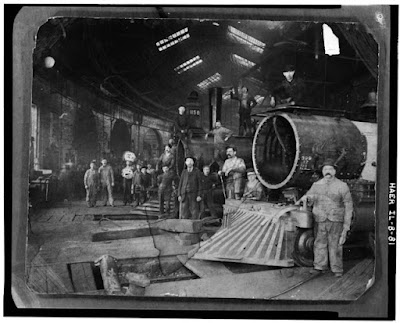
1878-85 Chicago, Burlington & Quincy RR Roundhouse

There was a reason most such facilities were round. The circular design allowed for a compact layout, keeping the locomotives and equipment inside closely spaced and within accessible reach. The building pattern was flexible, permitting a railroad to add stalls to an existing roundhouse (or remove them) as conditions warranted. The turntable used to access each roundhouse stall did not require multiple switches (such as using “Y” tracks) to move locomotives from place to place, thus simplifying moving the heavy pieces equipment between the tracks and repair bays.

Workers pose outside the Detroit, Toledo & Milwaukee Roundhouse on its original site in Marshall, Michigan, circa 1890-1900.

Utah Central Railroad, Salt Lake City Roundhouse

Roundhouses were built in a multitude of locations—from the heart of a large city to out on the open plains. Larger railroads operated multiple roundhouses, generally located at 100-mile intervals. This was roughly the distance one train crew could travel in a single shift. The roundhouses on these large railroads served as relay points where a new locomotive (and crew) took over the train while the previous locomotive went in for maintenance.

In North America, regular daily serving began with a hostler, a locomotive operator who moves engines around a train yard, moving an engine to an ash pit to remove the detritus of burned wood or coal. The locomotive's tender would be refilled with fuel, water, and sand, and the engine would be placed above an inspection pit so that workers could inspect it for any maintenance needs and to lubricate it.

Roadhouse, Chicago, Burlington & Quincy RR

At larger 24-hour North American roundhouses, steam locomotives would often be turned around and made ready for service within a few hours of arrival. However, locomotives with major issues or in need of semi-regular maintenance required additional time were often sent to larger roundhouses staffed with boilermakers, blacksmiths, and pipefitters. Only those engines requiring major unexpected repairs or scheduled major maintenance were transported to  specialized backshops.


In the middle of the B&O (Baltimore & Ohio) Railway Roundhouse is their 60-foot turntable. This turntable was used to position passenger cars in an available bay for necessary repairs. The turntable uses no electricity and relies on central ball bearings to freely rotate equipment. When centered properly, a single person can push the turntable.


Denver & Rio Grande RR #218 and other engines at Salida, Colorado, ca 1900.

The roundhouse and its connecting buildings for servicing locomotives on the Chicago & Aurora Railroad. were first opened in 1857.


Roadhouse (1856 and 1859 portions), general view showing columns and roofline - Chicago, Burlington and Quincy Railroad, Roundhouse and Shops, Broadway and Spring Streets, Aurora, Illinois

North side Chicago, Burlington & Quincy RR Roundhouse

By the 1920s, passenger cars became increasingly longer. More and more, existing roundhouses lost much of their usefulness. Following World War II, with the widespread adoption of diesel and electric locomotives—which needed far less maintenance—roundhouses lost much of their importance. The vast majority of roundhouses were torn down beginning in the 1950s and gradually disappeared from the American railroad scene.


Located in Jamestown, California, the roundhouse at Railtown 1897 State Historic Park, with its operating entity, the Sierra Railway, is known as "The Movie Railroad." Both entities are a heritage railway and are a unit of the California State Park System. The park preserves the historic core of the original Sierra Railway of California. The railway's Jamestown locomotive and rolling stock maintenance facilities, including its roundhouse, are mostly intact. They are one of the few remaining functioning steam engine facilities and continue to function much as they have for over 100 years.

In my most recent release, Lemon Cookies by Lisbeth, my hero first works as a section crewman for the Denver & Rio Grande Railway in Gunnison, Colorado. Once he decides to relocate to my hypothetical town of Cleora (loosely based on Salida, Colorado), he looks for work in the roundhouse.

Lemon Cookies byLisbeth is currently available as an ebook for sale and at no additional cost with a Kindle Unlimited subscription. To find the book description and purchase options,

Please CLICK HERE


Sources:

https://www.thehenryford.org/explore/blog/the-railroad-roundhouse

https://www.borail.org/collection/roundhouse/

https://www.frrandp.com/2018/12/the-aurora-roundhouse-from-railroad.html

https://www.borail.org/explore-learn/exhibitions/the-roundhouse/

https://community.utah.gov/westside-stories-image-gallery/

https://commons.wikimedia.org/wiki/File:Aurora_Roundhouse.jpg

https://commons.wikimedia.org/wiki/File:Roadhouse,_stalls_18-23,_shop_crew_and_two_locomotives._Photographed_possibly_between_1878_and_1885_-_Chicago,_Burlington_and_Quincy_Railroad,_Roundhouse_and_Shops,_Broadway_and_HAER_ILL,45-AUR,1-81.tif

https://commons.wikimedia.org/wiki/File:Detail_showing_the_joining_of_the_roundhouse_and_the_shop,_from_the_southwest._-_Chicago,_Burlington_and_Quincy_Railroad,_Roundhouse_and_Shops,_Broadway_and_Spring_Streets,_HAER_ILL,45-AUR,1-100.tif

https://commons.wikimedia.org/wiki/File:Detail_of_the_north_side_of_the_roundhouse._-_Chicago,_Burlington_and_Quincy_Railroad,_Roundhouse_and_Shops,_Broadway_and_Spring_Streets,_Aurora,_Kane_County,_IL_HAER_ILL,45-AUR,1-98.tif

https://commons.wikimedia.org/wiki/File:Roundhouse_LOC.fsa.8d23258.jpg

https://commons.wikimedia.org/wiki/File:EMRR_Roundhouse.jpg

https://commons.wikimedia.org/wiki/File:Providence_and_Worcester_Railroad_Roundhouse_Providence.jpg

https://en.wikipedia.org/wiki/Railtown_1897_State_Historic_Park