Showing posts with label Lemon Cookies by Lisbeth. Show all posts

Saturday, December 28, 2024

Spanning Half of a Century by Zina Abbott

As I prepared to focus on my year-end reviews of my 2024 books, I realized my stories had covered a wide span of years. Only seven this year—I planned on the time off in the summer to heal from my full knee replacement surgery—yet I realized what I wrote required quite a bit of research in order to keep them true to the decades and locations in which they took place.

I did not write my books in chronological order. My book with the earliest calendar setting—1855-1858—was Wyatt’s New Bride. My book with the latest calendar setting—1896-1898—was Phoebe. Here are the book timeframe/calendar settings in chronological order:


Between 1850 and 1869, except for very short spurs of rails in Kansas as the Kansas Pacific Railway began to build its line starting in Kansas City, Kansas, there were no transcontinental rail lines between the Mississippi or Missouri Rivers and the Pacific states. All long distance travel was accomplished by steamship, steamboat, carriage, covered wagons (or other wagons), carriages, or horseback/mule teams.


Wyatt in Wyatt’s New Bride (1855-58) probably covered the longest distance when he traveled by steamship, steamboat, and stagecoach from Maine to Sonora, California. It is interesting that Tuolumne County attracted many gold prospectors from Maine and other New England states. When he sent for a bride, she traveled by riverboat, covered wagon, and local freight wagon from Michigan to Sonora, California. To find the book description and purchase options, please CLICK HERE


Lucy and her Aunt Caroline plus the other characters in Lucy (1863-1865) traveled by covered wagon from Lawrence, Kansas, to a foothill community between Placerville and Sly Park, California. The Genoa, Utah Territory, characters who met them in Atchison, Kansas, (Oregon and California Trail travelers stopped using Independence and St. Joseph, Missouri, at that time due to the Civil War) traveled east from Carson City by Stagecoach on the Overland and Central Overland Trails. To find the book description and purchase options, please CLICK HERE

In A Surprise for Christmas (1864-1867), what was left of the North Carolina household of Analia’s family traveled by carriage and steamboat to her aunt’s house in Baltimore, Maryland. A couple of years later, train travel was available as far as Topeka, which was in east Kansas, where Analia met the husband she married by proxy. That was just about the limit of where the Kansas Pacific Railway tracks reached at that time. To find the book description and purchase options, please CLICK HERE

 Starting after the end of the American Civil War, the effort to expand railroad service between the Missouri River west to California began in earnest. That was when the West opened up to many. Since men were the first to head to the West—some to escape the Civil War, some seeking opportunity, or both—the issue of their being a far greater proportion of men to women continued. The number of women who made arrangements to travel to the West seeking husbands and families increased. Although it still had its drawbacks, rail service made travel much quicker. Since train service did not go everywhere, there still was plenty of stagecoach, covered wagon, and steamboat travel.


In Florence’s Good Deed (1877), Florence travels from West Virginia to Wisconsin to meet her groom she met through letters, only to end up traveling back after he rejects her. In Columbus, she meets Ash, who was bound for New York. He had traveled by steamboat from Fort Benton, Montana Territory, before taking the train from St. Joseph, Missouri. They continue on the train together to allow Florence to perform what could be a dangerous good deed. To find the book description and purchase options, please CLICKHERE


Jocelyn’s Wedding Dilemma
starts with a prologue in 1877 and ends in 1886. However, the bulk of the story takes place in 1881. She travels by buggy while still living in Columbus, Ohio. When she leaves to meet her groom, she travels by train. Too back her mother is following close behind. To find the book description and purchase options, please CLICK HERE

Lisbeth in Lemon Cookies by Lisbeth (1883-1884) is not a mail-order bride romance. Her father’s job with the Denver & Rio Grande Railway resulted in the family moving to Cleora, Colorado. However, my hero, Roy Hobart, is also an employee of the same railway—much of the time working track, then later part of the section crew based out of Gunnison, Colorado. He travels between his job and visits to his family—his cousin in Lisbeth’s brother-in-law. To find the book description and purchase options, please CLICK HERE

In the 1890s up until the end of the century, many of the travel conditions of the previous four decades still provided the means of transportation. However, there was a new development—the invention of the automobile.

In Phoebe (1896-1898), her love interest, Graham, embraces the future of the automobile to the point he is anxious to position himself to help finance the development of the oil industry in Oklahoma Territory and neighboring Indian Territory. Part of the conflict involves the attitudes of his father and Phoebe’s parents—both parties insisting they prefer to travel by train and in a well-sprung carriage. To find the book description and purchase options, please CLICK HERE

That is my writing year in review as far as place settings, and how my brides and grooms got from here to there, depending on the decade in which they lived. If you do not already receive my newsletter or follow me on BookBub, I would love for you to sign up to do so. Please click on the links below:

Zina Abbott Books Newsletter:  http://eepurl.com/clx3tn

Zina Abbott on BookBub:  www.zinaabbottbooks.blogspot.com

I wish all a very happy and prosperous New Year. Happy 2025!


Sunday, November 24, 2024

Gauging the Railroad Tracks by Zina Abbott


Originally, various railroad track gauges were used in the United States. Some railways, primarily in the northeast, used was called standard gauge, which was a span of four feet, eight and one-half inches (1,435 mm). Other railways used gauges ranging from two feet (610 mm) to six feet (1,829 mm). The Pacific Railroad Acts of 1863 specified standard gauge was to be used throughout the United States.


Where did this unusual width for parallel railroad tracks come from? Train technology was developed in Britain in about 1825. The new technology came to the United States the following year. Britain based the distance between the rails on the standard width of wagon ruts worn in the roads all over Europe, including the British Isles.


The reason these ruts tended to be uniform in distance from each other dates back to the time of the roads built by the Romans. Their chariots were built to be compatible with the width of a pair of warhorses. Since wagons ran into difficulty if their wheels did not fit inside existing ruts, that same gauge became the standard for wagons. Axles were built to accommodate the hubs of wheels so the rims would be four feet and eight and one-half inches.


During the Colonial period in North America, wagon sizes and widths followed the same standards as found in Europe—wherever the Roman roads and accompanying ruts played a role in transportation. Like Britain, the railroads followed the same pattern, including using what is known as standard gauge to determine the width between a pair of train rails.

There is a notable exception: Narrow gauge railroads built to allow trains to travel the windy mountain areas.


The Denver and Rio Grande Railway, which opened the mining and lumber operations of the Rocky Mountains to the rest of the country, was one such railroad. Later, much of the track was converted to standard gauge.


Narrow gauge railroads were used throughout the Sierra-Nevada Mountains, particularly for logging operations. The history of the Heisler #2 locomotive gives a picture of a narrow gauge locomotive used. From 1900-03, it was used by the Hetch Hetchy and Yosemite Valley Railroad, mainly to transport logs to be cut into lumber. Then, from 1904-1960, the railroad’s name was changed to the West Side Flume and Lumber Company. There the locomotive played a vital role in timber production by working both the woods and the lumber company switchyard. This little workhorse was also used to push a wedge plow to keep the tracks clear of snow.


The narrow gauge Denver & Rio Grande Railway, where my heroine's father and the hero work, was mentioned in my recent Christmas romance, Lemon Cookies by Lisbeth, part of the Old Timey Holiday Kitchen series. To find the book description and purchase options, please CLICK HERE


In Phoebe, my Christmas romance in the Christmas Quilt Brides series, my hero—a proponent of the brand new automobile industry—compared the potential of motorcars to the progress of railroads from when they were first brought to the United States. He described a picture similar to the one above as compared to the Atchison, Topeka, and Santa Fe standard gauge railroad in Oklahoma Territory. To find the book description and purchase options for Phoebe, please CLICK HERE


In my next publication, A Surprise for Christmas, part of the Confederate Widows, Spinsters and Proxy Brides series, my proxy bride travels by train shortly after the end of the American Civil War. She arrived in Topeka, Kansas, on the Kansas Pacific Railway, which used standard gauge tracks. This book is currently on pre-order and scheduled for release on December 9th. To find the book description and pre-order link, please CLICK HERE


Sources:

https://truewestmagazine.com/steam-engines/

https://en.wikipedia.org/wiki/Track_gauge_in_the_United_States

Tuolumne City Park Heisler #2 display, Tuolumne, California

Saturday, October 26, 2024

I've Been Working in the Roundhouse by Zina Abbott


This is a continuation of the group of blog articles I previously posted, including I’ve Been Working on the Railroad, I’ve Been Working in the Station, and I’ve Been Working on a Section Crew

Why Roundhouses? Roundhouses gave crews space to work on the locomotives and other rolling stock (passenger coaches, freight cars, wood/coal tenders, etc.). They also kept locomotives and equipment within easy reach. A roundhouse complex often included a blacksmith shop, paint shop, coach shop, and car shop.

The first roundhouse is believed to have been built in Birmingham, England, in about 1837. Although it cannot be confirmed due to loss of records, it is believed the first in the US was built by the Baltimore and Ohio at Mt. Clare, Baltimore, Maryland, about 1840.

1880s near Palenstine, Texas

Early roundhouses, especially those built in cold climates, were fully enclosed, with the turntable as well as the stalls under cover. Once locomotives became too large to fit in these structures, they were torn down and replaced with "doughnut"-shaped structures that surrounded an open turntable. 


Although some roundhouses used by Class 1 railroads were built as a full-circle with as many as 52 stalls, the vast majority were only part of a circle with 12 or fewer stalls.

1878-85 Chicago, Burlington & Quincy RR Roundhouse

There was a reason most such facilities were round. The circular design allowed for a compact layout, keeping the locomotives and equipment inside closely spaced and within accessible reach. The building pattern was flexible, permitting a railroad to add stalls to an existing roundhouse (or remove them) as conditions warranted. The turntable used to access each roundhouse stall did not require multiple switches (such as using “Y” tracks) to move locomotives from place to place, thus simplifying moving the heavy pieces equipment between the tracks and repair bays.

Workers pose outside the Detroit, Toledo & Milwaukee Roundhouse on its original site in Marshall, Michigan, circa 1890-1900.

Utah Central Railroad, Salt Lake City Roundhouse

Roundhouses were built in a multitude of locations—from the heart of a large city to out on the open plains. Larger railroads operated multiple roundhouses, generally located at 100-mile intervals. This was roughly the distance one train crew could travel in a single shift. The roundhouses on these large railroads served as relay points where a new locomotive (and crew) took over the train while the previous locomotive went in for maintenance.

In North America, regular daily serving began with a hostler, a locomotive operator who moves engines around a train yard, moving an engine to an ash pit to remove the detritus of burned wood or coal. The locomotive's tender would be refilled with fuel, water, and sand, and the engine would be placed above an inspection pit so that workers could inspect it for any maintenance needs and to lubricate it.

Roadhouse, Chicago, Burlington & Quincy RR

At larger 24-hour North American roundhouses, steam locomotives would often be turned around and made ready for service within a few hours of arrival. However, locomotives with major issues or in need of semi-regular maintenance required additional time were often sent to larger roundhouses staffed with boilermakers, blacksmiths, and pipefitters. Only those engines requiring major unexpected repairs or scheduled major maintenance were transported to  specialized backshops.


In the middle of the B&O (Baltimore & Ohio) Railway Roundhouse is their 60-foot turntable. This turntable was used to position passenger cars in an available bay for necessary repairs. The turntable uses no electricity and relies on central ball bearings to freely rotate equipment. When centered properly, a single person can push the turntable.


Denver & Rio Grande RR #218 and other engines at Salida, Colorado, ca 1900.

The roundhouse and its connecting buildings for servicing locomotives on the Chicago & Aurora Railroad. were first opened in 1857.


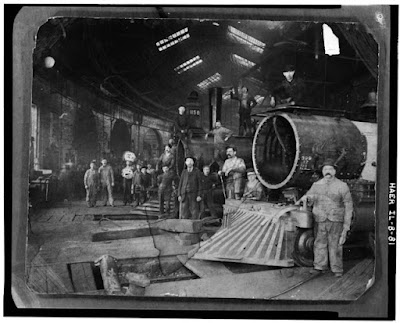
Roadhouse (1856 and 1859 portions), general view showing columns and roofline - Chicago, Burlington and Quincy Railroad, Roundhouse and Shops, Broadway and Spring Streets, Aurora, Illinois

North side Chicago, Burlington & Quincy RR Roundhouse

By the 1920s, passenger cars became increasingly longer. More and more, existing roundhouses lost much of their usefulness. Following World War II, with the widespread adoption of diesel and electric locomotives—which needed far less maintenance—roundhouses lost much of their importance. The vast majority of roundhouses were torn down beginning in the 1950s and gradually disappeared from the American railroad scene.


Located in Jamestown, California, the roundhouse at Railtown 1897 State Historic Park, with its operating entity, the Sierra Railway, is known as "The Movie Railroad." Both entities are a heritage railway and are a unit of the California State Park System. The park preserves the historic core of the original Sierra Railway of California. The railway's Jamestown locomotive and rolling stock maintenance facilities, including its roundhouse, are mostly intact. They are one of the few remaining functioning steam engine facilities and continue to function much as they have for over 100 years.

In my most recent release, Lemon Cookies by Lisbeth, my hero first works as a section crewman for the Denver & Rio Grande Railway in Gunnison, Colorado. Once he decides to relocate to my hypothetical town of Cleora (loosely based on Salida, Colorado), he looks for work in the roundhouse.

Lemon Cookies byLisbeth is currently available as an ebook for sale and at no additional cost with a Kindle Unlimited subscription. To find the book description and purchase options,

Please CLICK HERE


Sources:

https://www.thehenryford.org/explore/blog/the-railroad-roundhouse

https://www.borail.org/collection/roundhouse/

https://www.frrandp.com/2018/12/the-aurora-roundhouse-from-railroad.html

https://www.borail.org/explore-learn/exhibitions/the-roundhouse/

https://community.utah.gov/westside-stories-image-gallery/

https://commons.wikimedia.org/wiki/File:Aurora_Roundhouse.jpg

https://commons.wikimedia.org/wiki/File:Roadhouse,_stalls_18-23,_shop_crew_and_two_locomotives._Photographed_possibly_between_1878_and_1885_-_Chicago,_Burlington_and_Quincy_Railroad,_Roundhouse_and_Shops,_Broadway_and_HAER_ILL,45-AUR,1-81.tif

https://commons.wikimedia.org/wiki/File:Detail_showing_the_joining_of_the_roundhouse_and_the_shop,_from_the_southwest._-_Chicago,_Burlington_and_Quincy_Railroad,_Roundhouse_and_Shops,_Broadway_and_Spring_Streets,_HAER_ILL,45-AUR,1-100.tif

https://commons.wikimedia.org/wiki/File:Detail_of_the_north_side_of_the_roundhouse._-_Chicago,_Burlington_and_Quincy_Railroad,_Roundhouse_and_Shops,_Broadway_and_Spring_Streets,_Aurora,_Kane_County,_IL_HAER_ILL,45-AUR,1-98.tif

https://commons.wikimedia.org/wiki/File:Roundhouse_LOC.fsa.8d23258.jpg

https://commons.wikimedia.org/wiki/File:EMRR_Roundhouse.jpg

https://commons.wikimedia.org/wiki/File:Providence_and_Worcester_Railroad_Roundhouse_Providence.jpg

https://en.wikipedia.org/wiki/Railtown_1897_State_Historic_Park