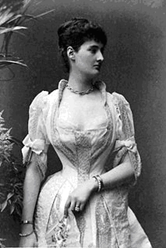
In the Victorian Era, during which most western historical romances are set, women were regarded as the weaker sex and corsets a necessity to protect their virtue and support their “fragile” bodies. Tight lacing indicated a virtuous woman, loose lacing a loose woman.
It didn’t seem to disturb men or even women that the devices made deep breathing impossible, caused fainting, led to lung infections, deformed internal organs and caused many miscarriages. Yes, maternity corsets were available but, rather than provide helpful support, they were designed to constrict the pregnancy. I hate to think what this did to the mother and baby.
Doctors were well aware of these ill effects. The following is from an article published in the British medical journal, The Lacet and reprinted in the The Time of London.
“Our old friend, tight-lacing, has again made his appearance. ... The folly is one which was formerly to be found mainly in the drawing-room, but now it also fills our streets. ... as medical practitioners, we see its effects every day in the train of nervous and dyspeptic symptoms … and in the still more grave internal mischief of permanent character which is often caused by it.”
Corsets also seriously restricted movement. After donning a chemise to protect the corset from body oil, it was advisable for a woman to put on her drawers, stockings, garters and shoes before being laced up because she wouldn’t be able to bend over afterward. How could a woman encased in layer upon layer of clothing, bone or metal stays, and laced up tight, ride a horse? Well, there were corsets designed especially for riding, cut higher over the hips to allow sitting in a saddle – a side saddle that is. Ladies did not ride astride, not by society standards.
In an article posted on http://lacingliaisons.wordpress.com/page/2/ the author states: “In the 19th century, officers in The Cavalry would wear corsets for back support while horseback riding. A well patterned and constructed steel boned corset can be a suitable replacement for a back brace (under advisement from your physician, of course). During a high impact activity such as horseback riding, extra support can be beneficial to the spine and also help prevent immediate and long term back pain.”
However, I’m pretty sure neither those society ladies nor the cavalry officers performed all the tasks required of a frontier wife and mother. Quoting an article about clothing on the American Frontier by Susan Jarrett, on her site History of Fashion and Dress:
“While there is evidence of high fashion entering the frontier, it can be surmised that for the average American settler of the early frontier, practicality and functionality mattered more than high style. A frontier family's day was filled with hard labor and long hours. For women, skirt lengths were shorter, necklines higher, and sleeves were close fitting. Both women and children wore large sunbonnets or woven hats to protect their skin from the sun. Aprons and smocks were worn to protect clothing from the laborious chores of frontier life.”
Nowhere does the author mention corsets, and although she was writing about an earlier period (1800-1840) it’s safe to assume the same applied to women on the advancing frontier through at least the 1880s, and probably longer. If a ranch wife needed to mount a horse and help her husband push cattle, which some did, she’d most likely put on a pair of boots, hike up her skirts and ride astride. As an alternative, she might sew a divided skirt or buy one readymade if available. Such a skirt wouldn’t be tailored. It would contain yards of cotton, wool, corduroy or possibly denim in later decades. It would be hot and heavy, but worn with a shirt and jacket, it had to provide more comfort than a tightly laced corset.

Now here’s an excerpt from Dearest Irish illustrating a shy young woman’s dilemma over what to wear for her riding lessons.

Jack insisted she learn to ride on a man’s saddle, saying it was more natural and safer. Tye grumbled but couldn’t say no since his wife pointed out she’d always ridden astride before growing heavy with child. Rose expressed no opinion in the matter until Lil casually mentioned she would need to wear a pair of men’s trousers for riding. Horrified at the thought, Rose stared at her wide-eyed from her chair at the kitchen table, where she sat peeling apples for a pie.
“What? No! I can’t,” she protested.
“Why not? I did,” Lil said, frowning from across the table as she shucked corn for dinner. Her mother stood between them, preparing dough for the pie.
“Ye did? But how could ye display yourself so . . .?” Rose bit back the word she’d been about to utter, not wishing to insult her sister-in-law, but it was too late.
Lil narrowed her eyes. “So brazenly? Is that what you were going to say?”
“I-I meant no offense,” Rose stammered, clutching a paring knife in one hand and a half peeled apple in the other. “But I’m not as b-brave as yourself. I simply can’t wear trousers.”
“Even if it means never riding your Brownie and knowing he’ll be shot?”
“Oh, please don’t say that!” Rose cried. Her eyes filled with tears. Dropping the knife, she clapped a hand over her trembling lips, fighting to hold back a flood of regret.
“There is another way,” Rebecca said. Wiping her hands on the long white apron draped over her dress, she glanced at Rose. “I could make a riding skirt for you.”
“You mean one of those split skirts like Jessie wears?” Lil asked dubiously. “I don’t know how she climbs aboard a horse with all that skirt dragging on her.”
“She manages.” Motioning Rose to her feet, Rebecca looked her up and down carefully. “You are about the same size as your sister. Perhaps she will let me use one of her skirts as a pattern.”
“I’m sure she would,” Rose said, a surge of hope helping to dry her eyes. Recalling the riding skirt she’d once seen on Jessie, she thought she could stand to wear such a garment. Certainly it was better than figure-hugging trousers. If it allowed her to ride Brownie, thereby saving his life, she would do it.
Word was sent to Jessie and she immediately supplied not only a skirt, but the paper pattern she’d used to make it. At Rebecca’s request, Tye escorted Rose and her into Clifton, the nearest town, where Lil’s mother chose a durable corded fabric suitable for their purposes. While there, Tye also outfitted Rose with a plaid work shirt, a pair of thick-heeled western boots, and a Stetson hat much like the one he wore.
Once back at the ranch, Rebecca wasted no time in cutting out the pieces for Rose’s skirt. With Lil pitching in to help, the three of them finished sewing it within two days.
On the morning her lessons were to commence with Jack, Rose hesitantly stepped out of the house wearing her blue plaid shirt and grayish blue riding skirt. She’d pinned her long hair into a tight knot at her nape beneath the brim of her brown hat. Walking cautiously in the unfamiliar boots, she tugged on a pair of leather gloves borrowed from her sister-in-law.
Lil had assured her she looked fine; Tye had merely raised an eyebrow and shrugged at her appearance. Still, when Rose spotted Jack standing by the corral, watching her approach, she blushed hotly, feeling self-conscious in her strange new clothes.
“Morning. You ready to learn?” he asked as she drew near.
“Aye, I’m ready.” Painfully aware of his gaze upon her and his imposing size, she studied the ground. Much to her relief, he made no comment about her changed attire.
Dearest Irish (Texas Devlins, Rose’s Story)
http://www.amazon.com/dp/B00CK9LGA2 (Kindle)
http://www.amazon.com/Dearest-Irish-Texas-Devlins-Volume/dp/1490384839 (paperback)
http://tinyurl.com/l64ctss (Nook)


