A riverboat port in Northeast Texas? Strange as it sounds, Jefferson, on Big Cypress Bayou, was an
important port in the 1870’s. Jefferson
is one of my family’s favorite places to sightsee. We visit antique shops and
the candy store (for yummy fudge), drive along the lovely streets, and enjoy
the beautiful scenery. Many of the 19th century homes are now bed
and breakfast inns, and the Excelsior Hotel still accepts guests. We’ve even
been known to go fishing in Lake Caddo. (Not me - I read a book while my husband fishes.)
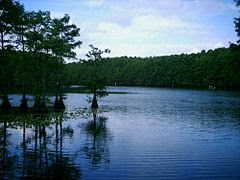
During the late 1840s efforts were made to clear Big Cypress
Creek for navigation. As the westernmost outpost for navigation on the Red
River, Jefferson quickly developed into an important riverport. The first
steamboat, the Llama, reached Jefferson in late 1843 or early 1844. Within a
few years steamboats were regularly making the trip from Shreveport and New
Orleans, transporting cotton and other produce downstream and returning with
supplies and manufactured goods, including materials and furnishings for many
of the early homes. By the late 1840s Jefferson had emerged as the leading
commercial and distribution center of Northeast Texas and the state's leading
inland port.

Among the persistent legends that have grown up around the
town was the belief that Jeffersonians had shunned the railroads. While much of
the city's wealth during the antebellum and early postbellum years derived from
the river trade, city leaders recognized early the importance of rail
transportation and made efforts to build a railroad linking the town with
Shreveport and Marshall. Construction of a line began in 1860, but only
forty-five miles of road was completed by the outbreak of the Civil War. During
the Civil War a meat cannery was established there, as were factories for boots
and shoes.
Jefferson was an up-and-coming city after the Civil War. In 1867 Jefferson became the first town in Texas to use
natural gas for artificial lighting purposes, and ice was first manufactured on
a commercial scale there in 1868. By 1870, Jefferson was the sixth largest city
in Texas. In the late 1860s more than 75,000 bales of cotton were being shipped
annually. By 1870 only Galveston surpassed Jefferson in volume of commerce.
 |
| Loading cotton bales |
The town reached its peak in 1872, but in 1873 two events
occurred that eventually spelled the end of Jefferson's importance. The first was the destruction of the Red River Raft. The Great River Raft or Red River Raft began in prehistoric
times as the river ate away at the river’s bank, causing trees at the river’s
edge to collapse into the river. Timber and driftwood formed solid bridges that
stretched across the river. In some places the raft was reported to be
twenty-five feet deep. Some areas were solid enough to serve as land bridges
that could support a man on horseback, although I can’t imagine a poor horse
having to cross. With slow-moving flow of water, the silt carried by the river
sank, damming the bayous along the river.
 |
| Breaking up the raft |
Imagine a 165-mile log jam. In November of 1873
nitroglycerin charges were used to remove the last portion of the raft, which
had previously made the upper section of the river unnavigable. The demolition
of the raft reopened the main course of the river, but significantly lowered
the water level of the surrounding lakes and streams making the trip to Jefferson by boat difficult.
Even more important to Jefferson's decline was the
completion of the Texas and Pacific Railway from Texarkana to Marshall, which
bypassed Jefferson. Death to any city! Although another line of the Texas and Pacific reached
Jefferson the following year, the development of rail commerce and the rise of
Marshall, Dallas, and other important rail cities brought an end to Jefferson's
golden age as a commercial and shipping center. Though efforts were made in
later years to raise the water level on the Big Cypress, the railroads soon
displaced the riverboats, and with them Jefferson.
For my latest release, BLUEBONNET BRIDE, I placed a
fictional town called Pearsonville a few miles from Jefferson that shared in
the riverboat shipping trade. The heroine’s late husband bullied his way to
control Pearsonville. Fortunately for Rosalyn, my heroine, she severed all ties
with the area only a month before the area’s decline.
Here’s the blurb for BLUEBONNET BRIDE, Men of Stone Mountain
book three:
He’s a by-the-book Texas sheriff; she’s on the run from a murder
conviction...
When a tornado provides Rosalyn with the opportunity to
escape the gallows, she collects her daughter Lucy and flees. They travel far
enough West that Rosalyn believes she’s gone to the ends of the earth. She
hopes she and Lucy will be safe in this remote North Texas town where she
embarks on a new life as a dressmaker. If only she could avoid contact with
people, especially the handsome sheriff who pops up every time she turns
around. She fears either she or her chatterbox daughter may slip and reveal too
much.
Joel Stone has been content with his life, even if it’s not
the one he’d dreamed. His younger brothers are married and living nearby, his
aunts have moved to Radford Springs, and he is respected for the efficient job
he does as sheriff. When he meets the new widow in town, his instant attraction
staggers him. She appears uninterested, but he is determined to win her hand in
marriage.
But life doesn’t turn out the way either Rosalyn or Joel
plan. They overcome temporary obstacles, but what of the secret she protects? Can
he save her from the gallows?
BLUEBONNET BRIDE is available at Smashwords in e-book:
And in print or e-book from Amazon at:
Thanks for stopping by!


