Showing posts with label gold. Show all posts

Thursday, November 20, 2025

Nevada City


Perched in the rugged folds of California's Sierra Nevada, Nevada City in the 1800s was a boomtown born of gold and grit. When word spread in 1849 that gold dust shimmered in the nearby creeks, fortune-seekers from across the world came pouring in--miners with rough hands and wilder hopes, gamblers with quick smiles and quicker guns. The streets were little more than mud and sawdust at first, but within a few short years, the town rose fast--saloons, hotels, blacksmith shops, and a courthouse, all standing shoulder to shoulder against the pine-covered hills. It was a place where luck changed faster than the weather.

Life in Nevada City was never easy. The winters bit hard, and the mines claimed their share of souls. Lawmen did their best to keep the peace, but justice was often decided at the end of a revolver. Freight wagons groaned along the mountain roads, bringing supplies and news from San Francisco, while prospectors staked new claims in the rugged country beyond town. Every man who came through had a story--some chasing riches, some running from their past--but all of them left their mark in the dust and timber of that frontier settlement.

By the late 1800s, Nevada City had begun to settle into something steadier. The rough camps gave way to fine brick buildings, and a sense of permanence took root, though the  spirit of the old mining days never truly left. Even now, you can almost hear the echo of hammers on rock, the call of the stage driver, the laughter spilling from a saloon on a Saturday night. Nevada City was--and remains--a living echo of the West's untamed beginnings, where courage was currency and every sunrise brought another chance to strike it rich. 


Saturday, March 1, 2025

Gold on Centennial Ridge by Zina Abbott


Centennial is a small town in Centennial Valley located between Sheep Mountain and the Snowy Range, which is part of the Medicine Bow Range. 

Centennial abt 1903

The Little Laramie River flows through the valley, which provided water to the town and surrounding settlers and helped keep miles of open prairie green. Centennial is located about forty-five miles west of Laramie City, Wyoming.

Centennial about 1920

Before there was a Centennial, crews of men had gone into the Snowy Mountains in 1868 to cut railroad ties for the Union Pacific Railroad that was laying track in Wyoming Territory. Problems with the local Native Americans eventually drove the tie camps, as they were called, out.

Laramie Plains near Centennial

Not long after the passage of the Pacific Railways Act and the Homestead Act in 1862, and the coming of the railroad, the Centennial Valley began to experience an increase in settlement. The first homestead in the area was filed in 1869. The original settlers were mainly homesteaders and ranchers.

Snippet from 1883 G.L. Holt map

Gold on Centennial Ridge, which ran across the tops of the Snowy Mountains above Centennial, was discovered in 1874.

Mine Tailings, Cliff Mine

In 1875, men who worked for I.P. Lambing, a mine supervisor from Golden, Colorado, plus Stephen W. Downey, who was a Laramie City Lawyer, established the Centennial Mine. Mr. Downey became the president of the mine, which was named to honor the coming anniversary of the signing of the Declaration of Independence of the United States. A post office was established. The Centennial Mining District was established, and still shows on a G.L. Holt map in 1883. 

Centennial received national attention with a gold nugget from the Centennial Mine was on exhibit at the 1776-1876 Philadelphia Exposition.

Queen Mine and tailings

In 1877, the vein of gold ended in a fault, but the continuation of that vein on the other side of the fault has never been found.  There were mining rushes in 1876, 1902, and 1923-1924. In spite of the excitement generated by each new find, none were long-lasting enough be considered noteworthy. However, Centennial had become an established town. The merchants who once served the miners continued to serve the nearby ranches.

After several efforts at finding additional gold failed, loggers returned to the area in 1905.


Also, the town of Centennial became known as an adventurous excursion destination. Hotels, restaurants, and a train line were built to transport the citizens of Laramie City and other nearby cities to visit and explore. Camping trips to the town and surrounding area became popular. 

Mountain View Hotel about 1914

Excursions were organized by Gustav Sundby of the Mountain View Hotel. Once automobiles came into wide use, car trips to Centennial and the Snowy Mountains became popular.

In the process of setting up a timeline for my recent release, The Bride Who Invades Saloons, I set my heroine’s home city as Chicago. She and her family lived in the section that was burned in the 1871 Great Chicago Fire. I wrote a post on a different blog about that fire, which you may find by clicking HERE.

Centennial Mining District-Centennial Ridge

However, when poverty and desperation sends her seeking a husband through the mail, my hero, a rancher in the Laramie Basin region, needed a compelling enough reason to explain why be became so distracted that he missed being at the Laramie City train depot on time to meet his future bride. It was learning of the discovery of gold on Centennial Ridge in 1874 that gave me the inspiration to set up those scenes.


My recent release, The Bride Who Invades Saloons, set in 1874 primarily in Laramie City, Wyoming Territory,  To find the book description and purchase options, please CLICK HERE


Sources:

https://www.visitlaramie.org/blog/post/the-fascinating-history-of-centennial-wyoming/

https://en.wikipedia.org/wiki/Centennial,_Wyoming#Geography

https://www.wyoachs.com/places/2018/1/9/centennial-wyoming-its-still-an-adventure

http://www.wyomingtalesandtrails.com/ghost2.html

Tuesday, February 17, 2015

Interesting Wild West Facts - Susan Horsnell

Hi Everyone

Getting excited. It is just 10 days before hubby and I visit Texas. Cannot wait to see the historical sites around the state. My good friend Caroline Clemmons will be hosting us for a few days in Dallas/Fort Worth and I hear she has some interesting things planned. It will be our first visit to mainland USA and I'm very sure it won't be our last. For my post this week I thought I would share some interesting facts on the "Wild West" of years past.

Judge Roy Bean
Judge Roy Bean once killed a Mexican official in a dispute over a girl in California. A friend of the Mexican official hanged Bean; but, before he died, he was cut down by the contested damsel. Ever after, Bean was unable to turn his head due to the injury.

The first gold strike in the Old West was made by Jose Ortiz in 1832 south of Santa Fe, New Mexico, in what would quickly become the boom town of Delores.

Billy the Kid was born in New York City on September 17, 1859.

Established in 1827, Fort Leavenworth, Kansas is the oldest military post in continuous operation west of the Mississippi River.

The oldest human skeleton ever found in the Western Hemisphere was discovered in 1953 near Midland, Texas. It was first believed that the skeleton, the remains of a 30-year-old woman, was 10,000 years old. However, the latest estimates are that it is much older.

The term "red light district" came from the Red Light Bordello in Dodge City, Kansas. The front door of the building was made of red glass and produced a red glow to the outside world when lit at night. The name carried over to refer to the town's brothel district.

Clay Allison was described in a physician’s report as maniacal” with a personality where "emotional or physical excitement produces paroxysmal of a mixed character.”

Estimates of how many people lived in North America before the arrival of the European explorers vary from 8.4 million to 112 million. This population was divided into about 240 tribal groupings speaking an estimated 300 different languages.

Buffalo,which were strewn across the Great Plains after the mass buffalo hunts of 1870-1883, were bought by Eastern firms for the production of fertilizer and bone china. "Bone pickers” earned eight dollars a ton for the bones.

Around 1541, the present state of Texas was called Tejas, a Spanish version of the Caddo word meaning "allies."

Wyatt Earp
Wyatt Earp was indicted for horse theft in Van Buren, Arkansas on May 8, 1871. He escaped trial by jumping bail and fleeing to Kansas. 

Rumor has it that the tradition of spreading sawdust on the floors of bars and saloons started in Deadwood, South Dakota due to the amount of gold dust that would fall on the floor. The sawdust was used to hide the fallen gold dust and was swept up at the end of the night.

After serving more than twenty years in prison, Cole Younger got a job selling tombstones, worked for a while in a Wild West show with Frank James and died quietly in 1916 in Lee’s Summit, Missouri, where he was known as an elderly churchgoer.

 Wyatt Earp was neither the town marshal or the sheriff in Tombstone, Arizona at the time of the shoot-out at the O.K. Corral. His brother Virgil was the town marshal, who had temporarily deputized Wyatt, Morgan and Doc Holliday prior to the gunfight.


The Oregon Trail from Independence, Missouri to Fort Vancouver, Washington measured 2,020 miles. An estimated 350,000 emigrants took the trail but one out of seventeen would not survive the trip. The most common cause of death was cholera.

Harry Longabaugh became known as "the Sundance Kid" because he served a jail term for horse stealing in Sundance, Wyoming.
The Sundance Kid


Mike Fink was a keel boatman along the Ohio and Mississippi Rivers and an expert marksman. However, he loved his drink and was a known brawler. One of his favorite games was to shoot a mug of brew from the top of some fellow's head. However, on one night in 1823, he had drank so much that it didn't matter how good were his shooting skills. This time he missed and killed the guy who was wearing the mug on his head. In no time, the dead man's friends retaliated by killing Fink. For whatever reasons, his legend was being told for decades along with the likes of Paul Bunyan and Pecos Bill.

Texas was the most active gunfighting state, with some 160 shoot-outs from the 1850's through the 1890's.

The Colt Peacemaker, the weapon that became known as "the gun that won the West” was a .45-caliber manufactured by Colt’s Fire Arms Manufacturing Company in Hartford, Connecticut in 1873. At the time it sold for $17.00.

Samuel Clemens, struck by silver fever, tried his hand at prospecting in the town of Unionville, Nevada in 1862. Having more luck in trading mining claims than actually producing silver, he wound up leaving the area. A short time latter Clemens, changes his name to Mark Twain and becomes one of the greatest writers of American Literature.

On December 21, 1876, Clay Allison shot and killed Deputy Sheriff Charles Faber at the Olympic Dance Hall in Las Animas, Colorado. If it weren’t for Allison purposely stomping on the feet of other dancers, the law probably would never have been called.

The Infamous Dalton Gang only operated for one year and five months, beginning with a train robbery in Wharton, Oklahoma on May 9, 1891 and ending at the shootout at Coffeyville, Kansas on October 5, 1892.

Though the term "stick 'em up" is widely used in Western films, it wasn't actually coined until the 1930's.

I hope you have enjoyed reading about some of the Wild Wests' history. 

Until next time, 
Stay Safe

Sue 
For info about my Western Romance books visit: http://horsnells.wix.com/susan--1


Thank you to Legends of America

Wednesday, May 7, 2014

Virginia City, Nevada


Comstock Lode

Virginia City, Nevada is likely familiar with people because of the television show, Bonanza, or the Comstock Lode. As men made their way across the United States to San Francisco’s gold rush, many traipsed over Nevada’s mountains. Feint strains of gold were seen, but most men didn’t put much faith into the strains containing valuable ore and pressed on to California. But the boom of San Francisco’s gold rush fizzled in 1859 when Pat McLaughlin and Peter O’Reilly discovered gold at the head of Six-Mile Canyon in Nevada. Henry Comstock was a fellow prospector in the area and convinced the men the gold was on his property. McLaughlin and O’Reilly believed Comstock and assured him he would earn a place in history when the giant lode was named; hence the vein becoming known as the Comstock Lode. The gold was followed up the canyon where an outcropping of gold in quartz was found by another miner, James Finney, saddled with the nickname ‘Old Virginny’. It is believed Finney honored himself by christening a new town at the top of the gulch, Old Virginny Town, during a drunken celebration.

Early on the miners faced a problem when panning for the newly discovered gold. A sticky blue-grey mud clung to axes and shovels. The mud was assayed and found to be silver of exceptional purity, worth over $2,000 per ton. Miners swarmed the area and Nevada became a territory in 1861. Within two years, the population of Virginny Town soared from 4,000 to 25,000, as saloon, hotels and various businesses sprang quickly into existence. Miners struck it rich and built their own mansions, importing furniture and fashion from Europe and the Orient. In the mix of this, Virginny Town was renamed Virginia City and became as important as Denver and San Francisco, with a reputation similar to modern day New York City. It was the town that never slept. Morning, noon and night, something was always going on above and below ground.

Comstock Minors
The rapid growth spurt of Virginia City produced the building of the Virginia-Truckee Railroad, which shuttled folks from Reno to Carson City to Virginia City. Investments made in the Comstock ignited the building of San Francisco. Among those striking it rich were Ralston and Crocker, founders of the Bank of California, Leland Stanford and George Hearst. Eventually, the gold mixed with the high quality of silver caught President Lincoln’s interest. He needed both to keep the Union solvent and made Nevada a state even though the population wasn’t enough for the land to qualify as a state. By the 1870’s, the Comstock Lode had produced enough money to help finance the Civil War and bolster the value of the Union’s greenbacks.  

The MacKay--Present Day
Virginia City’s population began to decline in 1877. In 1930, about 500 people remained. The city remains in existence today and is one of the largest federally designated historical sites in America. Many of the original buildings and homes are intact, most notably the Castle, the MacKay and the Savage. The Virginia-Truckee Railroad once again runs from Virginia City to Gold Hill.


****While my teachers briefly touched on the Comstock Lode in history classes, I gained a better knowledge for the silver mines in Nevada while researching Lady Luck. William Larsen is the villain in Lady Luck. Having grown up in poverty, William is now a prominent San Francisco banker, having gained his riches by stealing from his late boss and from the customers at his bank. But the wealth and power he’s accumulated isn’t enough to satisfy the memory of his cruel beginnings. He wants more and hopes to gain it by joining forces with those backing the Comstock Lode. However, he needs more cash than he has on hand to throw in with them, hence his quest to take possession of Lady Luck, the notorious gaming ship permanently dry-docked along the Barbary Coast.     

Thursday, January 26, 2012

Silver City, Idaho Territory: Rowdy, Raucous, & Rich

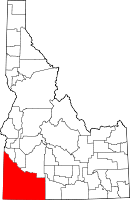
Current boundaries of Owyhee County, Idaho
Copyright © 2012 Jacquie Rogers
The Much Ado series and many of my other western historical romances are set in the Silver City area of Idaho, in Owyhee County, a large county in southwest Idaho with area about the same as New Jersey, but with one person per square mile.  The county was considerably larger in the 1880s, when my stories are set.  This remote county was a wild and wooly area of the West. 
The gold and silver strike sent prospectors, gamblers, painted ladies, merchants, Chinese miners and merchants, bankers, and newspapermen to Ruby City.  Problem is, the creek liked to flood there so the residents packed up the town, buildings and all and moved them to the Silver City site, where it still stands.
Historic Silver City Idaho writes:
During its "heydays", Silver City had about a dozen streets, seventy-five businesses, three hundred homes, a population of around 2,500, twelve ore-processing mills, and was the Owyhee County seat from 1866 to 1934. Some of the largest stage lines in the West operated in the area, and Silver City had the first telegraph and the first daily newspaper in the territory in 1874. Telephones were in use here at least by 1880, and the town was "electrified" in the 1890's.
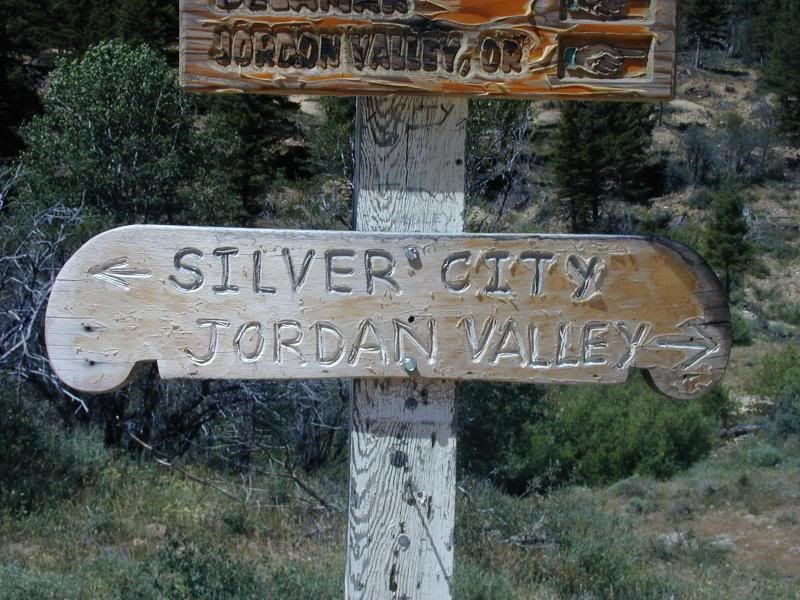
So let's take a tour.  On the right is the sign that tells you how to get there.  I'd advise not to miss the sign.  Oh, wait, there's only one road.  I'd advise you to stay on that road.  If you get lost, you have to pay Owhyee County to hunt for you.  They had to implement this because so many city people got themselves into fixes they couldn't get themselves out of.  Costs mounted and the budget just didn't have room for people's errors in judgment.
These pictures are all taken by my daughter, Mercedes Christesen.  Special thanks to her husband, Rodney, for using his day off to chase after pictures for his mother-in-law.  Yes, you get points for that.
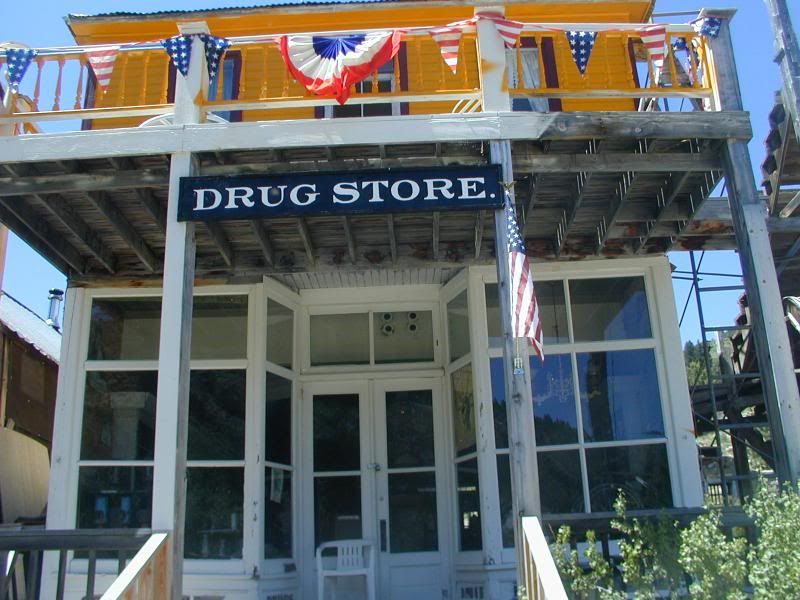
Drug Store
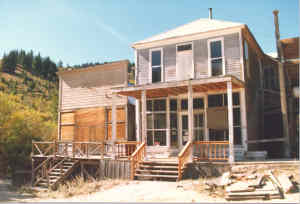
Here's the Drug Store.  She wasn't able to get any history on it, but it was either called the Knapp Drug Store or the Model Pharmacy.  Or maybe it was one and then the other.  I think it's just called the Drug Store now, and not open for business anymore.  It's currently a residence, as are so many former commercial buildings. 
There's an open house the weekend after Labor Day every year.  I've been there--really interesting, and I urge you to go if at all possible.  Make sure your car has decent ground clearance, though, and don't get too worried about the one-lane road (meaning room for only one car) because seldom does a vehicle come from the other direction.  And well, if that happens, someone will have to back up for a mile or two.  It's all fun.
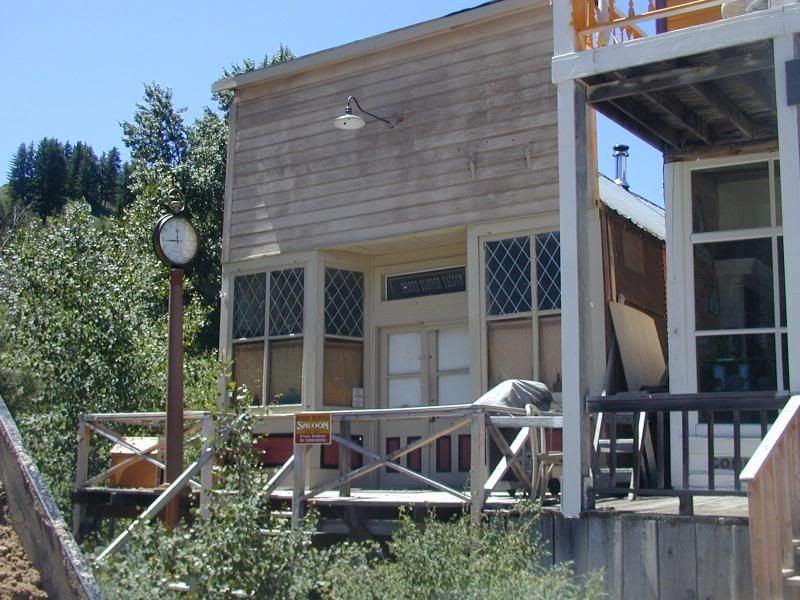
Silver Slipper Saloon
To the right is the Silver Slipper Saloon.  This is a 20th Century saloon, open from 1918 to the early 1940s but it still looks cool so I included it.  Silver City had many, many saloons and of course also had cribs and a street called Virgin Alley where ladies of ill-repute plied their trade.  On Ghosttowns.com, you can see an older photo of this saloon and the drug store above.
Oh yes, there were Cyprians--the ladies of the evening. Men out-numbered women at one point by 200 to 1 so every woman, no matter what her status, was highly regarded. The women, however were not so impressed with one another. From The Owyhee Avalanche, February 26, 1870:
FEMALE PUGLISTS One evening this week be observed two frail females in the vicinity of Catalow's stable, engaged in commintting assault and battery upon each other. For some time the fur flew in all directions. They finally sank down in the snow through sheer exhaustion. Jealousy was the cause of the muss.
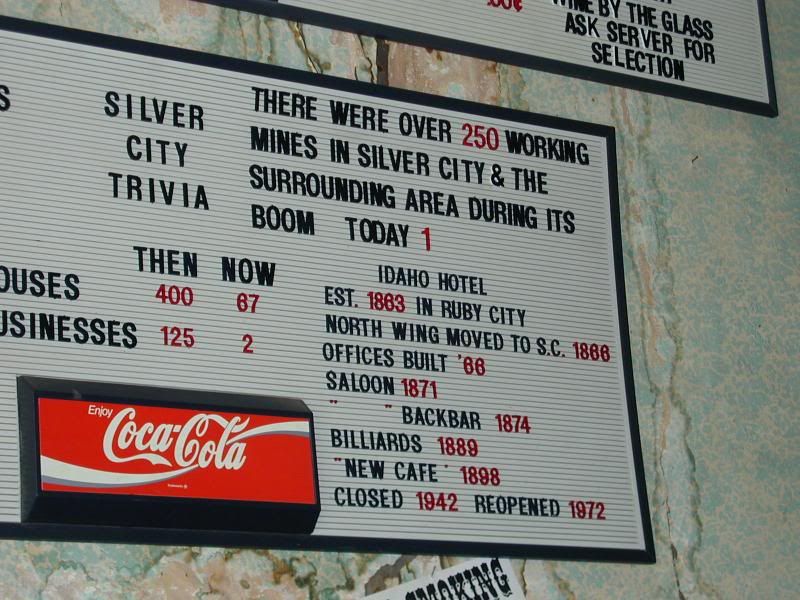
Silver City Trivia:
Houses at its peak, 400: now, 67.  Businesses at its peak, 125: now, 2.  Working mines at its peak, 250: now, 1.  This informaton comes from a sign on the menu at the Idaho Hotel.  The building was constructed in Ruby City and moved to Idaho City in 1866.
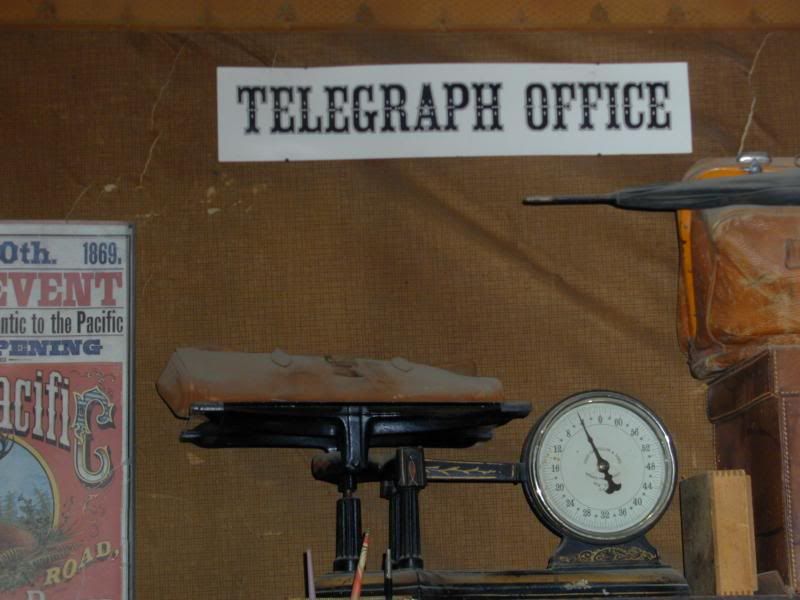
Even though Silver City had telephone service by 1880, the telegraph business thrived for longer distances.
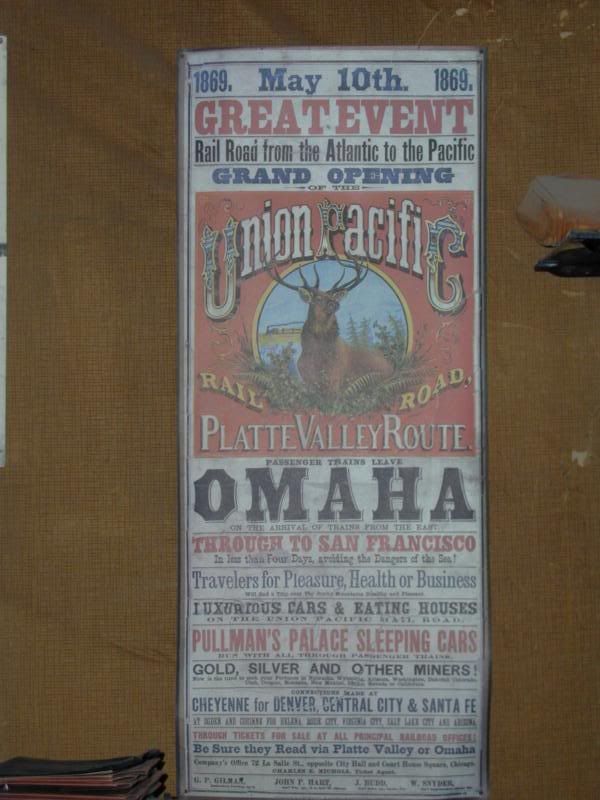
Silver City, Idaho Territory, never did have rail service, but the train service was within a stage ride.  Here's a Union Pacific train ticket:
May 10th. 1869
GREAT EVENT
Rail Road from the Atlantic to the Pacific
GRAND OPENING
of the
Union Pacific Rail Road
Platte Valley Route
Passenger trains leave
OMAHA
on the arrival of trains from the East
THROUGH TO SAN FRANCISCO
In Less than Four Days, avoiding the Dangers of the Sea!
Travelers for Pleasure, Health or Business
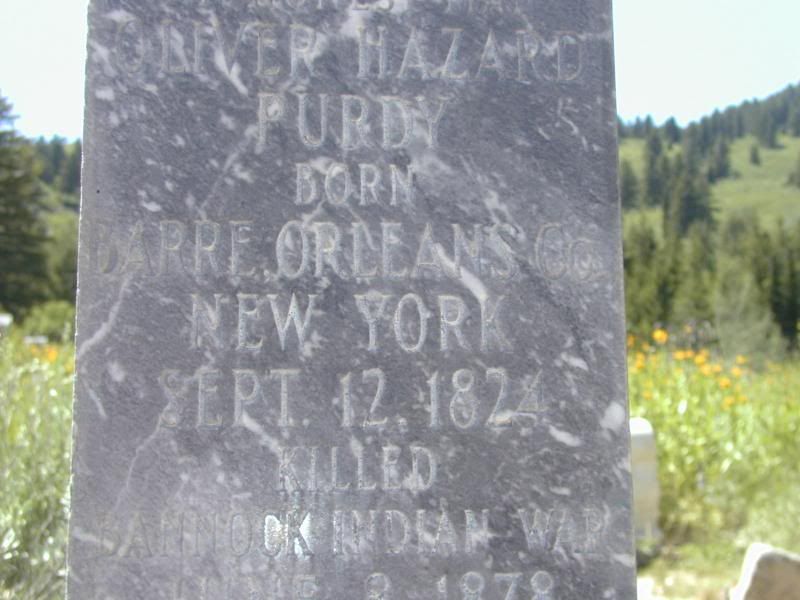
Life was hard in the Old West, especially when you're a couple hundred miles off the beaten path, at over 6,000 feet in elevation.  But this wasn't empty country. A long-standing population of Native Americans from the Bannock and Paiutes were not all that happy about Europeans coming in and ruining their livelihood and cultures.  The next photo is the gravestone of Oliver Hazard Purdy, born September 12, 1824, and killed during the Bannock Indian War in 1879.
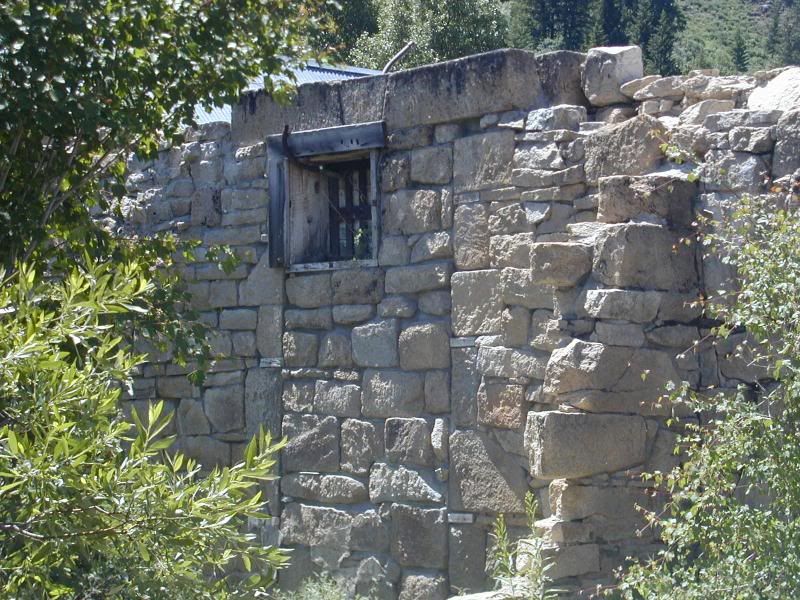
Sometimes bad things happen but instead of dying, the perpetrators were put in jail.  It looks as if this jail wouldn't be too secure these days, but it was formidible in its time.
For more cool photos and accompanying descriptions, I highly recommend EdnaPurviance.org and GhostTowns.com.  You can see the school and the church, too, where services are still held.  The Masonic Lodge is still in good condition and is in use as well.
I'll leave you with the coolest hotel ever.  I mean EVER.  This is the Idaho Hotel that I talked about above (menu board trivia).  Yes, you can still stay there--they have 13 rooms in service (and I've even heard that it's haunted!).  Go to the hotel's website for more cool history about Silver City.
Idaho Hotel, in Silver City, Idaho
The Much Ado series takes place in Owyhee County, and most books are set in or near Silver City because it was the county seat, the largest city in the county (maybe in the territory), and was the hub of activity for a couple decades.
Much Ado About Marshals takes place in Oreana, Idaho Territory, but the pre-story takes place right here in Silver City.  Stay tuned because another book in the Much Ado series, Much Ado About Madams (February 2012), is be set near Silver, in Dickshooter, Owyhee County, Idaho Territory.  No, I didn't make that name up, but I did move it closer to Silver City to suit the story purposes.  The third Much Ado book (June 2012) is set in Henderson Flats (modern day Marsing) and the fourth book, still in the planning stages, will be set in Silver City proper.
Several stories on my backlist are set there, too.  Owyhee County has a rich history and it's fun to share with others.
Where to find Jacquie Rogers:
Would you like to give Much Ado About Marshals a try?  One commenter wins a smashwords coupon for a free copy.  Be sure to include your email address in the comment.  Drawing will be held 19pm Pacific Time, January 31.  Good luck!