Showing posts with label mining town. Show all posts

Friday, December 11, 2020

Finding the Christmas Spirit in Robyn: A Christmas Bride

Christmas Inspiration in Noelle, Colorado, 1877

By Jacqui Nelson

When I first started pondering a plot for my second Christmas story, Robyn: A Christmas Bride, my first questions were... 

What should the theme be? Is there a classic Christmas tale with an uplifting spiritual theme that many people might recognize or at least relate to? 

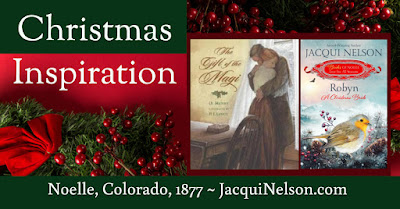
The Gift of the Magi - my first inspiration when writing Robyn: A Christmas Bride

The Gift of Love is Priceless

The Gift of the Magi (written by O. Henry and published in 1905) features the themes of selfless gift-giving and how the gift of love is priceless. In that story, a husband and wife each sell their most valuable possession, but they are items that can be grown again (hair) or can be bought back again (a watch). 

I wondered what if the thing you valued most was sustaining a way of life that you’d struggled a long time to create and that now defined your entire self-worth? Could you give that up if it meant ensuring the happiness of a loved one? That might be the ultimate selfless gift to give.

My next thought was having a heroine who was a trouser-wearing tomboy who loved driving wagons in a time, 1877, when society wasn’t very accommodating about women’s appearances and occupations that strayed from the norm. 

So…what if my heroine decided she needed to do something drastic to win the heart of the man she loved? Changing yourself to please another person (even if they haven’t asked you to) might be considered another selfless gift. So…what is a classic transformation story? 

My Fair Lady and its heroine Eliza Doolittle were my next inspiration

My Fair Lady (released in 1964 as a movie starring Audrey Hepburn) focuses on speech lessons, but Eliza’s transform also includes her appearance—her clothing, hair, the way she carries herself, and more. It’s a life-changing transformation that is difficult for Eliza and takes hard work and sacrifice—for her own good (a chance at better job prospects) but also, as time goes on, to please her instructors.

So…selfless giving and self-sacrifice. Ready. Set. Go. Write a Christmas story!

I hope you enjoy Robyn: A Christmas Bride as much as I enjoyed not only writing the story but also giving Robyn Llewellyn and Max Peregrine their hard-won and well-deserved Christmas gifts.

Here’s a teaser graphic from Robyn: A Christmas Bride about gift-giving and friendship because the man whose heart Robyn wishes to win is her best friend, Max.
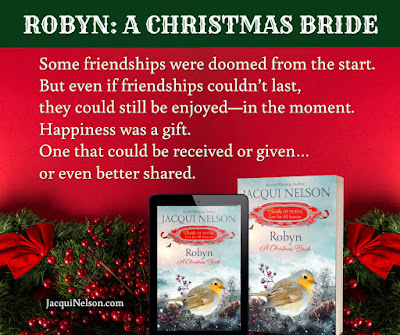
Some friendships were doomed from the start. But even if friendships couldn’t last,  they could still be enjoyed—in the moment.  Happiness was a gift.  One that could be received or given… or even better shared.

CLICK HERE to read an excerpt from Robyn: A Christmas Bride.

Or CLICK HERE to read an excerpt from my 1st Christmas story The Calling Birds - which happens also in the small mountain mining town of Noelle, Colorado, but one year earlier during Christmas 1876. 

Spend Christmas in Noelle, Colorado, 1876 & 1877

Wishing you the best Christmas possible during the challenging year of 2020! 


I hope we all find - and give - an abundance of love in our real and virtual stockings this year ❤️🎁 

~ * ~

Jacqui's author photo
Download MY FREE STORY Rescuing Raven (Raven & Charlie's story in Deadwood 1876) 

Read more of my 
Join me on 
Follow me on 

Tuesday, May 16, 2017

Who Was the First Woman to Write a Western Romance?


by Heather Blanton

A simple question on the surface, I thought a quick Google would give me the answer. Turns out, a few females claim the honor. So after a little more serious digging, I came up with Mary Hallock Foote and her first novel, Led-Horse Claim: A Romance of a Mining Camp published in 1883.

Turns out, Mary was quite an interesting gal. Born in 1847 in New York to Quaker parents, she attended school at the very proper Female Collegiate Seminary in Poughkeepsie. Her gift for the creative arts convinced her father (clearly a forward-thinking man) to invest more in his daughter’s education. He sent her to Cooper School of Design for Women, and by her early twenties, Mary was a sought-after illustrator and designer for some of the most notable publishers in New York City. She loved her job. She loved the city. But she loved a man more.

In 1876, she married Arthur De Wint Foote, a young mining engineer whose career would take her deep into the wild-and-wooly Western frontier. Mary saw it all. From Deadwood to Leadville, from Idaho to Mexico.

Impressed, sometimes astonished, at the characters populating these rowdy mining towns, Mary wrote and illustrated dozens of articles for readers “back East.” She quickly gained the reputation for being one of the sharpest observers of, and most civilizing influences on, the bawdy mining, and ditch (irrigation) towns out west. According to an article in the Oregon Cultural Heritage Commission, “The Victorian gentlewoman traveled the American West dressed in hoop skirt and petticoats, insisting that her children be educated by an English nanny and fed by a Chinese cook, so that she could work on her illustrations and stories, without interruption.

What this quote doesn’t tell you is that Mary didn’t have time to raise the children because she had to help put bread on the table. Her husband’s career as a surveyor and civil engineer was difficult, at best, due to his unswerving honesty. Apparently, fudging numbers was expected in the mining industry, but Arthur didn’t play along. Hence, the continual moves from one town to the next. But Mary wrote about it all and her short stories and serials gained in popularity. They were published alongside the likes of Rudyard Kipling. Her articles and observations of life in the Wild West were met with lavish reviews, especially by those who could recognize the ring of authenticity—because they lived it.

Mary’s stories leaned more toward Western romance, though, as opposed to Owen Wister-style shoot-outs and brawls. She wrote fifteen novels in all. However, her husband eventually landed a job managing a mine in California and as his salary increased, Mary’s hectic writing pace decreased. Her last book was published in 1919. She didn’t seem to miss writing.


Mary and Arthur were married nearly sixty years. She, ever hardy and determined, lived until the ripe old age of 90. Unfortunately, while her life was long, her fame was not. It is nearly impossible to find the complete collection of Mary’s works now, even on Amazon. What a loss for the Western Romance genre.

Wednesday, March 1, 2017

Nevadaville, Colorado

Colorado was home to numerous bustling mining towns in the 1800’s. Cripple Creek and Central City are two such towns most Colorado residents are familiar with, mostly because many of the historic buildings now house casinos. Here in Colorado Springs, we have tour buses shuttling folks to and from Cripple Creek to gamble, shop, and dine. One of the busiest times to take the bus to Cripple Creek is New Year’s Eve. Several years ago, the hubby and I experienced a New Year’s Eve celebration in Cripple Creek courtesy of the shuttle bus. It was a fun time, and I imagine Central City booms on New Year’s Eve, too. (I can’t say for certain, as I’ve not been there… yet.) But ‘over the hill’ from Central City is Nevadaville, a Colorado ghost town and home to two residents.

Nevadaville was founded three weeks after John Gregory’s discovery of gold. The Burrows Lode quickly became Gilpin County’s largest site for concentration of mining activity. A.D. Gambell and Sam Link formed the town site and Joseph Stadley named the town. Nevadaville was also known as Nevada or Nevada City. To not be confused with Nevada, CA, the post office changed Nevadaville to Bald Mountain in 1869. Residents refused to call their town anything other than Nevadaville, creating an unusual situation where the town name was different from the post office name, until the post office closed in 1921.

During its peak, Nevadaville had a population of 4,000. Most of the citizens were of Irish descent. Businesses included saloons, barbershops, a shoe store and a grocery store. A dry goods store opened inside The Colorado Trading and Investment Company and later, Dr. Bourke set up his medical practice and opened a drug store. Nevadaville did not welcome establishments catering to the wild night life and incorporated this into law. Grogg shops, bawdy shops and gambling saloons were not allowed with the town limits. A $50 fine was put in place for violating the law. If an establishment racked up enough violations, they were banished from the district. A sheriff was appointed to enforce the law, and given an added bonus of keeping some of the profits from the fines.

Masonic Lodge
In 1859, a Masonic Lodge was organized from the Kansas Grand Lodge and was given the name, Nevada Number 36. The Lodge relinquished their charters after only one meeting and came under the jurisdiction of the new Grand Lodge of Colorado, with the new name of Nevada Lodge Number 4. To this day, the Lodge continues to hold their meetings in Nevadaville. 

A fire in 1861 destroyed over 50 buildings. Residents used TNT to save the rest of the town and rebuilt what was destroyed. The town lacked a good water supply and fell victim to four more fires. The last was in 1914 and Nevadaville was never fully rebuilt after that. Sadly, the veins in the mine were worked out too soon, and by 1900, the population dwindled. 

December 2004
As stated above, Nevadaville currently has two citizens, rumored to enjoy answering questions about the town’s history. Many of the historic buildings are still intact today. They are on private land and not open to the public, though folks can enjoy an afternoon in the Rocky Mountains strolling around the town.  

The photos in this blog are courtesy of: