Games of chance first came to the American colonies with the
first settlers and lotteries were often used to help raise money to establish
universities and secondary schools throughout the 18th and 19th
centuries. As America grew, lotteries continued to be used at the state and
federal levels, while privately owned gambling businesses began to develop.
New Orleans became the epicenter of gambling but in the mid-1800’s
a backlash formed, and gambling was pushed from the Mississippi River toward
the less-regulated western territories, as well as to Mississippi River boats.
Anti-gambling forces in the northeast brought most state-sponsored lotteries to
an end, while the California Gold Rush spurred San Francisco into a gambling
mecca.
Reconstruction after the Civil War saw a brief return of
lotteries as a way to generate revenue, but by the beginning of the 20th
century, gambling was almost uniformly outlawed in the United States. This
created many forms of illegal gambling, especially among organized crime
syndicates.
The stock market crash of 1929 and the building of the
Hoover Dam led to the legalization of gambling in Nevada. During the 1950’s and
1960’s, Las Vegas saw rapid growth and development. In 1977, New Jersey
legalized gambling in Atlantic City, and in 1979, the Seminole tribe opened the
first reservation-based commercial gambling. Today, gambling is legal under
U.S. Federal Law.
* * * *
Don't miss Kristy's Wings of the West series - historical western romances with honorable heroes and courageous heroines.
Kate Ryan has always had a streak of justice in her. When
she decides to apply to the Pinkerton Detective Agency, nothing will stand in
her way. Initially hired in a clerical position, she quickly works her way up
to field agent with the help of her mentor, Louise Foster. When Louise is
injured, Kate gets her first assignment and the opportunity of a lifetime.
Henry Maguire has been undercover in the household of
wealthy cattleman Arthur Wingate. Employed as a ghostwriter to pen the man’s
memoir, Henry is also searching for clues to a lucrative counterfeiting scheme.
When Henry’s “wife” shows up, he’s taken aback by the attractive woman who isn’t
Louise. Now he must work with a female agent he doesn’t know and doesn’t
necessarily trust. And because he has another reason for coming into Wingate’s
world, Kate Ryan is unavoidably in his way.
Kate Ryan is the daughter of Matt and Molly from THE WREN,
and THE STARLING is the first of five novels featuring the second generation of
Ryans in the Wings of the West series.
For centuries,
gambling has been an accepted form of entertainment, dating back to the Old
Stone Age. The earliest 6-sided dice
game dates back to 3000 BC. In the 1800’s, a good portion of the male population
frequented saloons and gambling halls to imbibe in alcohol and play a game of
chance. These establishments were often considered their ‘home away from home’
and generally accepted by women, who had their own form of entertainment with quilting
bees and church revivals, where they had prayer meetings and sang hymns. Many
of my novels feature a saloon, and some of my heroes are quite adept at
cheating at poker to earn a living. Below are some other games of chance men
enjoyed.
Keno (E-bay)
Keno: Played exactly like
bingo, tables were set up in a room with Keno cards on them. Players would
enter and choose which card(s) they wanted to play. The people) running the
night’s game stood at the front of the room selling tickets and ivory chips the
size of half dollars that had half-moons in the middle. The other person
running the night’s game stood at the urn where the Keno balls were dropped in
to. Behind those two was a large board with numbers above holes. Just like
bingo, the urn holding the Keno balls has a handle. The man turns the handle,
the ball drops out at the bottom, the number is called out and the ball is
inserted into the hole corresponding with the number. The players use the ivory
chips to cover the numbers and when they cover a row, they yell out, Keno!
Faro (Wikipedia)
Faro: Because of its
fast action, easy-to-learn rules, and good odds, especially when players weren’t
cheating, Faro rivaled poker in popularity. With one person designated the ‘banker’
and played with one deck of cards, any number of people (punters) could enter
the game. To play, chips (or checks as some called them) were purchased from
the banker, with bet values being determined by the house. A board was placed on top of an oval table
covered with green, with a cutout for the banker. One suit of cards (usually
spades) was pasted on top of the board in numerical order. Players placed their
bets on one or more cards in the layout. A deck of cards was shuffled and put
inside the dealing box, (a mechanical device known as the shoe to prevent
manipulations of the draw by the banker). The 1st card dealt (the
soda card) was tossed away, leaving the remaining 51. The dealer then drew 2
more cards. The 1st (the banker’s card) was placed to the right of
the dealing box. The 2nd card (the player’s card) was placed to the
left of the banker’s box.
Suits of cards didn’t matter, and the banker’s
card was the player’s losing card. So if the banker’s card was the number the
player had set his betting chips on the board on top of the table, he lost his
bet and the house won. The players card was the winning card and all bets
placed on that number won. The dealer settled all bets on those two cards, then
the next round of bets were placed before the next 2 cards were drawn,
continuing to the lastcards where the
dealer would ‘call the turn.’ This was a special bet at the end of each round,
where the object was to predict the exact order of the remaining cards. If all 3 last cards were the same, there was
no bet.
Roulette (Wikipedia)
Roulette: There are several
theories as to who invented the game, dating back to the 17th century.
The modern version of the game appeared
in 184, with Frenchmen Francois and Louis Blanc inventing the single ‘0’ Roulette
wheel, that eventually found its way to America in the 1800’s. Americans eventually rejected the single ‘0’
and returned the ‘00’s’ back to the wheel. Early American wheels had the
numbers 1-28, 0, 00, and an eagle, which was a considered a house slot that gave
the establishment an extra edge. The game is played on a table with a wheel to
one side. On the other side of the table, players place their chip on the
number or symbol they think the ball will land on when the wheel stops spinning.
The person presiding over the game (croupier) spins the wheel in one direction.
He then spins a small white ball in the opposite around a circular track
running along the outer edge of the wheel. As the wheel slows, the ball loses
momentum and falls into one of the numbered slots, declaring a winner (or
winners).
Poker (Photos of old America)
Poker: The game as we
know it evolved in the U.S. in the 1800’s. Based somewhat on a game Three Card
Brag where players were dealt 3 cards, hoping for a triple, the strategy for involved
players remembering which was cards had been dealt and which were still in the
deck when placing wagers as the game continued until a winner was declared.
Early hands of poker in the U.S. were often played with a 20 or 25 deck of
cards. Eventually, the game broadened 1850’s to a 52 card deck, to include stud
poker with 5, 6 or 7 cards being dealt. Draw poker derived from that, and wild
cards and jokers also came into play in the 1850’s. From the Civil War through
the net 5 decades, draw poker was the basis for all other versions of the game.
Usually
played with 1- people, with players tossing chips into the center of the table for
their ante, the dealer which variation of the game is to be played (5 card
stud) and deals 5 cards to each player. In turn, each player either bets his
hand will beat the other players or folds, meaning he doesn’t think his cards
will win. Hands are determined as 2 pair (often Jacks or better); 3 of a kind,
full house, straight,of a kind and a
royal flush. A fun game, and in many of my books, the dealer is a professional
card sharp playing for the house to win money for the house.
Here is a scene from Luck of the Draw, capturing Royce’s
skills at a poker table.
As
Royce broke open a new deck of cards, he had no trouble pushing aside the
ethics he lived by. Honesty and morality had no place at the poker table, not
when Paige’s life and the life of their unborn child rested, literally, in the
palms of his hands.
He’d
spent the three days holed up in Waco due to the rain practicing the tricks
Paige had taught him. This morning he shuffled the stiff cards with the ease
and dexterity of an accomplished gambler.
Royce
picked up his cards and looked them over. His heart beat fast at the sight of
the two aces, and as Paige had taught him, he made sure that relief didn't
reflect in his gaze.
“How
many?” He looked to Mendoza seated across from him and all confidence he felt
skidded to a halt. Mendoza no longer had that cocky arrogance about him. He had
masked all feeling and thought, emitting a look so blank Royce thought he had
dealt Mendoza the wrong hand.
“One,”
Marcus answered.
As
he tossed one card, face down, to the center of the table, Royce's confidence
was restored. He hadn't dealt the wrong cards. By asking for only one card,
Royce was certain the landlord was chasing after a full house, betting that the
two pair he held would still be enough to beat Royce’s hand if he didn't get
his card.
“Dealer
will take three,” Royce announced then tossed his throw-away cards, face down,
to the center of the table and dealt himself three cards. At the sight of the
last card, a lone heart beat jolted him so hard it threatened to burst from his
chest, but somehow he managed to keep his entire body from flinching.
“Senor Weston.” Mendoza caressed his chin
with the side of his index finger. “Your senorita
is going to make a lovely addition to my cantina.”
“Is
that so?” Royce kept his gaze impassive.
The
landlord’s smile broadened as he laid his cards on the table, face up. A pair
of queens, a pair of tens, and an eight stared back at Royce, and for a long
moment, a deafening silence filled the air.
“You
accept defeat graciously, Senor.”
Mendoza’s grin widened as he shoved his chair back from the table. “I would say
I am sorry for your loss, but I am not. I will send your child to you after the
senorita gives birth.”
“Sit
down, Marcus,” Royce ordered tersely. “I have not shown my hand.”
Though
his eyes narrowed, Mendoza’s tone remained friendly. “You are correct. It would
be rude of me to leave the table without viewing your hand.”
A
sharp retort hung on the edge of Royce’s tongue, one that would have the
landlord turning red, but Royce swallowed the comment in exchange for ending
the game. Slowly, with his gaze bearing down on Mendoza, he laid his cards on
the table one at a time; an ace, a deuce, another ace, a five, and last, the
third ace.
“Paige stays with
me.” Royce's tone left no room for argument. And though he would have loved nothing
more than to wipe the disbelieving, murderous look from Mendoza’s face, time
was of the essence. Paige had been gone from his side too long.
Life is a gamble. No words more accurately described the Wild West where life's entertainments were as limited as the opportunities for a woman to earn a living.
Here are 2 real-life lady gamblers who bet against the odds (and won and lost) every day of their lives...
Carlotta Thompkins, Aka Lottie Deno (shortened from dinero - Spanish for money)
( born 1844 in Warsaw, Kentucky )
Lottie’s father, a wealthy Kentucky tobacco farmer, took her with him on business trips where they played poker, faro, and roulette at the finest gambling houses. By the time she was 16, she was a skilled card player. After her father enlisted in the Civil War and died during his first battle, her mother sent her to Detroit to live with friends and find a husband.
When the war left everyone struggling financially—her in Detroit and her mother and sister back home in Kentucky, she used gambling to earn enough to support herself and her family. When her mother died, she became a riverboat gambler in order to put her sister through private school.
Lottie fell in love with Frank Thurmond while dealing cards at his saloon, but Frank was forced to go on the run after he stabbed and killed a disorderly patron. She followed a rumor that he was heading West and went that way as well, gambling in each town until they played out—and until she found Frank in Texas.
After they married, she dealt cards at night and managed their restaurant, hotel, and two saloons during the day. When she eventually gave up poker to play bridge, she also became involved with civic organizations and helped build an Episcopal church.
Eleanor Dumont, aka Madam Mustache
( born 1829 in New Orleans )
Not much is known about Eleanor’s early years, but she worked in San Francisco dealing cards until 1854 when she traveled to Nevada City and opened her own gaming house. She decorated it expensively and tastefully, kept it open 24-hours a day, and offered guests free champagne.
In addition to being a beautiful and talented cardsharp, she had a reputation for being honest and for being generous to losers. She had many admirers but she loved unwisely.
The first was the editor of the Nevada Journal, a man who never returned her affections. So, when Nevada City’s gold mines stopped producing, she took her winnings to the gold camps that were booming. When their fortunes waned, she moved to the next camp, and the next.
When her good looks started to fade and the facial hair under her nose earned her the name Madam Mustache, she left gambling and bought a cattle ranch. Knowing nothing about the lonely life of ranching, she married a handsome cattle buyer who turned out to be a smooth-talking scoundrel. When he took all of her money and deserted her, she returned to her first love—gambling.
Sadie Sullivan
( born... in my mind )
Who is Sadie Sullivan?
She's my Kansas farm girl turned Dodge City cardsharp in my novel, Between Love & Lies (the first story in my Gambling Hearts series). And what happens to make Sadie turn to a life of gambling in 1877?
Here's the book blurb...
Sadie Sullivan lost everything when a herd of longhorn cattle bound for Dodge City destroyed her farm. Now she works in Dodge—one of the most wicked and lawless towns in the West—at the Northern Star Saloon. But her survival in this new world of sin and violence depends on maintaining a lie so deadly it could end her life before the town of Dodge can.
The one man capable of unraveling Sadie's secrets is Noah Ballantyne, the Texan rancher whose herd destroyed her home. Back in town and taking up the role of deputy alongside legendary lawman Bat Masterson, Noah vows he won't leave until he's made things right. But with the saloon’s madam unwilling to release Sadie and a rich cattle baron wanting her as well, the odds aren’t in favor of finding love…or leaving town alive.
In a town ruled by sin, will he earn her love or her lies?
Want to read more about Sadie and Noah?
CLICK HERE to read the opening scene of their adventure.
~ * ~
* CLICK HEREto read more Cowboy Kisses Wild Women blog posts *
Born in Sudbury, England in
1853, Alice Ivers is best known as the highly skilled female poker player and
faro dealer who loved cigars. The only daughter of a school teacher, Alice’s
childhood consisted of the best education and moral values. When she was
twelve, her family immigrated to the United States and settled in Virginia, but
with the Civil War raging and gold being discovered in the West, she and her
family eventually moved to Lake City, Colorado.
As a young woman, with
exceptional breeding, class and beauty, Alice was sought after by many men. The
first man she favored was Frank Duffield, a mining engineer and gambler. It is
believed that throughout her life Duffield was Alice’s one true love and she
soon married him. Duffield’s job took the couple from one mining camp to
another before they settled back in Lake City. There they enjoyed social
parties and Alice loved the attention lavished upon her. She began joining her
husband at the poker tables, where Duffield taught her everything he knew about
the game. Some nights she sat in for him while he was at work. Because of her
fine education, her math skills were exceptional and it wasn’t long before she
was more adept at the game than her husband and gaining a bit of notoriety; females
rarely ventured into a saloon and were never expected to be good poker players.
A few years into married
life, Duffield was killed in a mine explosion. Alice quickly came to the
conclusion she would now have to make her own way in the world and turned to
gambling full time as a means to support herself. Shortly after she hit the
tables, she earned the nickname ‘Poker Alice’.
Leadville, Colorado
Finding work wasn’t difficult
for Alice. She held many jobs in gaming houses throughout Colorado, to include
Leadville and Alamosa. She kept her appearance neat, dressed in fashion, carried
a .38 caliber revolver, and somewhere along the way, acquired a love for
cigars. Often seen puffing on a stogie, if anyone rudely commented on her
smoking habit, she’d pull out her gun and effectively put an end to their
ribbing.
Alice found her way to
Oklahoma and her fame spread there, too. She continued to win substantial
amounts and made her way to New Mexico before moving to New York City. There
she treated herself to new clothes and enjoyed the nightlife. With her funds
nearly depleted, she left New York and headed back west, to the new mining town
of Creede, Colorado. At forty years old, she took a job working eight hour
shifts at the tables at Bob Ford’s Exchange. Bob’s claim to fame was having
killed Jesse James. Many folks disliked his bragging, because at that time, Jesse
James was still considered more of a hero than an outlaw. Eventually, Ed Kelly
killed Ford in 1892. Alice witnessed the shooting and moved to Deadwood soon
after.
Deadwood, South Dakota
In Deadwood, Alice took another
job dealing stud. She met fellow dealer, Warren Tubbs, and the two struck up a
friendship. Tubbs hailed from Sturgis, worked as a house painter by day and
dealt at night, though his skills weren’t good. Alice saved Tubbs’ life when a
drunk miner came into the saloon and tried to stab Tubbs. She shot the miner in
the arm, and soon after Tubbs fell in love with Alice. They married, with the
agreement Tubbs would stick to painting and Alice would continue with gambling.
The couple had seven children, whom Alice kept away from the tables as she continued
winning large sums of money to provide for her family. Once their children grew
up and moved away, the couple retired to a chicken ranch north of Deadwood.
Tubbs contracted pneumonia in 1910. He died on a cold winter’s night with a
wish to be buried back in Sturgis. Alice drove his body back to Sturgis through
a blizzard and pawned her wedding ring for payment for his burial.
Playing cards, circa 1800's
Alice remained in Deadwood
and took another job dealing poker. At this time in her life, she changed her
clothing from fashionable to plain attire and continued with her cigar smoking
ways. She hired George Huckert to take care of her farm and when she owed him
wages of more than one thousand dollars, she married him, reasoning it was
cheaper to marry him than pay him what she owed him. Huckert was a loafer and
spent most of time in the bars. Upon his passing, Alice was relieved and took
back her name of Tubbs.
Life became tougher for
Alice as she aged. Most of her money was gone and reform was fast becoming the
rage in Deadwood and Sturgis. She opened her own gambling hall and catered to
the soldiers at Ft. Meade. Several times she was arrested on gambling,
prostitution, and alcohol charges. Each time, she beat the charges and was set
free. She was also charged with killing a soldier and beat this rap as the jury
agreed she killed the man in self-defense. Past the age of 70, Alice began
having gall bladder troubles. With medicine reaching new heights, doctors
convinced her to undergo a relatively new surgical procedure. She readily
agreed, mostly due to the fact a fortune teller had told her she would live to one
hundred. Sadly, Alice died during the operation. She is buried at St. Aloysius Cemetery
located in the Black Hills. Ted Walker saved her home in Sturgis from
demolition and had it moved to Junction Avenue. To this day, Alice remains a
poker legend in Colorado and South Dakota.
Picture the scene: a saloon in the old west. A long bar, shelves lined with bottles on the wall behind it, and maybe a painting of a scantily clad woman. Cowboys, gamblers, lawmen, the town drunk, tinny player piano music, and dance hall girls. At one table sit men playing a game of poker that's been going on for hours. Someone's accused of cheating. Chairs scrape on the floor as accuser and accused jump up and reach for their guns. A scene we've seen played out countless times on both the big and little screen.
Scrape. "Are you calling me a cheater?"
The characters played poker because that's the card game the writers and directors were familiar with. Except in reality, the card game of choice in the old west is one no longer played. Not poker. Faro.
I was raised watching the great western series of the 1970's and have been a fan of the genre all my life, and yet I never heard of faro until recently when I read a book about Doc Holliday's Tombstone years.
I was curious about the game so I did some research. I was surprised to find out that faro was the most popular gambling game--far more common than poker. Opposed to the long poker game, faro is a fast game, taking about ten to fifteen minutes. Also unlike poker, very little skill is involved. And like the roulette wheel or Blackjack in today's casinos, there is somewhat of a community atmosphere with spectators. Any number of players could play at one time, so it could be quite raucous.
Faro comes to us from 17th century France where it was known as pharaoh, which in turn is derived from the English game, basset. The game came to America with the French who settled in Louisiana. It then made its way up and down the Mississippi River at the gambling tables on steamboats. Before long it became so popular that every saloon out west had a faro table.
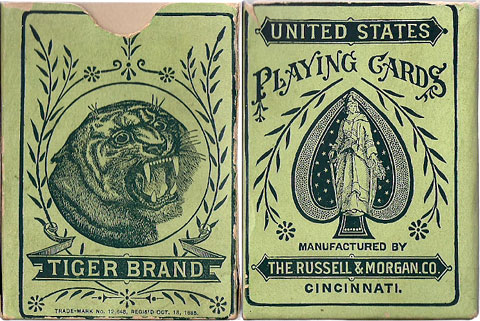
Because decks of cards at the time often featured a tiger, playing faro was also called "Twisting the tiger's tail" or "Bucking the tiger." Gambling districts were known as "Tiger Towns" or "Tiger Alleys."
Playing cards
The game was played on a table covered in green baize with thirteen spaces for players to place their bets on cards they hoped the dealer would draw from "the shoe." The dealer would pull two cards. The first was the "banker's card" and the second was the "player's card." The banker's card was always the "losing card." So if you were lucky, your card was on the space on the board corresponding with the "player's card." Pretty straight forward. No need to bring your poker face to the faro table.
Faro table in the Oriental Saloon, AZ. Notice the crowd of onlookers.
A couple of elements made the game more interesting. Cards played were keep track of on an abacus-like device called a "casekeep," and as more cards were played, the game got more exciting with diminishing possibilities. The only skill involved in the game was being able to keep track of the cards already played. A player could also reverse the win/lose cards by placing a copper disc on the board, which was known as "coppering the bet."
Famous faro players? Wyatt Earp started out his stint in Tombstone as a faro dealer in the Oriental Saloon. Doc Holliday supplemented his income in the same town as a dealer in at the Birdcage Saloon.
So, why don't we play faro anymore? Cheaters ruined it, that's why. It was so easy to cheat that the expert book on card games, Hoyle's, warned against it.
Want to know how to cheat at faro in case you come across a game? Watch those dealers. Because faro is a game where the player is as likely to win as the house, the dealer would sometimes resort to methods to insure his livelihood. For one thing, the cheating dealer could rig the shoe by placing tiny mirrors inside. If he didn't like the look of the card about to be played, the dealer could hide that card in a special compartment in the box. Then the deck itself could be tampered with so some cards were marked. For instance the backs of two cards could be sanded so they'd stick together, drawing a third unmarked card out of the shoe. And because the sometimes the unruly atmosphere around the table lent itself to acts of deception, there was the old sleight of hand. The dealer could move the winning card to his side if nobody was watching.
But, never fear, player! There are ways you too can cheat. The sleight of hand employed by the dealer worked for the player as well, though this is a riskier move. A less risky move would be to attach a horse hair or a silk thread to the bottom of a card and move it to a more favorable spot. Likewise the copper could be moved in this way. I have to say I have trouble picturing someone doing this undetected. They must have been nimble-fingered and quick. And what did they use to stick the hair to the card, I want to know? Or do I....
I am alone in not knowing about faro? How many of you knew it was the game of choice in the old west? Is it a game you'd like to play? Cheat? Do you like to gamble at all? What's your favorite game of chance?
Colorado
was home to numerous bustling mining towns in the 1800’s. Cripple Creek and Central
City are two such towns most Colorado residents are familiar with, mostly
because many of the historic buildings now house casinos. Here in Colorado
Springs, we have tour buses shuttling folks to and from Cripple Creek to
gamble, shop, and dine. One of the busiest times to take the bus to Cripple
Creek is New Year’s Eve. Several years ago, the hubby and I experienced a New
Year’s Eve celebration in Cripple Creek courtesy of the shuttle bus. It was a
fun time, and I imagine Central City booms on New Year’s Eve, too. (I can’t say
for certain, as I’ve not been there… yet.) But ‘over the hill’ from Central
City is Nevadaville, a Colorado ghost town and home to two residents.
Nevadaville
was founded three weeks after John Gregory’s discovery of gold. The Burrows
Lode quickly became Gilpin County’s largest site for concentration of mining activity. A.D. Gambell and Sam
Link formed the town site and Joseph Stadley named the town. Nevadaville was
also known as Nevada or Nevada City. To not be confused with Nevada, CA, the
post office changed Nevadaville to Bald Mountain in 1869. Residents refused to
call their town anything other than Nevadaville, creating an unusual situation
where the town name was different from the post office name, until the post
office closed in 1921.
During
its peak, Nevadaville had a population of 4,000. Most of the citizens were of
Irish descent. Businesses included saloons, barbershops, a shoe store and a
grocery store. A dry goods store opened inside The Colorado Trading and Investment Company and
later, Dr. Bourke set up his medical practice and opened a drug store. Nevadaville
did not welcome establishments catering to the wild night life and incorporated
this into law. Grogg shops, bawdy shops and gambling saloons were not allowed
with the town limits. A $50 fine was put in place for violating the law. If an
establishment racked up enough violations, they were banished from the district.
A sheriff was appointed to enforce the law, and given an added bonus of keeping
some of the profits from the fines.
Masonic Lodge
In 1859, a Masonic Lodge was organized from the Kansas Grand Lodge and was given the name, Nevada Number 36. The Lodge relinquished their charters after only one meeting and came under the jurisdiction of the new Grand Lodge of Colorado, with the new name of Nevada Lodge Number 4. To this day, the Lodge continues to hold their meetings in Nevadaville.
A fire in 1861 destroyed over 50 buildings. Residents used TNT to save the rest of the town and rebuilt what was destroyed. The town lacked a good water supply and fell victim to four more fires. The last was in 1914 and Nevadaville was never fully rebuilt after that. Sadly, the veins in the mine were worked out too soon, and by 1900, the population dwindled.
December 2004
As stated above, Nevadaville currently has two
citizens, rumored to enjoy answering questions about the town’s history. Many
of the historic buildings are still intact today. They are on private land and
not open to the public, though folks can enjoy an afternoon in the Rocky
Mountains strolling around the town.
The Western Romance genre is strictly
American, nowhere else in the world can lay a claim to the “Old West”. Other
countries had their wild and rowdy times, but no one else had the vast open
land west of the Mississippi—land of promise, change, beauty, wonder and
riches. Of course there was also pain, hardship, broken dreams and death. Men
had to be bold, women tough. But above all, they had to be willing to gamble.
People of all walks of life went west.
Rich and poor alike. Single men and women and families. Those with trades and
those with nothing more than dreams. And it was one big gamble. Not just with
their lives, but with their money and possessions.
Though it’s somewhat of a slapstick
movie concerning gambling in the old west, I love the move Maverick with James
Garner and Mel Gibson. It portrays how acceptable gambling was.
As communities formed, some local laws
were put into place, but ultimately, gambling wasn’t illegal. It was a much
sought after activity and in some instances, the only hope people had.
Prostitution wasn’t illegal either, and very few, if any, laws governed guns,
alcohol, or drugs.
Just like those who set up other
businesses—trading posts, hotels, bath houses, blacksmith shops and general
stores—those setting up gaming halls were welcomed, especially by groups
building churches and schools. Many gambling entrepreneurs were known for their
generosity, and community leaders recognized that.
Gambling wasn’t any more taboo than
riding a horse or wearing a gun. It was a part of life. Not even churches
preached against gambling until after the temperament movement. Ultimately, gambling
played a huge role in winning the west.
Poker was a popular game, mainly stud.
The cards consisted of a deck of twenty cards. Ace, King, Queen, Jack and Ten
in the four suits. Cards were dealt and there was no drawing for a better hand—that
came in later when decks of 52 become more popular.
Three Card Monte—three cards were
placed face down, quickly shuffled around, and then the player was to choose a
specific card. Slight of hand made this game a con man’s dream, and it soon
became the one game outlawed.
Faro was the most popular game and
played in every gambling house. The player played against the dealer in this
high card betting game.
In August of 1876 when Wild Bill Hickok was shot
and killed in Deadwood, South Dakota while sitting at a poker table, it is said
he was holding a hand that contained two aces and two eights—all black. (The identity
of his fifth card varies.) This hand, aces and eights, became known as “Dead
Man’s Hand.” In the 1920’s, not during the old west! There was no actual
account of what cards Wild Bill was holding at his time of death, or even if he
was in the midst of a game. Nonetheless, Wild Bill and his ‘Dead Man’s Hand’
was indicted into the Poker Hall of Fame in 1979.
As towns matured, they passed laws
concerning gambling, not making it illegal, but on taxing it to pay for other
city needs. For many communities, it was taxed into extinction.
Do you love Maverick? I grew up with this iconic bad boy, and James Garner played him perfectly. Watch any western and when they show a saloon scene, there are always men playing poker or faro. It's ubiquitous—and that's one of the few areas in these programs that are truly authentic.
Gambling was considered an honorable profession in the Old West, certainly not a vice as it's seen today. Of course, there was the seamy side, just as there has always been in any other profession. Part and parcel with gambling comes bilking, and there are several enduring methods that worked and are still being practiced today. Just go to YouTube and you'll see!
Before we talk about how bunko artists relieved people of their money, let's go over a few Old West terms:
Fish—gullible persons with plump money bags
Sucker—after the 1870s, sucker was sometimes used as well as fish
Capper—scouted the area for a fish, reeled him in, then set the stage for the player (gambler)
Player—the gambler
Now to the practical part—how to find a fish. All gamblers had to be good at reading people, as did cappers. The capper studied the crowd and found just the right person for the gambler to play. Three traits spelled a good take:
The person must have money.
He must be greedy enough to think he can outsmart the gambler to make even more easy money.
He must be gullible.
If he met these three criteria, he’d make a great fish. Here’s how all this works in a good example from George Devol’s book, Forty Years a Gambler on the Mississippi:
After supper I got my men in the barber shop, pulled out my three cards [3-card Monte will be explained below], and began to throw them, at the same time telling the men I had lost $1,000 at the game, and that I was going to practice until I could throw equal to the man that had beat me out of my money. They all took a great interest in the game, and could turn the right card every time for fun.
About this time the “capper” came up, and said he was positive he could guess the card, and kept insisting on betting me $100; so at last I concluded to bet him, and he lost the $100.
Then the fun commenced. One of the chicken men [chicken farmers who had just sold their stock] saw the corner of the “right” card turned up; so he jumped up, and wanted to bet me $500 that he could pick out the “right” card.
I told him I did not want to bet, but if he made it $2,000 I would bet him, and if I lost I would quit. At the same time I pulled out a large roll of small bills, with a hundred dollar bill on the outside, and laid it on the table.
The chicken men held a council of war, and of course they all saw the corner of the “right” card turned up. They went for their sacks of silver, and planked down four of them, with $500 cash in each.
I put up and said: “Gentlemen, you must all agree on one card, and select one man to turn it, as I must have the two chances.”
They picked out their man; he turned the card with the corner turned up; but, of course, it was not the “right” card.
Mr. Devol and his capper beat a hasty exit off the boat at this time and then writes, “I was soon on my way back to New Orleans to catch some more suckers.”
So there you have it, a lesson from one of the best.
3-card Monte
Lots and lots of money lined gamblers’ pockets in the late 1800s (and even now) from unsuspecting people on the game of 3-card monte, which is a take-off of the ancient shell game and requires skillful sleight-of-hand. George Devol, a Mississippi riverboat gambler, took huge bets of $2,000, $5,000 and more—and won. He often played with one of the best 3-card monte players of all time, Canada Bill Jones.
The first ingredient is to find a fish who is greedy and gullible. Remember, the only way a gambler could fleece a man out of his money is if that man thinks he’s fleecing the gambler.
3-card monte calls for a dealer, a capper, and three cards: two are often jokers, one is commonly a queen or ace. This card is called the “baby.” All three cards are slightly bent in the middle. The gambler tosses the cards, interchanging each with the other, while telling the crowd, “I have two chances to your one,” but making the fish believe he has a sure shot at picking the baby.
Three-Card Monte Tutorial
For detailed instruction on how to reel in a fish, toss or “throw” the cards (and cheat), and some typical patter, see The School for Scoundrels Notes on Three-Card Monte by Whit Haydn and Chef Anton. If you page down several times, you can read the section on “the hype,” one of the sleight-of-hand movements that guarantees the gambler a win.
In my latest release, Sleight of Heart, Burke O’Shaughnessy is a gambler and prestidigitator (sleight of hand artist) who isn't averse to throwing a little 3-card monte now and again to augment his next stake. Here's an excerpt where Burke raises some traveling funds. The heroine, Lexie Campbell, hasn't come around to his way of thinking.
Excerpt of Sleight of Heart by Jacquie Rogers
“Three-card monte’s the game.” Burke threw the three bent cards on the table. “You have one chance to win to my two.”
Several gentlemen, some of whom looked to be prime for the picking, had gathered around but none had yet to place a bet. What he needed was a good capper. He hadn’t trained Lexie yet, and besides, she still had qualms about taking money from people who wanted to give it away.
“I’ll pick a card.” A familiar voice—Charity! He was sure glad to see her and that innocent look of hers. The gents appreciated her curves and low-cut gown.
“Place your bet. We’ll start low—how about twenty?”
“Hmm, I don’t know... that’s a lot of money.”
“Remember, you have one chance to win and I two.” He flicked the three cards around, then turned them over. “Two black kings and a red queen. Pick the lady you’ve won yourself some money.”
“I don’t think it’s a good idea.” She turned to leave.
“How about a practice round, no money?”
Charity shrugged and moved back to the table, while Burke threw out the three cards, face down, happy to see his audience grow. “Why not.” She pointed to the middle card. “It’s that one.”
When he turned over the red queen, the gents grinned and nodded. “That was easy enough, and you’d have a fat bill in your pocket right now if you’d played for money. So why don’t you try it—your chance to my two.”
She placed twenty on the table. “Just this once.”
And of course she won. Burke paid, then suggested they play another round, which Charity agreed to. This time she purposefully picked the wrong card, working the gents up into a frenzy.
Burke asked one especially lucrative-looking fish to pick the correct card, which he did.
Charity ran her hand down his arm. “My, you have a sharp eye.”
The gent was duly hooked, greed in his eye, certain to win. But it was not to be, for the throw of the cards didn’t favor him, to the tune of several hundred dollars. Others were eager to win as well, and Burke took all the money they forked over. And then he bought them all drinks and cigars.
Before the hour was over, he had a fat wad of bills, which he’d split with Charity once they made it to another car.
“I’m surprised you threw so well with those skinned knuckles,” she said as the two of them headed to Lexie’s table.
“Skin cream from an old Indian lady. Thanks for helping out—we made quite a haul.” He pulled out a chair opposite Lexie and seated Charity, then he sat beside Lexie, who didn’t look at all excited that they’d won big.
Instead, she glared at Charity. “Yes, Mr. O’Shaughnessy is ever so grateful.”
There was that blasted “mister” malarkey again. By now, their kisses ought to entitle him to be called by his first name. He was sure she was as fired up as he’d been.
Charity’s gaze flicked from Lexie to him, and back to Lexie. She grinned, just like when they were kids and she used to foul the marks on his cards. “I can’t stay—have a fish on the hook so just slip me my share and I’ll see you later.”
He’d done it many times before. Charity placed her handbag under the table and while Burke took a sip of coffee, he secreted the money up his sleeve, and when he leaned back, dropped it into the bag. She left without a word, but he knew she’d catch up with him once she’d taken care of her own business.
He put his arm around Lexie and whispered, “Best we get out of here before those gents decide they didn’t want to give us all that money after all.”




.png)




.jpg)

