Wednesday, April 3, 2013

Lyrical Research


"It’s slightly reminiscent of Clan of the Cave Bear, but more lyrical and with all the boring parts removed to showcase the love story."
That is part of a review written by Bethany at Cloudy with a Chance of Books about the first book, Spirit of the Mountain, of what I call the spirit trilogy. (http://www.chanceofbooks.com/2011/03/five-umbrella-friday-giveaway-spirit-of.html)
She understood the lyricalness(is that a word?) I strived to show in the first book, which was set before the Whiteman entered their lives. The following two book had the same feel when in the Native American’s Point of view, but was as lyrical all the way through like the first. My spirit trilogy is set among the Nez Perce Indians of NE Oregon. My editor at The Wild Rose Press understood the lyrical writing and worried the reviewers might not. So far they have all understood and like the Native American cadence I gave the trilogy.
How I worked toward getting the cadence of the Native American speech and thoughts in my books came from two mediums. One, I listened to Native American music as I wrote. Some had lyrics and some were instrumental—drums and flutes. Two, I read books like Tales of the Nez Perce by Donald M. Hines not only using the tales to add flavor to my stories but to also get a feel for Native American word usage.
The books I relied heaviest on were Yellow Wolf: His Own Story by L.V McWhorter. In this book Yellow Wolf a member of Chief Joseph's band and who was on the flight to Canada told L.V. McWhorter the details up to and during the chase. His wording and thoughts were put down by an interpreter and still show the cadence of how they talked before being influenced by English.
The other book was That All People May Be One People, Send Rain to Wash the Face of the Earth by Chief Joseph.  Just the title shows you the cadence and thought process of this eloquent Native American. The stories in this book are from interviews Chief Joseph gave reporters in 1879 in Washington DC while there trying to persuade the leaders to let his followers return to their beloved homeland.
Do you enjoy reading books that capture the flavor and essence of characters?
Here is the blurb and an excerpt from Spirit of the Mountain:
Wren, the daughter of a Nimiipuu chief, has been fated to save her people ever since her vision quest. When a warrior from the enemy Blackleg tribe asks for her hand in marriage to bring peace between the tribes, her world is torn apart.

Himiin is the spirit of the mountain, custodian to all creatures including the Nimiipuu. As a white wolf he listens to Wren’s secret fears and loses his heart to the mortal maiden. Respecting her people’s beliefs, he cannot prevent her leaving the mountain with the Blackleg warrior.

When an evil spirit threatens Wren’s life, Himiin must leave the mountain to save her. But to leave the mountain means he’ll turn to smoke…

Excerpt
Wren’s eyes glistened with unshed tears. “My gift is to save The People. The weyekin who came to me in my vision quest said this.” She wrapped her arms around herself as if staving off a cold breeze.
Himiin hated that they argued when they should relish their time together. He moved to her, drawing her against his chest, embracing her. The shape of her body molded to his. Her curves pressed against him. Holding her this way flamed the need he’d tried to suppress.
He placed a hand under her chin, raising her face to his. The sorrow in her eyes tugged at his conscience. To make her leaving any harder was wrong. But having experienced her in his arms, he was grieved to let her go. Even for the sake of their people.
Her eyelids fluttered closed. Her pulse quickened under his fingers. Shrugging off the consequences, he lowered his lips to hers. They were softer than he imagined. Her breath hitched as he touched her intimately. Parting his lips, he touched her with his tongue, wanting to see if she tasted as sweet as she smelled.
Honey.
She tasted of sweet honey straight from the bosom of a bee tree.
One taste was not enough. He pulled her closer, moving his lips across hers, tasting and savoring the feel of them.
Her mouth opened and she sighed.
 His body came to life. The sensations transcended anything he’d experienced before. How could one woman make him feel powerful and vulnerable at the same time? Why did he wish to crush her to him and never let go and yet feel compelled to treat her with the tenderness
one would give the tiniest of creatures? He couldn’t continue this way.
To hold her, to touch her soft skin. He would never be able to let her go.
He must.
He released Wren and stepped back, avoiding her eyes. How could he show her the sensations she brought to him then turn around and tell her they couldn’t see one another any more?
“Himiin? Did I do something wrong?” The pain in her voice drew his gaze to her face.
The anguish and fear in her eyes cut through him like a knife.
“You did nothing wrong. It is I. I should not touch you so. It is wrong.” He took one step forward, before remembering he could not touch her and remain sane. “You are spoken for. We should not be together.”
She moved quickly, grasping his hand before he could pull away. “I could not bear to not have you to speak with these last days.” She stroked his hand. “Or to touch.” She placed his hand on her cheek. “I may never feel this touch from the Blackleg.” She kissed his palm. “I wish to have this to remember.”
He growled and pulled her into his arms. “I wish I were the one to touch you so, but I cannot. It is wrong.”
“Why?” She leaned back, studying his face. “I should be the one to say if it is wrong or not. It is my heart, my body. My life.”
“You belong to another. He has spoken.” Himiin released her and took a step back. He should not have shown himself to her as a man. Wewukiye was right.
It complicated things.
Buy Links


 Where to find Paty:


Monday, April 1, 2013

Sex and Popcorn


April Fools!!!  Yep, this article won’t be about sex or popcorn but about the pranks that one might play back in the old west.

Chaucer’s Canterbury Tales published in 1392 provides the first reverence to April 1 being celebrated as April Fools’ Day.  However, there were other such days for performing pranks and silly acts prior to this such as the Roman Festival of Hilaria or the Medieval Feast of Fools. Regardless, the tradition of April Fool’s Day carried over into the new world and has left its humorous mark since.

Cow Tipping:  Well, according to studies, this is actually an urban legend and tends to stereotype folks who live in rural areas. Cows are rather large and don’t sleep standing up so to tip one over, it would require the force of at least two people and that’s assuming both could sneak up on the cow. That said, though, I could see our illustrious young cowboys talking a city dweller into trying this activity as a way of pranking the unsuspecting city dweller.
Or maybe cow tipping isn't a myth after all? Watch this video and see what you think. (Language alert. There are a few bad words in this video so don't watch if you don't like cussing.)
 
 
Outhouse Tipping:  This rather odorous custom began as revenge for not getting Halloween candy. The trick was to turn over the outhouse so it landed on the door. That way, the unsuspecting victim inside would have a devil of a time getting out and the prank would last longer. One of my favorite scenes in Space Cowboys was when Tommy Lee Jones discussed tipping an outhouse and it rolling down a hill. Of course, just placing a harmless snake on the top rafter of an outhouse would give the indulger quite a fright. That actually happened to us when we were at Girl Scout Camp.

Snipe Hunting:  Snipe are real birds and difficult to catch, but the idea behind “snipe” hunting is so much more. The victim would be taken on a snipe hunt and told outlandish ways for hunting the animal/bird. They might be told to bang pots and pans to roust it from its lair, carry open sacks and rustle the brush until one hopped into the sack or maybe even wear their clothing backwards to attract the would-be target. I actually went snipe hunting with my father and brother but we hunted the real bird. It was difficult and I remember wearing overlarge waders and traipsing through a marshy area. I couldn’t shoot at the birds but my dad and brother actually bagged a few. The term sniper derives from those skilled enough to shoot a snipe.

Greased pig chase:  I couldn’t find a history for when this event got started at fairs but Florida was the first state where pigs first arrived in 1539. The event is run at many county fairs throughout the states where a pig is coated in some sort of grease like Crisco and let loose for kids to chase. A rather amusing sport to watch with the pigs squealing and kids and/or adults tumbling over each other for the prize. Letting a pig loose in a part of the ranch/farm where you wouldn’t want it would cause quite a stir, greased or not.  

Burr under the saddle?:  Some pranks could be dangerous like placing a burr under the saddle blanket to irritate the horse once a rider placed his/her weight in the saddle. Another prank might include cinching the saddle in the wrong place thus causing an adverse reaction from the horse when mounting. Even not cinching the saddle tight would have the unsuspecting cowboy falling onto the ground when the saddle slid to the side.

Edison’s Food Machine(1878) After he invented the light, American’s thought he could do no wrong so when a newspaper came out with an article that he’d invented a machine that could make cereal from dirt, other newspapers latched onto the article and perpetuated the lie and Americans bought it, hook, line and sinker.

Dribble Glass:  In the 1930’s, Adams came out with a glass that sported an etched grape design. Some of the etching went deep enough to leave small pinholes in the glass and would then leak when someone tried to drink from it.  In fact, Adams was the maker of many practical joke type items which date as far back as 1906.

At the Swimming Hole:  A classic prank was for someone to steal your clothes when you were skinny dipping in the swimming hole.
I'm sure the pranks cowboys played on others were many and usually stemmed from knowledge of the victim's habits. Things like replacing one's toilet water with a concoction less pleasant to the nose or putting dye in one's bath water could prove quite humorous to those in on the joke. And let's not forget spreading a thick layer of lard on the outhouse seat.
Excerpt from Julia's Golden Eagle:
A commotion at the entrance of the barn stopped whatever comment Ryan would have made. A mud slicked hog ran into the barn, chased by a group of rowdy boys. The large animal charged into the crowd at a frantic speed. The dance floor cleared, making room for the boys and the pig. The squeals of the poor beast drowned out the fiddle as the animal tried to escape the clutches of its pursuers. The women gave the hog and boys a wide berth while the men commenced to betting on the outcome of the hog’s capture. Julia ran to the refreshment table as the hog headed that direction. She grabbed hold of the punch bowl just as the pig careened into the table leg. Ruby, red liquid sloshed all over the tablecloth. She glanced down at her overalls with irritation as red punch stained her outfit.
“JD, do something,” Rachel called. “That animal is going to ruin my wedding.”
JD laughed, clearly enjoying the entertainment for what it was. “Your plan to head off pranks this evening backfired, didn’t it?” But he took off after the pig and joined the boys in their mad scurry.
Julia decided to take up the challenge as well. She, Rachel, and Mary Sue had worked hard to put this thing together, and she couldn’t stand the look of horror and disbelief that marred Rachel’s lovely features. Grabbing a rope that hung on a nail, she tied a loop. As the hog made another pass toward her, she swung the rope around and neatly lassoed the hog around its neck. She held on tight as the weight of the hog pulled her forward. Temper controlled the hog’s actions, and Julia landed on her rump, with the hog dragging her behind. Strong arms came from behind and lent their assistance. Together, they were able to halt the actions of the swine. Five wide-eyed boys made a run for the front door when they saw their game had ended. JD and Bryce steered the animal out of the barn, leaving Julia winded on the hay strewn floor with a pair of powerful arms wrapped securely around her.
“What in the world got into you, woman?” Julia looked up to see Ryan peering down at her.
“Well, someone had to stop that animal from ruining Rachel’s day.”
“Well that someone didn’t have to be you. I won’t have my future wife acting like some . . . some . . .”
“Cowboy? Hell, Ryan, I thought that’s why you wanted to marry me in the first place. So I could take over for you at the Rocking J.” She felt the arms around her tighten, almost cutting off her breath. She shoved an elbow in the unfortunate man’s stomach, but the arms didn’t loosen.

Friday, March 29, 2013

The Sears House ~ Ellen O'Connell


The story I’m currently working on (as yet untitled) is my first sequel and features a hero and heroine who were children in 1881–2 in Beautiful Bad Man. That puts the new story up to the turn of the century, later than anything I’ve done in the past.

In researching, as usual I went off on interesting tangents, and one of the most interesting was finding out about the Sears house, a little later still, but such a historical tidbit I can’t help but share.

Starting in 1908 and ending in 1940, customers could mail order complete houses from Sears, Roebuck and Co. through what was called their Modern Home program. Sears shipped via rail everything single thing needed to build the house of your choice right down to the nails. (I can’t help but wonder—did you get the exact number of nails needed? Did they make an allowance of some percentage for bent and ruined ones?)

The illustration included here (which is now in the public domain) is for House #115. I don’t know if you’ll be able to read it on your screen, but the price for this house is $725. In the Sears archives, I found prices ranging from $452–$2,906 for different models sold in the 1908–1914 time period.


Sears destroyed its records of sales of these houses after discontinuing the program, but during the years of the Modern Home program, the company sold between 70,000 and 75,000 houses in 447 styles. The customer could choose to have central heating and plumbing packages with his house (or order an outhouse).

Lumber was shipped precut and fitted. The houses included a new framing system that made building easier. Drywall and asphalt shingles were new building materials that superseded the previous plaster and lathe walls and wood or tin roofs that required more expertise to construct.

The houses were of excellent quality and some are now designated as historical buildings. Since there are no longer records, a house has to be identified as a Sears house nowadays by certain identifying marks or characteristics.

I see modular houses clogging up the highways as they’re transported by truck along the highways sometimes, and in remote areas of Colorado modulars are more common than“stick-built” houses, but somehow the idea of prefab houses being shipped so long ago and put up by their new owners the way barns were raised in the good old days tickles my fancy. I really wanted these houses to fit in my time frame and include one in the story, but darn it they came along a little too late.

Monday, March 25, 2013

BUILDING A SERIES - LINKED BOOKS


Don’t you love a nice series where a favorite hero and heroine reappear as secondary characters in a later book? Characters become our friends and we applaud when a hero or heroine we admired reappears in the cast of a new book. Series and linked books apparently remain popular through the ebbs and flows of subgenres.

A series can center around members of the same family, as in my Men of Stone Mountain series about the three Stone brothers. Others series feature characters who live in the same locale, such as Jacquie Rogers’ Hearts of Owyhee/Much Ado series. Lyn Horner’s Texas Druid series features siblings who share paranormal traits and come from Ireland to Texas. In fact, I believe the other authors on this blog each have had well-received series.

When setting up my Men of Stone Mountain series, I chose North Central Texas due to a fondness for the region in which I live. The site of fictitious Stone Mountain is near where the current Possum Kingdom Lake stands, plus surrounding ranch land, and is only an hour away from my home. A tour to the pioneer Belding-Gibson Ranch inspired me and I chose that ranch as it now stands and as it was for my stories--with a few fictitious alterations, of course. 

BRAZOS BRIDE is set at the main ranch, but with a Spanish-style hacienda instead of the actual home. HIGH STAKES BRIDE is set adjoining the first ranch for the most part, with parts on and in a mountain. BLUEBONNET BRIDE is set in the fictitious town of Radford Springs, which would be near Possum Kingdom Lake. 

The original Belding cedar log cabin on the right
and the smokehouse on the left are
now incorporated into the ranch house.
The Belding family descended from Henry Belding, a man who pioneered this area back when Comanche, Kiowa, and Apache were genuine threats. In spite of hardships, the ranch prospered and grew, but has been divided over the generations. Currently, the Belding-Gibson Ranch is operated by Barbara (Belding) and Charles Gibson. They honor their heritage and preserve the ranch's traditions. Theirs is a beautiful land and their home incorporates the original cabin as a bathroom and the smokehouse as a storage room/pantry. The cold room is now part of a hallway. I loved visiting this beautiful ranch when it was open for touring one day several years ago. Barbara Belding Gibson wrote a book about the ranch, PAINTED POLE: THE BELDINGS AND THEIR RANCHES IN PALO PINTO COUNTY, 2001, Sunbelt Eakin Press, that aided me in my research.  

Part of the Palo Pinto Mountains from a valley

This region is the Palo Pinto Mountains, which look like large hills to people from some areas, but geographically are genuine mountains. The Comanche named them Palo Pinto, which means painted post or painted pole, due to the way the scrub oaks covering them turn bright colors in the fall. There are also cedar and live oaks as well as the usual elm, cottonwood, hackberry, and other native trees to give a nice variety to the landscape. Fat cattle graze on this land and oil wells dot the area. 

Money on the hoof in good times;
a liability in drought times

 In my Men of Stone Mountain series, as well as being linked by siblings, poison plays a role in each book. Finding the right poison was an interesting task, and I think I came up with three that will prove perfect for the stories. Research on native Texas plants that could be used as poison proved interesting and, on the other hand, frightening that deadly poisons are so plentiful and easy to locate. Scared yet? Of course not, because you know these are romances and that by the end of the series all major characters will have found true love. But getting there is a pleasant experience (I hope) because there are surprises and mysteries in store along the way. 

Posionous Pokeweed, which some people
boil three times, pour off the water each
time, then serve as greens. But not to me!


Oleander blooms. Lovely but
don't taste any part of them!
Needless to say, I didn't conduct actual experiments from my poison research. Um, that's my story. Honest.

Here’s a brief glimpse of the Men of Stone Mountain series.

BRAZOS BRIDE, book one: Hope Montoya knows someone is poisoning her, but who and why elude her. She’s grown weak from the poison, and needs help. To whom can she turn? Both her parents have died, and she suspects they also were murdered by the same person targeting her. She seeks help from Micah Stone. He is outside the circle of people who might have wanted her dead. Micah’s cattle are dying from lack of water in the current drought. He needs access to the Brazos River. When Hope proposes a paper marriage, his is offended. He’s loved her since the first time he met her, and he can’t refuse her. His brothers Zach and Joel pitch in to help protect their new sister-in-law. Trouble dogs them with one disaster after another. Can Micah discover the killer before he and Hope become victims?
Buy Link:


HIGH STAKES BRIDE, book two: Zach Stone envisions himself as the head of a ranching empire with a dutiful wife by his side seeing to his comfort and a passel of children. When he comes across Alice Price, nothing goes as he plans. Alice is “event prone” and either stumbles onto or causes once crisis after another. She’s on the run from two stepbrothers who’ve promised her as payment in a gambling debt to the meanest man in Texas or Mexico. She throws in with Zach to escape, and that’s when Zach’s life gets interesting—more so than he intended. Along the way Zach and Alice find an orphaned boy and his dog to accompany them to Zach’s ranch. His aunts are staying with him to chaperone. Can Alice evade her stepbrothers and make her getaway to New Orleans? What if she decides to stay with Zach? Life is just too complicated for this pair, that is, until fate takes a hand.
Amazon buy link:

BLUEBONNET BRIDE: Joel Stone is proud of his brothers and the lives they’ve created. Each is married, and he wonders why, as the eldest, he is still single. He’s settled into the life he has as Radford County Sheriff, with his small ranch and his large house in town. As long as his brothers are happy, he’s happy. That is, until he meets the new widow in town and her little girl. Rosalyn Dumas is a dressmaker who captures Joel’s attention the first time he sees her and hears her sultry, Southern voice. Her daughter Lucy takes a shine to Joel right away and calls him Mister Sheriff. Joel knows Rosalyn hides a secret from her past, but he doesn’t care. Rosalyn knows her secret would send her to the gallows if she’s discovered, and she resists her attraction to Joel. A woman on the run from a murder conviction certainly doesn’t need to associate with the sheriff, but he pops up every time she turns around. How long can she evade capture?
Amazon buy link:

I hope that whetted your appetite for this particular series. There are more books planned about people living in Radford Springs, Radford County, Texas. The next one will be released late May, 2013. Watch for substitute mail-order bride Tabitha's story and then a Christmas story in November. Each book is available at iTunes, Kindle, Nook, Kobo, Smashwords, and in print from Create Space.

Here’s the link to my website where you can find my books listed with an excerpt from each: http://www.carolineclemmons.blogspot.com, 

Thanks for stopping by!

Thursday, March 21, 2013

Cotton, Cowboys and Indians


 When you think of the Old West, what fabrics immediately come to mind?

For me, there are two: denim and calico. It's true, cowboys were as likely to wear canvas or twill pants before Levis Strauss and Jacob Davis invented riveted jeans in 1873, but printed calico staked its claim in American fashions long before that. And both cotton fabrics have a long history before they became associated with the Old West.

Cotton has been cultivated and woven for at least 7,000 years in the Indus Valley (Pakistan) and Mexico. India developed a vital textile industry based on cotton. Through them, calico and muslin was introduced to Europe.

Calico and muslin have a simple weave. Muslin uses bleached cotton and is a more finished product. Calico is unbleached and rougher in texture. Typically, it would be dyed or printed in bright colors. Chintz is calico cloth that has been printed and finished. These printed fabrics were exported to Europe and highly popular with everyone not connected to the wool trade. Since the wool industry had more clout than fashion consumers, trade sanctions protected the wool trade until English and French mills could print the cotton cloth more cheaply than the Indians.
Unlike the larger, bolder floral prints that we associate with chintz and Indian calico, English calico used smaller, denser patterns. It was the Lancashire printed calico that went to America. There, the printed calico was so common that the term "calico" came to mean the print not the cloth.

Natural calico (known as grey cloth in the trade) became known as muslin in America. What the English called muslin became finished muslin.

The devolution of the Indian textile industry by English and French trade sanctions, was capped off by American ingenuity. With the invention of the cotton gin by Ely Whitney, British, French and American mills could produce cheap cotton cloth and no longer relied on importing Indian calico and muslin.

Calico and muslin are simple weaves. There are others. Twill is a weave where pattern of diagonal parallel lines is created by "by passing the weft thread over one or more warp threads and then under two or more warp threads and so on, with a "step" or offset between rows to create the characteristic diagonal pattern." (Wikipedia) Serge is a specific pattern of twill which is very durable.

Using worsted (the type of wool most used for weaving cloth), serge is used for overcoats and uniforms. Serge de Nimes, developed in Nimes, France, used cotton. De Nimes became anglicized to demin, a sturdy, hard-working cloth. Produced in American mills, it was the choice of Levis Strauss and his partner when they produced their new work pants. The cloth had been around, however, since the eighteenth century.

Jean, which takes it's name from Genoa (in French "Gene") is the same fabric and may be older than its French counterpart. Seventeenth century artwork has come to light showing common folk wearing clothes made of blue jean. (London Telegraph) Like our blue jeans, the cloth shows the indigo warp threads on the outside and the white weft threads on the inside.

Both calico and jeans are cotton fabrics, and both terms have evolved to mean more than material. Calico has come to mean the pattern, wherever it is used, as well as lending itself to calico cats and being used as a euphemism for women. Jeans are used to designate the pants made out of jean or denim. (However, denim jeans is a phrase that should be avoided.) Most of all (at least on this blog) they share a common bond in their connection to cowboys and their gals.


References:
Wikipedia entries for Calico, Muslin, Worsted, Twill, Serge, Denim
http://inventors.about.com/od/sstartinventors/a/Levi_Strauss.htm
http://fashion.telegraph.co.uk/article/TMG8014040/Denim-jeans-originated-in-Italy-not-France-art-historian-claims.html


Wednesday, March 20, 2013

Festivals - Then and Now by Ginger Simpson

Photo courtesy of www.howstuffworks.com 
Anyone like county fairs?  Carnivals?  Amusement parks?  I think most of us looked forward to all of these events when we were children, and maybe even as adults.  I shudder when I think about some of the ritualistic festivities that the plains Indians, especially, the Sioux, excitedly anticipated...events such as The Sun Dance.  Believe it or not, this twelve-day event ended in a ritual ceremony to celebrate the Great Spirt or Wakan Tanka as their God was called.

Imagine girding yourself for a ride on a roller coaster  or being brave enough to try something even scarier.  At Disneyland, even It's a Small World scares me, but then I'm a wimp.   I've already been stuck in a dark 'fun-house' when our watercraft bumped against the wall and stayed there.  Turned out, it wasn't quite so fun, but then I digress.

  Moving back to the topic at hand...picture yourself as a Sioux warrior, eager to show your bravery and endurance through a ritual of self-mutilation and torture.  Quite a contrast isn't it?  The Summer Sun Dance was a yearly get-together enjoyed by most of the plains Indians, the Sioux included.  For twelve days devoted to the Sun Dance  tribes gathered at an appointed area and communed with the Great Spirit and one another.  Although the gala wasn't a given, it was rare for a Sun Dance to be missed.

For the first eight days, Women socialized, children played, courtships began, and the men sat and swapped stories while Shamans of the tribes picked assistants for the last sacred four days of the ritual.

 On the first of the four final days, a brave from the masses located a forked-top cottonwood tree of proper dimensions.  This tree served as the centerpiece of the ceremony around which volunteers would spend the last day dancing.

On the second of the last four days, appointed women went in search of the selected tree, but for three times pretended not to find it.  Of course, since everything sacred was performed in "fours", their last try was a success.

The third of the last four days was spent painting the tree in four different colors...one for each of the four sacred directions.  With a buffalo cutout atop the "pole", it was raised and the men performed a war dance while shooting arrows at the mock buffalo.

Photo courtesy of www.crystalinks.com
The fourth and final day began at dawn with the Shamans preparing the dancers for their parts in the dance.  Some had volunteered to merely dance around the pole as long as they could, while others were tethered to the pole by having skewers implanted through flaps in their chest skin and danced through the pain which they believed enhanced their communion with their Great Spirit.  The dancing continued until the last of those attached to the tree broke free.

All of these festivities were performed inside a special lodge where an audience gathered and witnessed the dance.  The resounding of eagle-bone whistles filled the air, as the dances blew throughout their dancing ordeal.

Why a cottonwood you ask?  To the Sioux, the leaf resembled a tepee, and the buffalo provided almost everything the tribal Indians needed to survive.  There were many other rituals that took place during the Sun Dance, including a Buffalo Dance and the piercing of the ears of the children.  The ear piercing was considered an initiation to the faith of the Sioux customs.  Oh, what a boring life we lead in comparison, but as for me...I love to dance, but I'd skip right over the skewing part.  If I get scared on "It's a Small World," you can bet I'd never survive the first tinge of pain.  *smile*

Cover by Michelle Lee
Since Destiny's Bride is on Amazon now, I'd like to share an excerpt, dealing with the Sun Dance:

EXCERPT:


With the changing of the seasons came time to move back to the plains.  Cecile gathered their belongings to secure to a contraption Singing Sparrow and other women would help her build.  They called it a travois and from the description, sounded like a buckboard without the wheels and seat. She couldn’t fathom making anything, let alone this travois thing, but her mother-in-law assured her it wasn’t as difficult as it sounded.  Once the tepee was disassembled, the long support poles would provide the structure.  Even taking apart their lodge posed an overwhelming task. Try as she might, Cecile couldn’t understand the need to move from this place she loved.

“Lone Eagle, I don’t understand why we have to leave here. This is our home. The mountains give us safety that wide open land doesn’t provide.”

“Green Eyes, I know you have come to feel secure and happy in this place, but we must go where the herds of buffalo graze.  The fruit, grains, fish and other food we need are there, as well.”
“Why? You’ve done well on your hunts here. Deer are plentiful.”

“Yes, our hunting has been good, but there is more to our survival than food. The buffalo provides far more than meat. Nothing is wasted when a kill is made. What we don’t eat, we use for coverings for the lodges, blankets, robes, cooking utensils, sinew for our bows… too many things to count.”
“I had no idea. How many will you slay to make all of those things?”

“The Sioux respect every living thing and never take an animal’s life needlessly. We will kill only what we need to survive.”

“When does the buffalo hunt take place?”

“When we are settled on the plains, many tribes will join us in celebration of the Sun Dance. Afterwards, we will hunt together.”

Cecile’s thoughts were suddenly filled with the remembrance of Rain Woman’s description of a buffalo hunt. Daring braves dart in and out of the charging herd, forcing the buffalo into a circle. Other braves wait to shoot until the animals are close enough. Once they’ve slain a sufficient amount, the women are expected to help butcher.

When Rain Woman first told the story, Cecile couldn’t imagine handling the entrails of a dead animal. So far she managed to escape butchering anything, but she supposed the deer hides she’d been scraping were good preparation for what was to come.

“What is the Sun Dance?” There was still so much she didn’t know.

“During the twelve-day celebration, tribes gather to honor the Great Spirit. We dance to thank him for his many blessings. Many braves will participate. Their bodies will be painted in symbols and colors, and they will go without food and water.   Those like me who have already participated in communing with Wakan Tanka will only fast and dance, while others will have their chests pierced with skewers and hang from the sacred Sun Dance pole until their skin breaks free.  It is during this time those men will receive direction from the Great Spirit.

Lone Eagle bore the scars on his body to prove his day of the dance, and by the way his chest puffed with pride while describing the festivities, he'd been a worthy participant. She couldn’t imagine what would drive someone to go through such a test, and her body shivered at the thought of hanging from a pole by her skin. “Isn’t there more to the Sun Dance than that?”

“Of course,” Lone Eagle continued. “The ceremony is an opportunity to visit with those from the other tribes who we see only once a year. Just think of the new friends you will make. The Sun Dance is a festive time enjoyed and revered by the entire tribe.”

 Thinking ahead to summer proved difficult. Cecile’s mind meandered back to the move and the changes coming in her life. She worried about being responsible for reconstructing their lodge in their new camp, but then reasoned that with help anything was possible. She counted all the things she’d already learned. Laundry was among them, and she had even more to do now because of the baby.
“Before we leave, I will wash our clothing one more time.” 

“While you tend to that, I will go check with my father to see when we are going to leave.”  Lone Eagle left before she had a chance to inquire about him watching the baby.

You can find Destiny's Bride with all my other works at http://www.amazon.com/author/gingersimpson
My thanks to Books We Love for giving this story another chance in an improved format.


Aside from the excerpt, all Information for the article provided by America's Fascinating Indian Heritage published by Reader's Digest.


Monday, March 18, 2013

Cowboy Capital

www.laurirobinson.blogspot.com


Cowboys lived, rode, and tamed the entire area west of the Mississippi River, but only one town became known as the Cowboy Capital. 

Dodge City, Kansas, also known as the Queen of Cowtowns was incorporated shortly before the Santa Fe Railroad arrived. At the time, the booming business was buffalo bones and hides. The town also provided a social gathering place for the soldiers from nearby Fort Dodge.  (Fort Dodge was the first fort opened after the Civil War offering protection for wagon trains, mail service, and serving as a supply base for troops engaged in the Indian Wars.)

By 1872 when the building of the Atchison, Topeka, and Santa Fe railroad drew closer, the town was waiting, practically already bursting. It’s said this is where the red light district was born, from the railroad workers carrying their red caboose lanterns with them when visiting the ‘soiled doves’ already well established in Dodge.

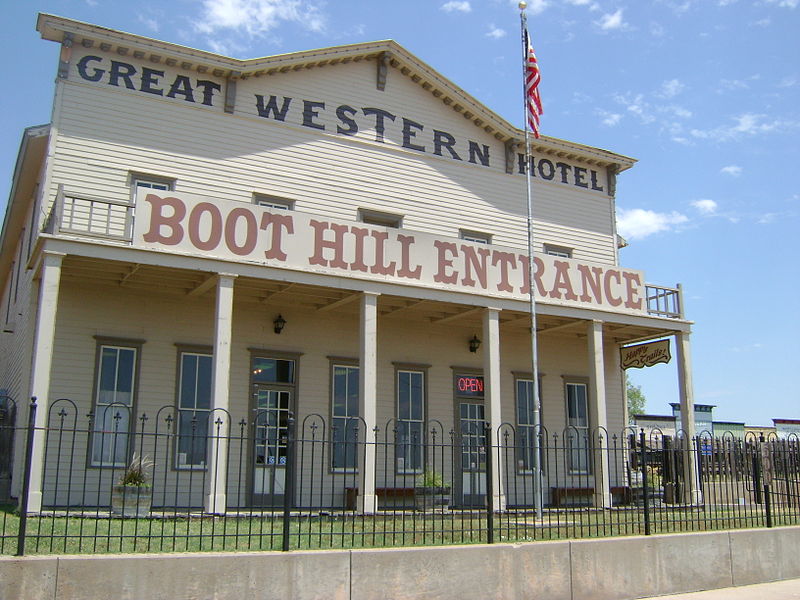
The military had no jurisdiction in Dodge, so there was no real law enforcement in the town. Railroad men, buffalo hunters, soldiers and drifters were known to settle their disputes with their guns, and the infamous Boot Hill cemetery was hastily created for those who “died with their boots on.” Others, those with money, friends, or community standing, were buried in the post cemetery at Fort Dodge.

With the only free bridge crossing the Arkansas (pronounced ARE KANAS in Kansas) River many wagon trains and settlers used the route taking them through Dodge while traveling west.  Once the railroad arrived, there wasn’t even time to build a depot (they used a box car as one) before shipping in and out of Dodge reached unbelievable records. Wheat, hides, meat, and flour filled dozens of cars each day, and the streets were packed with those bringing in things to be shipped, or picking up arriving supplies. Not even mining camps could compare to the riches being made in Dodge at the time. Everyone seemed to have money and nothing in town cost less than a quarter. When Governor St. John was visiting Dodge City on one occasion, he heard of a tornado that had devastated a little town near the Nebraska state line. Within two hours he raised over $1,000 from Dodge City residents and immediately wired the money to the other town.

The first jail house in Dodge City wasn’t a building at all. It was a dried up well, fifteen feet deep, in which offenders (mainly those who’d had too much to drink) were lowered into, and once they sobered up, they were allowed to use a ladder to climb out and be on their way. Dodge City was also known for its chivalry to women. All women were held at high esteem. If a man—any man—was witnessed (even unintentionally) jostling a woman, he was instantly ‘brought to his senses’ by a local bystander.
 
In 1875 the cattle days were born and for the next ten years Dodge City became the destination for many. Over five million head of cattle where driven up the Chisholm (western branch), the Great Western, or the Texas trails that all led to Dodge. Records indicate about 1200 people lived in the city proper in 1877, however the population varied, more than doubling as summer drew near the drives arrived. Gamblers, cattle buyers, prostitutes and others picked those opportune times to call Dodge home for a few months, and with nineteen establishments licensed to sell liquor, there was always a place to conduct business. 

Well-known lawmen and gunfighters took their turn in Dodge- Wyatt Earp; Bat, Ed, and Jim Masterson; Doc Holliday; William Tilghman; Clay Allison; Ben and Billy Thompson; Lake Short; to name a few.

Fort Dodge closed in 1882 and a few years later the cattle drives ended, but Dodge City remained strong. Due to its location and the numerous railroads, it continued to be one of the greatest overland freight hubs in the country, serving local cattlemen and farmers as well as many other businesses.

Made famous again by the TV series Gunsmoke, Dodge City has never lost its ability to draw in the curious. Still today, over 100,000 tourists visit Boot Hill and the historic Front Street.

Having grown up in southwestern Kansas, I’ve visited Dodge City many times, and never failed to have a wonderful time. 

All five of The Quinter Bride books—Shotgun Bride, Badland Bride, Boot Hill Bride, Guardian Bride and Wild Cat Bride--which are all currently on sale for just $2.99—were set in and/or around the Dodge City region.