Monday, November 13, 2017

Cinnabar Basin School House: A Small Piece of Montana History

Last summer, while searching online for a place to stay near the north end of Yellowstone National Park, my husband and I came across a HomeAway.com posting for Stermitz Ranch.  We'd been looking for a hotel in the town of Gardiner, Montana, just outside Yellowstone's north entrance. The ranch clearly wasn't going to be as convenient to the park. But it was a historic schoolhouse! On a ranch! As usual, we chose adventure over convenience and booked our stay.

Weeks later, heading into the mountains on a gravel road in the pitch dark with a carsick child, we questioned the wisdom of our choice. After an enormous day of driving we were all miserable. We reached the schoolhouse, found the key and stumbled into bed.

When we opened our eyes in the morning, we felt transported to another era.

When the owners of Stermitz Ranch decided to renovate the old, abandoned school house on their property, they were surprised to discover that many of the original furnishings and school supplies were still inside. They used them to decorate the one room cabin.


The old school books are still on the shelves.


The owners created a book about the schoolhouse that was pretty fascinating for a history buff like me.


After wandering around the school house, we stepped outside. While we knew the ranch would be beautiful, our surroundings still took our breath away.


And of course there were the horses. I couldn't wait to go riding, and I was thrilled when my little son said he'd like to go too.  Best of all, he absolutely loved it! In this photo he's meeting Reuger, the sweet horse he still talks about all the time.


While the location of the ranch isn't entirely convenient to Yellowstone, it was worth the extra twenty minutes of driving time. The road from the ranch to Gardiner follows the Yellowstone River.  We took the dirt back road and found ourselves driving through herds of antelope and elk.


Sometimes, taking a chance while traveling truly pays off, and our stay at the Stermitz Ranch Schoolhouse was one of those times.

Friday, November 10, 2017

Native Numbers

Before the Europeans came over on their handsome ships, before the “new world” was “discovered”, we’re told America was a great big empty land. Sure, there was an indigenous culture, but it was a handful of isolated people here and there, barely ever seeing each other. The continent was basically a blank canvas waiting for the mass of Europeans to come and settle it. A great wilderness with a giant vacant sign out front. Except it wasn’t.


Far from being just a bunch of ragtag tribes, Native Americans may have numbered as many as 100 million when Columbus first missed India by a few thousand miles. To gain perspective on this, one should know that the entire population of Europe numbered around 70 million in those days. Giovanni de Verrazzano, an Italian sailor, describes first seeing the East Coast of North America in 1523. “He observed that the coastline everywhere was ‘densely populated,’ smoky with Indian bonfires; he could sometimes smell the burning hundreds of miles away.”
It was Smallpox that wiped out about 90% of the population before the pilgrims arrived, contracted from European settlers used to living in close quarters with their livestock. Despite the plight of this plague, at least 1 million Natives still remained. And they were sophisticated. Television might have you believe the Natives were all about war paint and taking scalps, but there was more to the indigenous people by far. Native culture was all about extensive agriculture, opening up new trade routes across the continent and building America’s first city. Then “civilization” showed up, and any chance of recovering from that super-plague was swept away on a tide of smallpox, STDs and genocide.


About the Author:


I have been writing westerns for many years now. I feel my obsession with the Wild West stems mostly from my western heritage. My family is spread across the Appalachias, the Rockies, from the East Coast, all the way back to the west. I am mixed with Cherokee Indian, Irish, Black Foot Indian, French Creole, and several other nationalities I probably know nothing about. Through my journey to discover myself, I have managed to write some pretty amazing stories. If you would like to read any of my works you can find me at 

Wednesday, November 8, 2017

Hell Without Heat


I'm resharing  blog post I wrote two years ago after an early October blizzard decimated the cattle herds out West. 

I’m a weather watcher. This winter is seemingly starting early, starting out viciously and unseasonably cold (it’s ONLY mid-November!), and appears to be headed to another long, cold, and snowy winter, thanks to “polar vortices” and “above average precipitation” and “la nina” (or is it el nino?).

When I was a kid, we used to call this kind of weather “winter.” Last winter started out much the same and it was devastating for the cattle industry in places like Wyoming, the Dakotas, Nebraska, Kansas, and Iowa. Because the snow came very early, the cattle hadn’t put on their winter coats, and the snow was followed by the first, hard blast of the polar vortex, many ranchers lost a considerable number of head to hypothermia. It wasn’t that the ranchers don’t do all they can to help their herds survive the winter with hay feeding and by moving them down into lower pastures in the late fall or that the cattle couldn’t handle the cold and the snow under normal conditions—it was that “normal” wasn’t in play in fall and early winter last year.
Last winter and this year’s early arrival of winter make those of us who are Western history buffs think of the “Great Die-Up” on the Western Plains in the winter of 1886-87. The losses that winter were staggering and ruined many ranches. “Normal” wasn’t in play that winter, either.

The winter of 1886-87 came on the heels on one of the worst droughts that the settlers and ranchers on the Great Plains had seen in their limited time there. Prior to that winter, for many years of the preceding three decades of settlement, rainfall in a usually semi-arid land had been well above normal, creating lush landscapes on which to graze cattle. After the American Civil War, land was basically free for the taking under the Homestead Act and the land they grazed their cattle on was owned by no one so these cattlemen established codes to govern the West and to protect it from outsiders. Principal among such codes was the Law of the Open Range, the unwritten rule of free access to grass and water. Most did not own the land on which their cattle grazed, and thus the Law of the Open Range secured their rights, by warning farmer-pioneers “not to stand in the cowman’s route to the ranges, not to block his way with towns and fields–and of all things—fences.” The cattlemen had settled the West prior to the Civil War. It wasn’t until after the Civil War that their empire was built. After the Civil War the demand for beef reached unprecedented levels, driving the cattle to higher and higher values and more and more cattle were brought to graze the “free land” of the West.

Because of the railroads, that beef could be transported quickly and efficiently (either on the hoof or in rail cars specifically designed to transport meat kept cool with ice) to markets back East.
In the 1870s, barbed wire made its first appearance on the range, following the passage of The Homestead Act in the late 1860s. Now, smaller homesteaders could settle the Plains, keep their crops protected from ranging cattle and prevent access to water. The cattlemen were furious and range wars became the normal—but that’s a story for another day.
The rains dried up and the lush grasses that had first lured the cattlemen burnt in the summer sun. Two years of extreme drought was followed by one of the worst winters on record. The snows started in late October of 1886 and didn’t stop until the following May. There is a recorded period, from November 13, 1886 until December 24, that it snowed every single day. When it wasn’t snowing and would warm up to a few degrees above freezing, it rained. This rain created a cap of ice several inches thick on the snow cover. And when it would momentarily stop snowing or raining, the bitter cold would return.
In January of 1887, the blizzards came and with the blizzards came a kind of cold that locals call “freeze-eye cold”—a cold so intense and bitter it would freeze the moisture on eyelashes. Blizzards came howling over the plains, blasting the unsheltered herds. Some cattle, too weak to stand, were actually blown over. Others died frozen to the ground.
Starving cattle, already weakened by a lack of grazing fodder because of the drought, would attempt to paw through the ice and snow to what was left of the drought-blighted and sun-burnt grasses. “The cattle had the hair and hide wore off their legs to the knees and hocks. It was surely hell to see big four-year-old steers just able to stagger along” (Teddy Blue Abbott). The cattle would drift with the howling winds. Cattle won’t stop “drifting” until they run into an immovable object: a dead-end canyon, a rock face, a barbed wire fence. The results were horrific as one account states:
They moved “like grey ghosts” . . . icicles hanging from their muzzles, eyes, and ears,” directly into the fences. There they were stalled; they could not go forward, and they would not go back. They stood stacked together against the wire, without food, water, warmth or shelter. The pressed close against each other in groups all along the fence line, and sometimes they gathered in bunches reaching as much as four hundred yards back from the fence. Still there was not enough warmth in their huddled forms to counteract the cold, and within a short time they either smothered or froze in their tracks (Hill, J.L.. The End of the Cattle Trail. Austin, Texas: The Pemberton Press, 1969).

The spring thaw of 1887 (in late May) revealed the extent of the devastation. More than fifty percent of the cattle herds died that winter from hypothermia and starvation. Some ranches lost upwards of seventy-five percent of their livestock. Dead cattle were found everywhere, observed bobbing in the streams as the ice broke up, and discovered in large groups dying where they stood.
It was a perfect storm of conditions: decades of unusually high rainfall in a semi-arid land, overgrazed land, a severe drought that ended the wet period, too many cattle and the open range cut-up and sectioned off with barbed wire. The “Great Die-Up” as cattlemen called it in a dark attempt at humor marked the end of open range ranching, that supposedly sure way to riches which Theodore Roosevelt called “the pleasantest, healthiest and most exciting phase of American existence.” And it proved again that nature can at any moment shatter all sense of human control.

Tuesday, November 7, 2017

by Shanna Hatfield

Read a Book, Help a Cowboy!

JCCF_2017 REVISED 10-04-17.jpgNovember 1 through December 24,  ten percent of the net proceeds from all my book sales are donated to the Justin Cowboy Crisis Fund.
The JCCF is a non-profit organization that assists rodeo athletes who’ve sustained catastrophic injuries and are unable to work for an extended period. Every book purchased during this promotional period adds to the donation total. Don’t forget to include books on your Christmas lists!
Back in 2013, I was researching details for The Christmas Cowboy, the first book in the Rodeo Romance series. I wanted to know how much medical care an injured cowboy would receive at a rodeo versus going to the hospital.
In the story, the hero is a saddle bronc rider named Tate who sustains an injury at a rodeo. In an attempt to get my facts straight for the story, I reached out to the Justin Sportsmedicine Team®. Through mobile medical centers, they provide care at more than 125 PRCA rodeos annually. Their responses to my questions were extremely helpful and I was so impressed with them, I wanted to do a little something in return.
So I launched a campaign to donate a portion of my book sales to the JCCF during the month of December.
Two years ago, I added the month of November to my promotion, giving two months to raise funds for JCCF.
If you enjoy rodeos and the cowboys who make them possible (or reading about them in books), I hope you’ll take a look at the JCCF. It’s a great organization that really does make a difference when these cowboys are injured.

Be sure to come to the party planned Nov. 9 from 10 a.m. to 2 p.m. (Pacific Time) to kick off the campaign. Great prizes, giveaways, freebies, guest authors and more – so don’t miss out!


In addition to raising funds and awareness for the JCCF, I'll also celebrate the release of my fifth Rodeo Romance series book - Chasing Christmas!
He certainly didn't ask Santa for a bride. . .

Professional bull rider Chase Jarrett has the world on a string. The only blight in his idyllic existence is his nosy cousin’s nonstop nagging about his need for more publicity. Tired of listening to her suggestions, he gives her free rein when she hatches a plan to skyrocket his popularity. All he has to do is show up for a phony wedding in Las Vegas. Then Chase discovers the wedding was real, the surprise bride is beautiful, and his sponsors are demanding he remain married.

Shy and introverted, the last thing Jessie Pierce wants is to find herself in the spotlight. But thanks to a meddling so-called best friend, that’s exactly where she’s at. The promise of an all-expenses paid vacation to Las Vegas lures her on an adventure that ends with her unexpectedly married to a hunky bull rider who would draw her out of her shell if she’d let him.

A business proposal leaves the two of them committed to a year of marriage. How hard could it be to remain wed in name only?

Wrap yourself up in the joy of holidays and falling in love in this sweet, lighthearted romance from USA Today Bestselling author Shanna Hatfield.


 USA Today bestselling author Shanna Hatfield is a farm girl who loves to write. Her sweet historical and contemporary romances are filled with sarcasm, humor, hope, and hunky heroes. When Shanna isn’t dreaming up dreamy characters, twisting plots, or covertly hiding decadent chocolate from the other occupants of her home, she hangs out with her beloved husband, Captain Cavedweller.

Shanna loves to hear from readers. Follow her online at:

Find Shanna’s books at:

Monday, November 6, 2017

Madame Blavatsky

By Kristy McCaffrey

Helena Petrovna Blavatsky was an unconventional figure to emerge from the Victorian era, a time of high morals and puritanical behavior. Born in Russia in 1831, she was self-educated and widely-traveled, developing an interest in Western esotericism during her teenage years. She also claimed to be a psychic.

The rise of science in the 19th century had had a paradoxical effect—it undermined faith in Christianity and the literal word of the Bible while also creating an enormous void for an explanation to the mysteries of the universe. People became caught up in table-rapping, materialization, séances, clairvoyance, palmistry, and crystal-gazing.

In 1849, Blavatsky visited Europe, the Americas, and India, and it was during this period that she encountered a group of spiritual adepts known as the Masters of the Ancient Wisdom. They sent her to Tibet where she developed her psychic powers. Many critics dispute these claims, saying she fabricated these travels.

By the 1870’s, Blavatsky was involved in the Spiritualist movement, supporting the existence of Spiritualist phenomena (making contact with elementals and spirits). In 1875, she co-founded the Theosophical Society, describing Theosophy (wisdom of the gods) as “the synthesis of science, religion and philosophy.” Based heavily on occult teachings and Eastern religions, her work in the Theosophy movement influenced the spread of Hindu and Buddhist ideas in the West, with some Theosophists becoming Buddhists.

According to Blavatsky’s biographer, Marion Meade, people across the globe furiously debated whether the medium was “a genius, a consummate fraud, or simply a lunatic.” Madame Blavatsky had professed to be a virgin, but in fact, she had two husbands and an illegitimate son. She claimed to be an apostle of asceticism but smoked up to two hundred cigarettes a day and swore like a soldier. She was considered an enlightened guru while at the same time ridiculed as a fraudulent charlatan and plagiarist, but there is no doubt that her ideas eventually led to the New Age movement in the 1970’s.

Blavatsky died of influenza in 1891 at the age of 59 in the home of her disciple and successor, Annie Besant.


Connect with Kristy


Friday, November 3, 2017

Putting it all together

The Badlands

The plane begins its descent. The dun-colored ground below is dotted with little, black holes. As we get closer, little animals can be seen scurrying around the holes. "Ground hogs," says the passenger behind me to his wife. For the first time since leaving Chicago the handsome man wearing cowboy boots and a Stetson who is sitting next to me speaks. "No, those are prairie dogs. " (I knew that).

After we land and collect our luggage my husband and I make our way to the rental car lot. Posted on the automatic doors is a sign warning us about rattlesnakes. I start to get excited. West, here we come. When we step outside we are bowled over by the big, blue sky above and the endless fields of golden grassland stretching out before us. The sight sparks a debate between us about which great plains state boasts it's Big Sky Country. Is it South Dakota, where we landed or Montana? We waste some time running around the parking lot looking at car license plates to find said motto (all the while being mindful of rattlesnakes) trying to settle this dispute to no avail. It's Montana, by the way.

Big Sky over Little Bighorn Battlefield, Montana


I'm just a girl with long Midwestern roots, but I've always had a fascination for all things western. I've written both historical and contemporary westerns, relying on images from my computer to create my settings. I have made a number of trips to the southwest, which I love, but never to the other parts west. Writing this blog has sent me on further online excursions. I don't think I knew how much I've really learned until plopping down in South Dakota, jumping up to Montana, and finally ending up in Wyoming.

All during the trip I had the odd sensation of having islands of information in my head, but I couldn't piece them all together. It was overwhelming! As we traveled on, I likened the feeling to quilting in that I not only had pieces to stitch together but layers of time to go through as well. I pictured stitching the top of the quilt to the bottom and connecting it to the layers in between: the history, the personalities, the pivotal moments, not to mention current events such as the Dakota pipeline protests.

This may be a sneaky way of showing you my vacation pictures, but here we go!

Sometime ago I wrote a blog post about sod houses. http://cowboykisses.blogspot.com/2017/03/the-ould-sodhouse.html so when I heard the oldest, intact sod house in existence was on route, I had to see it. We were told it had already closed for the season, but when we got there it was open! The Prairie Homestead sits outside the Badlands of South Dakota. It was a beautiful, sunny day and walking around the homestead, surrounded by fields of grass with the Badlands in the distance, I got some sense of what it would have been like to be one of the early families trying to carve out an existence. When I stepped inside the low, dark house I think what surprised me was how solid it felt. The sod dried like blocks of cement so it wasn't as crumbly or dirty as I imagined, though I shudder to think about spending a cold, rainy day in there.

Inside a sod house, Prairie Homestead, South Dakota

While visiting the Badlands, we stayed in Wall, S.D., home of the famous Wall Drug, which to me previously was just a place where bumper stickers are born. You drive into town and there is billboard after billboard advertising Wall Drug promising free ice water, 5 cent coffee, and if you're on your honeymoon, free donuts. There's not much in Wall besides Wall Drug, which covers almost an entire block, and we were thinking we were not going to be lured into the tourist trap. Well, we actually made two trips there before we left, because it was fun! The stores within one big store were  a blast. We did get free ice water.
Delighted to find free ice water in South Dakota
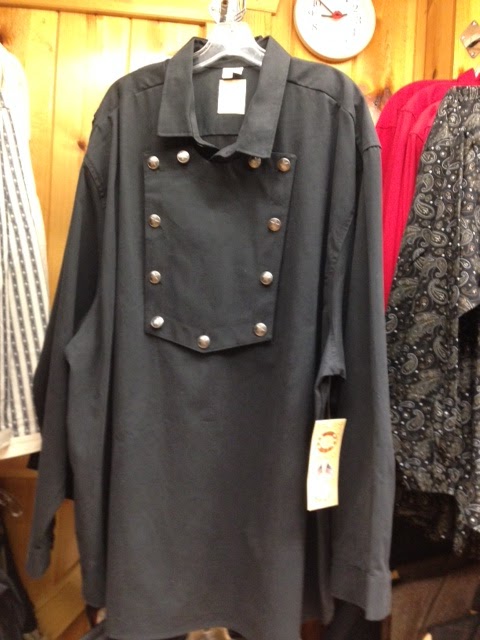
But somehow along the way to get the free ice water, our baskets got filled with shot glasses, salt and pepper shakers, and playing cards--basically anything with a jackalope printed on it (kids, it's going to be a jackalope themed Xmas this year). My husband even left with a lariat coiled around his shoulder. Typically, we don't have to rustle cattle in the suburbs of Chicago, but the longer the time spent in Wall Drug, the more he needed a lariat. I was excited to find so many items of western wear I'd written about. There were western wear shirts with snaps and yokes and even the shield fronted shirt. And walls and walls of cowboy boots and hats. http://cowboykisses.blogspot.com/2017/09/dress-like-cowboy.html?spref=pi

shield or bib front western shirt at Wall Drug
Next we headed up to Deadwood. The image of Wild Bill Hickok is plastered everywhere.

Wall O'Bill

 You'd think he founded the town. In reality, he was shot and killed on his one and only visit to Deadwood--where he'd only been about two weeks. To add insult to injury, the man has to spend eternity in boot hill next to Calamity Jane, who had a crush on the recently married Bill and requested she be buried next to him. Some reports say he barely knew her and found the whole thing embarrassing.
Mount Moriah Cemetery, Deadwood, S.D. Buffalo Bill wasn't in Deadwood a hot minute before he was shot in the back. Now he is forever associated with the town and doomed to spend eternity next to Calamity Jane.

But one person Wild Bill did know was Buffalo Bill Cody. He even performed in the latter Bill's Wild West Show. http://cowboykisses.blogspot.com/2017/07/the-wild-west-show-shaping-legend.html?spref=pi

Next, on to a place that has acted as a siren call for me for as long as I can remember: Little Bighorn Battlefield. Let me just say it did not disappoint. We spent all day there and it warrants a post all to itself, so I won't go into it too much here. I did a piece for this blog on the evolution of the place over time from a battlefield to a monument and the changes along the way. http://cowboykisses.blogspot.com/2017/08/little-bighorn-national-monument.html?spref=pi

Where they fell 

We left Montana and headed down to Wyoming. First stop Cody! There we meandered the boardwalks of Old Trail Town where buildings of historic note have been moved like the cabin of Jeremiah Johnson and the saloon the Hole in the Wall Gang hung out complete with bullet holes in the swinging doors. When I wrote Margarita and the Hired Gun, I set part of the story in an outlaw hideout, so I was especially excited to see the actual cabin Butch Cassidy and the Sundance Kid lived while hiding out in Hole in the Wall. A number of impenetrable hideouts were spaced along the Outlaw Trail, Hole in the Wall being one of them. http://sweetheartsofthewest.blogspot.com/2016/04/outlaw-hideouts-and-book-giveaway-by.html (note the book giveaway mentioned in the blog is no longer running).

Old Trail Town, Cody, WY

For me, on this trip the main course was Little Bighorn Battlefield. All stops leading up to that day were appetizers. Now time for dessert! We drove through Yellowstone (in a blizzard) and went to visit fellow author Andrea Downing in Jackson Hole and the Grand Tetons! It was so much fun to meet Andi in person. She, in fact, mapped out the route of our journey for us. 

Two authors cutting up under the antlers

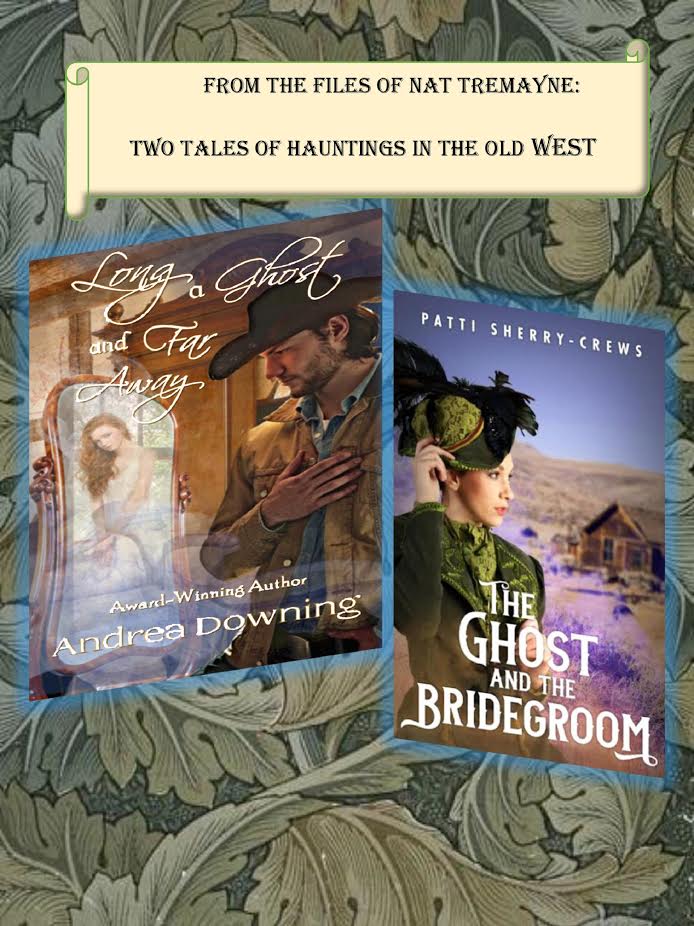
It wasn't all fun and games in Jackson Hole. Andi and I were able to finalize a joint project. We re-released our stories that were in the anthology The Good, the Bad, and the Ghostly under the title From the Files of Nat Tremayne: Two Tales of Hauntings in the Old West. The eight stories in the original anthology were all connected by a detective agency specializing in paranormal events. It was a fun project to work on, and I'm happy to see our work live again. This week the book is on sale for $0.99. Get it. It's a good one: spooky, funny, and above all--romantic.


All images courtesy of  me!

Wednesday, November 1, 2017

Silver Heels

Buckskin Joe, CO
Back in the day, jobs were scarce for women. Positions that are mostly filled by a woman in modern times, such as a secretary or a school teacher, were usually filled by a man. Respectable positions for women included a seamstress, nanny, and maid, but most homes couldn’t afford to pay for even one of these positions. Single women who’d fallen on hard times and had no family to turn to for help were often forced into prostitution as a means of survival. While the profession is degrading to women by today’s standards, back in the day, prostitution served a role in the expansion of the west. 
The Gold rush saw thousands of men pull up stakes and head west in the hopes of striking it rich. Some brought their families. Oftentimes, a man struck out on his own. Tent camps, small towns and cities sprang up throughout the west, and where men gathered, one need was shared by all; a woman. Females desperate for income or looking to escape a bad situation followed the men to provide a service. But whether working in a lavish parlor house, crib, or an in-between establishment, most didn’t get rich. And most never left the life of a soiled dove. A few women rose to wealth and fame, and some had a heart of gold. One such woman destined to help others now bears two legends—Silver Heels. 
Dance Hall Girls
Silver Heels’ first legend states she was a parlor house girl and a dance hall girl at Buckskin Joe, a mining town north Fairplay, Colorado. Many claimed she had a beautiful face and could dance faster and more gracefully than the other girls. She also wore glittering silver slippers, hence her nickname. It was said children adored her because she sent to Denver for candy to give to them.
Legend has it Silver fell in love with one of the miners and was engaged to be married to him. Before the two wed, smallpox struck the Buckskin Joe area and the town closed. Women went back to Fairplay, except for Silver. She stayed to help her fiancée. Sadly, he was one of the first to die from the disease. Silver remained in Buckskin Joe and moved from cabin to cabin to help the other miners stricken with the disease. She kept their houses clean, cooked meals and washed clothes all the while tending their illness. Once the epidemic broke, the town returned to life. Those grateful to Silver collected money to give to her to thank her for her help, but she couldn’t be found. She had secretly left town. Still wanting to acknowledge her good deeds, the miners named the highest mountain in the area after her.
Some years later, a woman wearing heavy black veils visited the cemetery beneath Mt. Silver Heels. The miners believed the woman was Silver Heels, returning to pay respect to her fiancée’s grave. 
Buckskin Joe, CO
Silver Heels’ second legend is more detailed and takes place in Dudley, which is stated to be near Fairplay and Buckskin Joe. A young woman of great beauty arrived in the mining camp, fresh off the stage from Denver. The crowd waiting for the mail noticed she seemed lost and confused. Jack Herndon, owner of Dudley’s main saloon and gambling hall, helped the woman. He took her to Mr. And Mrs. Mack’s home, where she could rest and gather her wits. It’s said during her stay with the Mack’s, the woman confided her past to Mrs. Mack, which Mrs. Mack kept secret. Later, Jack learned the woman’s name was Josie Dillon.   
Josie stayed with the Macks and helped in their kitchen. She also sent to Denver for candy to give to the children, often inviting them to the Macks’ home where she told them stories. During this time, she took a liking to Jack and the two fell in love.   
News of the great Chicago fire spread to the area. As a community, the townsfolk wanted to do something to raise money to help the people in Chicago. Several ideas were suggested, but it was Josie who came up with the idea she would sing and dance and if folks liked what they saw, they could leave a donation in a box. Jack closed his saloon for this meeting and for two-day event featuring Josie. She appeared on stage in a short, glittery dress most thought were diamonds outfitted around the neck and edge of the dress. But it was her slippers that earned her the nickname ‘Silver Heels’. Except for toes shining in gold, her slippers were all silver.
Silver Heels Mountain CO
The citizens loved Josie’s singing and dancing so much that they donated over seventeen hundred dollars to give to the people of Chicago. After that, Jack sold his saloon and went into mining, and he and Josie continued to see each other. Then two sheepherders came to town. Two of them came down with smallpox and were the first to die. Josie, Jack and the Macks took care of those stricken with the disease. Jack fell ill but did not die. During the epidemic, it is said the miners remembered Josie’s performance and took to calling her Silver Heels. Jack didn’t care for the nickname, but Josie allowed it, and shortly after the crisis passed, Jack and Josie went to Denver, married and returned, only to leave for Kentucky after Jack’s father died and his mother needed help. After they left the area, legend states a survey crew came to the area. They needed a name for one of the larger mountains. The miners suggested Silver Heels and that’s how the mountain got its name.

Personally, I like the first version of Silver Heels the best, but then, a little bit of romance mixed with heartache and mystery is a fondness of mine.