Saturday, June 11, 2016

Welcome Back Andrea Downing #coffee

THE COFFEE THAT WON THE WEST

Some years back I was deeply engrossed in reading a number of cowboy memoirs of the late 19th and early 20th centuries, doing research for the historical western romance I was writing.  I was amused to discover the number of everyday products the men mentioned consistently, some of which have now gone from the shelves.  There was Sapolio soap powder, Eagle Brand milk (still going strong) and, as any western historian will know, Arbuckles’ for coffee.  Ike Blasingame, in his Dakota Cowboy, (University of Nebraska Press, 1958)  gives Arbuckles’ more than a passing mention; he describes the chuck wagon and “A flat-sided coffee grinder was bolted to the side of the wagon, handy to reach, for in those days our coffee was made from freshly ground coffee beans.  Most all outfits used the famous Arbuckle brand.  It came in huge burlap bags holding one hundred one-pound packages of whole beans which were ground in the mill as needed.  I remember the stick of candy in each package, as well as a coupon, good for dozens of premiums—handkerchiefs, lace curtains, shears, Torrey razors, and jewelry of all descriptions, including wedding rings.”
So, what’s the story behind the “Coffee That Won the West” and what’s  become of it?
Right up through the Civil War, coffee was primarily sold ‘green’ and had to be roasted by the consumer.  On the range,  this was done in a skillet over the campfire or, at home,  in a wood burning stove, and it had to be done in small batches:  while green coffee beans could be stored indefinitely, roasted beans were subject to oxidation, leaving the beans rancid within a couple of weeks.  Furthermore, such individual roasting made for inconsistency, and one burnt bean could ruin an entire batch. Beans sold by grocers pre-roasted were subject to not only this inconsistency but also to mixed quality, and to the vagaries of the grocers’ scales.
The family grocery business of Arbuckles’ was established in Pittsburgh in 1859.  John Arbuckle dropped out of college to join the firm, which later, in 1865, included his brother Charles. His first innovation was to pack roasted coffee beans in 1-lb. packages, ready for the customer.  In 1871, the Arbuckles Bros. Co. was formed, and moved to New York.  John Arbuckle then went on to invent an egg and sugar glaze that “closes the pores of the coffee, and thereby all the original strength and aroma are retained.” (From the back of an Arbuckles’ trade card, circa 1890s). Packed in l lb. packages, the coffee was an instant hit and Arbuckles’ Ariosa Coffee was born.  By the 1880s, Arbuckles’ was the largest coffee importer in the world.
Part of their success was due to their marketing innovations.  The bags of coffee were packed in sturdy crates, which eventually found their use in grocery store shelving and other impromptu uses such as repairing homes for the Navajo in AZ.  Now collectible, one crate that survived intact recently sold at auction for $300.  The bags themselves had an attractive, bright red and yellow label, and contained a peppermint stick; this proved to be a means by which Cookie could bribe cowboys to grind the beans.  Arbuckles’ was also the first, in 1873, to advertise coffee on a full color handbill.  And best promotions of all were the coupons, as Ike Blasingame mentions above, along with trade cards.  The trade cards were works of art in themselves, and the different series included all the US states, countries of the world, humorous sketches, patriotic scenes, and maps.
The reverse side could be anything from an ordinary postcard backing to advertising slogans, recipes or a picture of the factory as above.  Now collectors’ items, they are often available on eBay, and a cookbook of the recipes has also been released.
While the Arbuckle Bros. diversified into other areas of commerce, including sugar refining, and owned a ranch in WY as well, it was as coffee magnates that they were primarily known.  When 20th Century improvements in packaging made the glazing of beans unnecessary, the company continued to blend premium coffees.  John Arbuckle developed a ‘Yuletide’ blend that was eventually marketed as Yuban, now owned by Kraft Foods.  Sometime after John Arbuckle’s passing in 1912, the company was sold on to C.W. Post of cereal fame, eventually becoming part of General Foods.
But the Arbuckles’ story doesn’t end there.  In 1974, Pat and Denney Willis decided to start a company in order to provide their restaurants with coffee of a consistently good quality.  They took on a salesman named Ken Arbuckle who claimed to be descended from the Arbuckle Brothers—and so Arbuckles’ Ariosa Coffee was resurrected.  Now located in Tucson, it still comes with a peppermint stick inside the bright red and yellow 1 lb. packages, and cowboys today can still say ‘they ain’t worth shootin’ ‘til they’ve had their Arbuckles’.
To read more about my coffee-drinking cowboys, please visit me at:

WEBSITE AND BLOG:  http://andreadowning.com
Twitter:  @andidowning  https://twitter.com/AndiDowning
Linkedin:  http://www.linkedin.com/profile/view?id=124888740&trk=nav_responsive_tab_profile_pic


Wednesday, June 8, 2016

#WomenoftheWest Calamity Jane

How many haven't at least tried to watch Deadwood (remember the series?)? I tried, needless to say, I picked up season 1 after going through every season of Justified. Then finding out Timothy O. also was in Deadwood, I wanted to give it a try. Definitely slow moving and gritty. I didn't mind the gritty, but some episodes I had to keep myself from fast-forwarding through. Needless to say, one day I plan on trying out season 2  - I just don't know when I'll be brave enough.

In any case, Calamity Jane makes her "appearance" in Deadwood (and, if we're being honest, I didn't care much at all for her character).

She grew up to act and look like a man ..but was known for her quick draw as much as she was her kindness.

In 1870 she joined with Custer as a scout at Fort Russell, opting to wear the uniform of a soldier and birthing Calamity Jane. In 1876, after recovering from an illness, she set out on her orders to head to Fort Laramie where she met Wild Bill Hickok. Both being heavy drinkers, they instantly connected. Together they headed to Deadwood, South Dakota.

While there has always been speculation that the two were romantically involved, there is absolutely nothing to confirm this.

Upon living in Deadwood, she took one of the roughest 50 mile routs for the Pony Express in Black Hill Country.

Once Wild Bill had been killed at a poker table, Jane kept to her lifestyle of drinking and traveling around. By August of 1903 she was back in Deadwood and dying. Her dying wish was to be buried by Bill (which was granted).

Tuesday, June 7, 2016

Prohibition in Pendleton

by Shanna Hatfield

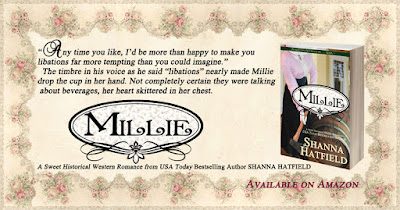
The latest installment in my Pendleton Petticoats series releases this week. In the story, Millie Matlock is leading the local Women's Christian Temperance Union to drive the saloons out of town. Gideon McBride is a saloon owner who also happens to be the one man who turns Millie's head.


http://amzn.to/1SzeYoO
 The story is set in 1908, when the citizens of Pendleton, Oregon (along with the rest of the county) voted to go "dry" and bring prohibition to the area.

As I started digging into the research, I couldn't help but question why a town that boasted more than thirty saloons and nearly 18 bordellos would suddenly decide to go dry.

In truth, I never found the exact reason why prohibition became an issue. Although Pendleton had a population of 4,406 and was the fourth-largest city in Oregon in 1900, it  catered to the surrounding communities as an "entertainment hub." Cowboys, wheat harvesters, sheepherders, railroad workers, miners, and crews of men who descended on the town to work could find quite an assortment of places to drink, play cards and visit soiled doves.

In late spring of 1908, articles began popping up in the newspaper about the possibility of prohibition. A special voter’s edition of the Pendleton newspaper was published May 22, 1908. It urged voters to consider the financial impact prohibition would have on the town. 


According to the article, the city would lose more than $23,000 in liquor licenses alone if prohibition came to town. With rent, salaries, and other expenses, it was estimated the abolition of liquor business would leave a deficit of approximately $270,000 (around $6.6 million in today's economy). Not only would prohibition create a significant loss of income, it would leave thirty businesses empty and a few hundred people seeking a new means of support.

When ballots were cast in the June 1 election, prohibition passed in Umatilla County, but also in three neighboring counties as well.

The saloon owners had until June 30 to close their businesses. According to newspaper articles, the saloons went out of business without much fanfare on June 30, 1908 (several closing at midnight) and only one man was arrested that night.

A group of saloon owners did their best to have the vote declared illegal, citing an improper navigation of voting protocols. Other than running up attorney's fees, nothing came of their efforts.

Although Pendleton went "dry," twelve saloons were allowed to retain their liquor licenses and remain in business. The how and why those twelve were given special treatment is lost to history.

In years between then and the time when prohibition officially ended across the nation in 1933, many underground drinking rooms and escape tunnels popped up throughout Pendleton.


~*~

http://amzn.to/1SzeYoO


He watched as Millie sipped her hot chocolate. As soon as she lowered the cup from her mouth, he took it from her, placing his lips in the exact spot hers had been. While he tasted the rapidly cooling drink, he stared at her over the rim of the cup. His green eyes locked on hers as he handed the cup back to her. “That’s not bad, but I like a pinch of cinnamon and a dollop of whipped cream in mine.”

In a huff, she scowled at him. “I don’t recall offering to share my chocolate with you.”

“Oh, what’s one little sip between friends, Miss Matlock?” Gideon laid on his charm, smiling in such a way it did great justice to the dimples in his cheeks. Ever so slightly, he bent closer to her and lowered his voice. “Any time you like, I’d be more than happy to make you libations far more tempting than you could imagine.”

The timbre in his voice as he said “libations” nearly made Millie drop the cup in her hand. Not completely certain they were talking about beverages, her heart skittered in her chest.

Unsettled, her gaze shot to his, yet he continued to smile in an amiable, almost boyish manner, appearing innocent of any indecent implications.


~*~
Shanna Hatfield 2Convinced everyone deserves a happy ending, USA Today best-selling author Shanna Hatfield is out to make it happen, one story at a time. Her sweet historical and contemporary romances combine humor and heart-pumping moments with relatable characters. When this hopeless romantic isn’t writing or indulging in rich, decadent chocolate, Shanna hangs out with her husband, lovingly known as Captain Cavedweller.
Find Shanna’s books at:
Shanna loves to hear from readers. Follow her online at:  

Monday, June 6, 2016

Mary Jane Colter

By Kristy McCaffrey

Mary Jane Colter
A visit to the Grand Canyon is remarkable for many reasons, not the least of which are the various buildings designed by Mary Elizabeth Jane Colter. In 1902, she became an architect, designer, and decorator for the Fred Harvey Company. At the time, American architecture followed the fashions of Europe, but Mary preferred to let her conceptions grow from the land, paying homage to the Native Americans who inhabited the area. Her designs include Hermit’s Rest, Lookout Studio, Bright Angel Lodge, Hopi House and the Watchtower—all located on the South Rim of Grand Canyon—along with Phantom Ranch, situated at the bottom of the canyon.

Mary Jane Colter was born in Pittsburgh, Pennsylvania, and while her family lived briefly in Texas and Colorado, the Colter’s finally settled in St. Paul, Minnesota when Mary was eleven, and she always considered this her home. She desired to pursue art as a career but couldn’t due to family opposition. It wasn’t until the death of her father that she moved toward following her dream.

Hopi House
Mary attended the California School of Design in San Francisco, studying art and design. Few universities taught architecture, so she apprenticed with a practicing architect. This was unusual for a woman, but Mary was determined. In 1890, as a new graduate, her biggest concern was finding a job to support her mother and sister. She returned to St. Paul as a teacher. In 1892, at the age of 23, she began a 15-year teaching career at the Mechanic Arts High School, an all-boys institution. Mary taught freehand and mechanical drawing, and after eight years her salary rose to 90 dollars a month. Ambitious, she also lectured at the University Extension on world history and architecture, and participated in the Century Club lectures in Minnesota and Iowa. In addition, she reviewed books as the literary editor of the St. Paul Globe. On her own, she studied archaeology. To her delight, she would eventually receive a job offer from the Fred Harvey Company.

Hermit's Rest
The Fred Harvey Company operated gift shops, newsstands, restaurants, and hotels of the Atchison, Topeka, and Santa Fe Railway beginning in 1876. Mary’s first assignment was to decorate the Indian Building which was adjacent to a new hotel built in Albuquerque. Once that job was complete, however, the company had no more work for her and she returned to St. Paul to teach.

Lookout Studio
In 1904, when the Santa Fe Railway determined to extend a line to the south rim of the Grand Canyon, the Fred Harvey Company decided to build a hotel at the edge. Plans were commissioned for El Tovar, and Mary was hired to design an Indian building across from the hotel, which resembled a Swiss chalet. Her building, Hopi House, was based on Hopi dwellings located in Oraibi, Arizona. Once again, with this project complete, Mary returned to St. Paul and to teaching, needing the steady income it provided. Soon thereafter she took a job in Seattle to develop a decoration department for the Frederick and Nelson Department Store, and her mother and sister accompanied her. Tragically, her mother died within a year after becoming ill from pernicious anemia.

The Watchtower
In 1910, at the age of 41, Mary was finally offered a permanent job with the Fred Harvey Company. She would design and decorate the new Fred Harvey hotels, restaurants, and union station facilities, a coveted position, especially for a woman. She wasn’t without her detractors, as a railroad man once complained of her “poorly illuminated buildings.” Mary often used soft lighting to create a restful atmosphere.

Bright Angel Lodge
Those who knew Mary Colter describe her in many ways. To her critics, she was a small woman with piercing violet eyes and hair that was never combed. She chain-smoked, was outspoken, and even cruel at times. To her friends, she was tall and stately, a wonderful woman, fun to talk with, and a happy person interested in life around her. Once her designs of Phantom Ranch were constructed—individual cabins, a large dining hall, and a recreational hall at the bottom of Grand Canyon—she took the mule trip down to view her new buildings. At 53, she remained in good health.

Phantom Ranch
For 30 years, she worked as an architect (few women did) and completed 21 projects for the Fred Harvey Company. She considered the La Posada Hotel in Winslow, Arizona her masterwork. It still stands today.


La Posada Hotel

In 1948, Colter retired to Santa Fe, New Mexico, and passed away in 1958 at the age of 88.

* * * *


Connect with Kristy

Wednesday, June 1, 2016

Cowboy Slang & Humor


courtesy of: pinterest.com

Every generation has its own slang and humor. The same can be said for an era. The 1800’s is no exception. The cowboys from the Wild West had some colorful and funny expressions. I shared some with you last year and have chosen more to share with you this year. Enjoy!    

All horns and rattles: a person displaying a fit of temper

Among the willows: a person dodging the law

Bangtail: a mustang or wild horse

Barkin’ at a knot: trying to accomplish the impossible
Case of slow: a loser in a gunfight

Chew gravel: to get thrown from a horse

Couldn’t drive nails in a snow bank: said of an ignorant person

courtesy of: www.directory-online.com
Didn’t have a tail feather left: one cleaned out at the gambling tables, or one thoroughly broke

Dough belly or dough boxer: slang for the cook

Duffer: codger, or useless fellow

Educated thirst: a man who drinks champagne or fancy mixed drinks

Fence lifter: a very hard rain

Fish: a yellow oilskin slicker

Flag his kite: leave in a hurry

Full war paint: a cowboy’s best Sunday-go-to-meeting clothes

Grabbin’ the brandin’ iron by the hot end: taking a chance

Guns on the table: fair play

Gut-warmer: slang for whiskey

courtesy of: pinterest.com
Hair case: slang for a hat

Heart-and-hand woman: a wife obtained through a matrimonial agency

Hide-out: a shoulder holster (I found this one interesting because my first instinct was a place where outlaws lay low)

Idaho brain storm: a twister or a cylindrical sandstorm

Ivories: poker chips

Jaw cracker: a traveling dentist

Just a ball of air: a very thin cow or calf.
courtesy of: pinterest.com