Showing posts with label #PlainsIndians. Show all posts

Friday, November 6, 2020

Ledger Art of the Plains Indians

by Patti Sherry-Crews


Dance

Ledger art is a type of narrative drawing done by Plains Indians, which emerged largely between the 1860's and and 1920's. Not so coincidently this was a time period of heightened contact, often hostile, between Native Americans and encroaching white civilization. Ironically, this close contact provided the Plains tribes with the tools to record the demise of a way of life.

Ledger Book


With their need for record-keeping and list-making, missionaries, military officers, traders, and agents came equipped with ledger books, pencils, and watercolors. These ledger books and drawing implements provided the Native Americans with a very portable, easy to use art medium.

Previously, painting was done on hides. Women typically worked in abstract design on portable artifacts such as bags or parfleches, while the men decorated shields, shirts, and tipis with representational art depicting visions, bouts of warfare, or hunting feats. Buffalo hides were a favorite canvas, but when the herds were decimated by the white men, buffalos became a scarce resource.

Bison Hunt


Ledger art depicts scenes of action without the noise of any images filling in the background--other than perhaps, lines marking columns and rows on the paper, making striking statements. Sometimes these works of art were communal with for instance, one artist drawing the people while another artist drew the animals. Other times the individual artists are known and their names have passed down to us. 

A large collection of ledger art came out of Fort Marion, Saint Augustine, Florida where a mixed group of 72 Cheyenne, Kiowa, Comanche, and Arapaho Indians were imprisoned there between 1875 and 1878. 

The battles between U.S. soldiers and Indians have proved valuable because we get the other side's view of the events. For instance, it's not true that there were no survivors of the Battle of the Little Bighorn. None of the men under Custer's command survived but there were thousands of survivors on the Indian side, and the ledger art they left behind has helped historians understand what happened on that day. 

Battle of Little Big Horn by White Swan


Sand Creek Massacre


Or glimpses of intertribal warfare.

Kiowa Mounted Warfare


Crow and Cheyenne Warriors 


The images presented in this narrative artform show a culture in transition and a memorialization of the before-days prior to reservation life. 


Big Elk's Tipi, complete with painting of two river steam boats 

Lakota Sioux Chief, Black Hawk, Depicting a Horned Thunder Being or Haokah


Images courtesy of Wiki Commons

You can find Patti Sherry-Crews books on Amazon
 https://www.amazon.com/Patti-Sherry-Crews/e/B01C7L8QUU


Friday, January 4, 2019

Wolf-Dogs and Leaping Buffalo


There was a time when the grasslands of the Great Plains were thick with buffalo, an important resource to the nomadic Native American tribes for centuries. When you think about Indians hunting buffalo this is the image that comes to mind, right?

Indians Hunting Buffalo, by Charles Marion Russell 

A mounted rider, skillfully chasing down a single beast and taking aim with bow and arrow. And that happened...but not until sometime after the introduction of the horse by Spaniards in the 16th c.
And it wasn't until the mid 18th c that the horse became fully part of Great Plains Indian culture, changing their lifestyle.

And yet, before that time there was this...

Pack Dog Pulling Travois 


And this...

Driving the Herd Over a Cliff

In the 1970's during construction of Interstate 90, engineers encountered a problem in the form of a hole. A big hole that would need filling before roadwork could begin. Fortunately, a few exploratory digs revealed that the hole was filled with bones, and archaeologists from the University of Wyoming were called in. A significant find was discovered and Interstate 90 was slightly rerouted.

Somewhere between the Black Hills of South Dakota and the Devils Tower in Wyoming is The Vore Buffalo Jump, one of many such natural kill sites in north central America and Canada.
The Vore Buffalo Jump, named after the Vore family ranch it sits on, is a sink hole 40 feet deep and 200 feet in diameter.

It was used as a kill and butchering site from about 1500 AD to 1800 AD by the Kiowa, Apache, Shoshone, Hidatsa, Crow, and Cheyenne tribes, who every fall harvested the buffalo for their meat and hides in preparation for winter. The sinkhole contains the bones of approximately 20,000 buffalo who plunged to their death.


Excavation at Vore Buffalo Jump (author's photo)

How do you convince a herd of buffalo to leap headlong off a cliff? One way is to deck out your fastest runner in a buffalo robe and headdress. Then while others harass the animals into running, the decoy "buffalo" positioned between the cliff edge and the herd, lures them in his direction. Then the decoy jumps out of the way (hopefully) into a safe cranny while the buffaloes in the rear push the buffaloes in the front of the herd over the cliff.

But it wasn't only buffalo bones that have been found (the site is only 5% excavated, by the way) but projectile points, stone tools, and five canid skulls. And because the silt washes down periodically it covers and preserves the aftermath of each separate event like a snapshot of the mayhem that took place on a day so long ago.

I was fortunate enough to visit the Vore Buffalo Jump in our trip west in 2017. It was supposed to be closed for cleaning but they let us in for an informal tour. Among other things of interest, the five canid skulls, or wolf-dogs caught my attention because they tell of a time before horse-culture took over the Plains.

Looking down into the sinkhole. The roofed structure covers active archaeological work. (Author's photo)
Before horses, there were no beasts of burden on the plains other than dogs. It was common for the dogs to breed with wolves who were in proximity to the camp, and in fact this breeding was often facilitated by humans in order to get a bigger dog. The five skulls found at the Vore site were large hybrid wolf-dogs, and their canine teeth were purposely broken or filed off, making them less threatening to humans and each other. But breaking the long canine teeth put more stress on the back teeth, which were worn down and in the end compromised the health of the dogs.

The wolf-dogs weren't used in the buffalo hunt itself as their tendency to chase would interfere with an organized herding effort. They would have been tethered back at camp. So how did the wolf-dogs skulls end up in the pit? It's likely that after the Indians had butchered and taken their gains back for a communal celebration, they let the dogs have a free-for-all amid the scraps. The dogs found in the pit may have been killed competing with other predators, where without their canine teeth, they wouldn't be able to defend themselves properly.

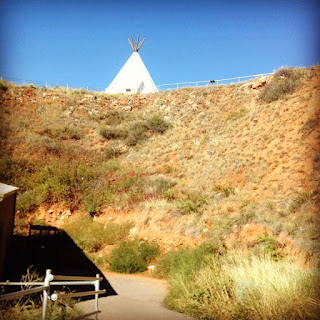
Standing at the bottom, looking up. The tepee-like building on rim is the Interpretative Center (Author's photo)
If you're headed west, the Vore Buffalo Jump is easy to miss, but equally easy to find! It's almost throwing distance from the Wyoming Welcome Center visitor center when you cross the state line. It's an active archaeology site and well worth a visit to anyone interested in Native American history as well as a chance to see archaeologists at work.

If you made it this far, you're almost there! Vore Buffalo Jump.
For more information on the Vore Buffalo Jump:
https://www.vorebuffalojump.org/content/

Images not the author's own are courtesy Wiki Commons

Fans of historical western tales, don't miss this collection of six full-length novels from Prairie Rose Publications. Still only $0.99