Showing posts with label #theWildBunch. Show all posts

Friday, November 2, 2018

Bad Girls, Bad Girls, Part 3, the Bassett Sisters of Brown's Park

Ann Bassett

Throwing caution to the winds, I pushed cattle off the range. I had to work alone. My neighbors did not support me in this, my challenge to Haley, and defiance of law and order. No other stockmen were responsible for what I did. I turned the heat against myself by an open declaration of war."--Ann Bassett on going to war with Two-Bar Ranch owner, Ora Haley, in revenge for the murder of her fiance, Matt Rash.


"Let's just say some men are harder to get rid of than others." --Josie Bassett on the suspected death by poisoning of her fifth and last husband.

"Why hasn't a mini-series been made about these people yet?"--Me

In the second part of this series on the wild women, we saw how a certain place in combination with an event could take things in unexpected directions. The devastating winter of 1887 changed cattle ranching forever, putting a lot of cowboys out of work. Some of those cowboys ended up mixing with outlaws in Knickerbocker, Texas, spawning a new generation of outlaws. In case you missed the post about Laura Bullion here it is again: https://prairierosepublications.blogspot.com/2018/08/bad-girls-bad-girls-part-ii-laura.html

Likewise, in the story of the Bassett sisters, place and event combine to create a page in outlaw history. The place: Brown's Park. The event: conflict between the large, wealthy ranchers and the homesteaders.
Brown's Park, or Brown's Hole as it originally was called, is an isolated mountain valley spanning Utah and Colorado. Difficult to penetrate by the law the area remained one of last pockets of lawlessness at the end of the 19th century.
The Bassett Ranch (Photo Credit State of Utah Historical Society)

It was here that Herb Bassett, his wife Elizabeth, and their two children Samuel and Josie while on their way from their home in Arkansas to a new life in California, decided to settle rather than continue west. Their daughter Ann was the first white person born in the valley. The baby was put in the care of an Indian tribe when Elizabeth couldn't breastfeed her. Ann liked to claim she was part Indian.
And, wild she was. When I first thought about doing this series on the women of the Wild Bunch, I saved the Bassett girls for last, because I wondered how wild two women who went to boarding schools out east could be? As it turns out on a scale of tame to wild, the Bassetts were near-feral. Their father sent them to boarding school in an attempt to control them. In school Ann seemed to have spent more time in prohibition than not.
Both sisters preferred the cowboy life and returned to the family ranch. At this time cattle rustling between neighboring ranches was the norm. Herb had health problems and preferred to spend time in his library or playing piano, and he also acted as post master for the area. His wife, Elizabeth, stepped up to run the day to day activities of the ranch.
The southern belle who rode sidesaddle was one tough customer. She had to be to protect their home. She was someone who not only knew where the bodies were buried, she likely had a hand in placing them there (...that time three Texans disappeared and the ranch acquired three new shotguns...). These were violent times, which she met by forming the Bassett Gang with her ranch hands Matt Rash, Isom Dart, and Jim McKnight.

Isom Dart, close friend and supporter of the Bassett Family

Elizabeth was a feminist and raised her daughters without the usual restrictions of gender. The girls were a match for any man in roping, shooting, and riding. When Elizabeth died suddenly in her thirties, her offspring well-able to take over the reins, which included cattle rustling.
The larger ranchers set out to eliminate the troublesome smaller holdings. They enlisted the notorious Tom Horn to act for them. When I saw he was involved, I worried about everyone in the valley (Horn was later hung for the cold-blooded murder of a 14 year old boy. Bragging about it was what got him arrested). Horn moved around under an fake name, pinning notes to the cabins of the small sheep and cattle farmers, and invited them to leave--or else.
Here is where the outlaws come into the picture. Besides having a natural hideout in the wild valley, the small ranchers welcomed the gangs and the protection as well as the money they spent on horses and provisions. In addition, the ranchers saw the outlaws plaguing the railroad and banks as kindred spirits as they themselves were David to the Goliath of the wealthy ranchers. Rumor had it that the Bassett family was left alone due to Kid Curry threatening anyone who went after them.
The valley was so popular with gangs that the Bassett Ranch was often the final destination of letters left along the secret postal system dotting the outlaw trail. Messages would be left in designated spots like hollow tree stumps so passing outlaws could pick up the "mail" and deliver it to Brown's Park where everyone was likely to end up.
The family's ranch was a favorite spot to cool their heels. Butch Cassidy was said to enjoy Herb's library and the musical nights. It didn't hurt that the Bassetts had two beautiful daughters.
With all the handsome cowboys and outlaws passing through, Ann and Josie enjoyed an active love life. They had romantic relationship with several of the Wild Bunch outlaws. Their relationships were so complex I made a chart for you, which is easier than trying to go into details:

Love Connections among the Wild Bunch. (dotted line denotes a possible)

Both girls were romantically involved with Butch Cassidy, though not at the same time. Ann began an on again, off again affair with Cassidy that spanned seven years, beginning when she was 15. She was one of only five women allowed into Robber' Roost where she stayed with Cassidy for a few months along with Elzy Lay and his girlfriend.
But, the sisters didn't limit their attentions to the Wild Bunch. Ann became engaged to Matt Rash, who was the nephew of Davy Crockett. Sadly, before they could marry Tom Horn shot Rash in the back while he was eating his lunch in his cabin where he was found dead. Not long after Isom Dart was shot and killed from a distance when he stepped out of his cabin.
Matt Rash

After the murders, Ann focused her energy on revenge. She spent the following years stealing Two-Bar cattle, running them off cliffs or drowning them when she couldn't, and sabotaging the other ranch's water supply. She was so successful she earned the nickname Queen Ann. She bought her own cabin and became one of the frontier's first female ranch owners.
She was so determined to bring down the Two-Bar that she went so far as to steal away the foreman of the rival ranch, by marrying him to help him run her own ranch. Hyrum "Hi" Bernard was twenty years her senior. The marriage lasted six years and did little to deter Haley.
After her divorce, Ann continued to run her ranch be herself. When a stock detective found butchered cattle belonging to the Two-Bar, Ann was arrested for rustling. The opera house was used to hold her trial to accommodate the crowd. One witness was killed and another disappeared, and Ann was acquitted to the delight of the residents who hated Haley. Ann was paraded through town in triumph.
As for the suggestion that Ann Bassett and Etta Place were the same woman, after reading about Ann, I'd say she was far too busy at Brown's Park to run off to South America. Part One, in case you missed it: https://prairierosepublications.blogspot.com/2018/07/bad-girls-bad-girls-whatcha-gonna-do.html
Meanwhile back at the ranch, Josie found herself pregnant by six foot tall, Scotsman Jim McKnight (It's a wonder this didn't happen more often) and they married. She had two sons by him before running him off with a frying pan (or shotgun, in some versions) when she couldn't tolerate his drinking.
They say Josie, who stayed on her father's ranch, was the more domestic of the two sisters. Maybe. She sure liked getting married. She had five husbands, divorcing four and surviving one.
Ann remarried in 1928 to cattleman Frank Willis. They moved to Utah where they went on to live a happy life. He doted on her and after she died of a heart attack at age 77 in 1956, unable to part with her, he carried around her ashes in his car until his death 1963. She wanted her ashes spread in Brown's Park and finally got her wish upon his death.
Queen Ann
When Josie's last husband died and traces of strychnine poison were found in his drinking cup, she was arrested for his murder. Josie was acquitted and swore off men. Donning bib overalls, she lived alone without electricity in a cabin that her son helped her build. She enjoyed hunting and fishing and living off the land like a homesteader with a herd of cattle penned in a nearby box canyon.

Cabin of Josie Bassett

Continuing alone, she remained a presence in Brown's Park into the next decades. During the Great Depression she helped out less fortunate neighbors. During Prohibition she made bootleg whiskey. She was arrested in 1936 for cattle rustling, but played her I'm-just-a grandma card and was acquitted. In 1963 she fell and broke her hip which led to her death at 90 years old.

Josie Bassett McKnight Ranney Williams Wells Morris

One more thing: Josie said Butch Cassidy visited her in Brown's Park decades after his supposed death in Bolivia. She said they stayed up all night reminiscing.*
There is a lot more to say about these fascinating women and Brown's Park, and I hope I whetted your appetite to read more about them. I couldn't fit all the stories into one blog post.
So, what do you think? Mini series? Who would you like to see playing all of these characters?

*Josie wasn't the only one who claimed to have seen Butch long after his supposed death in Bolivia. Several of his former girlfriends and acquaintances made the same claim. His own sister, Lulu Parker Betenson, said he visited his family and told her he'd just come from visiting Sundance and Etta in New Mexico (I threw that in for you romantics out there). Lulu claimed he died much later under an assumed name, and both his grave and the name he was buried under are Parker family secrets as they don't want him disturbed.
Ann Bassett also claimed to have paid a visit to Butch's grave in Utah decades after the Bolivian incident.
It is interesting to note that Alan Pinkerton of the famed detective agency who'd been hot on Butch and Sundance's trail didn't believe Butch died in Bolivia and didn't close the case until 1920. No evidence has ever been found that Butch and Sundance were killed in that shootout. If such a shootout even occurred. The story of their death was told by a friend of Cassidy's who owed him a favor.

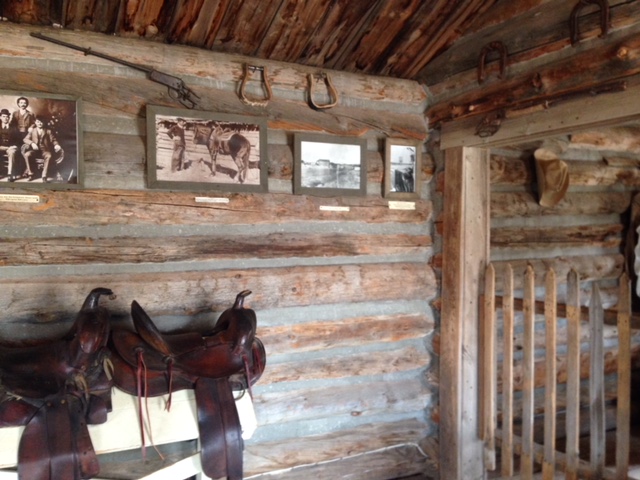
Thank you for reading along with me on my series featuring these fascinating women: Etta Place, Laura Bullion, and the Bassett sisters whose tales are all so different from one another. For a bonus I'm throwing in photos shot from the interior of Butch and Sundance's Hole-in-the-Wall cabin. Yes! I stood inside their cabin!!! The cabin, along  with other historic buildings from the old west, now stands in Old Trail Town, Cody, WY. I will sneak in my own vacation pics whenever I get a chance.




Friday, July 6, 2018

Bad Girls, Bad Girls Whatcha Gonna Do? Ladies of the Wild Bunch Gang, Part 1

Since my current work in progress involves outlaws and the women who ran with them, I've been researching the members of Butch Cassidy's Wild Bunch. Interesting characters indeed, but their female consorts are just as interesting, if not more so. I thought I'd write one single post about them, but their own stories are so rich, I'm take them in parts. We'll look at Etta Place, Laura Bullion, and the Bassett sisters, Ann and Josie separately.
Facts to keep in mind:
The Wild Bunch consisted of Butch Cassidy (Robert Leroy Parker), the Sundance Kid (Harry Longabaugh), Elzy Lay, the Tall Texan (Ben Kirkpatrick), News (Will) Carver, Camila "Deaf Charlie" Hanks, Laura Bullion, Flat-Nose (George) Curry, Kid Curry (Harvey Logan), and Bob Meeks.
The Outlaw Hideouts: Places  to shelter strung out along the outlaw trail where different gangs could rest, restock ammunition, and refresh horses. Place such as Hole-in-the-Wall, Robbers Roost, and Brown's Park. Often there was a give and take between the outlaws and the surrounding ranchers.

As I've mentioned on more than one occasion, because a classmate's father worked on the film Butch Cassidy and the Sundance Kid, we were treated to a showing of that film every year from late grade school to jr. high. One of the results of those repeated screenings was that The Wild Bunch became my gate-way drug to a more serious addiction to all things western, and I am always delighted to return to this topic.

The "Wedding Picture" of the Sundance Kid and Etta Place. Later this picture would be used on "Wanted" posters to identify Etta

If you look up Etta up on Wikipedia, you find this information on her birth and death: "c 1878-?" Which about sums her up. Her life is bracketed in uncertainty and speculation. Nobody knows where she came from or where she went post Sundance, though in contrast the years between 1900 and 1907 are well documented as the Pinkerton Detective Agency was on the case enlisted by the Union Pacific railroad who'd had it with being robbed.

The Pinkerton Detective Agency's description of her says, "Classic good look, 27 or 28 years old, 5'4' to 5'5" in height, weighing between 110 and 115 lbs, with medium build and brown hair." It was reported by those who met her that she spoke in a refined and educated manner.

Another fun fact: she was one of only five women allowed into the hideout Robbers Roost in Utah.

We can also thank the Pinkertons for her name. Because it wasn't Etta but Ethel (...sometimes). When the first "Wanted" posters with her picture went up in South America, her name went from Ethel to Etta when a detective misheard her name spoken with the local accent.

And, Place was probably not her real surname. Longabaugh sometimes used the alias Harry Place, Place being his mother's maiden name.

There are various rumors of her origin. One says she left her two children and school teacher husband for Longabaugh, or that she was a school teacher herelf. Another version is that she was a prostitute from Texas who had relations with both Butch and Sundance.

Madame Fannie Porter ran a bordello in San Antonio frequented by the Wild Bunch. One prostitute there, Madeline Wilson, is sometimes put forth as Etta. Madeline was originally from England (thus the refined speaking manner) and disappears from the census after Butch and Sundance left the area. Another prostitute, Ethel Bishop, from a neighboring establishment is another likely candidate. She was an unsuccessful music teacher which reflects back on the stories where a school teacher is mentioned, and she has the right first name.


The infamous Fortworth Five picture, which helped identify gang members and went straight onto "Wanted" posters, necessitating the disbanding of the Wild Bunch. Sundance on the lower left, Butch Cassidy on the lower right. Note to outlaws: When on the run, don't stop to have your picture taken--even if everyone is having a good hat day at the same time.


Here's what we do know about Etta. In 1901 Longabaugh and Etta went to New York City. They had a photo taken and sent copies of it to friends and relatives, announcing their marriage (though if they were legally married or not is not known). Longabaugh wrote a friend that he "married a girl from Texas he had previously known." Sadly, when a copy of this picture got in the hands of the Pinkertons it was used to identify Etta and put on "Wanted" posters.

Not long afterwards, Etta, Sundance, and Butch set off for Argentina where they bought a ranch and tried to go straight. Under a new act, women were allowed to purchase land in Argentina for the first time, and Etta Place was the first woman to buy land there, which is an awesome fact to know. Reportedly, she was very happy on the ranch and kept it very clean and homey according to visiting neighbors.

Unfortunately, the long arm of the law was able to stretch all the way to South America, and the Pinkertons were on to them. This could be because Sundance and Etta made a couple of trips back to the states. They went to visit his family in Pennsylvania and Atlantic City. They managed to fit in travel to such unexpected places as Coney Island and the St. Louis Fair as well as a couple of mysterious trips for medical reasons. All this to-ing and fro-ing attracted the attention of the Pinkerton detectives who were then able to track them back to their ranch.

After that, it was back to bank robberies and life on the run. Etta even took place in one bank heist and it was reported in the newspaper she was a great shot. At this point Etta decided she'd had enough of this life and Sundance accompanied her back to San Francisco where he left her before returning to South America (sob), a six month round trip for him. There is no evidence they ever saw each other again, which breaks my heart because, bank robbers though they were, they did seem to have a solid relationship.

Then in 1909 Butch and Sundance were surrounded in their boarding house by soldiers in a dusty town in Bolivia. After an exchange of fire, the soldiers found both men dead in the house. It appeared the mortally wounded Sundance had been shot between the eyes by Cassidy, who then turned the gun on himself. That was the end of Butch Cassidy and the Sundance Kid (...or was it?*). It's at this point Etta Place walks off the pages of history.

Again, there are as many theories of her end as there are of her origins. She was variously reported as committing suicide, being shot and killed in a domestic dispute in South America, turning up as a school teacher in Colorado, marrying a wealthy South American landowner, and as well as turning up again in Texas and running a brothel of her own under the name Eunice Gray. Not that Eunice, who died in a house fire at an old age, ever claimed to be Etta, but they had similar stories of having to spend time in South America at about the same time. But photographs found of Eunice didn't match Etta.

The most interesting theory is that Etta Place was really Ann Bassett, who we will talk about in detail in the a later post. Ann and her sister Josie lived on a ranch near the hideout Brown's Park and both sisters were girlfriends of Wild Bunch gang members (there was some fluidity of romantic relations within the gang as we will find out later.)

The woman look very much alike. The Pinkerton description of Ann is almost the same given for Etta. In this theory it is noted that whenever Ann disappeared from Brown's Park for a time, Etta showed up with Butch and Sundance somewhere else.

In modern times, Dr. Thomas G. Kyle of a computer research group used existing photos of the two women and enhanced them for comparison. He stated the women were almost certainly the same person. He also found what he thinks is a scar or cowlick in the same spot on their hairlines.

Ann Bassett on the left, Etta on the right.

So, this theory is sounding pretty convincing except at an important point the Superman/Clark Kent act falls apart. Ann Basset was getting married back in the states and subsequently getting herself arrested for cattle rustling at a time the Pinkertons knew Etta was in Argentina.

Plus, Ann, who later wrote her memoirs, never mentioned spending a considerable amount of time in South America, or having had an intimate relationship with the Sundance Kid. And, by the way, there is only one known image of Etta where her face is seen clearly--and photos can be funny things.

Where did Etta go? Who was she? I'm not an historian. I'm just a person sitting at her computer, but if you ask me I think Etta was Ethel Bishop, the prostitute/failed music teacher in Texas. It not a stretch to think that Ethel Bishop like many a bride took (one of ) the last names of her new husband and became Ethel Place. And, her prostitute past isn't something the young lady would want to broadcast. It was noted that the couple visited his family in Pennsylvania and Atlantic City, but there is no mention of them visiting her family, which makes me speculate her past wasn't something she wanted to revisit. I think she took she money from the sale of the ranch and the last bank robbery, which was considerable, changed her name, and kept out of trouble for the rest of her life.

One final possible sighting took place in 1909 when a woman matching Etta's description showed up at the US Vice Consul in Chili and asked if she could have a copy of Longabaugh's death certificate, but it was not available so she left empty-handed. I wonder if she ever got over him?

So, what do you think? Comparing the images above, do you think Etta and Ann were one in the same?

Next up: Laura Bullion

*There were those who say rumors of their death in Bolivia are greatly exaggerated. Some say the two Americans killed that day were not Butch and Sundance. The bodies were not positively identified by Bolivian authorities (remember there was no death certificate when the mystery woman came to claim it). The outlaws may have been happy to see that rumor spread as they could finally escape the law. Rumors of Butch living to an old age under an assumed name persist. Even Josie Bassett, who we will talk about later, claims Butch paid her a visit after the South American incident. In modern times there have been attempts to exhume bodies placed in unmarked graves in the cemetery in Bolivia, armed with DNA from surviving relatives, but to date no matches have been found. So for those of you looking for a happily ever after, I'm throwing that out there. By this time I have read more stories claiming Butch and Sundance went on to live under assumed names than I can count, and some of them have Etta and Sundance going off together. So, your guess is as good as anyone else's. I know what I'm going to choose to believe (wink).

You can find my books on Amazon https://www.amazon.com/default/e/B01C7L8QUU