One of the interesting museums I visited in 2014 was the Custer 1881 Courthouse Museum in the Black Hills. The building was originally
built as a courthouse in Custer City, and the room that housed the court has been preserved.
 |
| Custer 1881 Courthouse Museum |
One of the more interesting exhibits in the museum is
devoted to the 1874 Black Hills Expedition. It was largely because of the Army
expedition led by Lt. Col. (usually known by his brevet title of General) George
Armstrong Custer that the land surrounding the city of Custer became known to
the Americans of European descent.
 |
| General Custer kills his first grizzly bear-part of the museum exhibit of the 1874 Expedition |
The Black Hills region had been promised to the Lakota Sioux
as part of the Fort Laramie Treaty of 1868. It was the obligation of the U.S.
Army to prevent encroachment by the whites onto Indian land. Unfortunately,
word of gold existing in the Black Hills proved to be too much of a draw to
keep interlopers out.
 |
| 1874 Black Hills Expedition Wagon Train |
Some historians claim that the Black Hills Expedition which
began July 30, 1874 was also a violation of the 1868 treaty. Others claimed the
Federal Government was entitled to explore unknown territories. Perhaps one of
the biggest reasons for the expedition was to establish whether or not there
actually was gold in the Black Hills, and how much.
 |
| Black Hills Expedition: Then and Now - part of museum exhibit of 1874 Expedition |
General Custer prepared for the expedition at Fort Abraham
Lincoln in the Dakota Territory near present-day Bismark, ND. He gathered
companies of his Seventh Cavalry, two companies of infantry for a rear guard
for the wagon train, guides, teamsters and a large contingent of Indian scouts.
The expedition left Fort Lincoln on July 2nd with 110 covered wagons
and about a thousand men and one woman—an African American cook named Sarah
Campbell, but known as Aunt Sally. Sixteen band members rode white horses up
front and played “The Girl I Left Behind Me.” They dug roads and bridged creeks
as they worked their way across the plains. They covered 883 miles in 59 days.
For a map of the territory covered by the expedition, click HERE.
 |
Champagne Supper held by Major Joseph Tilford on July 31, 1874-
part of museum exhibit of 1874 Expedition |
The details of this expedition was well-documented. Several
photographs were taken and copies are a part of the museum exhibit. One of the
answers that came out of the expedition was yes, there is gold in them there
hills. Even though the area theoretically was not open to non-Lakota Sioux, several
members staked gold claims along French Creek east of present-day Custer City.
 |
Gen. Custer with Pvt. John Burkman, Indian scouts Bloody Knife, Goose and Little Sioux-
part of museum exhibit of 1874 Expedition |
Many of the miners who arrived in the Black Hill were Civil
War veterans. Gen. George Crook came in the area in 1875 to escort the
trespassers out. He did allow them to lay out and name a town. Some preferred
the name “Stonewall” after the famous Confederate hero while others preferred “Custer”
who was equally heroic for the Union. A vote taken on August 10, 1875 decided
the first town in the Black Hills would be named Custer.
The reports of gold brought on an even greater influx of miners and fortune-seekers. So much for honoring treaties with the Lakota Sioux. About two years later, many members of this expedition, soldiers and scouts, would be killed at the battle of the Little Big Horn.
 |
| Camp near present-day Custer City-part of museum exhibit of 1874 Expedition | |
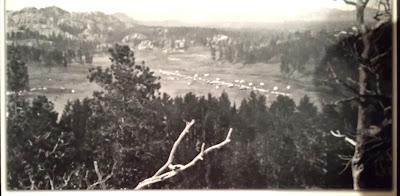 |
| "Permanent Camp" 3 miles east of Custer City-part of museum exhibit of 1874 Expedition | |
 |
Members of 1874 Expedition in camp-
part of museum exhibit of 1874 Expedition |
Zina Abbott is the pen name used
by Robyn Echols for her historical novels. Her novel, Family Secrets,
was published by Fire Star Press in October 2014 and her novelette, A
Christmas Promise, was published by Prairie Rose Publications in
November 2014. The first two novellas in the Eastern
Sierra Brides 1884 series, Big Meadows Valentine and A Resurrected Heart, are now available.


