Showing posts with label 19th century. Show all posts

Friday, July 8, 2022

Glimpses of the past

Something that's long been on my list of things to do is visit historical sites with live demonstrations. 

Before my kids left home, we made a trip to the George Ranch in Richmond, Texas. There was a lot to see, and we had a good time. 

Two of our favorite activities were the blacksmith demonstration and the chuck wagon lunch. (We went pre-covid.) The young man working in the blacksmith shop was not only talented, he was an engaging showman.

The tour of the Davis House, a Victorian era mansion, was particularly interesting to me. I learned a lot, including that fainting couches were a real thing. Growing up in Texas, I can't imagine wearing multiple layers and long sleeves in the summer, but ladies did!


The hogs at the 1830s Jones Stock Farm had the right idea. They wallow in the dirt to beat the heat.

The George Ranch Historical Park, which is located 30 minutes from Houston, opened in 1988 as an educational partnership between The George Foundation and the Fort Bend History Association. The Park features four historic home sites: the 1830s Jones Stock Farm, 1860s Ryon Prairie Home, 1890s Davis Victorian Mansion and 1930s George Ranch Home and Cattle Complex.

The Park accommodates pre-booked school and group tours Tuesday through Friday (including a day set aside for homeschoolers), and is open to the general public on Saturdays and other special weeks throughout the year, except during the month of August.

A place I wanted to visit with my kids but never did is the Texas Cotton Gin Museum in Burton, Texas. My family owns farmland near the King Ranch, and when my brother and I were kids, we used to watch the huge combines harvesting cotton and the bits of white fluff blow off the trucks as they'd haul it away. 

Whenever we went to see my paternal grandmother, my father would point out the cotton fields along the way and explain about the shriveled leaves on the plants after the defoliator had been applied. 

Once, he pulled the car over and picked a couple of cotton bolls. He let us feel of it, and he pulled the cotton apart so we could see the seeds. They are not easy to remove. I'd love to see how cotton was refined before the advent of modern machinery.

The Lyndon B. Johnson State Park, which lies between Austin and Fredericksburg, looks mighty tempting, too. And, best I can tell, the tours are free.

Have you visited any working farms or historical sites with live history demonstrations? Tell me, so I can add them to my bucket list!

###


I put my Forging America series into the Kindle Unlimited library. 

If you subscribe to KU, you can now read them for free! 

Tuesday, October 20, 2020

FALL CELEBRATIONS By Kathleen Lawless @kathleenlawless


Halloween is just around the corner and I expect it will look different from past years for everyone.  Several of my historical western books are set in the fall, and Halloween figures into the story line—because, of course it does. 

In ANORA’S PRIDE, As part of his plan to properly woo Anora, Jesse stops by her home with a pumpkin they carve together as he regales her with tales of the history of All Hallow’s Eve. 

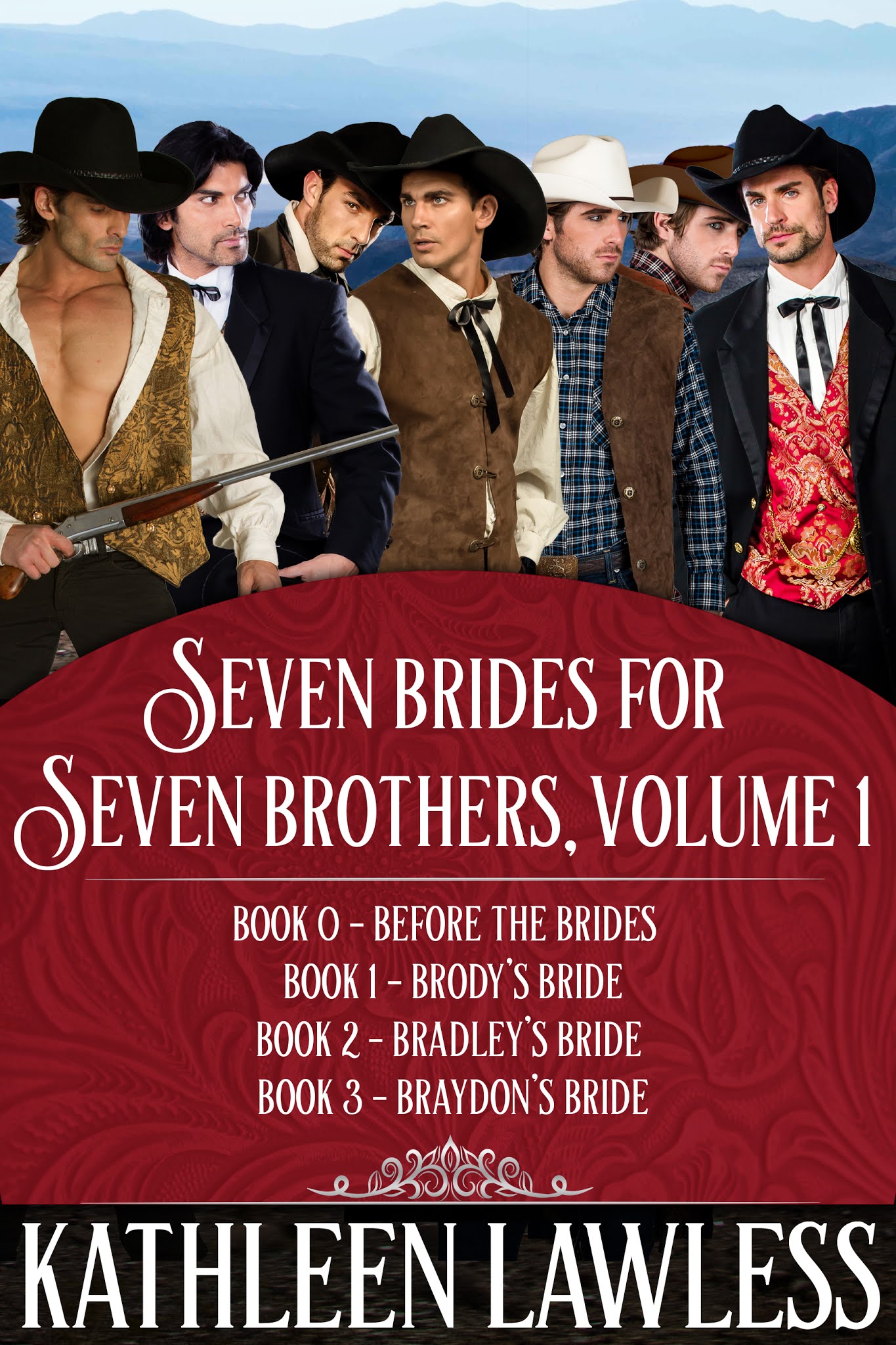
The lighting of bonfires and donning of costumes as a means to ward off evil spirits are activities the entire town of my SEVEN BRIDES FOR SEVEN BROTHERS characters gets behind in BISHOP’S BRIDE, where the citizens of Bullet gather together for a night of celebration, complete with costumes, a bonfire, taffy pulls and apple bobbing.  The party is interrupted by an intruder being killed—but I digress.

Rose, the heroine, is new to what her missionary father considered a “pagan celebration” and takes to heart the myth that whoever bites their apple first will be the first to marry.  She’s intrigued with the notion that by placing her bitten apple under her pillow, she will see her soulmate in her dreams.  Of course, like any true heroine, much as Rose might try to deny her heart, she already knows the identity of her soul mate.

Historians credit Irish immigrants for the North American tradition of carving pumpkins and placing a light inside, a tribute to “Sting Jack”, a mythical trickster.  Back in Ireland, they carved potatoes or turnips which were in abundant supply, but when they arrived in the new world pumpkins were more readily available and no doubt more fun to carve.

I’m Canadian, so October is a double celebration month with first Thanksgiving, then Halloween, and an excuse to decorate and celebrate all month long, which I love.

Wishing everyone a safe and Happy Halloween,

Kathleen

You can learn more about my books here.  https://www.amazon.com/Kathleen-Lawless/e/B001IXS2SA


The first 3 books in the Seven Brides Series are available in a box set which includes a bonus novella you can’t get anywhere else.  https://www.amazon.com/dp/B07ZW9SVZK

Sign up here for my VIP Readers Group to receive a free book and be the first to hear about contests, new releases and fan-priced specials.  http://eepurl.com/bV0sb1

WEBSITE | FACEBOOK | TWITTER | BOOKBUB

Tuesday, February 18, 2020

WHY WE LOVE COWBOYS By Kathleen Lawless @kathleenlawless

There comes a time in every writer’s life when suddenly it feels like someone flicked a switch.  All kinds of writerly things that had previously eluded me suddenly made sense.  My “ah ha” moment came about at my first romance writer’s conference when I crowded into a room with hundreds of other hopefuls to soak up the wisdom of Jayne Ann Krentz.

Ms Krentz spoke about the “basic core fantasies” which we now bandy about as “tropes” but back then for me, her workshop was a defining moment.  She listed about a dozen of these fantasies that readers respond to on a primal level including but not limited to: vampires long before they were a popular romance trope, secret babies, marriage of convenience, sheikhs, and most notably for me the Cowboy Fantasy which, as she said, needs no explanation.  The cowboy as hero is simply etched deep in our psyche. 


At a recent Reader’s Group Launch Party I asked readers some of their all-time favorite character traits for a western hero.  No surprise; the answers were all very similar.  #1 was strong yet gentle.  Closely followed by loyal, fair, brave yet humble, tough yet gentle, always willing to help, seeker of justice and willing to fight for it.   These traits easily apply to both historical and contemporary stories and, as a writer, are definitely something I aim for with my cowboy heroes. 

In my Seven Brides for Seven Brothers series, I have my favorite hero of the brothers.  He’s cocky and arrogant to start with and although the heroine puts him smartly in his place, not everyone loves him as much as I do. 

The most popular, well-liked brother, hands down is Blake, the quiet, humble one.  Blake feels like an outcast, out of step with the rest of them because he can’t learn to read.  But the lengths he goes to for his lady!  I have to admit there is one scene where even I get a little misty-eyed every time I read it.  Blake truly is a hero.

     
IN BLAKE’S BRIDE STORM, THE HEROINE, HAS BEEN USING SOME INTERESTING TECHNIQUES TO HELP BLAKE TO READ DESPITE HIS DYSLEXIA, WHICH BACK THEN WAS REFERRED TO AS ‘WORD BLIND’.  IN THIS SCENE SHE IS PREPARING TO LEAVE TOWN.
         
          Blake pulled his hand out from behind his back.  “I wanted to give something to you to take with you.”
          “Scissors?” she said, puzzled.
          “I made them special.  So you can use your other hand in them.”  He demonstrated, snipping the air between them, before he tucked the fingers of her left hand into the holes.  The metal of the scissors was warm from his hand. 
          “Oh, my word,” she said.  “They feel so good.”
          “Made ’em smaller on account of you have such little hands,” he said.
          “They’re perfect.  How did you know?”
          “When we were touching the sand letters.  I was taking a picture in my head of your hand on top of mine.  That way I knew how to make them the right size for you.” 
          Storm swallowed past the suddenly huge lump in her throat.  “No one has ever, in my entire life, done anything so nice for me.”
          He looked at her and nodded.  “Funny.  I feel the same way about you and the letter learning.” 
          Once again, her eyes threatened to fill with tears.  There was a painful weight on her chest.  Her lungs felt constricted, as if she couldn’t quite draw a deep enough breath. 
          “You okay?” He was watching her with concern.
          She gave her head a shake to clear her thoughts and her vision.  “Never better.”
          “Good.  Then I got something that needs said before you go.  Stay here, Storm.  Marry me and be my wife.”
          Dizzily, she swayed toward him, afraid she might faint. 
          He caught her and held her.  Safe.  If only she could stay and feel safe forever.
          “I can’t.”  Her words came out in the barest of whispers.  “I’m already married.”  

https://www.amazon.com/dp/B07W8B7ZH1

The series books can be read as stand alone, or enjoyed in the order they were written.  A free prequel is yours when you sign up for my VIP Readers Newsletter here.  http://eepurl.com/bV0sb1


Tuesday, March 21, 2017

Western Wives. The More Things Change...?

by Heather Blanton


“What are some of your favorite dishes to cook, Miss Swank?” Miss Stella rose and began clearing the breakfast dishes. Ellie immediately jumped in to help. There weren’t many. Mr. Hoyt had not joined them. Not that she had assumed he would, of course.
“Dishes? Well, I’m not really much of a cook.”
Miss Stella’s hand slowed as she dragged a coffee cup toward her. “Surely you must cook something. How do you expect to feed a husband?”
I don’t. Or he can cook. “Um, I guess I hadn’t given it much thought. I can muddle my way through the kitchen.”
The older woman gathered the cups to her and shook her head. “Miss Swank, I will save you a lot of heartache and grief. While you’re here, I will give you cooking lessons. Cowboys work hard, sun up to sun down, in blazing heat and bitter blizzards. They come dragging in at night half-dead. The least a wife can do is a have a meal on the table. Something edible.”
Ellie felt properly chastised. “Yes, of course, you’re right. It’s just that I don’t have much to offer in the way of culinary talents so I haven’t pursued it to any level of appreciable skill.”
“Well, we’ll start with bread. And while the dough is rising, we’ll go through my recipe book and pick out a couple of meals for you to learn. Clegg is fond of my country fried steak.”
~~~
This is the kind of conversation that would have Hillary Clinton turning purple and passing out. Women can do more than cook. We can be doctors, lawyers, astronauts, CEOs, anything we put our minds to.
That is a fact.
But what is also a fact is that a hundred years ago, the world was a different place. Roles were different. The expectations of a woman, both of herself and from society around her, were different.
In my current work-in-progess, tentatively titled Mail Order Bride: Undercover, I explore the delicate dance between a woman’s ambition and her submission to love. Ellie Blair wants to be the reporter who will never be confused again with Nellie Bly. She wants success, fame, and respect from her male peers, and will do almost anything to get it. But at what cost? Can she have fame and fortune and love, too?
Most of us know that a century and more ago, women faced unique challenges to chasing their dreams. The culture didn’t exactly encourage independent ladies to push past the bounds of propriety.
But narrow-minded expectations didn’t stop them as often as you might think.
As we all know, prior to modern times, women became doctors, lawyers, spies, politicians (https://ladiesindefiance.com/2014/10/13/the-first-woman-mayor-ever-elected-in-america-was-no-joke/ ) even law enforcement officers (https://ladiesindefiance.com/2015/03/02/the-first-female-sheriff-in-the-usa-was-in-texas-and-from-texas-of-course/ ). You name it, they did it. However, in most cases, they also did the child-rearing and the cooking. Few whined about the inequalities. Instead, they shouldered them. Then, as now, there was a vocal minority that decried chauvinism. Most women, however, dug in their heels, squared their shoulders, looked life right in the eye, and pursued their careers, babies on their hips, spoons in the sauce.
I think the primary difference between women of earlier centuries and today is that our ancestors didn’t expect anyone to lighten their load. Today we expect our husbands to help (whether it happens or not is a different story). Back then, I would argue the ladies truly had no expectation of assistance. If they ran a business, they ran the house. If they wore a badge, they darned their kids’ breeches. If they studied to become lawyers, they still helped the children with their homework. A vicious cycle, but these gals persevered and paved the way for us.
I, for one, sure appreciate their struggles.

Here’s to the Ladies in Defiance who find their own way. Never give in. Never back down. Never lose faith.

I'd love to hear your thoughts on where women have gone, vs. where we were. Do you think things have changed much?

Feel free to comment below or visit me on facebook!  https://www.facebook.com/authorheatherblanton/

Tuesday, June 9, 2015

Is There a Doctor in the House?

Is There a Doctor in the House?

A look back at sicknesses of the past

By Christina Cole


Although a lot of people complain about the current state of the medical industry, I'd be willing to wager that few of us would give up today's health advantages to return to the conditions faced by early settlers in the west. 

I remember well my astonishment when I read my great-grandfather's obituary. He died of cancer, and the newspaper clipping stated that it had "no doubt been caused by a snake bite he suffered in his youth." Really? Yes, really. 

Our knowledge of diseases, causes, and cures has advanced tremendously in the last century. As part of that advancement, new terminology has come about to describe many conditions. As a historical writer, I often have to do extensive research regarding medical issues. This was especially true for my upcoming western historical, No Regrets, which is scheduled for release next month by Secret Cravings Publishing.

It's the story of Hattie Mae Richards, a young woman who's entered into the field of nursing. At the time of the story -- 1880s -- there were only a few nursing schools in the United States. Most nurses trained with physicians, which is how Hattie Mae is pursuing her career. 

I did, of course, research nursing schools and the subjects a student was required to learn. Studies included the rudiments of nursing, but no instruction in anatomy or physiology was given.  Nurses were required to learn elements of basic hygiene, bandaging, and massage.


I've always been fascinated by old medical terms, so today I'm going to share a few with you. The next time you're reading a western historical and you come across someone suffering from lumbago or a case of ague, you'll know exactly what ails that individual.

Jail Fever: A common complaint of prisoners who were crowded into unsanitary cells. Jail Fever -- also known as Ship Fever -- is typhus, or "typhoid fever". 

Grocer's Itch: A skin condition caused by mites in flour or sugar.

Green Fever: Anemia.

Whiteblood: Leukemia.

Lumbago: Lower back pain.

Consumption: Tuberculosis.

Ague: Fever. 

Suffocative Breast Pangs: Angina.

Apoplexy: Paralysis caused by stroke.

Bloody flux or dystentery: Diarrhea, often caused by unclean drinking water.

Atrophy: Wasting away.

Canine Madness: Rabies

Childbed Fever: Infections resulting from unsanitary conditions during the delivery of a baby. This was widespread in hospitals in the late 19th century. Doctors would unknowingly spread infections from one patient to the next by performing deliveries with little regard for the cleanliness of the facilities.

Dropsy: A swelling caused by the retention of abnormally large amounts of fluid in the tissues.

Softening of the Brain: Mental illness or a cerebral hemorrhage.

Summer Complaint: A sickness that often affected infants and young children in the summer, caused by spoiled milk.

Winter Fever: Pneumonia.

Quinsy: An inflammation of the throat, tonsillitis.

Grippe: Influenza.

Gravel: Kidney stones.

French Pox: Venereal disease.

Vapors: Mental instability, hysteria, mania, bi-polar disorder, fainting, and PMS. Tight corsets were often thought to be the cause of the vapors. 

Effluvias: Contagious diseases, such as measles. 

Melancholia: Depression. 

Hatter's Disease: Insanity caused by working with mercury, a condition that affected many in the hat-making industry. 

I hope you've enjoyed this look back at some of the ailments our pioneer ancestors suffered. Many of these conditions are still around today, although we call them by very different names. Others, such as "Summer Fever" and Childbed Fever" are, thankfully, no longer a cause for concern.


Be watching for news on the release date for "No Regrets"
 Book 4 of "The Sunset Series".