John Baker
Omohundro, also known by some as John Burwell Omohundro, was born July 26, 1846
in Palmyra on the Pleasure Hill farm in Fluvanna County, Virginia, to John
Burwell and Catherine Baker Omohundro of Anglo-American ancestry. He attended
grammar school in Fluvanna. At an early age, he demonstrated a strong skill in
hunting and fishing.
Also known
as "Texas Jack", he was an American frontier scout, actor, and
cowboy. He served in the Confederacy during the American Civil War and, later,
as a civilian scout for the US Army during the Indian Wars. Before his untimely
death, Texas Jack became a legendary figure in the American Old West as a
Western showman performing dramas on the stage throughout the country. He
became a world-renowned hero in dime novels published around the world.
At the
start of the American Civil War, Omohundro attempted to join his older brother,
Orville, in the Confederate Army. He was twice refused for his age, but was allowed
to serve as a courier at the headquarters of the Virginia Militia under Major
General John B. Floyd. Because of his youth and knowledge of the countryside,
he became known as the "Boy Scout of the Confederacy". In February
1864, at the age of 17, he successfully enlisted as a private in Company G of
the 5th Virginia Cavalry, part of the Army of Northern Virginia. He soon served
directly in General J.E.B. Stuart's command as a courier and scout. At the
Battle of Yellow Tavern, he delivered a scouting report to Stuart only minutes
before the general was killed in battle. During the Battle of Trevilian
Station, Omohundro was wounded and admitted to the Confederate States General
Hospital in Charlottesville on June 20, 1864. After recovering from his injuries,
and a short leave home, he returned to his company and scouted under the
command of General Lunsford L. Lomax. Following the Third Battle of
Winchester, the 5th Virginia Cavalry was
consolidated with the 15th Virginia Cavalry, where Omohundro scouted under
General Fitzhugh Lee during the last months of the war.
After the
Civil War, Omohundro left Virginia at age 19 for Florida. After a short time,
he moved on to Texas, arriving at the Taylor Ranch near Brazos, where he began
working as a cowboy participating in cattle drives, notably on the Chisholm
Trail, driving herds north to railheads in Kansas. After one drive across
Arkansas to a meat-poor Tennessee, he was given nickname "Texas Jack"
by the locals.
On another
drive, Omohundro found a five-year-old boy orphaned after a Native American
raid killed his family. He took the boy to safety in Fort Worth, and the boy
later took the name Texas Jack Jr. in homage, going on to run the Texas Jack's
Wild West Show and Circus in 1903 in South Africa.
It may have
been on one of those drives that he made the decision to relocate once again,
moving first to Fort Hays, Kansas, and then to the North Platte, Nebraska,
area. Drawing on his past experience, including time spent as a scout during
the Civil War, Omohundro picked up odd jobs scouting, hunting and guiding.
In 1869,
Texas Jack moved to Fort Hays, Kansas, where he met California Joe Milner and
Wild Bill Hickok, the latter being sheriff of Ellis County at the time. Later
that year, Jack met and befriended William F. "Buffalo Bill" Cody,
who was working with the 5th U.S. Cavalry at Fort McPherson. Jack was hired as
a scout and trail guide during the Indian Wars. Special permission had to be
obtained since the U.S. government did not generally permit the employment of
ex-Confederate soldiers. During the Battle of Summit Springs, Texas Jack
captured his well-known white horse from Indian Chief Tall Bull. Texas Jack
moved to Cottonwood Springs, Nebraska, where he continued to work as a scout
for the government.
In 1869,
Texas Jack met William F. "Buffalo Bill" Cody, who was also
scratching out a living scouting, hunting and guiding. They became fast
friends, scouting together for the Army and engaging in hunts. Texas Jack made
a lucrative living leading hunting expeditions for American and foreign
parties, which were popular at the time.
 |
Custer, Grand Duke Alexei, and Cody
|
Together
with Cody, Texas Jack led the highly publicized royal hunt of 1872 with Grand
Duke Alexei of Russia and several American military figures, including General
Philip Sheridan, General George Armstrong Custer, and Colonel James W. Forsyth.
Later in 1874, Texas Jack guided the Earl of Dunraven though Yellowstone and
Geyserland. In 1876, Texas Jack led Sir John Rea Reid and his party on a hunt
around the Bighorn Mountains and Sweetwater country.
 |
| Texas
Jack points at Cody, who reclines in front
of Buntline |
In December
1872, Omohundro and Cody debuted the first Wild West show, Scouts of the
Prairie, written and produced by Ned Buntline. Dime novelist, Ned Buntline,
wrote the play in four hours. It debuted in Chicago.
Texas
Jack's performance was well-received by critics and featured the first rope act
performed on the American stage.
 |
| Ned
Buntline, Buffalo Bill Cody, Giuseppina Morlacchi, Texas Jack Omohundro |
The show
starred Giuseppina Morlacchi, a dancer and actress from Milan, Italy. She was
the same age as Texas Jack and Buffalo Bill. She became a classically trained
dancer, traveling throughout Europe. She moved to the United States at age 21
to perform in the theater circuit with her Morlacchi Ballet Troupe, making her
American ballet debut in 1867. She introduced the can-can to the country the
following year. A fine actress as well, she was soon appearing in the major
cities of the American Northeast. Just weeks before his buffalo hunting
expedition with Buffalo Bill and Texas Jack, the Grand Duke Alexis saw
Morlacchi on stage. Buntline also saw her and recruited her to join his new
play, Scouts of the Prairie.
Giuseppina
did not come alone to the United States. She was accompanied by her manager of
five years, John Burke, who was smitten by her. He had presented her with rings
and was planning on settling down with her in a house in Lowell, Massachusetts.
Those dreams ended when she met Texas Jack. For the Virginian and the Italian,
it was love at first sight. She returned the rings to John Burke and pledged
herself to John Omohundro. Heartbroken, Burke wore the rings and never married.
Instead of devoting his life to her or to any another woman, he spent it
instead promoting his new friend Buffalo Bill. It was a task he pursued until
Cody's death.
With Scouts
of the Prairie's combination of the two well-known scouts with the lovely and
talented Morlacchi, the 1872-73 season of the road show was a resounding
success.
The relationship between Morlacchi and Omohundro was also a success;
Texas Jack
and she fell in love and were married on August 31, 1873, at St. Mary's
Catholic Church in Rochester, New York.
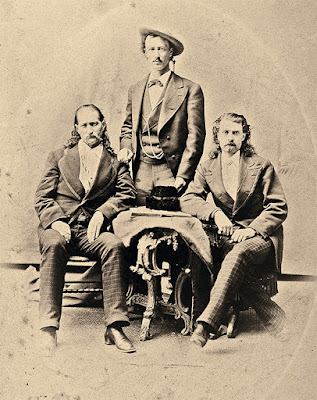 |
Bill Hickok, Texas Jack, Bill Cody
|
Texas Jack
and Buffalo Bill pose with their friend "Wild Bill" Hickok. Hickok
joined them onstage in the play Scouts of the Plains in 1873-74.
The following year Texas Jack, Morlacchi and
Buffalo Bill struck out on their own with a new play, Scouts of the Plains, and
a new co-star, their friend Wild Bill Hickok.
In 1873,
Buntline left, and Texas Jack's friend, Wild Bill Hickok, joined the group to
headline in a new play called Scouts of the Plains. Hickok did not enjoy
acting, often hiding behind scenery, and in one show, he shot the spotlight
when it focused on him. He decided he preferred gambling. He was the
first to leave the show mid-season.
Desiring a
lighter tour schedule, the Omohundros parted amicably with Buffalo Bill Cody in
1876 to create their own troupe, re-enacting scenes from the West on stage. In
1877, he formed his own acting troupe in St. Louis, known as the Texas Jack
Combination featuring Morlacchi, Arizona John Burke, Modoc War scout Donald
McKay, trick-shot Maud Oswald, and several Sweetwater and Warm Spring Indians.
In May of that year, he debuted Texas Jack in the Black Hills, written by Harry
Seymour, to rave reviews. Other plays the combination performed included The
Trappers Daughter, Life on the Border, and The French Spy.
 |
Texas Jack & Guiseppina
|
The Texas
Jack Combination was successful for Giuseppina Morlacchi and Texas Jack. They
happily toured together for the next several years, with periods of relaxation
at the Massachusetts home once desired by John Burke. They continued to perform
separately as well.
In 1878,
Texas Jack appeared with Dr. W. F. "Doc" Carver, a dentist turned
exhibition shooter who he met several years earlier in North Platte, Nebraska.
Five years later Carver joined forces with Buffalo Bill to create Buffalo
Bill's Wild West.
 |
| Beadles
Dime Novel |
Texas Jack
became a popular subject of the dime novels of the late 19th century. One of
the first in which he was featured was the 1872 title, Texas Jack; or The White
King of the Pawnees, written by Ned Buntline. Texas Jack's popularity grew as
he was featured on covers by publishers including Beadle's New York Dime
Library, the Nickle Library, Log Cabin Library, DeWitt's Ten Cent, Street and
Smith, and others. Many of these stories were written by the prolific author Prentiss
Ingraham. Omohundro wrote articles in newspapers across the country recalling
his hunting and scouting stories, and is credited as having authored one dime
novel for Beadle and Adams in 1876 titled Ned Wylde, the Boy Scout.
Texas Jack
and Morlacchi settled in Massachusetts with a home in downtown Lowell and a
small farm in Billerica. In the spring of 1880, after several performances in
the region, the couple decided to take their show business career to the
silver-mining town of Leadville, Colorado, for a series of performances. There,
Omohundro became acquainted with Horace Tabor and briefly joined Tabor's Light
Cavalry, a local militia formed to keep order in the newly founded town. The
couple decided to stay in the Rocky Mountain West rather than return to
Massachusetts.
A few
months after arriving, Texas Jack contracted a cold, which developed into
pneumonia, and he died weeks later on June 28, 1880. The funeral was
well-attended, and he was given full military honors, with several military
companies in attendance firing a three-volley salute as his flag-draped coffin
was lowered into the ground. His final resting place is Evergreen Cemetery in
Leadville.
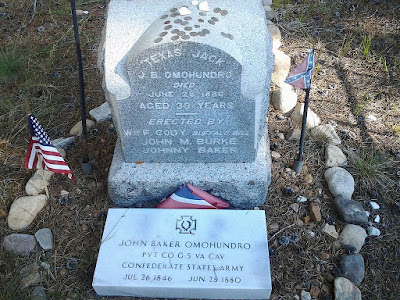 |
| The grave
of Texas Jack in Evergreen Cemetery |
Shortly
after Texas Jack's death, grief stricken Giuseppina Morlacchi departed for
their Massachusetts home in Lowell. She never returned to the stage. She died
of cancer six years later.
After
several years, the grave fell into disrepair, and a traveling group of
comedians raised funds to provide for its upkeep. In 1908, while passing
through Leadville, Cody visited the cemetery and commissioned a granite grave
marker for his old friend, mistakenly listing Texas Jack's age as 39 years.
In 1980,
the Texas Jack Association was formed to preserve and promote Texas Jack's
memory.
In 1994,
Texas Jack Omohundro was inducted into the National Cowboy & Western
Heritage Museum in the Hall of Great Western Performers.
-=-=-=-=-
In only one
source did I find reference to another incident in Texas Jack's life. Evidently,
during his 1878 exhibition tour with "Doc" Carver, he ended up in
Rawlins, Wyoming. He was there at the same time that Thomas Edison and a slew
of astronomers,. scientists, and newsmen descended on the small railroad town
in mid-July to prepare for the upcoming total solar eclipse expected to take
place July 29, 1878.
The
following was how Thomas A. Edison described his stay:
"There
were astronomers from nearly every nation. We had a special car. The country at
that time was rather new; game was in great abundance, and could be seen all
day long from the car window, especially antelope. We arrived at Rawlins about
4 P.M. It had a small machine shop, and was the point where locomotives were
changed for the next section. The hotel was a very small one, and by doubling
up we were barely accommodated. My room-mate was Fox, the correspondent of the
New York Herald.
"After
we retired and were asleep a thundering knock on the door awakened us. Upon
opening the door a tall, handsome man with flowing hair dressed in western
style entered the room. His eyes were bloodshot, and he was somewhat
inebriated. He introduced himself as `Texas Jack'--Joe Chromondo--[sic] and
said he wanted to see Edison, as he had read about me in the newspapers. Both
Fox and I were rather scared, and didn't know what was to be the result of the
interview. The landlord requested him not to make so much noise, and was thrown
out into the hall. Jack explained that he had just come in with a party which
had been hunting, and that he felt fine. He explained, also, that he was the
boss pistol-shot of the West; that it was he who taught the celebrated Doctor
Carver how to shoot. Then suddenly pointing to a weather-vane on the freight
depot, he pulled out a Colt revolver and fired through the window, hitting the
vane. The shot awakened all the people, and they rushed in to see who was
killed. It was only after I told him I was tired and would see him in the
morning that he left. Both Fox and I were so nervous we didn't sleep any that
night.
"We
were told in the morning that Jack was a pretty good fellow, and was not one of
the `bad men,' of whom they had a good supply…."
-=-=-=-=-
Although it
did not move my plot along, I thought this scene was too good to pass up. I
included a fictionalized version in my book, Mail Order Blythe. Blythe and her
roommate view this scene from the top of the stairs that led to their attic
room.
To find the
book description and purchase link for Mail Order Blythe, please CLICK HERE.
Sources:
https://truewestmagazine.com/the-tragedy-of-texas-jack/
https://en.wikipedia.org/wiki/Texas_Jack_Omohundro
https://en.wikipedia.org/wiki/Texas_Jack_Omohundro#/media/File:Texas_Jack_Grave_Tight.jpg
https://www.texasjack.org/
http://www.wyomingtalesandtrails.com/rawlins2.html


_Buffalo_Bill_Dam_(Shoshone_Dam)%20F.J.%20Hiscock,%20Cody,%20Wyoming.jpg)




_(52583715570).jpg)


