Showing posts with label General William Jackson Palmer. Show all posts

Wednesday, June 2, 2021

Glen Eyrie Castle & General William Jackson Palmer ~ Julie Lence


Original Glen Eyrie Castle


Last month, I wrote about General William Jackson Palmer and how he founded Colorado Springs. There is so much General Palmer did for Colorado Springs and Colorado that one blog would go on for pages, so I condensed that blog and I return today with another of the General’s accomplishments.

William Jackson Palmer
Military Wiki 

While living in Colorado Springs, Palmer built a grand home for himself and his wife (nicknamed Queen) in the 1870’s. Situated just north of Garden of the Gods at the mouth of a canyon, Glen Eyrie was originally a clapboard home of twenty rooms. While in residence, Palmer’s wife taught school at Colorado Springs’ first school, but more often than not, the Palmers were not in residence; she because of her health and he because of his work. Suffering a heart attack wile pregnant with their second child, Mrs. Palmer gave birth at the home then spent most of her time on the East Coast or in England. She permanently left Glen Eyrie and Colorado Springs in 1885 and passed away 1894.    

Queen Palmer
Pinterest

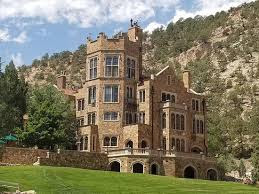
With his daughters coming to live with him after his wife’s passing, Palmer sold his Denver & Rio Grande Western Railroad in 1901 for 6 million and retired in Colorado Springs, where he donated several plots of land to the city while forging ahead with plans to renovate Glen Eyrie. He hired architect Frederick J. Sterner and engineer Edmond Van Dienst to help with the project, which took near two years to quarry stone from the estate’s lands and transform the clapboard house into a stone castle. With 67 rooms and 20 fireplaces, the interior was paneled in oak, with the main floor boasting several parlors, a solarium, a dining room, and a kitchen that had ice storage and a walk-in refrigerator. Bedroom suites for Palmer and his daughters occupied the second level, as well as guest suites and servants quarters. The third floor held more bedrooms, a sitting room, and access to the tower, but the belle of the castle was Book Hall. Large enough to hold 300 people, Book Hall boasted a large fireplace and a balcony where an orchestra could perform. Beneath the hall were billiards rooms and a bowling alley.      

Renovated Glen Eyrie 
PBS.org

Sadly, Palmer only enjoyed his renovated home for a handful of years. Paralyzed from a horse riding accident in 1906, he passed away 3 years later. His daughters wanted to donate the castle to the city, but city leaders declined because they feared the cost to maintain the property and home would be too high. For the next 40 years, Glen Eyrie saw many owners, though the house was rarely occupied, to include a group of businessmen who wanted to turn the property into a golf resort, complete with a tavern and luxury houses. World War 1 saw them changing their plans and operating the castle as a tea room. Alexander S. Cochran bought the property in 1918, closed the castle because of the high expense to maintain and let it go to ruin. He did build a ‘pink home’ on the property for a vacation house, and passed away at the start of the Great Depression. The property sat on the market until Texas oilman George W. Strake bought it in 1938.  He expanded the pink house, opened the castle for parties and used some of the land for ranching, and in 1953 listed Glen Eyrie for sale at a price of $500,000, which caught Dawson Trotman’s attention.

Dawson Trotman
Find a Grave

A Christian evangelist and founder of the Navigators ministry, Trotman was planning to move from Los Angeles to Colorado and hoped to split the cost of Glen Eyrie with fellow evangelist Billy Graham. Discovering Christians were interested in the property, Strake lowered the sale price. With Graham backing out of the deal, Trotman quickly raised the down payment with the help of his Navigators ministry and Glen Eyrie became their home in September 1953, and remains so today. The Navigators use the property as a home for their publishing firm, NavPress and as a Christian conference center. The property came with a lake in the Rampart Range area and now houses the Eagle Lake Camps, a Christian summer program. With the exception of the kitchen and the removal of the bowling alley to incorporate a dining area, the main part of the castle is unaltered. The castle and grounds are open to visitors for afternoon tea (reservations required) a tour of the castle, and an overnight stay within the castle, the pink house or the lodges the Navigators built.       


Throughout Colorado Springs and Colorado, General Palmer isn’t just known for Glen Eyrie Castle and the high school named after him. Palmer was responsible for bring the narrow gauge railroads to Colorado’s Rocky Mountain, for providing land and funding for Colorado College, for forming Colorado Coal and Iron Company’s steel mill in south Pueblo and laying out a second town, Bessemer, which is now incorporated into Pueblo. He also founded the General Palmer Hotel in 1898 in Durango, Colorado. Originally named the Palace Hotel, the hotel is still in use today, and in 1962 he was inducted into the Hall of Great Westerners of the National Cowboy & Western Heritage Museum.  

Glen Eyrie Castle
Trip Advisor
Glen Eyrie Castle East View
Trip Advisor

Wednesday, May 5, 2021

Colorado Springs & William Jackson Palmer ~ Julie Lence


William Jackson Palmer
Colorado Springs Gazette

Being an east coast girl from upstate New York, one would think hubby and I would’ve retired to our hometown to be close to our families, but we didn’t. Hubby spent twenty years in the Air Force and one of his assignments was Cheyenne Mountain in Colorado Springs. We fell in love with the area and decided to make it home when he retired. In the past 18 years, Colorado Springs has boomed in population and business, and every day, weather permitting, I get to see America’s Mountain.


Pikes Peak
Pinterest

Long before Army lieutenant and explorer Zebulon Pike traveled through the area and discovered the mountain that is now his namesake, Pike’s Peak, the Ute, Cheyenne and Arapaho tribes called the area at the bottom of what is now Ute Pass home. It was Pike’s wish to summit the peak to map out rivers and the landscape, but feet of snow prevented him from doing so. He published an account of his travels in 1810 naming the mountain, Grand Peak, thus putting it on the map. Fast forward a few years to when gold was discovered in the area and folks rushed to the region, where businessmen established Colorado Springs’ first settlement, Colorado City, at the base of the peak. (Situated west of where Colorado Springs currently sits and Manitou Springs, Colorado City is now known as Old Colorado City.) Colorado City became the hub for selling mining equipment and supplies to those headed up Ute Pass to pan for gold. For a short time, Colorado City was also a territorial capital.

Those looking to strike it rich in the mines weren’t the only people coming west to Colorado Spring’s first settlement. Many came for health reasons, hoping the fresh air and sunshine would cure tuberculosis, and others came for business opportunities, including Colorado Springs’ founding father, William Jackson Palmer. Born in Delaware on September 17, 1836 to a Quaker family, Palmer had a fascination with trains at a young age. He eventually hired on with the Pennsylvania railroad and learned everything he could about the railroad industry and engineering and was the first person to suggest trains should burn coal and not wood, since wood was fast becoming short in supply. Because of his teachings, the Pennsylvania Railroad was the first to use coal.

Vintage Map
Walmart

A man who loathed slavery, Palmer served as a general in the Civil War and won a Medal of Honor for heroic efforts. After the war, he financially supported education efforts for the freed slaves and ventured to the Kansas Railroad and helped lay the tracks all the way to Denver. He and his friend, Dr. William Bell, founded their own railroad company, the Denver & Rio Grande Western Railroad. The first tracks went to the Pikes Peak. The area struck a chord deep inside Palmer and he predicted the foothills would become a booming resort town. Purchasing 10,000 acres of land along the train route, Palmer laid out streets, hauled in thousands of trees to make the city lush and green, and erected lavish buildings resembling European style, to include the Antler’s Hotel. In 1871, his Victorian resort town was born. From the start, Colorado Springs wasn’t a boom town. Palmer used the breathtaking scenery to lure the rich to the area, along with capitalists, artists and intellectuals. Gold was discovered to the west of the peak in Cripple Creek in 1891. More of the wealthy flocked to Colorado Springs and for a spell, the city had more millionaires per capita than any other location in the United States. 

Durango & Silverton RR
ASCE Library

In 1870, Palmer married Mary Lincoln (Queen) and the two enjoyed a honeymoon in the British Isles. It was there he saw and learned about the narrow gauge railroad. The narrow gauge was cheaper to build, could make sharper turns and climb steeper slopes, making it the perfect type of railroad for Palmer to incorporate throughout the state of Colorado to make travel through the Rocky Mountains easier. To date, two of his tracks remain in place; the 45 mile trek between Durango and Silverton in the southwest corner of Colorado, and the Cumbres and Toltec 63 mile trek between Chama, NM and Antonito, CO.    

Colorado Springs today
4word

Palmer went on to bring the railroad to Pueblo. He co-founded the Colorado Fuel and Iron company, and drove the ‘golden spike’ at the Promontory Summit in Utah to finishing America’s Transcontinental Railroad. He eventually retired to Colorado Springs where he helped to establish the Colorado School for the Deaf and the Blind, and the University of Colorado at Colorado Springs, before passing away March 1, 1909. A statue of him riding his favorite his horse,  Diablo, sits in the intersection of Nevada and Platte Avenue in Colorado Springs across from Palmer High School, which is named after him. 

General Palmer Statue
and high school