Showing posts with label Colorado Springs. Show all posts

Wednesday, July 6, 2022

History of the Pikes Peak or Bust Rodeo ~ Julie Lence

courtesy of Pinterest

 Last month, I introduced you to Spencer Penrose, a successful businessman in the mining industry who helped to shape Colorado Springs as a town and community. Besides erecting a road to the top of Pikes Peak, building the world famous Broadmoor Hotel, and the first hospital in Colorado Springs, Spencer Penrose was detrimental in bringing the rodeo to town.  


Will Roger Stadium

The history of the rodeo in Colorado Springs dates back to 1911 when rodeo events took place in Sportsman Park located between North Nevada Avenue and North Cascade Avenue, but by the late 1920’s, the rodeo had died out. Penrose brought back the excitement, the skill, and the fun in 1937 by developing and building the Will Rogers Stadium at the Broadmoor Hotel and founding the Pikes Peak or Bust Rodeo. The 1st Pikes Peak or Bust Rodeo was held in 1938 and continues today in mid-July. To promote the rodeo, Penrose enlisted the help of his longtime business partner and friend Charles L. Tutt and Jasper Ackerman, also a friend. The stadium at the Broadmoor was home to the rodeo for many years, and after World War ll was dedicated to the men and women of the military who sacrificed their lives for our country. (This tradition continues today, with one night of the weekend-long rodeo dedicated to military members. The Ft. Carson Color Guard is also present at the rodeo. They ride in the parades hosted by Colorado Springs, with their horses stabled on Ft. Carson and their army job titles reflecting their equestrian work.)               


Norris-Penrose Event Center
El Pomar Foundation

During the 1970’s, the Broadmoor needed the land the stadium sat on for expansion. With parking also a growing problem during rodeo week, then Mayor Eugene McCleary joined forces with William T. Tutt, Russell Tutt, and rancher Robert Norris to build a new stadium on Lower Gold Camp Road. Bearing the name, Norris-Penrose Event center, one of Spencer Penrose’s foundations, El Pomar, donated $1.25 million to help reduce contractors’ cost in the building of the stadium. Today, the Norris-Penrose Event center is still home to the Pikes Peak or Bust Rodeo. As for the Will Rogers Stadium,  it was cut into sections and moved to the new stadium one piece at a time. The land on which it sat currently houses boarding barns. The horseshoe opening was enclosed to make a new entryway and renamed the Spencer Penrose Stadium.  

Spencer Penrose at the rodeo
El Pomar Foundation


Wednesday, June 1, 2022

Businessman Spencer Penrose ~ Julie Lence


Spencer Penrose
courtesy of Wikipedia

One of the most notable buildings in Colorado Springs is the Broadmoor Hotel, a 5 Star resort that sits below Pikes Peak. Complete with its own pond and golf course, the hotel has hosted major golf tournaments as well as local banquets thanks to its founder, Spencer Penrose. The 5th of seven sons, Penrose was born November 2, 1865 in Philadelphia. His father, Richard Alexander Fullerton Penrose was a doctor and founded Children’s Hospital of Philadelphia. His mother, Sarah Hannah Boies, favored the simple life. Spencer and his siblings attended Harvard, but unlike his brothers who graduated with high honors, Spencer graduated at the bottom of his class. He didn’t have the academic drive to become doctors or lawyers that brothers did. Rather, the west and frontier life beckoned him and after graduating, he made his way to Las Cruces, New Mexico where he opened several business and sold them for just enough to cut his losses and move on to something else. In 1892, his brother, Richard and childhood friend, Charles L. Tutt (who was a real estate developer in Colorado Springs), informed him of a potential gold rush in Cripple Creek, Colorado. Penrose made his way to Colorado, where Tutt loaned him the money to buy a ½ stake in Tutt’s Cripple Creek real estate business, to include the Cash on Delivery Mine. The mine was one of the most successful in Cripple Creek, thus solidifying Penrose and Tutt’s partnership that took them to a new business of ore processing in Old Colorado City.     


courtesy Colorado Springs 
Gazette

To become successful in ore processing, Penrose and Tutt sold their Cash on Delivery Mine, formed a new company, Colorado-Philadelphia Reduction Company, and brought in partner Charles Mather MacNeill. MacNeill was considered an expert in ore processing and in 1899, the three met with success; their plant was treating over 3 million worth of ore from Cripple Creek annually. The trio’s partnership continued (and enabled them to create a mining, milling, and real estate empire) and took them to Bingham Canyon, Utah where they followed the advice of Daniel C. Jackling regarding success in mining copper deposit. A survey of the canyon’s ore deposit revealed the deposit contained 2 percent of copper that could efficiently be extracted from the ore. Penrose formed the Utah Copper Company in 1903 and worked with a new team to design a mill to extract the copper at a rate that was considered extremely fast, but the gamble paid off and Penrose and his team mined and milled more copper than imaginable. His success in Utah led him to invest in copper mining in Arizona, New Mexico and Nevada.


Julie Penrose
El Pomar Foundation

Having made a sizeable fortune in the mining industry, Penrose returned to Colorado Springs. It was here that he met widow Julie Villiers McMillan. The two became friends and later married April 1906 in London, England, despite Penrose claiming he would always remain a bachelor. Spencer and Julie honeymooned throughout Europe. Their stay in grand hotels inspired Spencer to build his own in Colorado Springs. Before that occurred, Spencer and Julie bought and renovated a home near a close friend, to include adding two stories, marble tiles, carved wood panels and crystal chandeliers, and hiring the Olmsted Brothers to design the grounds around the home. (Today, the home is known as the Penrose House, is on the National Register of Historic Places and free for conferences and other such gatherings.)           


Broadmoor Hotel
Colorado Artifctual

Penrose again partnered with Tutt and the two came up with a plan to build a road to the top of Pikes Peak in an effort to promote tourism. The road cost $283,000 and was completed in August of 1916. That same year Penrose organized the first car race to the top of the peak. (The Broadmoor Pike’s Peak International Hill Climb still runs today, on the last Sunday in June, and competitors are by invitation only). While working on the road to the top of the peak, Penrose also wanted to build his hotel, or rather, purchase the Antler’s Hotel from Colorado Springs founder William Jackson Palmer and rebuild it. But Palmer wouldn’t sell and Penrose ended up buying a site outside city boundaries for $90,000. He hired several architects to design the hotel of his dreams, and after careful consideration, went on to choose a design from the Warren and Wetmore Firm, who are known for their work on Grand Central terminal in New York City. Ground was broken in April 1917 and in June 1918, the Broadmoor hosted its opening ceremony.      

Will Rogers Shrine
Pinterest

 The Broadmoor hotel wasn’t Spencer’s only claim to fame for Colorado Springs. He and Julie were avid supporters to several civic events, including the Cheyenne Mountain Zoo, the Will Rogers Shrine and the Colorado Springs Fine Arts Center, not to mention the Glockner-Penrose Hospital, which was the 1st hospital in Colorado Springs and is now known as Penrose-St. Francis Health Services. Spencer and Julie also founded the El Pomar Foundation to promote the current and future well-being of the people of Colorado. The organization is still in existence today, supporting the Penrose-St. Francis Health Services and operating The Will Rogers Shrine of the Sun and the Penrose Heritage Museum. Spencer Penrose passed two years after founding the El Pomar Foundation. Julie served as president of the organization until her passing in 1956. Both are entombed at the Will Rogers Shrine of the sun. Spencer was inducted into the Hall of Great Westerners and the National Cowboy & Western Heritage Museum in 2001.     


Penrose House
El Pomar Foundation 

Bingham Canyon Copper Pit
SAH Archipedia


Wednesday, June 2, 2021

Glen Eyrie Castle & General William Jackson Palmer ~ Julie Lence


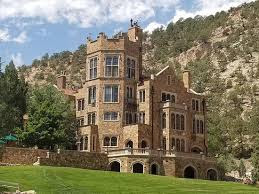
Original Glen Eyrie Castle


Last month, I wrote about General William Jackson Palmer and how he founded Colorado Springs. There is so much General Palmer did for Colorado Springs and Colorado that one blog would go on for pages, so I condensed that blog and I return today with another of the General’s accomplishments.

William Jackson Palmer
Military Wiki 

While living in Colorado Springs, Palmer built a grand home for himself and his wife (nicknamed Queen) in the 1870’s. Situated just north of Garden of the Gods at the mouth of a canyon, Glen Eyrie was originally a clapboard home of twenty rooms. While in residence, Palmer’s wife taught school at Colorado Springs’ first school, but more often than not, the Palmers were not in residence; she because of her health and he because of his work. Suffering a heart attack wile pregnant with their second child, Mrs. Palmer gave birth at the home then spent most of her time on the East Coast or in England. She permanently left Glen Eyrie and Colorado Springs in 1885 and passed away 1894.    

Queen Palmer
Pinterest

With his daughters coming to live with him after his wife’s passing, Palmer sold his Denver & Rio Grande Western Railroad in 1901 for 6 million and retired in Colorado Springs, where he donated several plots of land to the city while forging ahead with plans to renovate Glen Eyrie. He hired architect Frederick J. Sterner and engineer Edmond Van Dienst to help with the project, which took near two years to quarry stone from the estate’s lands and transform the clapboard house into a stone castle. With 67 rooms and 20 fireplaces, the interior was paneled in oak, with the main floor boasting several parlors, a solarium, a dining room, and a kitchen that had ice storage and a walk-in refrigerator. Bedroom suites for Palmer and his daughters occupied the second level, as well as guest suites and servants quarters. The third floor held more bedrooms, a sitting room, and access to the tower, but the belle of the castle was Book Hall. Large enough to hold 300 people, Book Hall boasted a large fireplace and a balcony where an orchestra could perform. Beneath the hall were billiards rooms and a bowling alley.      

Renovated Glen Eyrie 
PBS.org

Sadly, Palmer only enjoyed his renovated home for a handful of years. Paralyzed from a horse riding accident in 1906, he passed away 3 years later. His daughters wanted to donate the castle to the city, but city leaders declined because they feared the cost to maintain the property and home would be too high. For the next 40 years, Glen Eyrie saw many owners, though the house was rarely occupied, to include a group of businessmen who wanted to turn the property into a golf resort, complete with a tavern and luxury houses. World War 1 saw them changing their plans and operating the castle as a tea room. Alexander S. Cochran bought the property in 1918, closed the castle because of the high expense to maintain and let it go to ruin. He did build a ‘pink home’ on the property for a vacation house, and passed away at the start of the Great Depression. The property sat on the market until Texas oilman George W. Strake bought it in 1938.  He expanded the pink house, opened the castle for parties and used some of the land for ranching, and in 1953 listed Glen Eyrie for sale at a price of $500,000, which caught Dawson Trotman’s attention.

Dawson Trotman
Find a Grave

A Christian evangelist and founder of the Navigators ministry, Trotman was planning to move from Los Angeles to Colorado and hoped to split the cost of Glen Eyrie with fellow evangelist Billy Graham. Discovering Christians were interested in the property, Strake lowered the sale price. With Graham backing out of the deal, Trotman quickly raised the down payment with the help of his Navigators ministry and Glen Eyrie became their home in September 1953, and remains so today. The Navigators use the property as a home for their publishing firm, NavPress and as a Christian conference center. The property came with a lake in the Rampart Range area and now houses the Eagle Lake Camps, a Christian summer program. With the exception of the kitchen and the removal of the bowling alley to incorporate a dining area, the main part of the castle is unaltered. The castle and grounds are open to visitors for afternoon tea (reservations required) a tour of the castle, and an overnight stay within the castle, the pink house or the lodges the Navigators built.       


Throughout Colorado Springs and Colorado, General Palmer isn’t just known for Glen Eyrie Castle and the high school named after him. Palmer was responsible for bring the narrow gauge railroads to Colorado’s Rocky Mountain, for providing land and funding for Colorado College, for forming Colorado Coal and Iron Company’s steel mill in south Pueblo and laying out a second town, Bessemer, which is now incorporated into Pueblo. He also founded the General Palmer Hotel in 1898 in Durango, Colorado. Originally named the Palace Hotel, the hotel is still in use today, and in 1962 he was inducted into the Hall of Great Westerners of the National Cowboy & Western Heritage Museum.  

Glen Eyrie Castle
Trip Advisor
Glen Eyrie Castle East View
Trip Advisor

Wednesday, May 5, 2021

Colorado Springs & William Jackson Palmer ~ Julie Lence


William Jackson Palmer
Colorado Springs Gazette

Being an east coast girl from upstate New York, one would think hubby and I would’ve retired to our hometown to be close to our families, but we didn’t. Hubby spent twenty years in the Air Force and one of his assignments was Cheyenne Mountain in Colorado Springs. We fell in love with the area and decided to make it home when he retired. In the past 18 years, Colorado Springs has boomed in population and business, and every day, weather permitting, I get to see America’s Mountain.


Pikes Peak
Pinterest

Long before Army lieutenant and explorer Zebulon Pike traveled through the area and discovered the mountain that is now his namesake, Pike’s Peak, the Ute, Cheyenne and Arapaho tribes called the area at the bottom of what is now Ute Pass home. It was Pike’s wish to summit the peak to map out rivers and the landscape, but feet of snow prevented him from doing so. He published an account of his travels in 1810 naming the mountain, Grand Peak, thus putting it on the map. Fast forward a few years to when gold was discovered in the area and folks rushed to the region, where businessmen established Colorado Springs’ first settlement, Colorado City, at the base of the peak. (Situated west of where Colorado Springs currently sits and Manitou Springs, Colorado City is now known as Old Colorado City.) Colorado City became the hub for selling mining equipment and supplies to those headed up Ute Pass to pan for gold. For a short time, Colorado City was also a territorial capital.

Those looking to strike it rich in the mines weren’t the only people coming west to Colorado Spring’s first settlement. Many came for health reasons, hoping the fresh air and sunshine would cure tuberculosis, and others came for business opportunities, including Colorado Springs’ founding father, William Jackson Palmer. Born in Delaware on September 17, 1836 to a Quaker family, Palmer had a fascination with trains at a young age. He eventually hired on with the Pennsylvania railroad and learned everything he could about the railroad industry and engineering and was the first person to suggest trains should burn coal and not wood, since wood was fast becoming short in supply. Because of his teachings, the Pennsylvania Railroad was the first to use coal.

Vintage Map
Walmart

A man who loathed slavery, Palmer served as a general in the Civil War and won a Medal of Honor for heroic efforts. After the war, he financially supported education efforts for the freed slaves and ventured to the Kansas Railroad and helped lay the tracks all the way to Denver. He and his friend, Dr. William Bell, founded their own railroad company, the Denver & Rio Grande Western Railroad. The first tracks went to the Pikes Peak. The area struck a chord deep inside Palmer and he predicted the foothills would become a booming resort town. Purchasing 10,000 acres of land along the train route, Palmer laid out streets, hauled in thousands of trees to make the city lush and green, and erected lavish buildings resembling European style, to include the Antler’s Hotel. In 1871, his Victorian resort town was born. From the start, Colorado Springs wasn’t a boom town. Palmer used the breathtaking scenery to lure the rich to the area, along with capitalists, artists and intellectuals. Gold was discovered to the west of the peak in Cripple Creek in 1891. More of the wealthy flocked to Colorado Springs and for a spell, the city had more millionaires per capita than any other location in the United States. 

Durango & Silverton RR
ASCE Library

In 1870, Palmer married Mary Lincoln (Queen) and the two enjoyed a honeymoon in the British Isles. It was there he saw and learned about the narrow gauge railroad. The narrow gauge was cheaper to build, could make sharper turns and climb steeper slopes, making it the perfect type of railroad for Palmer to incorporate throughout the state of Colorado to make travel through the Rocky Mountains easier. To date, two of his tracks remain in place; the 45 mile trek between Durango and Silverton in the southwest corner of Colorado, and the Cumbres and Toltec 63 mile trek between Chama, NM and Antonito, CO.    

Colorado Springs today
4word

Palmer went on to bring the railroad to Pueblo. He co-founded the Colorado Fuel and Iron company, and drove the ‘golden spike’ at the Promontory Summit in Utah to finishing America’s Transcontinental Railroad. He eventually retired to Colorado Springs where he helped to establish the Colorado School for the Deaf and the Blind, and the University of Colorado at Colorado Springs, before passing away March 1, 1909. A statue of him riding his favorite his horse,  Diablo, sits in the intersection of Nevada and Platte Avenue in Colorado Springs across from Palmer High School, which is named after him. 

General Palmer Statue
and high school 


Tuesday, December 8, 2020

Legacy - Giving

 Post by Doris McCraw writing as Angela Raines

Photo property of the author

As this year 2020 winds to an end my mind reflects on endings. The long-running show 'Supernatural' came to an end in November. Now you may ask what a television show has to do with endings, with legacies. There was a line in one of the early shows in which the writer, Chuck, says "No doubt endings are hard, but then again, nothing ever really ends." after which the character disappears from the screen.

The end of that line "...nothing ever really ends." is what brought the thought of legacies to the forefront.

So what is a legacy? The online dictionary has among its definitions: a thing handed down by a predecessor.

For a look at part 1 - Legacy - The Beginning?

This time I am looking at Dr. B.P. Anderson and the Sisters of St. Francis. This doctor and nurses gave of their time to bring the first hospital, St. Francis, to Colorado Springs. 

B.P. Anderson gravesite 
Photo by Ron West

The hospital was established in 1887, however, the story begins before that. Dr. Anderson was the physician/surgeon for the Midland Railroad. Dr. Anderson was in Colorado Springs, according to the newspapers, in 1878 and he could have been here earlier. 

The Sisters of St. Francis were part of the beginning of the hospital and remained so through its early years and beyond. 

So what prompted the building of the hospital? Prior to the building of the hospital, Dr. Anderson had brought four Sisters of St. Francis from Layfette, Indiana. According to articles, Anderson had become acquainted with their work as nurses during the War. The Sisters and Dr. Anderson had a clinic for the workers who were building the Midland Railroad Line to Leadville. 

St. Francis Hospital 1925

After an accident in which a number of workers were injured near Leadville of which sixty were brought to Colorado Springs for treatment. The incident showed the need for a larger facility to care for the sick and injured. Through door to door and other means, they found the funds to build their hospital.

This hospital grew over the years from a place that could handle fifty patients to being a part of the Penrose-St. Francis Hospital that we know today. I quote you from an article from February 20, 1916, in the local paper, the Colorado Springs Gazette:

"Charity — that is, real charity — goes on quietly and unobtrusively. Consider that St. Francis handles more than 300 charitable cases annually, ...Take this charitable work away from Colorado Springs and what would the community do? Taking these facts into consideration, it is not amiss to say that Colorado Springs cannot get along without St. Francis. The larger part of these cases are of an emergency sort, of which the public knows little. All this is done without cost to the city at a heavy expense to the St. Francis management."

This is just a brief overview of the giving that became the St. Francis Hospital. This came at a time when Colorado Springs was also a haven for those suffering from consumption, which at the time was defined as any wasting disease. The legacy of this giving of time and service is a legacy that lives on today.

Sometimes we forget what happened that has made our lives easier and those who did so did it selflessly. 

What is our legacy as we move forward into 2021 and beyond? I don't believe we need to become nuns or doctors unless called to do so, but we can be a friend to those in need. Our words can be a comfort to those shut-in or ill. We can choose and the world will be a better place.


Doris Gardner-McCraw -
Author, Speaker, Historian-specializing in
Colorado and Women's History
Angela Raines - author: Telling Stories Where Love & History Meet


Tuesday, August 13, 2019

COLORADO SPRINGS WEATHER HISTORY - WIND

Post by Doris McCraw
writing as Angela Raines


There is a saying I heard years ago, and whether it's true or not, it applies to where I live in Colorado. It was said the natives wouldn't build/live in the area because it would make the wind gods angry. If you've ever dealt with 'wicked' wind you know what I am speaking of. So, I thought it would be interesting to take a look at how wind played its part in the history of Colorado Springs, Colorado.

I will also note that McAllister House, a museum now, was built in 1873 to specifications that would allow it to withstand the winds that blew through the area. As you will read below, it did, for it still stands as it stood all those years ago.

According to the local newspaper on March 8, 1873, which was a Friday night, the wind commenced around midnight and continued unabated for at least two hours. It came from the Northwest bringing clouds of dust. It did considerable damage to unfinished buildings including three that were under construction, and among the businesses affected, the livery stable lost the front of its building. A Mr. James Wilson whose residence was located on Cascade Avenue was "obliged to get a bricklayer to build him a new chimney before he could indulge in breakfast".  A number of smaller outhouses that were found lying on their sides when the sun rose. Although no one was hurt a number of people were frightened including those in the local boarding house and the Colorado Springs Hotel.

McAllister House Museum today
photo property of the author
In January of 1887, the city was hit with another 'wind storm'. This one did damage estimated at between five and six thousand dollars. The wind started picking up around 9am, blowing around 45 miles per hour. By around 1:44 pm it had reach 72 miles per hour, where it remained for about thirty minutes. "During the progress of the storm businesses were almost entirely suspended and the streets wore a deserted appearance. Great clouds of dust were blown through the cross streets and even pebbles the size of marbles were hurled through the air at a terrific rate."


On November 21, 1900, the wind blew for approximately twelve hours straight. According to the newspaper article, "there is hardly a section of the city, there is hardly a house in the city that has not been visited by some injury. There is only the consolation that the wind was not happy or the fair city would have been practically wiped from the map." In this particular windstorm, the article went on to say no one knew for sure what the velocity of the wind was at its height. They went on to say that the college weather Bureau, that being Colorado College, showed that it was 80 miles an hour. To quote the article: "the weathervane spun around for a long time, but finally became overheated and melted away. It was a carried away at last and no exact record is known"

Prior to 1900, there were numerous wind events.

On New Year's Day of 1874, a gale blew up that "people were blown flat on the ground as they tried to move about"

In the winter of 1886, the wind blew for three days and nights. In that particular event, a railroad train of cars was overturned, and plateglass windows were damaged by the gravel and sand.

In the winter of 1889, another strong wind blew and the timber on Cheyenne Mountain caught fire.
There was also a "great wind and in 1898 when the Antlers hotel was destroyed, there was also a terrific gale that day although it did not last very long."

On a personal note,  on April 3, 1982, the wind at the Garden of the Gods was clocked at 103 miles an hour.  So I guess you could say it does get a bit windy here.

Kissing Camels - Garden of the Gods
photo property of the author.

An excerpt from my latest story included in the collection: "Hot Western Nights"

 "So that's how it is?" Dan's voice cut into the silence. He was angry to have been wool-gathering when he should have been paying attention. His voice shook as he asked, "Was this her idea, bushwhacking a person after…"
"You don't speak nothing against Miss Miranda," Sherman cut in. "She don't know nothing about this," he continued.
Dan stared, then began, "So what's next?"
"Why you really here?" Sherman asked, "just seems kinda coincidental you showing up when you did."
Dan took his time, gauging the temper of these men, their obvious respect for their lady boss, Miranda. At the same time, he had his duty to locate, and return one 'Corporal Dawson' for desertion, theft and possible murder. While these men might be able to help, he doubted they would be much use.
"Seems he's trying to get his story straight," Huck cut in on Dan's thoughts.
Dan pulled himself back. Things had gotten ugly mighty fast. He could pull his papers from the hidden pocket of his jacket, but he didn't want to play that hand unless he had to.
"Fine, I'll leave," Dan growled, turning to pick up his gear.
"Don't think so," Sherman countered, "you're staying here even if we gotta lock you up."

"I doubt you could do that," Dan challenged, setting himself for whatever was to happen. "First you question my being here, and when I offered to leave —"

Hot Western Nights by [Nutt, Karen Michelle, Culiner, J. Arlene, Raines, Angela, Clements, Elizabeth, Lence, Julie, Spencer, Kaye]
Purchase from Amazon Here


Doris Gardner-McCraw -
Author, Speaker, Historian-specializing in
Colorado and Women's History

For a list of Angela Raines Books: Here 
Angela Raines FaceBook: Click Here


Tuesday, June 11, 2019

WHO WAS ANNA D. CHAMBERLAIN?

Post by Doris McCraw
writing as Angela Raines

Photo property of the author

Anna D Chamberlain

When I find an interesting subject I have to dig in and find out all I can. I love history, especially the history of the region I live in. When I find women in the history of the Pikes Peak Region I really get excited.

In researching I found an early woman dentist in Colorado Springs. Yes, a woman dentist practicing prior to 1900. While studying the city directories, there she was, I even looked twice to make sure I wasn't seeing a typo.

Her name is Anna D. Chamberlain. I initially found her in the 1896 Colorado Springs city directory listed with her husband Frank C. Chamberlain, also a dentist. Their office was #12 in the bank building with a residence at 1451 N. Nevada Ave.

Anna was born in 1866 to John Shaw and Helen B Shaw in Harlan, Page County, Iowa. Her father came from Ireland and her mother was born in Ohio. Anna married Frank in 1887 and they had three children by 1900. In 1914 she died at the age of forty-eight.

Photo property of the author
According to her obituary she and her husband were associated with dentistry starting around 1888. Some sources indicate they practiced in Colorado Springs, Colorado City and Manitou Springs. One story says she loved her husband so much, wanted to be with him, so she studied to be a dentist too. ( It's a story I can't verify, but if you like romance, it is a good story) 

Anna was not only one of the first women to study dentistry, she was in the first graduating dentistry class from the University in Denver. Her husband, in addition to being a dentist, was also an M.D.  He received his Colorado license in 1892. However, no record of his pursuing medicine in Colorado Springs, other than that of dentist. When you realize how many physicians there were practicing in Colorado Springs, he was wiser to focus on dentistry.

His brother Fred, who was a dentist in Cripple Creek in the 1890's,  also ended up in Colorado Springs. On a side note, Fred also married a woman named Anna, but it was Anna B., very similar to D. As some of you know, census records are not always easy to read, so following the threads can be challenging.  Some of those census takers didn't know how to write, at least in my opinion.

Photo property of Author
In addition to a dental practice and raising three children, she was also active in the church, the WTCU (Women's Christian Temperance Union), and in the late 1890's was the president of the local Colorado Springs WCTU organization. 
Anna and her husband along with Wm. H. Dewey and Oscar J. Fullerton, created the Fullerton Consumption Cure Company with an initial investment of $30,000, near the beginning of the 1900s. So far records have not been found as to what became of their venture.

After Anna's death in 1914,  her husband moved to California and remarried. After his death in 1928 his second wife returned his body to Colorado Springs where he is buried near Anna in Evergreen Cemetery.


In my novel, "Josie's Dream", I have a women who dreamed of becoming a doctor. After graduating medical school, she finds herself on the plains of Colorado establishing herself and following her dream.

Josie's Dream (Grandma's Wedding Quilts Book 9) by [Raines, Angela, Quilts, Grandma's Wedding, Americana, Sweet]
Amazon Link


Doris Gardner-McCraw -

Author, Speaker, Historian-specializing in
Colorado and Women's History
Angela Raines - author: Where Love & History Meet
Angela Raines Books: Here 
Angela Raines at FaceBook: Click Here


Wednesday, September 4, 2013

Garden of the Gods

Before the white man settled at the base of Pikes Peak, the area was home to several American Indian tribes, such as the Cheyenne. In August of 1859, two Denver surveyors scouting the area for a new town site, to be named Colorado City, happened upon acreage consisting of sandstone rock formations. One of the surveyors thought the area would be perfect for a beer garden in generations to come. The other believed the land was a better fit for the Gods to assemble, and the name, 'Garden of the Gods' was born. Later, General William Jackson Palmer, founder of Colorado Springs, urged his friend and railroad builder Charles Elliott Perkins to move to the Garden of the Gods area, build himself a home and erect a railroad from Colorado Springs to Chicago. Perkins did come to Colorado Springs. He purchased some of the land and bought more later, but he never built a home amidst the red rocks. He admired the beauty of the land as it was and hoped to arrange for the land to become a public park, but he died before he saw this happen. His children honored his wishes in 1909, and Garden of the Gods became a public park, with no admission fee for entry, no alcohol served and no buildings allowed to be erected.    


Balanced Rock
The park doesn't just consist of red rocks. There are plenty of native plants, bushes and trees to provide shade from the sun. As far back as the late 1800's, folks toured the park in their buggies. And as cameras became more popular and cheaper, they took photos, too. One of the more interesting spots folks visited and still do is Balanced Rock. The name speaks for itself; a large boulder precariously situated on a thin base. Years ago, from fear the rock would topple and roll downhill, the base was filled with cement, though an exact date of when this was done is unknown.
Steamboat Rock
Steamboat Rock is right next to Balanced Rock. A road separates the two. The top of Steamboat resembles a ship deck. Early on, people were allowed to climb to the top of Steamboat. (With the road, people walking by and snapping pictures or enjoying the view, folks aren't allowed to climb to the top any longer.) Steamboat is also unique with the story behind it. It's said that back in the day, the owner of the land encompassing Steamboat and Balanced rock had a son who charged a fee to take photos of the tourists. Once the camera became popular, folks stopped paying the fee. The owner, Goerke, built a tall, wooden fence and charged a 25 cent admission fee so folks could continue to admire and photograph the rocks. People complained and Goerke soon found himself in a dispute with the city of Manitou Springs over who owned the road rights to the rocks. Goerke lost the initial battle but later won in appeals court.  Afterward, it's said that he granted a public right-of-way to the city of Manitou Springs when he was in the process of divorcing his wife so she couldn't claim the property.    
Another such popular attraction is Kissing Camels (left). From the photo, one can see the top of the rocks have formed together to resemble two camels kissing. Thousands of photos of the camels have been taken by locals and by tourists. From the modern day parking lot, a sidewalk leads down the front side of the camels, loops around and comes up the back side. Rock climbing near the camels is allowed, with a permit and proper rock climbing gear.

Today the park is open year-round and receives thousands of guests. A newly built visitor's center showcases a small theatre where one can learn how the rocks were formed billions of years ago, a gift shop and an eatery. At the south end of the park is garden of the Gods Trading Post--a must stop place for those who love all things western and Native American.  One of the oldest trading posts in the west, I speak from experience when I say they have the most beautiful pottery.


Deer are abundant in the park, as are picnic areas and breathtaking views of Pikes Peak, downtown Colorado Springs and Cheyenne Mountain. And best of all, it is still free to the public.