Trust your Intuition Day. When we think about intuition it's usually about ourselves. However, this made me think back to how much early pioneers did or did not trust their intuition.
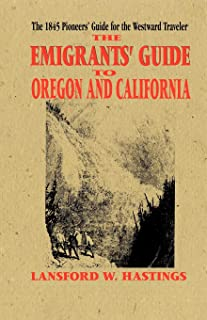
When planning their travel via the Oregon, Santa Fe, or any other of the East to West Trails, were they able to talk to anyone who'd made the trip? Perhaps, by 1859 they could have read "The Prairie Traveler" by Randolph B. Marcy, Captain, U. S. Army. This was written in response to "The Emigrants' Guide" and used by those heading to the goldfields in Colorado. They could have made use of the articles and pamphlets written by those who'd traveled their expected route. Another example is the 1848 book "Emigrants' Guide to Oregon and California" by Lansford Hastings, used by the Donner Party. Here is a link to that publication: The Guidebook used by the Donner Party
While these options were useful, as we know, the weather, time of departure, and any number of factors would have made a trip much different from the one before. On the trail, intuition and common sense might have been the best weapon in the traveler's arsenal.
How much did intuition play in the search for gold? Early prospectors were probably not versed in geology and the earth sciences. That's not to say they didn't have on-the-job learning/training.
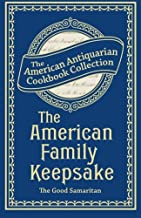
Early physicians. A lot of their diagnosis probably had to do with practical applications and a lot of intuition. Antibiotics, understanding of germ theory, etc. were not known in the early days of medical practice. An 1848 book "The American Family Keepsake" says that drinking Olive Oil is a cure for snakebite.
A dive into some of the small details or reading books published during a certain time period give a lot of insight into how people thought and/or acted. I've found all of this to be very useful when I'm researching my books.
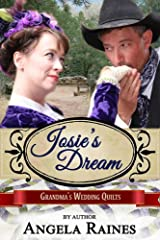
In "Josie's Dream" a study of the Keokuk School of Physicians and Surgeons gave me an understanding of what Josephine would have been exposed to as she studied to become a physician herself. And yet, when she started her practice her intuition served her well.
I want to introduce you to two women who
were practicing medicine in Denver before 1900. Both were named Mary Bates.
Although I'm still learning about these doctors, their
stories so far are still the stuff of legends and can and will lead
to so much more.
To
help put their story in context let’s start with Colorado, which became a
state in 1876. From the early days, Colorado was filled with people
who were adventurers, the people who go where others may fear to tread. When gold and other minerals were found in the high
mountains the state population began to explode. Those not searching for gold, remember the1859 slogan “Pikes
Peak or Bust”, they were providing services and goods for the searchers.
Additionally, there was an influx of people who found the Colorado climate beneficial
for their health. This combination led many women to brave this new
territory to practice their medical skills. Into this mix, Mary Elizabeth Bates and Mary Helen Barker Bates arrive.
an early image of Leadville from Wikipedia
Mary
Helen Barker Bates
(b.1845-d.1934) was the daughter of Dr. Ezra Barker who practiced in
New York. She graduated from the Woman’s Medical College in
Philadelphia. In her early career, she practiced in Salt Lake City, Utah. Family history says she was the physician for Mormon leader Brigham Young. In reality, she probably was the doctor for members of his family. It was in Utah she met and married George Bates in 1876. In 1878. at
the age of 33, she moved to the mining town of Leadville,
Colorado.
Leadville for those who don’t know sits at 10,152 feet above sea
level in the Colorado Rockies. While there she was part of the group who tried to create the Ladies
Relief Hospital. In 1881 she moved to Denver for her husband’s
health. She was also one of the early women licensed by the State when the state began licensing physicians in 1881.
(Her license #271). She took a special interest in Women's Suffrage,
children and education. She introduced the Colorado bill for the Law for the
Examination and Care of Public School Children which went into effect
in 1910.
Denver, CO 1887 Library of Congress
Mary Elizabeth Bates (b.1851
d.1954) arrived in Denver in 1891. Before arriving in Colorado, she
was the first woman intern (1882-1883) at Cook County Hospital in Chicago, Illinois after
a grueling exam in which she beat out several male candidates.
She studied in Vienna from 1883-1884. Upon her return, she was a
professor of anatomy at the Woman’s Medical College in Chicago from
1884-1889. In Colorado, she also was involved in the Woman’s
Suffrage movement and was part of the group that affected the passage
of the 1893 referendum which gave Colorado women the right to vote.
Dr. Bates also was a champion of the strict adherence to the liquor
and gambling laws of the state. Dr. Bates other passion was animal
rights and before her death in 1954 she created the Mary Elizabeth
Bates Foundation for animal care.
Both
women were and are strong role models for following a dream and not
giving up on what you believe in. As I continue to research and learn
about these early women pioneer doctors I find their stories are something I
do not want future generations to lose. The gift these women have
left us are the nuggets of gold that far outweigh the stuff that was
torn from the earth during the time they were practicing their
careers.
Photo property of the author
In the novel "Josie's Dream", Josephine Forrester dreams of creating a medical practice of her own. She gets the chance in the town of Kiowa Wells, CO. Below is a short excerpt where Josies is treating Will Murphy, the man who is the one who ...
The early summer heatwave of the
past week drove Will’s patience past all control. He was sitting in
Josie’s office, his hands moving under the bandage on his head.
“Fussing with your bandages
won’t make your wound heal any faster,” Josie said grinning.
“A lot you know, lady doctor,”
Will shot back.
“Insulting me will not help
either,” Josie laughed. The look of frustration on Will’s face
was too ludicrous to keep the laugh inside.
“I’ll show you,” Will
snarled as he began unwinding the bandage on his head. Almost as
quickly, the kitten, seeing movement pounced on the flying ends.
It was too much, Josie laughed so
hard tears were falling, as she held her ribs, gasping for breath.
Sheepishly, Will grinned,
reaching over to pet the kitten. “Perhaps you could…”
Still gasping, Josie could only
nod her head in assent, her green eyes sparkling at Will’s
discomfort. She knew she should be professional, but between the
kitten and Will’s discomfort, she just couldn’t keep a straight
face.
In the meantime, the kitten
reverted to its ancestral self, attacking the bandage with a
vengeance. The way the kitten pounced, attacking the ends, then
pulling, it appeared she might manage to topple Will over.
Jumping up, Josie picked up and
moved the kitten away. Taking a pair of scissors, Josie began cutting
the bandage from around Will’s head. Once she’d removed the
bandage, she gently examined the wound from the bullet. “Well,
you’re healing nicely, but that wound is still looking like a piece
of rare meat.”
“Are
you saying you could place my head between two pieces of bread?”
Will grinned.
“I doubt it would be very good,
too tough,” Josie retorted.
“What, you don’t like it
tough?”
Josie wasn’t comfortable with
the way the conversation was heading. Will was her patient, but…
When I find an interesting subject I
have to dig in and find out all I can. I love history, especially the
history of the region I live in. When I find women in the history of the Pikes Peak Region I really get excited.
In researching I found an early woman dentist in Colorado Springs. Yes, a woman
dentist practicing prior to 1900. While studying the city
directories, there she was, I even looked twice to make sure I wasn't
seeing a typo.
Her
name is Anna D. Chamberlain. I initially found her in the 1896
Colorado Springs city directory listed with her husband Frank C.
Chamberlain, also a dentist. Their office was #12 in the bank
building with a residence at 1451 N. Nevada Ave.
Anna
was born in 1866 to John Shaw and Helen B Shaw in Harlan, Page
County, Iowa. Her father came from Ireland and her mother was born in
Ohio. Anna married Frank in 1887 and they had three children by 1900.
In 1914 she died at the age of forty-eight.
Photo property of the author
According
to her obituary she and her husband were associated with
dentistry starting around 1888. Some sources indicate they practiced in Colorado
Springs, Colorado City and Manitou Springs. One story says she loved her husband so much, wanted to be with him, so she
studied to be a dentist too. ( It's a story I can't verify, but if you like
romance, it is a good story)
Anna was not only one of the first women
to study dentistry, she was in the first graduating dentistry class from the University in Denver. Her husband, in addition to being a dentist, was also an
M.D. He received his Colorado license in 1892. However, no record of his pursuing medicine in Colorado Springs, other than that of dentist. When you realize how many physicians there were practicing in Colorado Springs, he was wiser to focus on dentistry.
His
brother Fred, who was a dentist in Cripple Creek in the 1890's, also
ended up in Colorado Springs. On a side note, Fred also married a
woman named Anna, but it was Anna B., very similar to D. As some of you know, census records are not always easy to read, so following the threads can be challenging. Some of those census takers didn't know how to write, at least in my opinion.
Photo property of Author
In
addition to a dental practice and raising three children, she was
also active in the church, the WTCU (Women's Christian Temperance
Union), and in the late 1890's was the president of the local Colorado
Springs WCTU organization.
Anna and her husband along with Wm. H. Dewey and
Oscar J. Fullerton, created the Fullerton Consumption Cure Company
with an initial investment of $30,000, near the beginning of the 1900s. So far records have not been found as to what became of their venture.
After
Anna's death in 1914, her husband moved to California and remarried. After his death in 1928 his second wife returned his
body to Colorado Springs where he is buried near Anna in Evergreen
Cemetery.
In my novel, "Josie's Dream", I have a women who dreamed of becoming a doctor. After graduating medical school, she finds herself on the plains of Colorado establishing herself and following her dream.
I’ve had less time to research with the new novel that arrived on April 6, 2019. So for this post, I'm re-posting an older, revised post. I’m sharing some statistics about early women doctors. For this post, I focused on the women who were licensed prior to 1890. This is just a sample of these amazing women.
I've written a number of time of Alida Avery,who was one of the first women doctors in Colorado, arriving in 1874. She worked to be admitted into the Colorado Medical Society. She did not succeed, but her efforts helped those who came later. By 1881, when Colorado began licensing doctors, it didn't matter whether you were male or female. If you met the criteria, you were licensed.
There was Julia Loomis, who was Colorado Springs first female doctor. She arrived sometime between 1876 and 1878. She passed away in 1880. Her contemporary was Harriett Leonard, the first in Manitou Springs. She also arrived between 1876 and 1878.
Below are additional women who received a Colorado license prior to 1890. This is not a complete list, but a sampling.
Augusta B. Nelson: practiced in Denver, received her license in 1888 and was 59 at the time.
Mary Ogden: practiced in Denver, received her license in 1886 and was 45.
Caroline F. Parker: practiced in Longmont, received her license in 1883 at the age of 43.
Celestia D Messinger: practiced in Leadville and other places was 41 when she was licensed in 1883
Anna Marsh: received her license in 1881, was 43. She started her practice in Greeley.
Madeline Marquette (Baker): was licensed in 1888 at a young 28 and along with Dr. Josepha Williams opened a private sanitarium in Denver.
Mary Mallory: licensed in 1888 also at 42 years of age. She started her practice in Salida, but moved to California in 1890.
Julia McNutt: was 41 in 1884 when she received her license and practiced in San Juan County Colorado
Trail to the North Star mine up King Solomon Mountain, Cunningham Gulch. San Juan County, Colorado. 1875.
Julia Adams: was 50 in 1881 and practiced in Chaffee County. Her license is #124.
Elnora W. Anderson: was a young 35 in 1881 when she received license #184, setting up a practice in Denver.
There are twenty plus additional women on the list, and with rare exception the age at time of receiving their license is forty or older. Yes, a lot of them set up a practice in Denver, but as you can see by the sample above they also headed out to the mountains and other less populous areas. The more I learn about these women who followed their dreams the more I want to know. Their desire and fortitude show me that a dream doesn’t end when you reach a certain age, it is ageless. Can I do any less?
Until next time, here’s to history and the stories it tells.
My novel "Josie's Dream" is this story of an early women doctor who comes to Colorado in 1879 to settle in the fictional town of Kiowa Wells. Here is an excerpt from that story:
Since corresponding with Dr.
Harriett Leonard, a past student of her medical school and dear
friend, despite the difference in age, Josie had been dreaming of
coming to Colorado. Dr. Leonard had offered to let her work at the
Spa in Manitou Springs where Harriett was the proprietor, but Josie
wanted to create a practice in a smaller town, where people really
needed her.
Now here she was in Kiowa Wells,
on the eastern plains of Colorado just a few miles from the railhead
at Kit Carson. Her biggest obstacle now was finding a place to set up
her medical practice.
Despite
his reservations, her father gave her a medical bag, equipped with
the basics. “Something to remind you of this commitment, your
Hippocratic oath,” were his parting words.
Her parents, though still in
Iowa, were in her heart. Still, she knew it had been time to leave.
While others of her friends were getting married, she had gone to
medical school, her path clear to her.
“Can
I help you?” The voice behind her asked, a hand reaching around to
grab her bags.
Turning to face the speaker,
Josie took in the disheveled appearance, the look of cunning in the
eyes.
“I can manage, thank you,”
Josie replied, taking a firmer hold on her belongings.
“Now, there is no need to be
rude. I was just tryin’ to be helpful,” the man said as he tugged
at her bag.
Stiffening, Josie sternly
repeated, “I can manage.”
With a hard yank, the man managed
to pull her doctor bag loose and without a thought, Josie swung her
large bag at the man, striking him on the legs as he turned to run
off. Instead, he found himself flat on the ground.
Calmly, Josie bent, retrieved her
property, and knowing he was just stunned, started down the street.
She had only gone a few steps when she heard a bellow behind her.
“Let me get to the point
quickly,” she said as she turned to her tormentor, who stopped so
quickly he almost fell. “I have nothing of value you could use. So,
unless you are in need of medical care, I suggest you stop while you
are ahead.” Now, standing close, she could smell the liquor on him.
Her eye took in his inability to stand upright without swaying. But
to be fair, his fall might have had something do to with that.


.png)


![Josie's Dream (Grandma's Wedding Quilts Book 9) by [Raines, Angela, Quilts, Grandma's Wedding, Americana, Sweet]](https://images-na.ssl-images-amazon.com/images/I/614xQF8KubL.jpg)


