Showing posts with label Much Ado About Madams. Show all posts

Friday, February 13, 2015

The Comstock Lode by @JacquieRogers #history #western


Website | Pickle Barrel Gazette | Amazon

The Wild Rich West

What one event influenced the outcome of the Civil War, built the Bank of California, financed San Francisco, created a new state, built a prestigious university, and pushed the completion of the trans-continental railroad? Yep, the discovery of the Comstock Lode.

Virginia City, Nevada, is on top of this momentuous find--it's a great place to visit and you can go on several excellent tours. The Comstock Lode was the world's richest mining discovery at the time. People think about silver when you mention the Comstock Lode, but actually miners extracted 57% silver, and 42% gold--more gold than most gold mines.


Since the 1849 California Gold Rush, prospectors scoured the western half of North America obsessed with gold fever. In 1859, Pat McLaughlin and Peter O'Reilly found gold at the head of Six-Mile Canyon. Henry Comstock, good fellow that he was, told McLaughline and O'Reilly that the discovery was on his pasture land and, well, they believed him. Same old story--the discoverers weren't the ones who made the money. But then neither did Henry Comstock.

Old Virginnie Town's population increased from about 3 to 17,000 in the first year. One major frustration the gold miners had was the annoying sticky blue-gray mud that clung to their shovels. When they assayed the mud, it turned out to be silver ore worth $2,000 per ton! That's a lot of money in 1859. Things really heated up around then! From Calliope:

"Frame shanties pitched together as if by accident - tents of canvas, of blankets of brush, of potato-sacks, and old shirts, with empty whisky barrels for chimneys - coyote holes in the mountain-side forcibly seized and held by men - pits and shafts with smoke issuing from every crevice - piles of goods and rubbish in the hollows, on the rocks, in the mud, in the snow everywhere, scattered broadcast in pell-mell confusion."
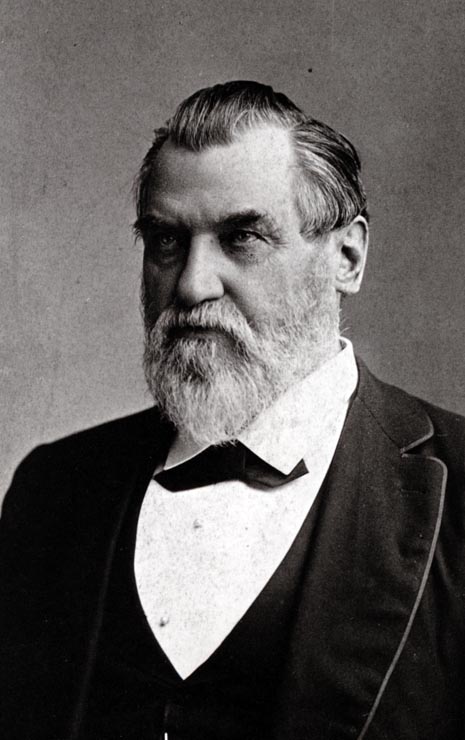
Lots of men who are household names today made their fortunes from the Comstock Lode, among them are: George Hearst, father of William Randolf Hearst; Leland Stanford (right), founder of Stanford University; William Ralston, founder of the Bank of California; and of course the most famous was an unsuccessful prospector who took up the pen, Samuel Clemens, better known as Mark Twain.


Within a few years, the political climate back East heated to boiling. President Abraham Lincoln had a war to finance, and the Comstock Lode was entirely too enticing. The boundaries were defined and Nevada became a state even though the population was too small to qualify it.

All didn't go smoothly at first. There was much dispute and hooplah over boundaries, and in the first six years, of the $50 million of ore mined, $10 million went to litigation! And of course one of the preeminent lawyers, William Stewart, ended up in the U.S. Senate.

The Comstock Lode brought a lot of innovations: the first miners' union, advances in drilling and tunneling technology, square-set timbering (which changed mining all over the world), and lots of other inventions that were the catalyst for modern mining practices. It also made a few men rich and broke thousands.

Sources:
Online Nevada, Calliope, Stanford University, Wikipedia


Free today, Feb. 13 only!
Much Ado About Madams
Hearts of Owyhee #1

"Rogers' talent shines as she creates a stunning portrait of what it was like to live in the old west. Her characters leap off the page and she handles humor with as much skill as she does the deeper emotions. MUCH ADO ABOUT MADAMS was a fabulous read. I am anxiously awaiting the next book in the Hearts of Owyhee series." ~Gerri Russell, author of the Brotherhood of the Scottish Templars series.

Oh my stars! Suffragist Lucinda Sharpe can’t believe she was hired to teach a bunch of soiled doves their letters. And what about the handsome brothel owner? Only a despicable cad would engage in such a business. 

Blast that woman! Reese McAdams didn’t want the brothel in the first danged place, and now a suffragist schoolteacher is stirring up the works. 

Can she reform the Comfort Palace ladies without losing her heart to Reese? Will her secret past ruin her future?


coming soon:
Much Ado About Mustangs

Friday, January 9, 2015

#Free book + giveaway. Hearts of Owyhee by @JacquieRogers #western #romance #oldwest


Cowboy kisses is not for promotion, although we aren't at all averse to telling people about our books.  Still, every once in a while, the contributors do need to let folks know what we have available.  In my case, the rights to the entire Hearts of Owyhee series reverted back to me Dec. 31, so I'm reissuing the books--re-edited and with new covers.  In one case, Much Ado About Madams, I wrote a new ending.  Well, more like added-to.  

So for this month, I'm hauling out all the books for you to see.  Oh, that reminds me that I need to update my author page here at CK.  Better get to it!

And don't forget that Friday only (Jan. 9, 2015), Much Ado About Madams is free!  If you miss the free day, the book will be only 99¢ the next two days, so still a bargain.


Welcome to 1880s Owyhee County, Idaho Territory!  It was a hoppin' place in those days, and I've brought you several fictional adventures, both novels and short stories.  These can be read in any order, but here's the chronological sequence:

Much Ado About Madams
Hearts of Owyhee #1
by Jacquie Rogers

Amazon Kindle

5 Stars from Detra Fitch, Huntress Reviews: "A story this good can only come from the imagination of Jacquie Rogers."

"A rollicking riot of a good read!" ~Ann Charles, author of the Deadwood Mysteries

Low-down on Much Ado About Madams

Oh my stars! Suffragist Lucinda Sharpe can’t believe she was hired to teach a bunch of soiled doves their letters. And what about the handsome brothel owner? Only a despicable cad would engage in such a business.

Blast that woman! Reese McAdams didn’t want the brothel in the first danged place, and now a suffragist schoolteacher is stirring up the works.

Can she reform the Comfort Palace ladies without losing her heart to Reese? Will her secret past ruin her future?

"A romantic trip to the Old West stamped with Jacquie Rogers' special brand of humor. ~ Caroline Clemmons, author of Brazos Bride

"Ms Rogers' clever western romance, MUCH ADO ABOUT MADAMS manages to enrousingly engage her growing readership while reminding us of the difficulties faced by the brave women who tamed the American West. All that, and did I say entertaining!" ~ John Klawitter, author of The Freight Train of Love
♥ ♥ ♥

Much Ado About Marshals
Hearts of Owyhee #2
by Jacquie Rogers

Amazon Kindle

NOR Top Pick
CTRR Award
Winner: RttA, Best Western Historical Romance Novel

5 stars from Laron Glover: Need a break? This is a FUN book (seriously--when's the last time you read a laugh-out-loud book?)! Turn off the iphone, kick off yer boots (or Jimmy Choos) and let Jacquie Rogers provide that mini-vacation you KNOW you need!

Low-down on Much Ado About Marshals

Rancher Cole Richards rescues his friend from robbing a bank, but is shot for his efforts, and now is a wanted man. His friend takes him to Oreana to see the doc, but Cole's mistaken for the new marshal!

Daisy Gardner is obsessed with solving crimes just like dime novel heroine Honey Beaulieu. But Daisy's parents insist she marry a farmer. Problem is, she can't be a detective if she's stuck miles from town. What better solution than to marry the new marshal.

Now Cole faces a dilemma few men have to face—tell the truth and hang, or live a lie and end up married. Either way could cost him his freedom.

5 stars from romantchick: Nancy Drew meets William Shakespeare ...hilarious characters, memorable colloquialisms, a clever, engaging plot and fine writing. All of which recommends Rogers' Much Ado About Marshals as everything to do about a charming, well-written romp.
♥ ♥ ♥

Much Ado About Miners
Hearts of Owyhee #3
by Jacquie Rogers

Amazon Kindle

"My biscuits are burning from this scorcher of a book. I will never be able to bake again without a wicked grin on my face.This is the latest installment of the Much Ado series, and it's as explosive as a stick of dynamite." ~reader Karla Eakin

"My biscuits are burning from this scorcher of a book. I will never be able to bake again without a wicked grin on my face.This is the latest installment of the Much Ado series, and it's as explosive as a stick of dynamite." ~ Agnes Alexander, author of Drina's Choice

Lowdown on Much Ado About Miners

Cupid’s bullet...
Hired gun Kade McKinnon interrupts a bank holdup and is shot by the teller, Iris Gardner, whose victims have a tendency to be the next groom in town. Will he be the groom this time?

Cupid’s bow...
Iris Gardner, a smart, independent bank clerk, fell in love with Kade when she was too young to know better. So when he walks back into her life and her bank, it's only fitting that she shoots him ... by accident, of course.

Cupid’s blindfold...
Kade doesn’t know Iris’s company is the one who hired him to escort a bullion shipment, and Iris doesn’t know Kade owns the security company, but they both know robbers are on their trail. Which is more likely to be stolen—the silver, or his heart?

"...if you love a good romance set in a fun western setting, and you love to laugh, you will love this book as much as I did!" ~ reader Terry Gregson

♥ ♥ ♥

Much Ado About Mavericks
Hearts of Owyhee #4
by Jacquie Rogers

Amazon Kindle

FIVE STARS! "Jacquie Rogers writes some of the best Historical Romances on today's market. Not content to simply write a plot and toss in a lot of bed scenes and/or filler, this author adds in subplots, humor, action, suspense, and some endearing strays." ~Detra Fitch, Huntress Reviews

"When you read a Jacquie Rogers book, you know you're in for a fast, fun ride!" ~BookwormForever

Low-down on Much Ado About Mavericks

Against the sweeping backdrop of the Owyhee Mountains, Benjamin Lawrence meets the one woman who'll rattle his derby forever.

Ben is a highly respected attorney in Boston, but in Idaho Territory, they still think of him as that gangly awkward boy called Skeeter.  When he goes back home to settle his father’s estate, he’s confronted with an outlandish will and a fiery redheaded head wrangler, who just happens to be the sexiest female he's ever met.

Janelle Kathryn O'Keefe, affectionately called "Jake," can out-ride, out-shoot, and out-rope any cowboy on the Bar EL, which is why she was promoted to foreman.  She's not at all amused that she has to teach an eastern greenhorn how to work cattle, no matter how handsome he is.

5 Stars from reader Claudia Stephan: "I can't even count the times I laughed out loud while reading this book. What are you waiting for? Give it a try!"
♥ ♥ ♥
Contest!
One commenter will win a free digital copy of 
Much Ado About Mavericks  
Drawing will be January 12, 2015, at 9pm Pacific Time

Thursday, July 11, 2013

Outhouses in the Old West by Jacquie Rogers #western @JacquieRogers


Outhouses in the Old West
by Moriah McCormick 

Have you ever wondered about outhouses? Growing up, my family and I did a lot of camping and at most camping sights there were outhouses available for use. My grandpa even had one on his farm. To me, outhouses were just a part of life. Nothing else.

It wasn’t until I moved to “The Big City” that I realized that not everyone thought that outhouses were commonplace structures. My friends would look at me strangely when I mentioned my grandpa’s outhouse and they’d tease me about how I was living in the wrong era, but invariably they’d start asking questions about them. I didn’t know how to answer these queries because an outhouse was a place to do your business and that was that.

When I was seventeen I went on a week long camping trip to Silver City, Idaho, where I saw a two-story outhouse. It triggered every question that my friends had ever asked me and a few of my own as well. For instance, what about that poor fellow on the ground floor? It was time to find some answers.

Crescent Moon
In modern day, there are men’s and women’s restrooms, but in all the pictures you see only one outhouse. Why? Also why was there a crescent moon on all of the outhouses? Conveniently for me those two questions can be answered at the same time.

An outhouse was made for privacy, but without a window how would light get in? Cutting a shape above eye level let in light but still allowed the users their modesty. In public places, a person could usually find two outhouses next to each other: one would have a carving of the crescent moon the sign for women, the men's would have a star.

Apparently the sanitation and maintenance of the men’s outhouses were not always on par with the women’s, and sometime in the early to mid 19th century, men began using the women’s outhouses and leaving the star behind.

But wait!  What about toilet paper?  Corncobs or paper (from whatever magazine or catalog available) had to suffice in the first half of the 19th century.  

Toilet Paper

In 1857, Joseph C. Gayetty introduced the first paper specifically for this purpose, Gayetty's Medicated Papers, also called therapeutic papers.  Rolled toilet paper wasn't invented until 25 years later, and wasn't commercially available to the mass market until the 1890s.

How did you keep down the inevitable foul smell of an outhouse so that a person could use it without throwing up? And what happens when it fills up?

Controlling the odor of an outhouse was a full time job. A bag of lime with a scoop was usually placed in the corner.  After every use you sprinkle a scoop of lime in the hole as a chaser to keep down the smell.  As for what happens when the outhouse gets full, easy—you simply dig a new hole, move the outhouse over it, and fill the old hole with dirt. This is a good place to plant a flowerbed or a tree.

Two-story outhouse in Silver City, Idaho
The two-story outhouse perplexed me the most. How in the world would you use the top without making a mess on the person below? It turns out that the seats were staggered and the top seat was placed farther back than the one on the bottom.  In the lower outhouse there was a wall placed behind the seat so that the occupants wouldn’t be defiled by the contents falling from above (thankfully).

Apparently I’m not the only person who thinks about outhouses. I Googled “outhouse” and was slammed with thousands of sights.

Do you like music?  Here's an outhouse song:

Anything you want to know about outhouses, you'll probably find on the Outhouses of America Tour website. Don't overlook the trivia and FAQ pages.

You just know Legends of America will have something to say on this topic. Take a look at their Outhouses of the American West pages (five of them).

A fun site to visit (and to send your outhouse photos and anecdotes) is OutHouseGraffiti.com. They refer to the Legends of America site for the history, but this site offers photos, stories, and "misc. crap" (which has nothing to do with anything, but fun if you like disgusting humor).

Outhouses have long been a convenient source of good old American humor, the most often used is privy-tipping.  Outhouse scenarios are frequent in shoot-outs because they lend a little comic relief to an otherwise very tense "sit"-uation.  Yes, there's outhouse humor in nearly all my books--didn't realize that until now!

Here’s a snippet from
Much Ado About Madams
by Jacquie Rogers

Reese took aim, but lowered his rifle when he realized Buster was stabled just the other side of the wall. The .54 caliber bullet would go right though the man and the barn wall. Desperately, he searched for another way to take out the gunman. He ran to the outhouse and threw himself to the ground.

Gunfire stopped, and Reese’s skin crawled. Maybe his men had been shot. Maybe they were reloading. Praying for the latter, he positioned himself into a crouch, ready to spring. Seconds passed. The odor of the privy didn’t help his patience a bit. He made a note to tell Sadie to use more lime. Lots more lime.
♥ ♥ ♥
Hearts of Owyhee
Where the Old West really happened!
Much Ado About Marshals
Much Ado About Madams
Much Ado About Mavericks

Friday, January 11, 2013

Jacquie Rogers: A Fun Tour of Idaho History


Most westerns are set in Texas, Arizona, or Wyoming, a few others set in Oklahoma, Kansas, and Montana, then comes Colorado, and New Mexico.  The other states are for the most part ignored, only getting a book set in their neck of the woods on rare occasions.

Of course, every single state I listed is back East to Idahoans.

First, I thought it would be fun to do a glossary.  Ron Scheer does one every now and again in his blog, Buddies In The Saddle, and he always comes up with some interesting terms.  (Great resource--you should check it out!)  Some terms I know, some I never heard of and would like to try, some aren't of much use to me, but fascinating nonetheless.  I thought it would be fun to list a few terms and phrases still in use when I lived in Owyhee County, Idaho, where my ♥ Hearts of Owyhee ♥ series is set.

Bazoo: Late 1880s word for "mouth."  probably from Dutch bazuin meaning "trumpet."  Example: Shut your bazoo before I shut it for you.

California widow: A product of the 1849 gold rush, and referring to the men who left to find the mountain of gold, leaving their wives and children behind.  Some of the men took West Coast wives but were still married to their East Coast brides. Example: If Jeb hadn't opened his big bazoo, his new housekeeper never would have found out about his California widow, but he did miss his son.  In contemporary use, it refers to a woman whose husband is gone a lot because of his job--a long-haul truck driver or something like that.

Crowbait: Originated around 1855-1860, meaning an emaciated horse (or could be a mule, cow, or oxen) that isn't much good for work anymore.  Example: Jeb wants to sell me some crowbait for fifty dollars.  I doubt that critter would make it halfway home before he gave up the ghost.

Dry gulch: From the early 1870s, this term means to ambush.  It probably stems from bandits luring their victims into a box canyon or dry gulch to kill and rob them.  Can be used as a noun or verb.  Example: Jeb's hair stood on the back of his neck.  He had a strong feeling bandits were waiting in the next arroyo, and they had a mind to dry gulch him.

Hard case: This phrase comes from the 1830s and is used to refer to a man (sometimes a woman) who is prone to felonious behavior and who has few moral scruples.  Generally a very dangerous person.  Example: Jeb pursued a hard case wanted for murder, rape, and painting a puppy.

Hell-bent for leather: Late 1800s saying meaning to ride as fast as you can, more than likely wrecklessly.  Original saying is "hell-for-leather" and was a favorite phrase of Rudyard Kipling, who probably picked it up from the British troops in India, so not exclusive to Western at all.  Example: Jeb rode hell-bent for leather to stay out of rifle range of the mudsills waiting to dry gulch him.

Mudsill: According to Etymology Online: 1680s, "lowest sill of a house," from mud + sill. The word entered U.S. political history in a speech by James M. Hammond of South Carolina, March 4, 1858, in U.S. Senate, alluding scornfully to the very mudsills of society, and the term subsequently was embraced by Northern workers in the pre-Civil War sectional rivalry.  Example: Ready to draw, Jeb rode through the camp of mudsills, never turning his back to a one of them.

The whole kit and caboodle: Mid 1800s.  From  Etymology Online: "also kaboodle, 1861, from kit (n.1) in dismissive sense "number of things viewed as a whole" (1785) + boodle "lot, collection," perhaps from Dutch boedel "property." Kit also was paired with other words in similar formations."  Jeb rode hell-bent for leather out of the box canyon where the whole kit and caboodle of mudsills had tried to dry gulch him.

Idaho Territory
Not for the faint of heart

Before the Europeans, residents of the Idaho area were the Lemhi, Shoshone, Bannock, Nez Perce, Salish, Paiutes, and Piegan Indians.

British fur trappers roamed Idaho in search of beaver pelts and other animal furs as early as 1809, but in 1814, the trading post in southern Idaho was destroyed by the Bannock.  Still, trappers and traders came from the East Coast, Britain, Russia, and the Sandwich Islands (Hawaii).  In fact, the later provided the name for Owyhee County.  From Wikipedia:
The name "Owyhee" derives from an early anglicization of the Hawaiian term "Hawaiʻi." When James Cook encountered what he named the Sandwich Islands (now the Hawaiian Islands) in 1778, he found them inhabited by Native Hawaiians who Anglo-Americans referred to as "Owyhees." Noted for their hardy physique and maritime skills, numerous Native Hawaiians were hired as crew members aboard European and American vessels. Many Owyhees sailed on to the American Northwest coast and found employment along the Columbia, where they joined trapping expeditions or worked at some of the fur trade posts.
In 1819, three Owyhees joined Donald Mackenzie's Snake expedition, which went out annually into the Snake country for the North West Company, a Montreal-based organization of Canadian fur traders. The three Hawaiians left the main party during the winter of 1819-20 to explore the then unknown terrain of what since has been called the Owyhee River and mountains and disappeared. They were presumed dead and no further information regarding their whereabouts has been found. In memory of these Native Hawaiians, British fur trappers started to call the region "Owyhee" and the name stuck.
Up to 1846, the area was  considered part of the Oregon Territory, and the primary industry was the fur trade.  Trappers and mountain men were the ones who laid out the Oregon Trail (and all the rest of the major trails, too).
Captain Benjamin L. E. Bonneville and Joseph Rutherford Walker crossed South Pass with twenty wagons and one hundred and ten men on July 24, 1832. On a two-year leave from the army, Captain Bonneville and Walker led the first wagon train over South Pass on what became the Mormon and Oregon-California Trail.
We always think of the Spaulding/Whitman wagon train as the first, but not.  Eliza Spaulding and Narcissa Whitman were the first Euro-American women to make the trek west--the Spauldings to Northern Idaho and the Whitmans to Washington State.  Henry Spaulding also brought the first printing press to Idaho in 1839.

Keep in mind that Idaho wasn't called Idaho yet.  That didn't happen until 1863, when Idaho Territory was carved from Washington Territory.  When I was in school, we where taught that Idaho was from the Shoshone "Ee-da-how," meaning "sun over the mountains," or "gem of the mountains."  This turned out not to be true and as far as we know, the name was simply made up by George M. Willing.  Yep, a hoax.  Good thing we Idahoans have a sense of humor.

Because of modern-day boundary shifts, Owyhee County is no longer the largest county in Idaho, but it's still large--the size of New Jersey.  The population is growing by leaps and bounds and is now 1.5 people per square mile.  Even so, a lot of the old ways are preserved there, both because of the remote location and because the people like it that way.  The latter is what a whole lot of city people don't understand.

So it's with the spirit of those hearty Owyhee pioneers that the Hearts of Owyhee series was born.


Where the Old West really happened!
Much Ado About Marshals
Much Ado About Madams
Much Ado About Mavericks


♥ Hearts of Owyhee ♥ 
A fun short story: Willow, Wish For Me (Merlin’s Destiny #1)

Friday, November 9, 2012

Jacquie Rogers -- Sourdough Baking: Part 3, Sourdough Biscuits


Sourdough was the most common yeast used in the Old West.  Believe me, it wasn't a hardship.  Delicious!  My family prefers it over regular yeast bread.  By far. One of my family's all-time favorites is sausage gravy and sourdough biscuits.  We don't have it often but it's sure a treat when we do.

So now let's get cooking. :)  

If you have a sourdough starter, go for it.  If you don't, check out Sourdough Baking: Part 2 to make one.


Sourdough Biscuits
Truly, truly, a Food of Love!

(Feed starter the night before: 2 cups flour and 2 cups water, if you don't have enough.)

2 ¾ cups Flour
1 tsp Sugar or Honey
½ tsp Baking soda
½ tsp Salt
1 Tbs Baking powder
¼ cup Butter
2 cups Starter
½ cup Milk

Cut butter into dry ingredients. Stir in milk and starter. Knead on floured surface about 30 seconds. Pat to ½" thick (or a little thicker, but not thinner), cut into biscuits, place in greased pan. Let rest at least 30 minutes (or a couple of hours--sourdough isn’t picky). Bake at 400 degrees for 15 minutes depending on your oven (I bake them at 425 degrees for 18 minutes). When done, turn out on rack so the bottoms don’t get soggy.

Don’t forget to feed starter for tomorrow!


New covers!  Yes, the ♥ Hearts of Owyhee ♥ books all have new covers now, so here's the unveiling!

5 stars from romantchick: Nancy Drew meets William Shakespeare ...hilarious characters, memorable colloquialisms, a clever, engaging plot and fine writing. All of which recommends Rogers's Much Ado About Marshals as everything to do about a charming, well-written romp.


A romantic trip to the Old West stamped with Jacquie Rogers' special brand of humor.
 ~ Caroline Clemmons, author of Brazos Bride


FIVE STARS! Jacquie Rogers writes some of the best Historical Romances on today's market. Not content to simply write a plot and toss in a lot of bed scenes and/or filler, this author adds in subplots, humor, action, suspense, and some endearing strays. ~Detra Fitch, Huntress Reviews


Thursday, June 7, 2012

Chuck Wagon Cooking: Sometimes a Wild Ride


The first rays of dawn are peeking over the horizon, and a few moos from the waking cattle herd tell the cowboys it’s time to mount up and tend to business. Life for both man and beast is hard on a cattle drive.
.
But one man had been hard at work long before the cowhands awoke--the cook, or Cookie, as he was often called (or cousie, by those who spoke Spanish).

About Chuck Wagon Cooks

Before we get into Cookie's day, let's take a look at who he was. Most chuck wagon cooks were ex-cowboys who were either too old (meaning in their 30s and sometimes 40s) for cowpunching or were injured. Either way, he was experienced in all aspects of the cattle drive and no one, not even the trail boss, questioned his authority around the campfire if they knew what was good for them.
.
Most cooks were considered surly old coots. Of course, with the terrible working conditions, the injuries, the heavy lifting, the rigid schedule of long working hours and short nights, it would be hard for nearly anyone to maintain a sunny disposition. In return for their efforts, cooks made nearly as much money as the trail boss and double that of the average cowhand, but they earned every penny of it.
.
Food was (and always will be) important to young men, and most cowhands were 14 to 25 years old, so hiring the best cook helped the trail boss recruit the most accomplished cowhands. That's another reason why trail bosses didn't give a good cook any guff, or let the young men get out of line. Once he lured a good cook onto his crew, he did his best to keep him.

About Chuck Wagons

Chuck is defined by Etymology Online as a "piece of wood or meat," 1670s, probably a variant of chock "block." The "meat" sense is the source of American English chuck wagon, from approximately 1880. The date is, of course, wrong, since Charles Goodnight is credited for inventing the chuck wagon in 1866, and it was called a chuck wagon, so the correct date should be 1866 or before.
.
While companies did make chuck wagons (Studebaker, for one), most were converted farm wagons with a chuck box on the back. A hinged lid with folding legs on the chuck box served as a fold-out work bench, and there were generally hooks for a canvas at the top of the wagon to use as a sun shade. Underneath the chuck box was the boot, where they carried the Dutch ovens, tin plates, forks, knives, spoons, and cups, and whatever else they could get in there. Various hooks and fasteners on the sides of the wagon held the water barrel, large pots and tubs, axes, the coffee pot, and the like.
.
Underneath the wagon was another canvas or cowhide called the possum belly. Sometimes two or three. This is where they kept the firewood (or buffalo or cow chips) collected along the way for the evening fire. They also kept the kerosene for the lanterns here, usually in a separate boot. Inside the wagon, they hauled the flour, beans, coffee, dried fruit, canned goods, and other foodstuffs to last 30 days, as well as cowhands' bedrolls and personal effects, and whatever else was needed on the trail drive.

A Day in the Life of a Chuck Wagon Cook

Three in the morning comes pretty early when you put in an eighteen-hour day before, and before that, and before that... But while the cook got away with a considerable amount of crankiness and general orneriness, one thing that the cowhands wouldn't put up with was late meals. First order of the day is to build the fire and put the coffee on to boil. Then he'd "build the biscuits," meaning he'd mix up the biscuit dough and set it to rise. Those two things were the mainstays no matter whether he was cooking for a cattle drive or a roundup. After that, he'd fry some sowbelly (bacon) and maybe a few potatoes if he had them, or maybe sourdough flapjacks. It took a good two hours to get breakfast ready.
.
After the cowhands ate, they tossed their dishes in the wreck pan and off they went to the herd. But the cook's job has just begun, and he didn't get to sit on a horse all day to do it, either. He had to clean up the dishes and pots, pack everything away, hitch up the team (usually four mules), and head to the noon destination hell-bent for election, because he had to have dinner (served midday) ready before the herd got there. The business of the chuck wagon moseying along with the herd just wasn't true. In reality, he started an hour later, but had to be there two hours earlier than the herd, so it was sometimes a wild ride accompanied by a lot of cussing and hollering.
.
Finally at the destination, he unpacked everything, started the fire and put on the coffee. He made coffee by boiling the water and then tossed a couple handfuls of ground coffee in (Grandpa threw in some egg shells and salt, too) and let it simmer. It's said that if you dropped a horseshoe in the pot and it sank, the coffee hadn't boiled enough yet. This meal usually consisted of warming up whatever was left over--just enough food to keep the hunger at bay. Maybe some son-of-a-bitch stew or the some other kettle food.
.
After he did the dishes and disposed of the food scraps, he packed everything up again and raced the team to the evening camp, collecting firewood and other materials to use for camp fire fuel along the way.
.
When he got there, you guessed it, he unhitched the team, unpacked everything all over again, started the campfire, put on the coffee, built the biscuits, slapped some steaks on the grill (for roundup, usually didn't have steak on a cattle drive), and, if the cowhands were lucky, maybe he'd make a vinegar pie or a tasty dessert out of dried fruit.
.
While the cowhands were sitting around the campfire drinking coffee and shooting the breeze, the cook was cleaning up, feeding his sourdough starter, and getting ready for the next day--more of the same.
But the cook didn't just cook. He was also the doctor, banker, referee, often the letter writer, and father figure.
.
Once the fire was out, the cowhands were bedded down, the cook could go to bed, too. He got the prime sleeping spot--under the chuck wagon, but in just a few hours, another grueling day would begin.

Cow Camp Etiquette
  • Riders always stayed downwind of the chuck wagon so as not to kick up dirt in the food.
  • Horses were not to be tied to the chuck wagon.
  • There was no using the worktable as the dining table.
  • Cowboys were very careful not to let the pot lid touch the dirt while serving themselves from the pot.
  • Never take the last of anything unless everyone had been served.
  • Always scrape your plate clean and stack it in the wreck pan to be cleaned (when water was scarce, they were cleaned with sand.)

Sources
Carter Museum
Lone Hand Western: Reliving History
Phudpucker
Muller's Lane Farm
My Wooden Spoon
Friona Star


May your saddle never slip!

Jacquie

♥ Hearts of Owyhee ♥
Coming soon: #3: Much Ado About Mavericks
Try a short story, western with a bit of magick:
Willow, Wish For Me (Merlin's Destiny #1)