Showing posts with label Hearts of Owyhee. Show all posts

Friday, April 10, 2015

Patent Medicines: Strong Stuff! by @JacquieRogers #oldwest #health


Patent Medicines: Strong Stuff!
by Jacquie Rogers

The labels carried wild promises but no list of ingredients. Patent medicines were ubiquitous in the 1800s, partly because medical science had made advances and partly because the search for health exceeded medical science's capabilities.  What a goldmine for stories!

These elixirs, creams, and compresses were made from any number of ingredients, ranging from vegetable juice to narcotics. Remember, there were no drug laws in the USA until after the turn of the 20th Century. When a patient took a dose of patent medicine, he or she could be taking opium, alcohol, mandrake, belladonna, marijuana, or extracts from hellebore, henbane, datura, and hemlock.


The term "patent medicine" refers to a product with a proprietary list of ingredients and sold directly to the public, not that the medicine was patented. Some of these products originated as old family recipes, but some manufacturers were a bit more mercenary in the development of their tonics. The quest for the almighty dollar soon surpassed any anecdotal or scientific basis for these medicines, and the patent medicine business became a huge economic force.

Tired of Viagra ads? Believe me, these ads certainly aren't new. Here's one of my favorite patent medicine ads, taken from The Owyhee Avalanche in the 1880s:


*************************************
LOST MANHOOD RESTORED
*************************************

THE DR. LIEBIG Private Dispensary
400 Geary St. San Francisco, Cal
Conducted by qualified physicians and surgeons--regular graduates. The Oldest Specialists in the United States, whose LIFE-LONG EXPERIENCE, perfect method and pure medicine, insure SPEEDY and PERMANENT CURES of all Private Chronic and Nervous Diseases. Affections of the Blood, Skin, Kidneys, Bladder, Eruptions, Ulcers, Old Sores, Swelling of the Glands, Sore Mouth, Throat, permanently cured and eradicated from the system for life. NERVOUS Debility, Impotency, Seminal Losses, Sexual Decay, Mental and Physical Weakness, Failing Memory, Weak Eyes, Stunted Development, Impediments to Marriage, etc. from excesses or youthful follies, or any cause, speedily, safely and privately cured.

Young, Middle-Aged and Old men, and all who need medical skill and experience, consult the old European Physician at once. His opinion costs nothing and may save future misery and shame. When inconvenient to visit the city for treatment, medicines can be sent everywhere by express, free from observation. It is self-evident that a physician who gives his whole attention to a class of diseases attains great skill, and physicians throughout the country, knowing this, frequently recommend difficult cases to the Oldest Specialist, by whom every Known good remedy is used. The Doctor's Age and experience make his opinion of Supreme Importance.

...and it goes on and on!  I couldn't resist this one--yes, I used it in Much Ado About Marshals.  I managed to squeeze in a few more, too.  Hostetter's Stomach Bitters was another favorite.  But the cash cow for the patent medicine manufacturers would soon be dried up.  Abuse of such strong ingredients couldn't go on.

The patent medicine industry was brought to its knees shortly after the turn of the 20th Century. From the Food and Drug Administration:
A few muckraking journalists helped expose the red clauses, the false testimonials, the nostrums laden with harmful ingredients, the unfounded cures for cancer, tuberculosis, syphilis, narcotic addiction, and a host of other serious as well as self-limited diseases. The most influential work in this genre was the series by Samuel Hopkins Adams that appeared in Collier's on October 7, 1905, entitled "The Great American Fraud." Adams published ten articles in the series, which concluded in February 1906; he followed it up with another series on doctors who advertised fake clinics. The shocking stories of the patent medicine menace were accompanied by startling images, such as "Death's Laboratory."
Good health to you!


coming soon:
Much Ado About Mustangs

Friday, March 13, 2015

Jumpin' Jackrabbits - by @JacquieRogers


Jumpin’ Jackrabbits
by Jacquie Rogers

Jackrabbits are ubiquitous all throughout central and western North America, but they’re not rabbits—they’re hares. Hares stand taller than rabbits and are generally more sleek, with quite long ears. Originally, they were called “jackass rabbits” because of their ears (Mark Twain used this reference in Roughing It) and eventually that was shortened to jackrabbit.

Jim Harper – Wikipedia Commons
Females are called does, males are bucks, and babies are kits. There are five species, the most common being the black-tailed and the white-tailed. They’re speedy little devils and can run 40 miles per hour. They can jump ten feet.

Jackrabbits are essential to the food chain. They’re a prey animal, but the predator has to be pretty wily (and fast) to catch them. Wolves, coyotes, and badgers are their main enemies.

They’re herbivores, and eat a lot, have been known to wipe out entire crops; hence, Old West farmers considered them varmints and often kill them to keep the population down. Jackrabbits also provided a lot of meat for the stew pot, especially in lean times. So whether a blessing or a curse, jackrabbits do what jackrabbits do.

And what they do is multiply. Does can birth several litters of kits each year (gestation is 42 days), and a litter can have one to seven kits. The kits can hop within minutes of birth and their eyes are open, unlike rabbits. Camouflage is their friend and they instinctively freeze when danger is near. Unlike other mammals, the kits don’t need constant nursing, and the doe usually only feeds them at dawn and dusk. They don’t dig dens, but make nests in the grasses and bushes.

White-tailed jackrabbits are also prevalent in Owyhee County, where my Hearts of Owyhee series is set. They, as all jackrabbits, are nocturnal and stay in their nests during the day, emerging to feed at night. An adult jackrabbit can eat a pound of grasses and vegetation a day, which would be the equivalent of a 120-pound person eating 20 pounds of food a day. That is why they’re considered a nuisance.

Wikipedia Commons – Connormah

Who knows... jackrabbits just may show up in my next book, Much Ado About Mustangs, Hearts of Owyhee #5.  I'll never tell.


coming soon:
Much Ado About Mustangs

Friday, February 13, 2015

The Comstock Lode by @JacquieRogers #history #western


Website | Pickle Barrel Gazette | Amazon

The Wild Rich West

What one event influenced the outcome of the Civil War, built the Bank of California, financed San Francisco, created a new state, built a prestigious university, and pushed the completion of the trans-continental railroad? Yep, the discovery of the Comstock Lode.

Virginia City, Nevada, is on top of this momentuous find--it's a great place to visit and you can go on several excellent tours. The Comstock Lode was the world's richest mining discovery at the time. People think about silver when you mention the Comstock Lode, but actually miners extracted 57% silver, and 42% gold--more gold than most gold mines.


Since the 1849 California Gold Rush, prospectors scoured the western half of North America obsessed with gold fever. In 1859, Pat McLaughlin and Peter O'Reilly found gold at the head of Six-Mile Canyon. Henry Comstock, good fellow that he was, told McLaughline and O'Reilly that the discovery was on his pasture land and, well, they believed him. Same old story--the discoverers weren't the ones who made the money. But then neither did Henry Comstock.

Old Virginnie Town's population increased from about 3 to 17,000 in the first year. One major frustration the gold miners had was the annoying sticky blue-gray mud that clung to their shovels. When they assayed the mud, it turned out to be silver ore worth $2,000 per ton! That's a lot of money in 1859. Things really heated up around then! From Calliope:

"Frame shanties pitched together as if by accident - tents of canvas, of blankets of brush, of potato-sacks, and old shirts, with empty whisky barrels for chimneys - coyote holes in the mountain-side forcibly seized and held by men - pits and shafts with smoke issuing from every crevice - piles of goods and rubbish in the hollows, on the rocks, in the mud, in the snow everywhere, scattered broadcast in pell-mell confusion."

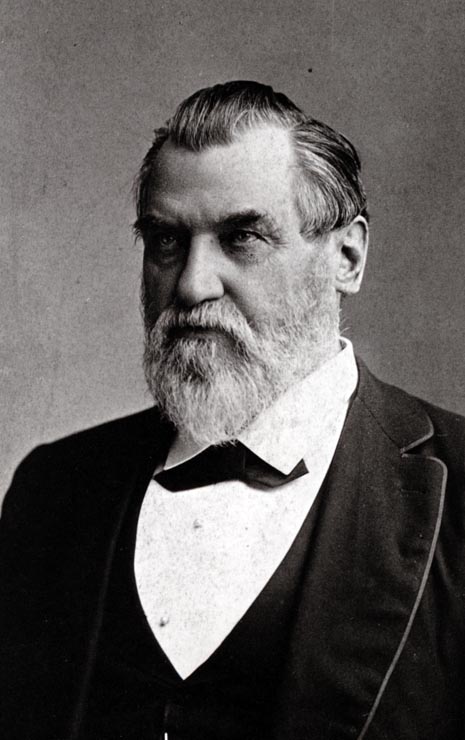
Lots of men who are household names today made their fortunes from the Comstock Lode, among them are: George Hearst, father of William Randolf Hearst; Leland Stanford (right), founder of Stanford University; William Ralston, founder of the Bank of California; and of course the most famous was an unsuccessful prospector who took up the pen, Samuel Clemens, better known as Mark Twain.


Within a few years, the political climate back East heated to boiling. President Abraham Lincoln had a war to finance, and the Comstock Lode was entirely too enticing. The boundaries were defined and Nevada became a state even though the population was too small to qualify it.

All didn't go smoothly at first. There was much dispute and hooplah over boundaries, and in the first six years, of the $50 million of ore mined, $10 million went to litigation! And of course one of the preeminent lawyers, William Stewart, ended up in the U.S. Senate.

The Comstock Lode brought a lot of innovations: the first miners' union, advances in drilling and tunneling technology, square-set timbering (which changed mining all over the world), and lots of other inventions that were the catalyst for modern mining practices. It also made a few men rich and broke thousands.

Sources:
Online Nevada, Calliope, Stanford University, Wikipedia


Free today, Feb. 13 only!
Much Ado About Madams
Hearts of Owyhee #1

"Rogers' talent shines as she creates a stunning portrait of what it was like to live in the old west. Her characters leap off the page and she handles humor with as much skill as she does the deeper emotions. MUCH ADO ABOUT MADAMS was a fabulous read. I am anxiously awaiting the next book in the Hearts of Owyhee series." ~Gerri Russell, author of the Brotherhood of the Scottish Templars series.

Oh my stars! Suffragist Lucinda Sharpe can’t believe she was hired to teach a bunch of soiled doves their letters. And what about the handsome brothel owner? Only a despicable cad would engage in such a business. 

Blast that woman! Reese McAdams didn’t want the brothel in the first danged place, and now a suffragist schoolteacher is stirring up the works. 

Can she reform the Comfort Palace ladies without losing her heart to Reese? Will her secret past ruin her future?


coming soon:
Much Ado About Mustangs

Friday, January 9, 2015

#Free book + giveaway. Hearts of Owyhee by @JacquieRogers #western #romance #oldwest


Cowboy kisses is not for promotion, although we aren't at all averse to telling people about our books.  Still, every once in a while, the contributors do need to let folks know what we have available.  In my case, the rights to the entire Hearts of Owyhee series reverted back to me Dec. 31, so I'm reissuing the books--re-edited and with new covers.  In one case, Much Ado About Madams, I wrote a new ending.  Well, more like added-to.  

So for this month, I'm hauling out all the books for you to see.  Oh, that reminds me that I need to update my author page here at CK.  Better get to it!

And don't forget that Friday only (Jan. 9, 2015), Much Ado About Madams is free!  If you miss the free day, the book will be only 99¢ the next two days, so still a bargain.


Welcome to 1880s Owyhee County, Idaho Territory!  It was a hoppin' place in those days, and I've brought you several fictional adventures, both novels and short stories.  These can be read in any order, but here's the chronological sequence:

Much Ado About Madams
Hearts of Owyhee #1
by Jacquie Rogers

Amazon Kindle

5 Stars from Detra Fitch, Huntress Reviews: "A story this good can only come from the imagination of Jacquie Rogers."

"A rollicking riot of a good read!" ~Ann Charles, author of the Deadwood Mysteries

Low-down on Much Ado About Madams

Oh my stars! Suffragist Lucinda Sharpe can’t believe she was hired to teach a bunch of soiled doves their letters. And what about the handsome brothel owner? Only a despicable cad would engage in such a business.

Blast that woman! Reese McAdams didn’t want the brothel in the first danged place, and now a suffragist schoolteacher is stirring up the works.

Can she reform the Comfort Palace ladies without losing her heart to Reese? Will her secret past ruin her future?

"A romantic trip to the Old West stamped with Jacquie Rogers' special brand of humor. ~ Caroline Clemmons, author of Brazos Bride

"Ms Rogers' clever western romance, MUCH ADO ABOUT MADAMS manages to enrousingly engage her growing readership while reminding us of the difficulties faced by the brave women who tamed the American West. All that, and did I say entertaining!" ~ John Klawitter, author of The Freight Train of Love
♥ ♥ ♥

Much Ado About Marshals
Hearts of Owyhee #2
by Jacquie Rogers

Amazon Kindle

NOR Top Pick
CTRR Award
Winner: RttA, Best Western Historical Romance Novel

5 stars from Laron Glover: Need a break? This is a FUN book (seriously--when's the last time you read a laugh-out-loud book?)! Turn off the iphone, kick off yer boots (or Jimmy Choos) and let Jacquie Rogers provide that mini-vacation you KNOW you need!

Low-down on Much Ado About Marshals

Rancher Cole Richards rescues his friend from robbing a bank, but is shot for his efforts, and now is a wanted man. His friend takes him to Oreana to see the doc, but Cole's mistaken for the new marshal!

Daisy Gardner is obsessed with solving crimes just like dime novel heroine Honey Beaulieu. But Daisy's parents insist she marry a farmer. Problem is, she can't be a detective if she's stuck miles from town. What better solution than to marry the new marshal.

Now Cole faces a dilemma few men have to face—tell the truth and hang, or live a lie and end up married. Either way could cost him his freedom.

5 stars from romantchick: Nancy Drew meets William Shakespeare ...hilarious characters, memorable colloquialisms, a clever, engaging plot and fine writing. All of which recommends Rogers' Much Ado About Marshals as everything to do about a charming, well-written romp.
♥ ♥ ♥

Much Ado About Miners
Hearts of Owyhee #3
by Jacquie Rogers

Amazon Kindle

"My biscuits are burning from this scorcher of a book. I will never be able to bake again without a wicked grin on my face.This is the latest installment of the Much Ado series, and it's as explosive as a stick of dynamite." ~reader Karla Eakin

"My biscuits are burning from this scorcher of a book. I will never be able to bake again without a wicked grin on my face.This is the latest installment of the Much Ado series, and it's as explosive as a stick of dynamite." ~ Agnes Alexander, author of Drina's Choice

Lowdown on Much Ado About Miners

Cupid’s bullet...
Hired gun Kade McKinnon interrupts a bank holdup and is shot by the teller, Iris Gardner, whose victims have a tendency to be the next groom in town. Will he be the groom this time?

Cupid’s bow...
Iris Gardner, a smart, independent bank clerk, fell in love with Kade when she was too young to know better. So when he walks back into her life and her bank, it's only fitting that she shoots him ... by accident, of course.

Cupid’s blindfold...
Kade doesn’t know Iris’s company is the one who hired him to escort a bullion shipment, and Iris doesn’t know Kade owns the security company, but they both know robbers are on their trail. Which is more likely to be stolen—the silver, or his heart?

"...if you love a good romance set in a fun western setting, and you love to laugh, you will love this book as much as I did!" ~ reader Terry Gregson

♥ ♥ ♥

Much Ado About Mavericks
Hearts of Owyhee #4
by Jacquie Rogers

Amazon Kindle

FIVE STARS! "Jacquie Rogers writes some of the best Historical Romances on today's market. Not content to simply write a plot and toss in a lot of bed scenes and/or filler, this author adds in subplots, humor, action, suspense, and some endearing strays." ~Detra Fitch, Huntress Reviews

"When you read a Jacquie Rogers book, you know you're in for a fast, fun ride!" ~BookwormForever

Low-down on Much Ado About Mavericks

Against the sweeping backdrop of the Owyhee Mountains, Benjamin Lawrence meets the one woman who'll rattle his derby forever.

Ben is a highly respected attorney in Boston, but in Idaho Territory, they still think of him as that gangly awkward boy called Skeeter.  When he goes back home to settle his father’s estate, he’s confronted with an outlandish will and a fiery redheaded head wrangler, who just happens to be the sexiest female he's ever met.

Janelle Kathryn O'Keefe, affectionately called "Jake," can out-ride, out-shoot, and out-rope any cowboy on the Bar EL, which is why she was promoted to foreman.  She's not at all amused that she has to teach an eastern greenhorn how to work cattle, no matter how handsome he is.

5 Stars from reader Claudia Stephan: "I can't even count the times I laughed out loud while reading this book. What are you waiting for? Give it a try!"
♥ ♥ ♥
Contest!
One commenter will win a free digital copy of 
Much Ado About Mavericks  
Drawing will be January 12, 2015, at 9pm Pacific Time

Friday, December 12, 2014

Champagne, #Christmas, and Fossils in the Old West by @JacquieRogers #western


December in the Old West
by Jacquie Rogers

Winter months in Owyhee County in Idaho Territory brought plenty of inclement weather and the citizens couldn’t do much in the way of prospecting or farming. Nevertheless, they kept themselves busy, and the Christmas season brought plenty of opportunity, which The Owyhee Avalanche took great delight in reporting. The following articles all came from December issues.

December 14, 1867
SOCIAL BALL. We had the pleasure of attending a Social Ball given at the Mechanics hall on Tuesday evening last. A general invitation was extended and a large number were present, who appeared to enjoy themselves hugely. There was good music, and the new Hall is certainly a splendid place in which to “twist your heel around.” One of the best features of the arrangement was the magnificent supper prepared and eaten at the Idaho Hotel, the proprietors of which can’t be excelled in their line of business. We return thanks for complimentary tickets.

I think it would be rather painful to “twist your heel around,” but it is a colorful term for dancing. Besides the larger events, plenty of spirit found its way to smaller venues, such as the Avalanche office.

December 21, 1867
Thanks to Messrs. Chase & Brooker of the Owyhee Exchange for a liberal supply of champagne. “Fenian dew drop,” and a box of fragrant Havana’s. The boys use everybody first rate—give them a call.

Another article on the same day shows that the people of the Old West had a variety of interests besides finding the next big strike, drinking, and gambling.

FOSSIL RESEARCH. There is an extensive and interesting field for geological research on and in the vicinity of Sinker Creek, commencing at its junction with Snake River and extending several miles up the creek. Mr. J.C. Holgate of this place, who is quite a practical geologist has recently made of some interesting discoveries in that section, showing abundant evidence of its having been densely populated by animals that existed during the Cretaceous period of the Reptilian age. Among other things of interest that were shown us by Mr. H were a number of bones that from their size and appearance, unmistakably have belonged to the Microgigarous, long before a man’s appearance on the earth. It is thought the entire skeleton in which these bones belong can be exhumed. In the collection we observed the head of a reptile, well preserved and almost entire somewhat resembling that of an alligator of the present day. It had fearful looking teeth and its jaws were firmly set as it was sealed by some great and sudden convulsion of nature. Marine shells and petrified rocks also abound. Facts like these, if investigated by Agassiz would form valuable to science. As it is, they exhibit one among the many interesting features of Owyhee County.

One thing about people—there have always been scammers. And so it went in Owyhee County, although they seemed to have good humor about it.

December 7, 1872
A HOAX. As referred to in our last issue the great diamond excitement has proved as complete a hoax as was the South Sea Bubble. Owyhee, too, has her diamonds, which can be gathered by the quart on Sinker Creek. Perhaps we can dig up old Caleb Lyons diamond, and get up another first-class excitement.

Nothing went to waste. People moved often and those who stayed or had just moved in were beneficiaries, either by gift or by sale.

December 7, 1872
THERE WILL BE AN AUCTION TODAY, commencing at 11 o’clock A.M. at the house recently occupied by W.D. Walbridge, near the Owyhee mill. Carpets, stoves, and household furniture of every description will be sold to the highest bidder. A conveyance will be in readiness to accommodate ladies who desire to attend the auction.

I’ve heard lots of talk lately about whether they had Christmas trees in the Old West. They did in Silver City.

December 21, 1872
THE CHRISTMAS TREE. The Christmas Tree Festival will be held in Jones & Bonney’s Hall. We will stake in addition to what was said in our last issue, that the Brass Band, composed at present of Messrs. Charles Leonard, Joe Gross, Benj. Davis, Rufus King, Ferd. W. Frost and E. Douglas, will perform some of their best pieces, which will add greatly to the pleasure of the occasion.

The singing, accompanied by the organ, will be done principally by young girls who have learned all the music they know in Silver City, and who by virtue of talent, industry and a good teaching have acquired, in our judgment, wonderful proficiency in the beautiful art over which the Muses preside. They are our little folks, and not imported singers, which will make it all the more interesting; that they will do their part in first-class style for their ages, we have not the least doubt, in fact, we know they will.

The tree will be a prolific one no doubt. The Argosy of Santa Claus, St. Nicholas, & Co. arrived at the port of San Francisco four days ago, as we are informed per telegram, and a large cargo of its merchandise is on its way up here, and will not fail to arrive in time.

In 1871, the livestock business was just taking hold.  The oldest ranch had been in business only five years. New stock, especially blooded animals, whether horses, cattle, or hogs, always made the news.

December 23, 1871
THOROUGH-BRED STOCK. We regard the man, who introduces an improved breed of horses, cattle, or hogs into our Territory, as a greater public benefactor than he who discovers a rich quartz mine. Messrs. Hoffer & Miller, well known, highly esteemed and enterprising citizens of this place, are taking steps in the right direction. Last summer they imported from Kentucky nine thorough-bred Durham bulls and two young Berkshire hogs—a bore and a sow. From some cause or the other one of the bulls died not long ago, but the remaining eight are doing finely. The hogs are beauties and can be seen at Sommercamp’s Brewery. Mr. Hopper started for Kentucky again last week after more stock, and will bring back with him in the spring several thorough-bred Durham heifers, some genuine White Chester hogs, and also a number of Durham bulls for Mr. W.F. Sommercamp, who intends to engage quite extensively in the business of stock raising... It costs no more to raise good stock than inferior, and it is vastly more profitable to the owners after getting rightly started in the business. Although they will have expanded a large amount of money, before they can hope for an return, yet they are certain to reap the substantial benefits that their energy and enterprise so well deserve.

The editor of The Owyhee Avalanche reported something about the suffragist movement in nearly every issue. It appears as though he’s amused by the whole idea of women voting, and I doubt he thought such a thing would ever come about.

December 14, 1872
COLONEL SUSAN B. ANTHONY and fourteen other strong-minded females have been arrested in New York for voting. Col. Susan has long been anxious to have her action at law against the State for depriving her of the elective franchise; now has her lawsuit, but the State is a plaintiff. This is pilling on the outrage. Susan went to one of the registrars in the city of Rochester and demanded registration; like a man of gallant and chivalrous disposition, he said “Yea, yea,” and now the lady must fight the word “male” in the State Constitution. Susan’s constitution is by far the strongest.

I’ve seen this next item on the internet several times, although never in a contemporaneous newspaper. But here it is, the language of handkerchiefs. Saratoga is in New York, so I’m not quite sure what this article had to do with the local citizens, especially when there weren’t enough ladies to go around as it was.

December 14, 1872
THE HANDKERCHIEF LANGUAGE.—The young ladies at Saratoga are so closely watched by their parents that they can’t flirt half as well as they used to. The fellows complain that they can’t get five minutes talk with a young lady alone, and that accounts for so few engagements this year. They say they don’t want to propose before the young ladies’ mothers. To foil the fathers and mothers, some of the fellows have invented the following language of the handkerchief. Thus they can set an talk for hours, and the savage and Kroll parent can’t understand a word. This is the new handkerchief language:
Drying a cross the lips—Desirous of acquaintance.
Handing it to mother—Mother objects.
Putting it in the pocket—Meet me at the spring.
Letting it rest on the right cheek—Yes.
Letting it rest on the left cheek—No.
Drawing it across the eyes—I am sorry.
Taking by center—You are too willing.
Dropping—We will be friends.
Twirling in both hands—Indifference.
Drawing it across the cheek—I love you.
Drawing through the hands—I hate you.

You can just imagine the poor editor scrambling for anything he could find to fill the pages during the slow months. Here’s the very definition of a slow news day—he reported a man’s dream. Not kidding. Here it is.

December 16, 1871
ED. SMITH’S DREAM. A comical genius, of War Eagle Mountain, named Ed. Smith, relates that he dreamed of dying the other night and going to heaven, or at least to the gate of the celestial city whose streets are said to be paved with gold. Knocking at the portal, Smith was confronted by St. Peter who told him he must cut 15 cords of dry tamarack wood, or take a ticket for “the other place.” He took the ax, and after performing the task imposed, returned to the gate, where he was somewhat surprised to meet his old friend Ike Culp, of the Oro Fino saloon. St. Peter directed Ike to take the ax and cut 14 1/2 cords of dry tamarack as a preliminary to the right-of-way through the gate. Ike didn’t seem very well pleased with the idea and went off grumbling. In a short time he returned, threw down the ax, and told St. Peter he would take a through ticket for Pandemonium rather than cut the d.m.d wood. Ike’s boisterous manner and loud talk awoke Smith and thus ended the dream.

All those who wonder whether or not they cussed have it right there. I’m sure we all know what d.m.d means.

If you need to know about stage lines, this next tidbit could be useful:

December 24, 1870
CHANGED HANDS. Wells, Fargo, & Co. have sold out their stage line between Virginia and Reno to Hill Beachey. That was the last of W.F. & Co.’s stage lines.

And here’s a variety of local events and happenings collected from several issues:

  • Our old friend Fred Hibb is again driving stage from Silver City to the Sheep Ranch.
  • Crowley & Glynn have leased Maj. Brookey’s Restaurant, and will dish things up in tip-top shape. Their advertisement will appear next week.
  • There are some tattling busybodies in Silver City, who would do well to mind their own business instead of continuing meddling with that of others.
  • Andy Baker has taken the place of Charles Haybes in the management of the stage line from Boise City to Winnemucca. He is a clever, genial gentleman, and has the reputation of being a good stage man.
  • J.F. Dye, of MTN City, whose settlement of the Pacific Coast antedates old ‘49-ers 20 years, passed through Elko on Thursday last for San Francisco where he will spend a few weeks with his children, after which he contemplates a visit to Texas with a view of driving a band of cattle to Nevada. Mr. Dye is an old pioneer on this coast, and although aged 65 years, still has the vim and the enterprise of one in the prime of life.
  • We are informed that a gay deck of hardies will all arrive here this week.
  • Joe Short has just received an extensive stock of liquors, &c, from San Francisco.
  • Another an effort has been made to get a Governor for Idaho, the President having nominated a carpet bagger named A.H. Connors.
  • Yesterday we noticed a large quantity of goods being brought into town. We understand that our townsman G.W. Grayson, Esq., has gone into merchandising and will do business in the building formerly occupied by Creed & Bro.
  • Every time that Thos. Ewing & Co. make a big sale of goods they consider the printers and send us a bottle or two of something nice to take. They have made it rather lively for us during the last two weeks.


December Events

  • December 18, 1860: Texas Ranger Sul Ross found Cynthia Ann Parker during the Battle of Pease River, in Foard County. She’d been captured in 1839 and married Peta Nocona. 
  • December 3, 1864: Gold was discovered near Confederate Gulch in Montana Territory. 
  • December 3, 1866: Nelson Story and his cowboys drive his herd of a thousand cattle into Gallatin Valley in Montana Territory. This was the first cattle drive from Texas to Montana, a distance of 2,500 miles. 
  • December 9, 1867: Denver becomes the capital of Colorado, taking the honor from Golden.
  • December 11, 1869: About 65 vigilantes lynched the Reno brothers, who’d been jailed for the country’s first train robbery (Ohio and Mississippi Railway, Indiana) in 1866. 
  • December 25, 1869: In Towash, Texas, John Wesley Harding got his reputation as the fastest gun in the West when he out-drew Jim Bradley. (This event is reported as occurring Jan. 5, 1870, at some sites, including Wikipedia.)
  • December 10, 1871: Lots go on sale for the first time in Phoenix, Arizona.
  • December 8, 1874: Lt. Lewis Warrington III attacked a Comanche camp in the Mushaqua Valley, Texas, while on a scouting mission during the Red River War. He was awarded the Medal of Honor. 
  • December 4, 1876: Jack McCall’s second trial for the murder of Wild Bill Hickock begins in Yankton, Dakota Territory. He was convicted on December 6. 
  • December 10, 1878: Henry Wells, of Wells, Fargo, & Co., died.
  • December 15, 1890: Lakota police officers shot and killed Sitting Bull, saying he resisted arrest. 
  • December 24, 1894: Harvey Logan (Wild Bunch) shot and killed deputy sheriff Pike Landusky at a party in Jew Jake’s Saloon. 

 May your saddle never slip.


Hearts of Owyhee

Thursday, June 12, 2014

Great Links for Western Lovers - @JacquieRogers


I spent a lovely five days with a writer friend, Judith Laik, on the shores of Lake Chelan, Washington.  We plotted and brainstormed the whole time--at least, when we weren't partaking of fine wine.  Oh wait, it was that fine wine that helped with the brainstorming...  Ahem.  

Like most authors, I have several projects lined up waiting to be written.  Each of these stories requires a different knowledge set, and it's always necessary to do at least a little research for the next story.  Some people think this is work, but I call it fun, and in fact I have to limit myself.  Same with visiting museums.  Doncha just love museums! 

Anyway, take a look at some of the sites I visited this week:

Hungry Cowboys
Head on over to the Cowboy Showcase if you want to learn how to cook on the trail.  Dutch Oven Cooking with Floyd Crandall tells you how to heat, use, and clean a dutch oven.

Oregon Trail
At the Pathways of Pioneers site, historian Don Shannon tells about the tragic experience of a wagon train at Castle Butte, Idaho Territory, and their forty days of hell until 16 of 44 immigrants were finally rescued at what now is called Starvation Camp.

There's Gold In Them Thar Hills
Think the gold rush is over?  Someone forgot to tell that to about 367 members of the Idaho Gold Prospectors Association.  If you want to prospect for gold and have a little fun besides, check 'em out.

Gnarly Mountain Men
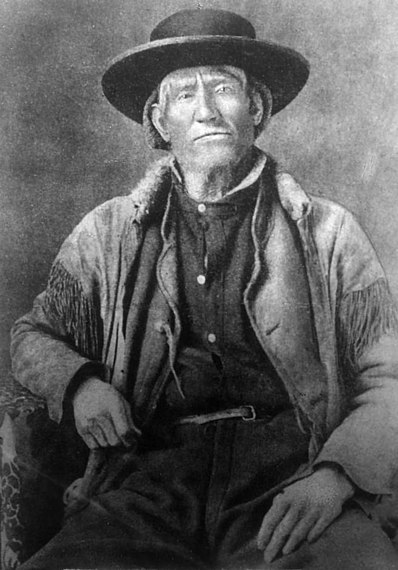
The first lucrative enterprise of the American West was fur trapping and trading.  John Jacob Astor made a pile of money from this business.  Jim Bridger (left) and his friends wanted in on the action and formed the Rocky Mountain Fur Company. 

Dressed in buckskins, wearing coonskin caps, and packing scalpin' knives, these men explored and trapped in every area of the West.  Some of the later "explorers" used these men's maps and lore.  Learn all about the trade, the men, and the business from Legends of America, Fur Trading in the American West.

Back East...
Another site that I frequent, especially when writing the Wolf Creek stories for Western Fictioneers, is the Kansapedia.  The cowtowns, several of the famous lawmen and outlaws, and lots of wheat aren't the only things you'll find in Kansas.  Besides, Matt and Miss Kitty were there... oh wait...

And Home Again
Since my stories are mostly set in Idaho, I do a lot of research there.  For a brief overview, go to the Visit Idaho Site.  For more in-depth information, go to Idaho State Historical Society Digital Collections, and here's an overview of Owyhee County history.  Of course, the best thing to do is ride a horse in the Owyhee Mountains and smell the sagebrush, but if that's not in the cards, a visit to the Idaho State Archives is in order.  They have a grant to digitize many of their newspapers, so that will be a boon to me since I live in Seattle now.


To be released Fall of 2014:
Much Ado About Mustangs


Friday, May 9, 2014

Sparks Fly in the Old West by Jacquie Rogers


It's a Hot Topic

We see “Sparks fly when...” in just about every romance novel, either in a review or the back cover blurb. A lot of emotional sparks did fly in the Old West, romantic or otherwise. I’m going to talk about the “otherwise.”

Fire
We don’t worry too much about making fire these days. All we have to do is go to the store and buy matches or a lighter and we’re all set for our outdoor grilling. But what did the lawdogs use when they were hot on the trail? Or the outlaws who were making that trail? They had to fry bacon and boil coffee some way, and there weren’t a whole lot of Thermador stoves or Super 8s around.

Flint and Steel
The use of flint and steel is the percussion style of fire making. Hold the flint in one hand with the sharp side facing away from you, and strike the steel at an acute angle. That makes sparks fly but you won’t get a bonfire from it—you have to strike the steel (or iron pyrite) near a charcloth or tinder and just hope something catches even the tiniest flame. Then feed it more tinder while shielding it from the breeze until the flame grows large enough to light the kindling. Once the kindling catches, then larger fuel items—logs, buffalo chips, brush, prairie grass, or whatever is available—and tend until the flames are large enough to provide heat and light.

Here’s a quick demonstration:


Our hero wouldn’t always have the perfect materials, though. Charcloth could be hard to come by on the trail. I watched a park ranger demonstrate the use of a flint and steel kit (consists of flint, striker, and tinder box) with no charcloth, taking nearly 30 minutes to gather the materials and build a fire. Keep in mind he was in familiar territory and knew where to find what he needed for tinder and kindling.

Imagine that you’ve ridden hard all day with little to eat or drink, unpacked and unsaddled the horse, groomed and picketed the horse, and now that you’re dead-dog tired, you have to spend 30 minutes building a fire before you can eat or have a cup of Arbuckles. This is why, with the new invention, flint and steel was quickly replaced by...

Lucifers
The first friction matches were invented in 1827 by English pharmacist John Walker and called “Congreves.” He didn’t patent the matches, but Samuel Jones did. He designed a cardboard box, with the warning, “If possible, avoid inhaling gas that escapes from the combustion of the black composition. Persons whose lungs are delicate should by no means use the lucifers,” and an industry was born.

The need for fire was great but unfortunately the “strike anywhere” matches did strike anywhere, intentional or not, and they gave off a foul odor. Worse, the factory girls suffered from phossy jaw, cancer caused by phosphorous.

Safety Matches
By 1855, Johan Edvard Lundstrom had perfected the safety match, and from then on, not many who could somehow get their hands on matches bothered with flint and steel anymore. These safety matches were still called “lucifers,” though, and would be clear into the 20th Century.

Even with matches, our tall, dark, and handsome hero still has to use kindling, so he has to collect the perfect, dry grasses and bark shreds to make his fire, and he doesn't have any charcoal briquettes, either.

Oops - It Rained!
The weather isn't always perfect. Rainstorms make it danged hard to find dry burning material. This next video shows what to look for. Of course, if your characters are in the middle of the prairie with nary a tree in sight, it’s a whole different game.


Pull up a log and have a cup of Arbuckles!


Friday, January 10, 2014

Showdowns and Shootouts in Western Fiction by @JacquieRogers


Romance in Traditional Westerns

Most Cowboy Kisses readers are dedicated Western Romance Historical (WHR) fans, as am I and the other CK contributors. But we also love anything that has to do with the Old West. Lately, I've been reading Traditional Westerns just to get a taste outside our subgenre.

Guess what? Nearly all the traditional westerns I've read contain a significant amount of romance even though there's no way these novels could be confused with a WHR.

Or is that true? If you've read Hondo by Louis L'Amour, you know that the spine of the story is the relationship of Hondo Lane and Angie Lowe. Hondo happens onto a homestead looking for a place to light. Mrs. Lane and her son soon worm their way into his heart, and everything he does from there on out has to do with her in some way. All this leads up to the classic romance happily ever after ending.

Robbers Roost by James Reasoner features a protagonist who’s so full of himself that you wouldn't think any author could make him likable. Preston Fox is out for glory and to prove himself the best army officer ever, even though he's been busted. His thought processes are warped at best. He’s egotistical, misguided, impulsive, and vain. Nevertheless, once his heart is captured by a young Chinese woman who just happens to be a prostitute, we actually start rooting for the guy. I read this book a year ago and still, after reading many books in the meantime, this character is still vivid in my mind. Now that’s good writing.

I just finished a book written by Monty McCord, Mundy's Law. This is a very traditional western where the entire book leads up to the final shootout, yet Marshal Joe Mundy is smitten with the previous marshal’s widow, who’s now a prostitute. This relationship is the spark for several events and the book and is not just window dressing.

This sort of relationship is nothing new in the western genre—look at Gunsmoke’s Marshal Dillon and Miss Kitty. While their relationship was never spelled out (except in one episode late in the series), we always knew that that the marshal was Miss Kitty's special man. Marshal Dillon never seriously messed around with any other woman and in our hearts, we knew that the two of them were made for each other.

Maverick and Paladin were both womanizers and most of the female viewing audience wouldn't have minded either of them putting their boots under their beds. And these shows, the romantic relationships—even though temporary—was either the inciting incident or a major turning point to get to the big showdown.

The major difference between traditional western and western historical romance is that in the latter, women are equals and half or more of the scenes are told using the heroine’s point of view, whereas the heroine’s viewpoint is often (not always) ignored in traditional westerns. In a WHR, the hero and heroine are both strong and the little woman doesn't sit around twiddling her thumbs as she waits for the big rescue.

None of that precludes the Big Shootout. Some WHR’s have one and some don’t. Mine nearly always do just because that’s the way the stories come to me, and often that scene flashes in my mind right after the initial story concept. My books generally have other showdowns and minor scrapes as well. The excerpt below is borne of the hero’s frustration with the heroine. Kade and Iris had kissed in the previous scene, and worse, one of her friends saw them.

Excerpt
Much Ado About Miners
♥ Hearts of Owyhee ♥ #4
By Jacquie Rogers

Kade ordered drinks for Phineas and himself. The hotel bar was noisy, and no one paid them any mind, which was good considering how his business partner was carrying on.

“I told the ladies not to go up there until you was done firing. Guess I’d better tell ’em what kind of firing.” Phineas laughed at his own joke.
Much Ado About Miners
by Jacquie Rogers

Kade didn’t.

“I’m telling you,” his old friend continued, “were it me up on that hill with a beautiful woman, I would’ve been kissing her, too. And whatever else she let me do.”

“This ain’t Lollie.”

“It’d be a lot easier on you if it was.”

Kade couldn’t argue with that.

“Might we ought to find you a woman, get some of that vinegar out of your veins.”

“Might.”

Harold poured their whiskeys. “Leave the bottle?”

Kade threw out some coins and waved the barkeep off. His head was scrambled enough without the sauce.

Phineas grabbed his glass and saluted Kade with it. “Then again, it’s hard on a man—thinking of one woman and pokin’ another.” He downed the whiskey in two gulps and slammed the glass on the counter. “ ‘We should be woo’d and were not made to woo.’ A Midsummer Night’s Dream, Act 2, Scene 1.”

Kade pulled his hat low over his forehead and pushed himself away from the bar. “Phineas, you are a trial of a man’s patience. Think I’ll head over to the sheriff’s office.”

“You are too blasted grumpy these days. I might just go back to the hotel and see if Lollie needs some entertaining.”

“Do that.” Kade tromped past the banker and his cronies, shoved past the bat wing doors, and took off to see if Sheriff Adler had anything interesting going on. He needed to forget all about the kiss, that woman, and her breasts pressed against his chest. And he was tired of being Phineas’s source of amusement.

Two roostered-up young men, doubtful they were over eighteen years old, walked down the boardwalk toward him. They evidently thought they required the entire boardwalk. In no mood to coddle big-headed whippersnappers who hadn’t learned to hold their liquor, Kade determined to stay his course. Not surprisingly, they tried to shoulder him off.

He leaned into the taller one and knocked him on his can. The other one pulled his pistol, cocked, and jammed the barrel in Kade’s side. Kade slammed his elbow into the kid’s solar plexus, grabbed the weapon, then kicked the upstart’s feet out from under him.

“You need to learn to respect your elders.” He waved the pistol at them. “Now get your sorry carcass up and come with me. It’s time for you to explain to the sheriff why you think you own that piece of boardwalk.”

With a little luck, they’d put up a fuss and he’d get a chance to work off some of his frustration. Unfortunately, luck wasn’t on his side, and they meekly walked to the sheriff’s office just as he had told them to.

When they got to the jail, Adler wasn’t there so Kade locked them in separate jail cells. The taller one, with a hang-dog expression, stood at the front of his cell with his hands wrapped around the bars. The other one headed straight to his cot and flopped down on his back, groaning. Kade gave them each a bucket of water.

“What are we supposed to do with that?” asked the taller one.

“You can drink it, wash in it, or piss in it—your choice.” He woke up Wilfred, the other deputy, who slept in the sheriff’s chair. “You have prisoners.”

Wilfred snorted and slid his feet off the desk, sat up, then took a swig of cold coffee. “Foul-tasting crap. Who made this?”

Kade tossed the jail cell keys on the desk. “You did.”
♥ ♥ ♥

♥ Hearts of Owyhee ♥ 

Friday, December 13, 2013

Bounty Hunters in the Old West by @JacquieRogers


The law was a bit sparse in the Old West, often not a lawman around for hundreds of miles. If a criminal knew how to live off the land and he owned a fast horse, he was pretty well guaranteed an escape. What's a sheriff to do?

In 1872, the Supreme Court ruled that bounty hunters were a part of the U.S. law enforcement system with a decision in Taylor vs. Taintor:

“When the bail is given, the principal is regarded as delivered to the custody of his sureties. Their domain is a continuance of the original imprisonment. Whenever they choose to do so, they may seize him and deliver him up to his discharge; and if it cannot be done at once, they may imprison him until it can be done. They may exercise their rights in person or by agent. They may pursue him into another state; may arrest him on the Sabbath; and if necessary, may break and enter his house for that purpose. The seizure is not made by virtue of due process. None is needed. It is likened to the arrest by the Sheriff of an escaped prisoner.”

As you can see by this decision, bounty hunters didn't have to adhere to the same rules of due process that lawmen did. (This is still true in some states.)

One of the greatest bounty hunters was Pinkerton Detective, Charlie Siringo. Siringo had a long and distinguished, if not controversial, career. He had steely nerves and his cleverness got him out of more than one jam. But he wrote a book, and the Pinkerton Agency wasn't too keen about that, so he spent several years at the end of his life arguing with them. Could be that the Pinkertons were the only ones to ever best him.

Lots of town marshals and county sheriffs supplemented their meager incomes with bounties. Of course, they had to follow the rules of due process while a bounty hunter had no such restrictions. Then again, if there's no one around for a couple hundred miles, who's to know? This is part of how the West was tamed. Many lawmen straddled the fence between law-enforcing and law-breaking.

In order for a bounty hunter to get his money in British Columbia, he had to bring the criminal in alive. The US had no such compunctions, but the bounty was half if the prisoner died before making it to jail. Bounty hunters didn't receive payment until later, so when they brought in prisoners, they'd either have to wait, or have the money sent to a bank. (They'd probably wait, considering the state of banking at the time.) But the most important thing was that bounty hunters' names were never, ever recorded, because their anonymity was their protection. This little item is what makes research difficult.

(From Wikimedia Commons)
Much to movie and TV viewers' delight, popular lore glorifies the Old West bounty hunter. The role of Josh Randall in Wanted: Dead or Alive in the 1950s made Steve McQueen a star. "Josh Randall (Steve McQueen) was a man of few words. A bounty hunter by trade, he tracked his prey all over the West. Randall carried an 1892 44/40 center fire Winchester carbine that he called "Mare's Laig." It handled like a revolver by had the punch of a rifle. Unlike other bounty hunters, Randall had scruples. He tried to bring the prisoner in alive and often found himself called upon to protect people in need."

Then there's my personal favorite, Paladin, played by Richard Boone on "Have Gun-Will Travel." (Okay, so he was more of a hired gun than a bounty hunter, but they go together well.) 

I haven't written a novel with a bounty hunter character yet, but I have a few planned.  My Christmas story, A Gift for Rhoda, in Wishing for a Cowboy (Prairie Rose Publications) has a retired bounty hunter hero.

Blurb

Rhoda Johnson is stranded in a lonely cabin without a groom. The townsfolk say she's better off without him, but her drunken groom sends a message that he'll claim her as his Christmas bride. Gunman and ex-Confederate soldier Nate Harmon comes to Idaho to make peace with his abolitionist preacher father. When half-frozen Nate reaches the cabin on a snowy Christmas Eve, instead of finding his folks, he's greeted by a pretty blonde with a shotgun who keeps calling him Mr. Snyder. Will she shoot him, or melt his heart?

Excerpt of
A Gift for Rhoda
by Jacquie Rogers
a short story in 

With trepidation, Rhoda stoked up the fire in the stove, then leaned her back against the door and closed her eyes, praying for strength. It was Christmas Eve, a stranger—a hulking grizzly of a man, but a stranger nonetheless—had come bearing gifts, so sharing her shelter in the blizzard was the Christian thing to do. Maybe.

Before she gave herself a chance to think again, she turned around and yanked open the door. The wind caught it, blew it open, and nearly mashed her into the wall.

Rhoda grabbed her shotgun and pushed the door nearly shut, and yelled, “Mr. Snyder, you can come into the house.” She slammed the door again, not sure whether she was frozen from fear or from the cold.

Within a minute, boots clomped on the porch. She had said she would let him in and she’d go through with it—that was that. With false bravado, she swung the door open.

Aiming the shotgun at him, she said, “Leave all your weapons outside, Mr. Snyder.”

“Yes, ma’am.” He held his hands out to his sides, likely wanting to assure her that he had no intention of using his weapons. “But who the blazes is Mr. Snyder?”

♥  ♥  ♥
There are eight wonderful stories in this Christmas anthology, and at the end, there are recipes that go with each story, and mine is Rhoda's Wedding Custard Pie (bonus—it's gluten-free!).

Hearts of Owyhee series

(and available for Christmas...)