Showing posts with label Owyhee County. Show all posts

Friday, December 12, 2014

Champagne, #Christmas, and Fossils in the Old West by @JacquieRogers #western


December in the Old West
by Jacquie Rogers

Winter months in Owyhee County in Idaho Territory brought plenty of inclement weather and the citizens couldn’t do much in the way of prospecting or farming. Nevertheless, they kept themselves busy, and the Christmas season brought plenty of opportunity, which The Owyhee Avalanche took great delight in reporting. The following articles all came from December issues.

December 14, 1867
SOCIAL BALL. We had the pleasure of attending a Social Ball given at the Mechanics hall on Tuesday evening last. A general invitation was extended and a large number were present, who appeared to enjoy themselves hugely. There was good music, and the new Hall is certainly a splendid place in which to “twist your heel around.” One of the best features of the arrangement was the magnificent supper prepared and eaten at the Idaho Hotel, the proprietors of which can’t be excelled in their line of business. We return thanks for complimentary tickets.

I think it would be rather painful to “twist your heel around,” but it is a colorful term for dancing. Besides the larger events, plenty of spirit found its way to smaller venues, such as the Avalanche office.

December 21, 1867
Thanks to Messrs. Chase & Brooker of the Owyhee Exchange for a liberal supply of champagne. “Fenian dew drop,” and a box of fragrant Havana’s. The boys use everybody first rate—give them a call.

Another article on the same day shows that the people of the Old West had a variety of interests besides finding the next big strike, drinking, and gambling.

FOSSIL RESEARCH. There is an extensive and interesting field for geological research on and in the vicinity of Sinker Creek, commencing at its junction with Snake River and extending several miles up the creek. Mr. J.C. Holgate of this place, who is quite a practical geologist has recently made of some interesting discoveries in that section, showing abundant evidence of its having been densely populated by animals that existed during the Cretaceous period of the Reptilian age. Among other things of interest that were shown us by Mr. H were a number of bones that from their size and appearance, unmistakably have belonged to the Microgigarous, long before a man’s appearance on the earth. It is thought the entire skeleton in which these bones belong can be exhumed. In the collection we observed the head of a reptile, well preserved and almost entire somewhat resembling that of an alligator of the present day. It had fearful looking teeth and its jaws were firmly set as it was sealed by some great and sudden convulsion of nature. Marine shells and petrified rocks also abound. Facts like these, if investigated by Agassiz would form valuable to science. As it is, they exhibit one among the many interesting features of Owyhee County.

One thing about people—there have always been scammers. And so it went in Owyhee County, although they seemed to have good humor about it.

December 7, 1872
A HOAX. As referred to in our last issue the great diamond excitement has proved as complete a hoax as was the South Sea Bubble. Owyhee, too, has her diamonds, which can be gathered by the quart on Sinker Creek. Perhaps we can dig up old Caleb Lyons diamond, and get up another first-class excitement.

Nothing went to waste. People moved often and those who stayed or had just moved in were beneficiaries, either by gift or by sale.

December 7, 1872
THERE WILL BE AN AUCTION TODAY, commencing at 11 o’clock A.M. at the house recently occupied by W.D. Walbridge, near the Owyhee mill. Carpets, stoves, and household furniture of every description will be sold to the highest bidder. A conveyance will be in readiness to accommodate ladies who desire to attend the auction.

I’ve heard lots of talk lately about whether they had Christmas trees in the Old West. They did in Silver City.

December 21, 1872
THE CHRISTMAS TREE. The Christmas Tree Festival will be held in Jones & Bonney’s Hall. We will stake in addition to what was said in our last issue, that the Brass Band, composed at present of Messrs. Charles Leonard, Joe Gross, Benj. Davis, Rufus King, Ferd. W. Frost and E. Douglas, will perform some of their best pieces, which will add greatly to the pleasure of the occasion.

The singing, accompanied by the organ, will be done principally by young girls who have learned all the music they know in Silver City, and who by virtue of talent, industry and a good teaching have acquired, in our judgment, wonderful proficiency in the beautiful art over which the Muses preside. They are our little folks, and not imported singers, which will make it all the more interesting; that they will do their part in first-class style for their ages, we have not the least doubt, in fact, we know they will.

The tree will be a prolific one no doubt. The Argosy of Santa Claus, St. Nicholas, & Co. arrived at the port of San Francisco four days ago, as we are informed per telegram, and a large cargo of its merchandise is on its way up here, and will not fail to arrive in time.

In 1871, the livestock business was just taking hold.  The oldest ranch had been in business only five years. New stock, especially blooded animals, whether horses, cattle, or hogs, always made the news.

December 23, 1871
THOROUGH-BRED STOCK. We regard the man, who introduces an improved breed of horses, cattle, or hogs into our Territory, as a greater public benefactor than he who discovers a rich quartz mine. Messrs. Hoffer & Miller, well known, highly esteemed and enterprising citizens of this place, are taking steps in the right direction. Last summer they imported from Kentucky nine thorough-bred Durham bulls and two young Berkshire hogs—a bore and a sow. From some cause or the other one of the bulls died not long ago, but the remaining eight are doing finely. The hogs are beauties and can be seen at Sommercamp’s Brewery. Mr. Hopper started for Kentucky again last week after more stock, and will bring back with him in the spring several thorough-bred Durham heifers, some genuine White Chester hogs, and also a number of Durham bulls for Mr. W.F. Sommercamp, who intends to engage quite extensively in the business of stock raising... It costs no more to raise good stock than inferior, and it is vastly more profitable to the owners after getting rightly started in the business. Although they will have expanded a large amount of money, before they can hope for an return, yet they are certain to reap the substantial benefits that their energy and enterprise so well deserve.

The editor of The Owyhee Avalanche reported something about the suffragist movement in nearly every issue. It appears as though he’s amused by the whole idea of women voting, and I doubt he thought such a thing would ever come about.

December 14, 1872
COLONEL SUSAN B. ANTHONY and fourteen other strong-minded females have been arrested in New York for voting. Col. Susan has long been anxious to have her action at law against the State for depriving her of the elective franchise; now has her lawsuit, but the State is a plaintiff. This is pilling on the outrage. Susan went to one of the registrars in the city of Rochester and demanded registration; like a man of gallant and chivalrous disposition, he said “Yea, yea,” and now the lady must fight the word “male” in the State Constitution. Susan’s constitution is by far the strongest.

I’ve seen this next item on the internet several times, although never in a contemporaneous newspaper. But here it is, the language of handkerchiefs. Saratoga is in New York, so I’m not quite sure what this article had to do with the local citizens, especially when there weren’t enough ladies to go around as it was.

December 14, 1872
THE HANDKERCHIEF LANGUAGE.—The young ladies at Saratoga are so closely watched by their parents that they can’t flirt half as well as they used to. The fellows complain that they can’t get five minutes talk with a young lady alone, and that accounts for so few engagements this year. They say they don’t want to propose before the young ladies’ mothers. To foil the fathers and mothers, some of the fellows have invented the following language of the handkerchief. Thus they can set an talk for hours, and the savage and Kroll parent can’t understand a word. This is the new handkerchief language:
Drying a cross the lips—Desirous of acquaintance.
Handing it to mother—Mother objects.
Putting it in the pocket—Meet me at the spring.
Letting it rest on the right cheek—Yes.
Letting it rest on the left cheek—No.
Drawing it across the eyes—I am sorry.
Taking by center—You are too willing.
Dropping—We will be friends.
Twirling in both hands—Indifference.
Drawing it across the cheek—I love you.
Drawing through the hands—I hate you.

You can just imagine the poor editor scrambling for anything he could find to fill the pages during the slow months. Here’s the very definition of a slow news day—he reported a man’s dream. Not kidding. Here it is.

December 16, 1871
ED. SMITH’S DREAM. A comical genius, of War Eagle Mountain, named Ed. Smith, relates that he dreamed of dying the other night and going to heaven, or at least to the gate of the celestial city whose streets are said to be paved with gold. Knocking at the portal, Smith was confronted by St. Peter who told him he must cut 15 cords of dry tamarack wood, or take a ticket for “the other place.” He took the ax, and after performing the task imposed, returned to the gate, where he was somewhat surprised to meet his old friend Ike Culp, of the Oro Fino saloon. St. Peter directed Ike to take the ax and cut 14 1/2 cords of dry tamarack as a preliminary to the right-of-way through the gate. Ike didn’t seem very well pleased with the idea and went off grumbling. In a short time he returned, threw down the ax, and told St. Peter he would take a through ticket for Pandemonium rather than cut the d.m.d wood. Ike’s boisterous manner and loud talk awoke Smith and thus ended the dream.

All those who wonder whether or not they cussed have it right there. I’m sure we all know what d.m.d means.

If you need to know about stage lines, this next tidbit could be useful:

December 24, 1870
CHANGED HANDS. Wells, Fargo, & Co. have sold out their stage line between Virginia and Reno to Hill Beachey. That was the last of W.F. & Co.’s stage lines.

And here’s a variety of local events and happenings collected from several issues:

  • Our old friend Fred Hibb is again driving stage from Silver City to the Sheep Ranch.
  • Crowley & Glynn have leased Maj. Brookey’s Restaurant, and will dish things up in tip-top shape. Their advertisement will appear next week.
  • There are some tattling busybodies in Silver City, who would do well to mind their own business instead of continuing meddling with that of others.
  • Andy Baker has taken the place of Charles Haybes in the management of the stage line from Boise City to Winnemucca. He is a clever, genial gentleman, and has the reputation of being a good stage man.
  • J.F. Dye, of MTN City, whose settlement of the Pacific Coast antedates old ‘49-ers 20 years, passed through Elko on Thursday last for San Francisco where he will spend a few weeks with his children, after which he contemplates a visit to Texas with a view of driving a band of cattle to Nevada. Mr. Dye is an old pioneer on this coast, and although aged 65 years, still has the vim and the enterprise of one in the prime of life.
  • We are informed that a gay deck of hardies will all arrive here this week.
  • Joe Short has just received an extensive stock of liquors, &c, from San Francisco.
  • Another an effort has been made to get a Governor for Idaho, the President having nominated a carpet bagger named A.H. Connors.
  • Yesterday we noticed a large quantity of goods being brought into town. We understand that our townsman G.W. Grayson, Esq., has gone into merchandising and will do business in the building formerly occupied by Creed & Bro.
  • Every time that Thos. Ewing & Co. make a big sale of goods they consider the printers and send us a bottle or two of something nice to take. They have made it rather lively for us during the last two weeks.


December Events

  • December 18, 1860: Texas Ranger Sul Ross found Cynthia Ann Parker during the Battle of Pease River, in Foard County. She’d been captured in 1839 and married Peta Nocona. 
  • December 3, 1864: Gold was discovered near Confederate Gulch in Montana Territory. 
  • December 3, 1866: Nelson Story and his cowboys drive his herd of a thousand cattle into Gallatin Valley in Montana Territory. This was the first cattle drive from Texas to Montana, a distance of 2,500 miles. 
  • December 9, 1867: Denver becomes the capital of Colorado, taking the honor from Golden.
  • December 11, 1869: About 65 vigilantes lynched the Reno brothers, who’d been jailed for the country’s first train robbery (Ohio and Mississippi Railway, Indiana) in 1866. 
  • December 25, 1869: In Towash, Texas, John Wesley Harding got his reputation as the fastest gun in the West when he out-drew Jim Bradley. (This event is reported as occurring Jan. 5, 1870, at some sites, including Wikipedia.)
  • December 10, 1871: Lots go on sale for the first time in Phoenix, Arizona.
  • December 8, 1874: Lt. Lewis Warrington III attacked a Comanche camp in the Mushaqua Valley, Texas, while on a scouting mission during the Red River War. He was awarded the Medal of Honor. 
  • December 4, 1876: Jack McCall’s second trial for the murder of Wild Bill Hickock begins in Yankton, Dakota Territory. He was convicted on December 6. 
  • December 10, 1878: Henry Wells, of Wells, Fargo, & Co., died.
  • December 15, 1890: Lakota police officers shot and killed Sitting Bull, saying he resisted arrest. 
  • December 24, 1894: Harvey Logan (Wild Bunch) shot and killed deputy sheriff Pike Landusky at a party in Jew Jake’s Saloon. 

 May your saddle never slip.


Hearts of Owyhee

Friday, July 11, 2014

Fireworks in the Old West by @JacquieRogers


July in the Old West


(This article was first published at Western Fictioneers.)

In the Old West, Independence Day had the honor of being the most celebrated holiday of the year.  Not Christmas, you ask?  First, remember that Christmas wasn’t commercialized to the extent it is today, and second, December 25 is often not good traveling weather.  But July 4th was an ideal time for celebration — good weather, and people needed a break from all their hard work in the fields, mines, or on the range.

All the articles here are taken from The Owyhee Avalanche, which is still publishing newspapers today in Homedale, Idaho.  Most of the articles pertain to Silver City, a boomtown in Owyhee County, that never burned down and is a great place to visit.  So what happened in the Old West this month?  Let’s take a look.

From July 6, 1872, we learn a little about a typical Independence Day celebration:

THE FOURTH OF JULY IN TOWN, BOILED DOWN.
- National salute from a 12-pounder, at sunrise, for which we may thank Charley Bowen’s patriotic gizzard.
- Music by the Band from the balcony of the Court House, at 9 o’clock, a.m., and from the balcony of the Owyhee Exchange, a 7½ p.m.  The boys toot their horns infinitely better than we had reason to expect.
- Firecrackers, the delight of youth, but the bane of old age—plenty all day long.
- Lots of folks went to Wagontown; our reporter hasn’t come to time.
- Of those who stopped at home, comparatively few got beastly drunk, and few had heads put on them.
- Banners flying, and ladies flitting around all day getting ready for the Ball.
- Ball at night, huge success, both financially and otherwise.
- Fireworks, no good.
- Ball supper, at the Idaho Hotel, magnify.; good grub and well cooked, fault of Gus, chef de cuisine; served up in a style that can’t be beat, owing to the exquisite taste of Charley Umber, dining room captain.
- Fine day; beautiful night.  Finis.

Every year, Owyhee County sported several horse races on Independence Day, and the citizens took it seriously; thus, the reporting was quite detailed.  Here’s the only short article I could find (probably because the race was held in Wagontown instead of Silver).

THE WAGONTOWN RACES.   Our Wagontown reporter furnishes us with the following account of the races, which took place there on the 4th and 5th.
    On the 4th, the saddle purse and 2d class racehorse purse were run for.  Entries for the saddle purse: Muller, Lucy Cook and Springer’s “Molly.”  Molly beat Mullet by 5 feet, and owing to a bad start Lucy Cook whipped both the others all the way through.  Second class  racehorse purse contended for by Gray Jack, Milty or Malheur and Nannie Hunt.  Nannie won by 30 feet, chased by Malheur and Gray Jack bringing up the rear.  A number of scrub races ended the sport on the 4th.
    On the 5th a match race came off between Louis Walker’s horse and Weasel, from Boise City, for $600 — Weasel winning by 22 feet.  First class racehorse purse was then contended for by Billy Cheatham of Boise Valley, and Tom Walls’ Old Ben, of Wagontown.  Betting two to one on Cheatham, but Ben won the race by 18 feet.  Scrub races, to numerous to mention, ended the season’s races, which passed off in a highly satisfactory manner.
    Owing to a painful though not too serious accident to the rider of Charley-Come-Up, he did not run as was expected.

Military forts and camps were built all over the West and most were abandoned within a few years.  Such is the case of Camp Three Forks Owyhee, which I’ve never heard of until I read this article in the July 29, 1871 issue.

GOVERNMENT SALE.  The subsistence and miscellaneous stores and articles on hand at Camp Three Forks Owyhee are to be sold at public auction to-day.  Quite a number of our citizens have gone out to attend the sale.

It’s always interesting to see a contemporary account of an event that we’ve all read in the history books.  People of the time don’t necessarily see things the way historians do, and this next item, in light of Troy Smith’s series How to Write an Indian When You’re Not One, Part 1 and Part 2, is quite telling.  This is also from the July 29, 1871 issue.

RED CLOUD DEPOSED.  Lieutenant Quinton writes from Fort Shaw, Montana, that Red Cloud has been superseded by Sitting Bull.  It appears that Red Cloud returned to his people with wonderful stories of what he had seen and heard while visiting the Great Father at Washington.  Red Cloud saw too much.  The Indians say that these things cannot be, and that the white people must have put bad medicine over Red Cloud’s eyes to make him see everything and anything that pleased them, and so Red Cloud lost his influence.  Sitting Bull is at war with all Indians who trade or deal with whites, and all those Indians appear to be afraid of him.  He says he never will make peace with the whites.

Accidents happened frequently in the Old West.  This next article reports a minor accident, considering several mine deaths occurred the same week, but it sure made me wince.  This is from the July 18, 1885 issue:

A MAN NAMED JANSEN, in the employ of B. F. Hawes of Bruneau, met with a painful accident on Wednesday at Pole Creek, while hobbling a horse, by which he had the first joint of his thumb pulled off.  He came to town at once in company with Joseph Byers, and on Thursday Dr. peters amputated the thumb immediately above the first joint.

Also:

We learn that Frank Hoyt of this place was thrown from the upper deck of a mule at Trout creek, on Thursday, and severely injured, though it is hoped not seriously.  His head was bruised and it is thought that a rib or so were cracked.

Those who immigrated west, especially the miners, were looking for the pot of gold.  Gambling was ubiquitous and not considered vice.  Lotteries were common, and in fact some of our nation’s most prestigious buildings were funded by lotteries.  So it’s not surprise that a little girl winning big would be reported in every paper west of the Mississippi.  From the July 25, 1885 issue:

LITTLE SIX-YEAR-OLD BESSIE’S FORTUNE. Little 6-year-old Bessie Lilienthal, who, orphaned by the death of her father, became a pet of her grandfather,  Abraham Leffler, is the holder of one-tenth of the $150,000 ticket in the Louisiana State Lottery.  Last week her uncle Adolph bought three on-tenth tickets of the Louisiana State Lottery.  Across of No. 51,106 he wrote Bessie’s name...

That was quite a sum in 1885!  I wonder what little Bessie did with her $15,000.

There was little effort put out for what today we call political correctness.  Racial and religious intolerance were the norm rather than the exception.  Such is the case with the article just below little Bessie’s.

IDAHO REPORTER.  We have received the Idaho Reporter, just started at Blackfoot, in this territory, by a publishing company, ex-U. S. District-Attorney White, editor.  The paper presents a net appearance, and will, we judge, be anti-polygamous.  We wish it success.

Men, women, and children all worked hard in the mining camps, but they played hard, too.  I’m sure there was plenty of excitement when the circus came to town!  This must be a hardy circus because the road to Silver City was and still is a mountain dirt road—in places, only one lane.

CUSHING’S CIRCUS visited Silver City on Sunday and remained until Tuesday morning, when it moved on towards Boise City.  It took in a good many dollars here as well as a great number of people.  When we say took in a great number of people, we do not intend to say that it was a humbug, for the trapeze performance by the little boy and girl and the aerialist performances were worth one dollar, to say nothing of the extra twenty-five cents for a reserved seat.  So far as the circus is concerned, it must be seen to be judged.  We make no comments for the reason that we have never seen a circus before, and from the performance we think that the manager of the show imagined that no one else in Idaho ever did.

And a dance:

WE ARE REQUESTED by Judge P. A. Tutt, to state that a dance will be given by him at the Boonville house, on Monday night, July the 27th.  The best of music has been engaged for the occasion, and everything that the market affords in the say of edibles will be placed on the supper table.  This will be a rare chance for young gentlemen with downy mustaches and smooth tongues to whisper words of consolation in the ears of the gentle sex as they ride undisturbed, beneath the starry heaven from town to Tutts’ dancing hall at Boonville.  The admission to dance and supper will be only three dollars.

Lots of building was going on in 1871.  Here are a couple items from the July 15th issue:

A COMPANY of Chinese are building quite extensively on Jordan Street, near where Marshall’s blacksmith shop was burned a couple years ago.

and

SHERIFF Stevens’ residence presents quite an attractive and tidy appearance, with its new green-colored window shutter.

Silver City always had strong women.  They had to be to put up with the conditions and the men on the mountain.  I found this item in the July 15, 1871 issue:

Mrs. Clare Lewis and Miss Emma Cox have made arrangements to lease the Miners’ Hotel and will take charge of it the first of August.

In that same issue, we see their humor when it comes to imbibing in certain beverages.

POST AND GRAHAM.  The Avalanche office acknowledges the receipt of a bottle labeled “Strychnine,” from Jno. A. Post. And one labeled “Blue Lightning,” from Ed. Graham, with appropriate directions.  Ferd took an overdose of the strychnine — which came near knocking him off his pins — so much for not following directions — but we happened to be present at the time and prescribed a dose of Blue Lightning and his equilibrium was immediately restored.  The above gentlemen have each a large assortment of the very best quality of liquors.

Short items from various March issues of The Owyhee Avalanche from 1866 to 1885:

  • A number of tender-hearted chaps have organized a “Female Protection Society” in Silver City.  In order to make a stand-off, the women talk of getting up an institution for the benefit of their male friends, calling it “A Society for the Prevention of Cruelty to Animals in Owyhee.”
  • Two artificial teeth and a fragment of a broken jaw were found in the parlor of the Miners’ Hotel the next morning after they Hyde-Borman wedding.  The owner can get them by calling at the Avalanche office.
  • Charley Weeks & Co. intend to have a regular coach on between here and Boise City with in a day or two at farthest in opposition to the old line — which, we understand ahs already put the fare down to $5.
  • One Dr. A. Turlock was to have lectured in this city on Wednesday night last on “Human Nature and the Science of Medicine.”  He failed to get an audience; also , to pay his printing bill.
  • Matt Holms is running a branch of his Fairview saloon at the Mahogany mine and doing a lively business.
  • Jerry Philips and Frank Hunt went out to the head of Sucker Creek last Thursday and brought in 25 sage-hens and chickens.
  • There are five faro games running in town, besides monte, poker, &c., on the side.  Quite a number of Boise sports are here and occasionally make it quite lively for the Owyhee boys.


July Events


  • July 25, 1850: Gold was discovered in Rogue River, Oregon Territory.
  • July 5, 1858: William Green Russell, his brothers, and ten other men discover gold in Cherry Creek in what is now Denver, Colorado.
  • July 11, 1861: On the Missouri River near Fort Benton, Montana, the steamboat Chippewa, loaded with gunpowder and whiskey, exploded.
  • July 12, 1861: Rock Creek, Nebraska – James Butler “Wild Bill” Hickok killed Dave McCanles, who didn’t care for Hickok romancing his mistress, Sarah Shull.
  • July 1, 1862: The Pacific Railroad Act authorized the Central Pacific and the Union Pacific Railroads to build the transcontinental railroad.  
  • July 1, 1863: Confederate General Stand Watie, in a failed attempt to capture a Union wagon train, fought against the First Kansas Colored, Third Indian Home Guard, Second Colorado Infantry, Third Wisconsin Cavalry, Sixth and Ninth Kansas Cavalry.
  • July 10, 1863: President Abraham Lincoln signed into law the Act of Congress to create the Territory of Idaho. 
  • July 3, 1865:  Col. Patrick E. Connor, Fort Laramie, receives orders to protect the Overland Mail Company's stagecoaches from Arapaho Indians.
  • July 10, 1866: The 13th Infantry Regiment established Camp Cooke, Montana Territory’s first permanent army post.
  • July 8, 1867: Captain Eugene M. Baker and the 1st Cavalry kill two Indians and capture fourteen women and children, and two horses, near the Malheur River.
  • July 4, 1869: Emilne Gardenshire won the title “champion bronco buster of the plains” in what some claim as the first rodeo in Deer Trail, Colorado Territory.
  • July 26, 1870: Hickman, Kentucky - Charles Goodnight and Molly Dyer were married, then left for Rock Canon, Texas.
  • July 3, 1871: Colorado - The Denver and Rio Grande Western Railway Company introduced Montezuma, the first narrow-gauge locomotive.
  • July 5, 1881: Tombstone – Sheriff John Behan jailed Doc Holliday for the murder of But Philpot and an attempted stage robbery. Wyatt Earp paid the $5,000 bail.
  • July 13, 1882: Strawberry, California - Black Bart (Charles E. Boles) attempted to rob a Wells Fargo stage but instead the driver, George W. Hackett, shot him.  Black Bart got away but was wounded in the scalp, which left a permanent scar on his forehead.
  • July 3, 1884: Montana Territory - Granville Stuart and his outfit hanged a rustler near Fort Maginnis, according to Teddy Blue (E.C. Abbot).
  • July 3, 1887: Pecos, Texas - Rancher Clay Allison, renowned gunman, fell off his buckboard.  The wheel rolled over his head and he was killed.
  • July 1, 1892: The Dalton Gang robbed $11,000 from a train near Red Rock in the Cherokee Strip.
  • July 20, 1889: Sand Creek Gulch, Wyoming – Ella Watson, known as Cattle Kate, and James Avrill were lynched for rustling.
  • July 8, 1897: Skagway, Alaska Territory - Jefferson Randolph “Soapy” Smith and Frank Reid were shot.  Soapy died immediately and Reid died twelve days later. 

May your saddle never slip.

New Release!


Elsie Parry and her eight mules survived the war, but can they escape the wrath of the Danby Gang? She lived alone for five years after the Recent Unpleasantness and was overcome with happiness to be reunited with her father. Now, his fondest desire is to leave all the bad memories behind and see the Pacific Ocean, so she agreed to head west. All’s well until they approach Wolf Creek, where they’re set upon by the notorious gang of ex-Confederate guerrillas… intent on proving the war is not over, after all.

Muleskinners #1: Judge Not

Thursday, June 12, 2014

Great Links for Western Lovers - @JacquieRogers


I spent a lovely five days with a writer friend, Judith Laik, on the shores of Lake Chelan, Washington.  We plotted and brainstormed the whole time--at least, when we weren't partaking of fine wine.  Oh wait, it was that fine wine that helped with the brainstorming...  Ahem.  

Like most authors, I have several projects lined up waiting to be written.  Each of these stories requires a different knowledge set, and it's always necessary to do at least a little research for the next story.  Some people think this is work, but I call it fun, and in fact I have to limit myself.  Same with visiting museums.  Doncha just love museums! 

Anyway, take a look at some of the sites I visited this week:

Hungry Cowboys
Head on over to the Cowboy Showcase if you want to learn how to cook on the trail.  Dutch Oven Cooking with Floyd Crandall tells you how to heat, use, and clean a dutch oven.

Oregon Trail
At the Pathways of Pioneers site, historian Don Shannon tells about the tragic experience of a wagon train at Castle Butte, Idaho Territory, and their forty days of hell until 16 of 44 immigrants were finally rescued at what now is called Starvation Camp.

There's Gold In Them Thar Hills
Think the gold rush is over?  Someone forgot to tell that to about 367 members of the Idaho Gold Prospectors Association.  If you want to prospect for gold and have a little fun besides, check 'em out.

Gnarly Mountain Men
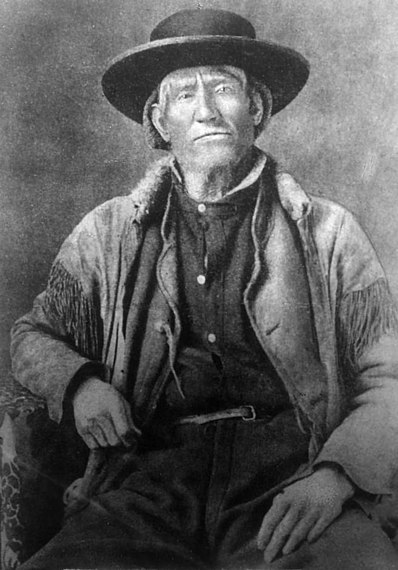
The first lucrative enterprise of the American West was fur trapping and trading.  John Jacob Astor made a pile of money from this business.  Jim Bridger (left) and his friends wanted in on the action and formed the Rocky Mountain Fur Company. 

Dressed in buckskins, wearing coonskin caps, and packing scalpin' knives, these men explored and trapped in every area of the West.  Some of the later "explorers" used these men's maps and lore.  Learn all about the trade, the men, and the business from Legends of America, Fur Trading in the American West.

Back East...
Another site that I frequent, especially when writing the Wolf Creek stories for Western Fictioneers, is the Kansapedia.  The cowtowns, several of the famous lawmen and outlaws, and lots of wheat aren't the only things you'll find in Kansas.  Besides, Matt and Miss Kitty were there... oh wait...

And Home Again
Since my stories are mostly set in Idaho, I do a lot of research there.  For a brief overview, go to the Visit Idaho Site.  For more in-depth information, go to Idaho State Historical Society Digital Collections, and here's an overview of Owyhee County history.  Of course, the best thing to do is ride a horse in the Owyhee Mountains and smell the sagebrush, but if that's not in the cards, a visit to the Idaho State Archives is in order.  They have a grant to digitize many of their newspapers, so that will be a boon to me since I live in Seattle now.


To be released Fall of 2014:
Much Ado About Mustangs


Friday, February 8, 2013

Setting: What’s Unique about the Wild West? by @JacquieRogers


Many genre writers start with setting. Yes, they say they start with characters, or with situations, but the truth is, if you’re writing a Regency, it’ll be set in England between 1811 to 1820, give or take. If you’re writing a Scottish Medieval, then it has to be set in Scotland between the 5th and 15th centuries. If you’re writing a Western, it’ll be set west of the Mississippi, usually sometime after the first wagon train went to Oregon and before automobiles. If you’re writing to the commercial market, the setting needs to be marketable.

So yes, many of us do start with setting.

Setting is far more than a time and a place. Woven properly into a story, it becomes a character in itself. Louis L’Amour was a master at this. How did setting come into play in the first book in my Hearts of Owyhee series, Much Ado About Marshals, which is set in 1885 Owyhee County, Idaho Territory? The seeds of the idea came to me when we visited Idaho to see relatives and while there, made some research trips to local sites.

I grew up in Owyhee County, so I’d been to the former boom town, Silver City, many times, but as I stood in front of the Idaho Hotel taking in the view, the huge bank safe sparked my imagination. What if a desperate bumbling cowhand botches up a bank robbery, is saved by his sensible friend, but then his friend is shot? Hmmm.

Setting and character were on equal footing at this point—couldn’t have one without the other. Why? Because the bank and its proximity to the other buildings in Silver City were firmly a part of the story. Besides, the sensible friend is Cole Richards and he has a ranch on Sinker Creek. The bumbling cowhand is Bosco Kunkle and he’s Cole’s best friend. Okay, so I moved geography around a little. Writers can do this.

As I contemplated that scenario, we stopped by Our Lady Queen of Heaven Catholic Church in Oreana. Even though I grew up not far from there, I never knew that the church was originally built as a general store by stonemasons John Pierson and Jim Kelly, the best stonemasons in the area. A store! It’s a good-sized rock building and was actually built later than my story is set, probably 1888, but is typical of the rock buildings constructed during the 1870s and 1880s. My book is set in 1885 so I felt comfortable using the building.
General Mercantile converted to
Our Lady Queen of Heaven Church
Oreana, Idaho

(To read more about the history of the church in Oreana, visit St. Paul's website.  The graphic on the right is from there.)

Aha! In my imagination, I saw a vivacious young woman run down the steps, carrying a package. She has a purpose and no one can stop her. Her name is Daisy Gardner. The store is Gardner’s Mercantile, owned and operated by her father. An aside note—I’ve always thought Oreana was the prettiest name for a town, and so I envisioned a lively little town full of fun characters. It was the perfect place for Bosco to take Cole for medical care.

That little rock building behind the store-now-church?  It was originally a saloon—extremely small, with room for maybe three customers.  Short ones.  I was told that men came in to buy their drinks but usually went outside to socialize and play cards while imbibing.

And no, the real Oreana isn’t on the way to Sinker Creek from Silver City, so I moved it, too. Literary license, you know. Bustling? Hardly. (See Google Maps satellite photo.  Yes, that's the whole town for real.)

So let’s say the editor wanted this story set in Boston. First problem is law and order—Boston had some, but Owyhee County wasn’t nearly as “civilized.” (Many would contend that’s still true, but in my opinion it depends on your definition.) At least 50% of the events could never have happened in Boston or any metropolitan area. Worse, Cole would never have been accepted by the city fathers, and Daisy would’ve been ostracized by society for her behavior. This story simply can’t be moved.

The point of all this is to not underestimate the value of setting. When well written, setting emphasizes conflict and every aspect of a character’s decisions. Writers: how do you use setting to the best effect in your stories? Readers: how does setting influence your perception of the characters? Would Hondo be the same character if the story took place in New Orleans or Paris?

Free Book!!!
One commenter will win a free Kindle copy of Much Ado About Marshals. Also, if anyone who sends a message to jacquierogers @ gmail.com telling me that you’ve posted a review and where, I’ll send you a Kindle copy of your choice of the second book in the series, Much Ado About Madams or the third book, Much Ado About Mavericks.

Drawing will be February 9 at 9pm Pacific Time. Please leave your email address in your comment. Thanks!

Jacquie Rogers, author of the
♥ Hearts of Owyhee ♥ series
#1 Much Ado About Marshals (RttA Winner)
#2 Much Ado About Madams
#3 Much Ado About Mavericks
A short story: Willow, Wish For Me (Merlin’s Destiny #1)

Visit Jacquie:
Website * Twitter * Facebook * Romancing The West * Blog

Friday, January 11, 2013

Jacquie Rogers: A Fun Tour of Idaho History


Most westerns are set in Texas, Arizona, or Wyoming, a few others set in Oklahoma, Kansas, and Montana, then comes Colorado, and New Mexico.  The other states are for the most part ignored, only getting a book set in their neck of the woods on rare occasions.

Of course, every single state I listed is back East to Idahoans.

First, I thought it would be fun to do a glossary.  Ron Scheer does one every now and again in his blog, Buddies In The Saddle, and he always comes up with some interesting terms.  (Great resource--you should check it out!)  Some terms I know, some I never heard of and would like to try, some aren't of much use to me, but fascinating nonetheless.  I thought it would be fun to list a few terms and phrases still in use when I lived in Owyhee County, Idaho, where my ♥ Hearts of Owyhee ♥ series is set.

Bazoo: Late 1880s word for "mouth."  probably from Dutch bazuin meaning "trumpet."  Example: Shut your bazoo before I shut it for you.

California widow: A product of the 1849 gold rush, and referring to the men who left to find the mountain of gold, leaving their wives and children behind.  Some of the men took West Coast wives but were still married to their East Coast brides. Example: If Jeb hadn't opened his big bazoo, his new housekeeper never would have found out about his California widow, but he did miss his son.  In contemporary use, it refers to a woman whose husband is gone a lot because of his job--a long-haul truck driver or something like that.

Crowbait: Originated around 1855-1860, meaning an emaciated horse (or could be a mule, cow, or oxen) that isn't much good for work anymore.  Example: Jeb wants to sell me some crowbait for fifty dollars.  I doubt that critter would make it halfway home before he gave up the ghost.

Dry gulch: From the early 1870s, this term means to ambush.  It probably stems from bandits luring their victims into a box canyon or dry gulch to kill and rob them.  Can be used as a noun or verb.  Example: Jeb's hair stood on the back of his neck.  He had a strong feeling bandits were waiting in the next arroyo, and they had a mind to dry gulch him.

Hard case: This phrase comes from the 1830s and is used to refer to a man (sometimes a woman) who is prone to felonious behavior and who has few moral scruples.  Generally a very dangerous person.  Example: Jeb pursued a hard case wanted for murder, rape, and painting a puppy.

Hell-bent for leather: Late 1800s saying meaning to ride as fast as you can, more than likely wrecklessly.  Original saying is "hell-for-leather" and was a favorite phrase of Rudyard Kipling, who probably picked it up from the British troops in India, so not exclusive to Western at all.  Example: Jeb rode hell-bent for leather to stay out of rifle range of the mudsills waiting to dry gulch him.

Mudsill: According to Etymology Online: 1680s, "lowest sill of a house," from mud + sill. The word entered U.S. political history in a speech by James M. Hammond of South Carolina, March 4, 1858, in U.S. Senate, alluding scornfully to the very mudsills of society, and the term subsequently was embraced by Northern workers in the pre-Civil War sectional rivalry.  Example: Ready to draw, Jeb rode through the camp of mudsills, never turning his back to a one of them.

The whole kit and caboodle: Mid 1800s.  From  Etymology Online: "also kaboodle, 1861, from kit (n.1) in dismissive sense "number of things viewed as a whole" (1785) + boodle "lot, collection," perhaps from Dutch boedel "property." Kit also was paired with other words in similar formations."  Jeb rode hell-bent for leather out of the box canyon where the whole kit and caboodle of mudsills had tried to dry gulch him.

Idaho Territory
Not for the faint of heart

Before the Europeans, residents of the Idaho area were the Lemhi, Shoshone, Bannock, Nez Perce, Salish, Paiutes, and Piegan Indians.

British fur trappers roamed Idaho in search of beaver pelts and other animal furs as early as 1809, but in 1814, the trading post in southern Idaho was destroyed by the Bannock.  Still, trappers and traders came from the East Coast, Britain, Russia, and the Sandwich Islands (Hawaii).  In fact, the later provided the name for Owyhee County.  From Wikipedia:
The name "Owyhee" derives from an early anglicization of the Hawaiian term "Hawaiʻi." When James Cook encountered what he named the Sandwich Islands (now the Hawaiian Islands) in 1778, he found them inhabited by Native Hawaiians who Anglo-Americans referred to as "Owyhees." Noted for their hardy physique and maritime skills, numerous Native Hawaiians were hired as crew members aboard European and American vessels. Many Owyhees sailed on to the American Northwest coast and found employment along the Columbia, where they joined trapping expeditions or worked at some of the fur trade posts.
In 1819, three Owyhees joined Donald Mackenzie's Snake expedition, which went out annually into the Snake country for the North West Company, a Montreal-based organization of Canadian fur traders. The three Hawaiians left the main party during the winter of 1819-20 to explore the then unknown terrain of what since has been called the Owyhee River and mountains and disappeared. They were presumed dead and no further information regarding their whereabouts has been found. In memory of these Native Hawaiians, British fur trappers started to call the region "Owyhee" and the name stuck.
Up to 1846, the area was  considered part of the Oregon Territory, and the primary industry was the fur trade.  Trappers and mountain men were the ones who laid out the Oregon Trail (and all the rest of the major trails, too).
Captain Benjamin L. E. Bonneville and Joseph Rutherford Walker crossed South Pass with twenty wagons and one hundred and ten men on July 24, 1832. On a two-year leave from the army, Captain Bonneville and Walker led the first wagon train over South Pass on what became the Mormon and Oregon-California Trail.
We always think of the Spaulding/Whitman wagon train as the first, but not.  Eliza Spaulding and Narcissa Whitman were the first Euro-American women to make the trek west--the Spauldings to Northern Idaho and the Whitmans to Washington State.  Henry Spaulding also brought the first printing press to Idaho in 1839.

Keep in mind that Idaho wasn't called Idaho yet.  That didn't happen until 1863, when Idaho Territory was carved from Washington Territory.  When I was in school, we where taught that Idaho was from the Shoshone "Ee-da-how," meaning "sun over the mountains," or "gem of the mountains."  This turned out not to be true and as far as we know, the name was simply made up by George M. Willing.  Yep, a hoax.  Good thing we Idahoans have a sense of humor.

Because of modern-day boundary shifts, Owyhee County is no longer the largest county in Idaho, but it's still large--the size of New Jersey.  The population is growing by leaps and bounds and is now 1.5 people per square mile.  Even so, a lot of the old ways are preserved there, both because of the remote location and because the people like it that way.  The latter is what a whole lot of city people don't understand.

So it's with the spirit of those hearty Owyhee pioneers that the Hearts of Owyhee series was born.


Where the Old West really happened!
Much Ado About Marshals
Much Ado About Madams
Much Ado About Mavericks


♥ Hearts of Owyhee ♥ 
A fun short story: Willow, Wish For Me (Merlin’s Destiny #1)