Showing posts with label New Mexico. Show all posts

Monday, November 4, 2019

Landscape Lines in Chaco Canyon


By Kristy McCaffrey


Certain areas around the world, such as Chaco Canyon in New Mexico, contain landscape lines that resemble ancient roads. Chaco Canyon is in semi-arid high mesa country in northwest New Mexico, within the San Juan Basin, a depression about one hundred miles in diameter. Home to the Anasazi, Chaco Canyon was one of their key centers and contained many Great Houses comprised of walls, courtyards and kivas (subterranean ritual chambers). There were nine Great Houses within Chaco Canyon itself, all built between 900 AD and 1115 AD, and in the surrounding area there were at least 150 more Great Houses that have been identified by archaeologists.

A kiva in Chaco Canyon.

Within the canyon and for miles around it, there are “Chacoan roads” that comprise a surprising linearity. Serving as a link between the Great Houses, they were clearly engineered since the roads were wide (nearly consistent at approximately thirty feet across) and were bordered by berms, rows of stones, or occasionally drystone walls. The road surfaces were either compacted subsoil or sometimes simply cut down to the bedrock.

Why would an ancient people with neither wheels nor horses go to so much effort to create such broad and exact roads? That it was for trade and mundane usage seems unlikely. The prevailing theory is that they were used for religious purposes, connecting the Great Houses and their ceremonial functions.

Nasa scientist Thomas Sever, who was involved in infra-red and computer image-enhancement work at Chaco, states, “…we should not always perceive roads as always being utilitarian; that, in short, we must not transfer our concept of modern-day roads into the prehistoric past.”

It’s now believed that at certain times of the year, the local populations made pilgrimages to Chaco Canyon to participate in religious rituals, and these roads supported these journeys.


Connect with Kristy


Wednesday, April 4, 2018

San Francisco de Assisi Mission, New Mexico

Front of the mission
It’s been several years since I visited Taos, New Mexico, but when I do, one place in particular draws my attention, the San Francisco de Assisi Mission. Situated south of Taos and a few feet back from the curb, the mission is a small, adobe building rich with history. Built between 1772 and 1816, every time I enter, I feel at peace.  
Rear of the mission
During the 18th century, Spanish and Mexican civilian families moved from Taos Pueblo to Ranchos de Taos to farm. To protect themselves from Comanche raids, they built their homes and work buildings out of adobe and situated them close together in a U-shape around a plaza, which became known as San Francisco Plaza. Steadfast in their Catholic religion, they founded the San Francisco de Assisi Mission, with the Franciscans overseeing the building of the church inside the u shape. Construction of the mission was completed in 1816, featuring two front facing bell towers with three white crosses adorning the towers and entryway. Four beehive shaped buttresses support the back of the church and two buttresses in front of each bell tower support the front of the church. Thick adobe walls surround the church, the cemetery, and the forecourt.
Original altar
San Francisco de Assisi Mission is the only original church to remain intact in the Taos area, and has been photographed, drawn, and painted by several well-known artists, including Georgia O’Keefe and Ansel Adams. Through the years, the mission has undergone several restorations, most notably in 1967 when all of the ceiling vigas and doors were replaced with reproductions. Every June, parishioners and the community re-plaster the adobe in a project titled The Enjarre, or mudding of the church.
After the altar was repainted
The interior artwork of the church is breathtaking, with the altar decorated in original Spanish woodwork and the wall behind the altar having been repainted in 1981. The paintings behind the altar are believed to be oil paintings brought to the mission from the Archdiocese of Mexico by way of Spain some 200 years ago. Depictions of the 14 Stations of the Cross adorn the side walls of the chapel. There is a balcony at the back of the church, but is roped off to visitors. Research led me to discover the Santa Fe Desert Chorale has held concerts in the church, but the author of the article does not know if the choir sang from the balcony, as he had never attended one of their concerts.
Whether you’re a history buff or a tourist, of religious beliefs or not, if your travels take you to Taos, the San Francisco de Assisi Mission is one place you don’t want to miss. 
The balcony

Wednesday, October 4, 2017

Fred Harvey and the Harvey Girls

Fred Harvey
Born in England 1835, Fred Harvey immigrated to the United States in 1850 at the age of 15. His first job was washing dishes in New York City. Soon after he moved to New Orleans and again gained employment in a restaurant, learning the ins and outs of the restaurant business. In 1853 he moved to St. Louis and six years later, he and a business partner opened a restaurant at the start of the Civil War. Unfortunately, his partner joined the war and not too long after, Harvey was broke for lack of customers. Harvey gained employment working on a riverboat and as a mail clerk for the railroad. It was during this time that he noticed trains did not provide dining cars, especially on long journeys, and the few eateries along the train route were deplorable. He concocted an idea to build a chain of restaurants along the AT&SF train route, but his idea was denied by his supervisor. A spur-of-the-moment meeting the AT&SF owner and gourmet, Charles Morse changed that. Morse liked Harvey’s idea and the first Harvey House restaurant opened in Topeka, Kansas in 1876.
Dining Room, Topeka, KS
Harvey leased a lunch counter at the Santa Fe Topeka depot. His focal points for running the counter were cleanliness, good food and reasonable prices. He was an immediate success, catching the attention of the Atchison, Topeka & Santa Fe line. They turned their food service over to Harvey and The Harvey Houses became the first chain of restaurants in the United States, with Harvey using the depot in Topeka as a training base. Harvey bought a hotel in Florence in 1877 and created an upscale establishment, featuring juicy steaks and crisp hash browns. Tables were set with imported linens, silver and china. He required male patrons to wear a jacket and always kept a supply of alpaca coats on hand for those who didn’t have one, ensuring no one was turned away. Eventually, Harvey extended his restaurants all the way to California.
Harvey Girls
Originally, Harvey hired males to work in his establishments. He soon found that many of them were as wild as the west and came up with another idea to hire women. He recruited women in newspaper ads, requiring them to have an 8th grade education, be of good manners and moral, and have a cleanly appearance. He paid them a good wage, with free room and board, and upon hiring a girl, he offered her the establishment of her choice along the train route. The girls were outfitted in black shirtwaist dresses, black bows and starched white aprons. In exchange for this, the girls had to agree to six months of employment, that they wouldn’t marry, and that they would obey company rules. With little opportunity for women in this era, the position as a Harvey Girl rose to popularity instantly. 
   
Harvey House Santa Fe (La Fonda)
Harvey’s success didn’t stop with his chain of restaurants. In the southwest, he hired architect Mary Colter to design hotels in Santa Fe (La Fonda) and Gallop New Mexico and in Winslow, Arizona, and at the south rim and at the bottom of the Grand Canyon. At the peak of the Harvey Houses, there were 84 restaurants in operation. Harvey continued to improve his businesses before he passed away in 1901. His sons and grandsons took over and kept the company profitable as long as possible. The inventions of cars and airplanes made that difficult, as most folks no longer traveled by train. The company was bought out by Hawaiian based Amfac in 1968. Amfac has hotels worldwide and adopted Harvey’s strategy for business and his standards. 


PS: If you ever get the chance, spend the night at La Fonda. I have and it's beautiful.
Inside La Fonda

Friday, June 24, 2016

Six-Shooter Siding aka Tucumcari, NM


Tucumcari, New Mexico began as a railroad camp in 1901 when the Rock Island Railroad decided to extend a line through New Mexico. The residents of Liberty (a small town three miles north) saw the opportunity the rail line presented. They moved southward closer to the rail line, and the camp became a tent city. It started as a rowdy railroad camp filled with saloons, merchants, gamblers, dance hall girls and outlaws.

Originally called Ragtown, the camp became known as Six Shooter Siding, due to numerous gunfights. Its first formal name, Douglas, was used only for a short time. One year later In 1908 it was renamed Tucumcari after the scenic Tucumcari Mountains acting as a background for the city. There are several legends behind the meaning of the word "Tucumcari.” You can read about them in my previous blog post by CLICKING HERE.
 
Tucumcari Mountain
The fathers of Tucumcari were five business men from Liberty who filed on the land, then donated 120 acres of land for town site. They were: M. B. Goldenberg, A. D. Goldenberg, Jacob Wertheim, J. A. Street, and Lee K. Smith.  J.A. Street is credited for erecting the first tent in the new railroad camp.

The first passenger train arrived in Tucumcari on March 12, 1902 and before long there were four passenger trains arriving daily, two from the east and two from the west.
 
Tucumcari, NM Train Depot, courtesy of Christian M. Mericle
One of the first issues these early pioneers dealt with was the lack of water. Initially, wells were dug into the hard ground, but failure to locate water discouraged further drilling. Therefore, water had to be hauled into the new settlement from the South Canadian River daily, costing the residents fifty cents a barrel.

Some of the first businesses to open in 1902 were the Waldorf-Astoria Hotel with rooms for $2 a day, the Monarch Saloon, as well as many others baudy taverns, a furniture store, a livery barn, a boarding house located at First and Turner Streets, several mercantile stores, and the Exchange Bank. Max Goldenberg's home was the first permanent home built in Tucumcari, which contained the post office.

The Elk Drug Store was established in 1906. It was owned by Drug Store Cowboy Herman Moncus, who collected a mammoth assortment of items more or less relating to the history of the area. He hung his collection from the ceiling of his drug store.


At this time New Mexico was one of the last territories available for settling. By 1907 arriving homesteaders had caused many small towns to crop up around Tucumcari. By 1910, the town had expanded to include several churches, a school system and over seventy businesses. Growth continued through the 1920s, brought on by railroad and ranching opportunities. When the depression hit in 1930, many of the smaller towns began to disappear, and the town's population began to dwindle.
 
Baca-Goodman House, Tucumcari
Primarily thriving from the railroad and area ranching opportunities, the town continued to prosper until the Great Depression era. At that time, most of the 20 some small towns that surrounded the city were abandoned and quickly reverted to cow pastures. With the development of Route 66 and the businesses it generated, Tucumcari survived the depression.


In 1940, when the South Canadian River was dammed, this created some 60,000 acres of irrigated farmland. What were once cow pastures soon became rich farmland, pulling Tucumcari out of its slump.
 
Blue Swallow Motel, famous Route 66 landmark in Tucumcari, NM


Sources:

Legends of America, Tucumcari, New Mexico, http://www.legendsofamerica.com/nm-tucumcari.html

Ballinger Family History, Tucumcari, New Mexico - 1910-1920; http://history.fristad.net/ballenger/tucumcari_nm.shtml

Tucumcari, NM; Wikipedia

Zina Abbott is the pen name used by Robyn Echols for her historical novels. The first three novellas in the Eastern Sierra Brides 1884 series, Big Meadows Valentine,  A Resurrected Heart, and Her Independent Spirit, are now available. He Is a Good Man was published as part of the Lariats, Letters and Lace anthology.


Tuesday, July 14, 2015

The Cowboy Minister


The Cowboy Minister - By Christina Cole

One of the things I most enjoy about writing western historical romance is the information I accidentally find as I’m researching different topics. Recently I stumbled across a website that told the story of Ralph J. Hall, better known in his day as “The Cowboy Minister.”

“…To a great many people, ‘Go ye into all the world’ means only going to China, Japan, Africa, or to some distant place across the sea; but to the Sunday school missionary it means going into the most isolated and neglected parts of his field…It often means dim and rugged trails over the mountains or across the parched sands of the desert. It means visiting that lonely and isolated home or community, for the Sunday school missionary must ever be primarily a trailblazer, a pioneer in the work of the Kingdom…”

—Ralph J. Hall, in The Main Trail, 1973


I was intrigued at once and wanted to learn more. Now, I’m pleased to share with you the story of this remarkable man and his ministry.

Born in 1891, Ralph Hall grew up in a remote area in west Texas. One day a traveling minister knocked on the family’s door, and the boy knew then what his mission in life would be. At the age of eighteen, and with only a fifth-grade education, he left home to be a lay missionary for the Presbyterian faith. His first official assignment was with the cowboys and ranchers of Texas and New Mexico.

At that time, Hall wasn’t ordained to offer communion services, nor could he baptize, so he was accompanied by Dr. Houston Lowery, a minister from Carlsbad, New Mexico. Dr. Lowery soon found himself a bit disoriented with no pulpit, no choir, no pews. He quickly realized, however, that young Ralph Hall was a gifted speaker, one who knew the people and understood their hearts.

In 1916, after only two days of instruction and examination, Ralph Hall was ordained. Throughout his life in the ministry, he gained respect from the people he served because of his willingness to work alongside of them, helping with the roping and ranching.

He traveled extensively throughout the southwest, and under his supervision, many conference grounds, camps, church schools and chapels were constructed. Whenever he arrived in a new town, his first job was to figure out how to build rapport with the cowboys and ranchers in the area. Many of them, he said, “had a scowl rather than a welcome for the preacher when he came around,” so Hall wouldn’t let on that he was a minister until the men had accepted him as a “real cowboy”.

Folks said Hall could “rope a steer in record time” and “read trail signs like an Indian”, skills that quickly won over the men he worked with.

Later, having gained acceptance and trust, he would open up to the cowboys about his faith, usually late at night as they sat near a roaring fire. Even the most skeptical of the men would listen.

As the story of his missionary work with the cowboys made its way back East, many curious folks wanted to join him for a taste of the “cowboy experience.” Those who did accompany Hall on his journeys found out that the cowboy’s life was not an easy one. Most were unprepared for the grueling 18-hour work days, the roping, the riding, and the difficulties of tending to cattle over treacherous terrain and erratic weather.

Hall was comfortable riding long distances and preferred to sleep out under the stars. His eastern-born friends often found themselves jettisoning their over-packed bags at the side of the trail and leaving their bedrolls behind while they scurried off to find shelter on cold desert nights.


According to the Presbyterian Historical Society, Ralph Hall went on to supervise all Sunday School missionary work west of the Mississippi River, traveling hundreds of miles to remote ranches to perform baptisms and marriages. He brought church to the homes of many pioneer families who were hundreds of miles from the nearest towns. He was also instrumental in developing the idea of “camp meetings” in order to find ways to bring people together for worship. Although he relied on word of mouth to promote the first Ranchman’s Camp Meeting, hundreds of people came together at Nogal Mesa – a beautiful pine-covered mountain near Carrizozo, new Mexico – to hear the word from guest preachers, to read and study scriptures, to pray together, and to partake of meals cooked over a fire. The Ranchman’s Camp Meeting still meets annually at Nogal Mesa.

In addition to becoming the subject of several documentaries filmed between 1920 and 1950, he shared the story of his life and his mission in The Main Trail, published in 1973.

“Bible in his bedroll, a dedicated young missionary hit the trail for New Mexico's far-flung cow camps and isolated homesteads. Now, nearly sixty years later, he writes about a rich and rewarding life in which hilarious roundup anecdotes and amusing frontier experiences are counterpoint to situations of high drama and deep pathos. He says that cowboys and lonely young people, deprived as they were of Christian fellowship and any opportunity for Christian worship, were his two dominant concerns. As a circuit rider in his early years he would join a cattle outfit as an extra hand, prove his ability to ride any mean horses and win recognition as a bonafide cowboy. Then, after a few days, he would hold a meeting around the evening campfire. For the young people, he instituted youth camps - a program which has extended into Arizona, Colorado and northward almost to the Canadian border. He tells how he dramatized the importance of his missionary work to supporting churches by organizing traveling seminars - a project for taking seminary students and church members by caravan on a tour of missionary fields in New Mexico, Colorado, and Arizona. And he tells it all with so much humor that the most casual reader will find his accounts as interesting as any tale of roughing it in the West.” --- Excerpt from publisher's notes


I’m glad I got to know Ralph Hall’s story. His devotion is inspiring. I hope you’ve enjoyed learning about this “cowboy missionary” and his dedication to serve others. 

Monday, January 5, 2015

Las Vegas, New Mexico

By Kristy McCaffrey


When you hear Las Vegas you immediately think of the gambling mecca in Nevada, but there is another.


Las Vegas, New Mexico—located east of Santa Fe—was established in 1835 on the Gallinas River, near the Sangre de Cristo Mountains.

Sangre de Cristo Mountains
It prospered as a stop on the Santa Fe Trail and was 30 miles from Fort Union, a large Army outpost.

Fort Union
Las Vegas had a unique combination of Spanish and Anglo traditions. The white people held balls and church socials while the Spanish community held fandangos, or neighborhood dances, and fiestas.

The railroad arrived in 1879 and Las Vegas soon became one of the largest cities in the American southwest. The sophisticated town supported an opera house, social and literary clubs, an orchestra, and a theater. But Las Vegas also had a reputation for rowdiness, and had its fair share of gamblers, hoodlums, and fallen women. Infamous characters such as Doc Holliday and his companion, Big Nose Kate, as well as Billy the Kid, Jesse James, and Wyatt Earp all passed through in the late 19th century. The area later became known as a resort town because of its dry, temperate climate and the hot springs north of town, attracting wealthy patrons from as far off as Europe. These luxury resorts flourished during the 1880’s and early 1890’s.

Las Vegas, New Mexico
Many movies have been filmed here, beginning with silent western films, from 1913 to 1915, to Easy Rider, Convoy, Wyatt Earp (starring Kevin Costner), All the Pretty Horses (with Matt Damon and Penelope Cruz), No Country for Old Men (with Tommy Lee Jones and Javier Bardem) and Paul (with Simon Pegg and Kristen Wiig).


My second book in my Old West romance series, The Dove, is set in Las Vegas and the surrounding countryside.


THE DOVE
Wings of the West Series: Book Two

Disappointment hits ex-deputy Logan Ryan hard when he finds Claire Waters in the midst of a bustling Santa Fe Trail town. The woman he remembers is gone—in her place is a working girl with enticing curves and a load of trouble. As a web of deceit entangles them with men both desperate and dangerous, Logan tries to protect Claire, unaware his own past poses the greatest threat.

Plagued by shame all her life, Claire is stunned when Logan catches her on the doorstep of The White Dove Saloon dressed as a prostitute. She lets him believe the worst, but with her mama missing and the fancy girls deserting the place, she's hard-pressed to refuse his offer of help. As she embarks on a journey that will unravel the fabric of her life, one thing becomes clear—opening her heart may be the most dangerous proposition of all.


Monday, October 6, 2014

The Four Corners Area of the United States

By Kristy McCaffrey

A popular tourist destination is the Four Corners area in the southwestern U.S. Here, one can occupy Arizona, New Mexico, Utah, and Colorado at once.
My husband and I at Four Corners on a chilly New
Year's Eve.
Within this expanse are four prominent landmarks: Monument Valley, Canyon de Chelly, the Painted Desert, and Shiprock.

Monument Valley is located on the Arizona-Utah border on the Colorado Plateau, and the Navajo have preserved the area as a vast tribal park. The iconic sandstone buttes and spires rising from the ground have become famous worldwide, due in part to filmmaker John Ford who featured the area in many western movies in the 1940's and 1950's.
Monument Valley 
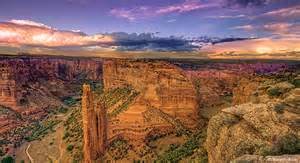
Canyon de Chelly (pronounced 'de shay') National Monument is located in northeastern Arizona within the boundaries of the Navajo Nation. Rock art and other excavations reveal human habitation for at least 4,500 years, encompassing not just the Navajo but the ancient Anasazi as well. In the 18th century this became a major stronghold of the Navajo—the high canyon walls offered protection and the streams helped grow corn crops and peach trees. Today, Navajo still live here.
Canyon de Chelly
The Painted Desert, approximately 120 miles long and 60 miles wide, is composed of stratified layers of easily erodible siltstone, mudstone, and shale. The layers of rock contain an abundance of iron and manganese, which cause the varied colors of the region. This area also includes the Petrified Forest National Park, a landscape frozen in time for more than 220 million years, revealing colorful petrified wood and animal fossils. How does wood become petrified? Long-ago floods carried timber onto a plain, then, over time, minerals in the water replaced the wood cells, filling the spaces with quartz and jasper crystals.

The Painted Desert
Petrified Forest National Park
Located in northwestern New Mexico, Shiprock rises 1,583 feet on a desolate plain and is visible in all directions for many miles. It has great religious and historical significance to the Navajo people.

Shiprock

~ Now Available in Print and Digital ~
Cowboys, Creatures, and Calico Vol. 2
Haunted tales of romance set in the Old West
Includes my short story
"The Crow and the Coyote"


In Arizona Territory, Hannah Dobbin travels through Cañon de Chelly, home to the Navajo, in search of a sorcerer who murdered her pa. Bounty Hunter Jack Boggs is on the trail of a vile Mexican bandito, but with the shadows of Hallowtide descending, more dark magic is at hand than either of them know.


What better way to spend Halloween than with some handsome cowboys and feisty heroines who are determined to fall in love despite their supernatural powers—or lack thereof. Halloween's a good time to take a chance on love—and to see what these Cowboys, Creatures, and Calico Vol. 2 stories might reveal to the unsuspecting reader—YOU!

Cheryl Pierson's Spellbound will have you on the edge of your seat as safecracker Brett Diamond and witch Angie Colton take on a border gang leader who is pure evil. Can Angie's supernatural powers save them? No matter what, Brett and Angie are hopelessly spellbound.

C. Marie Bowen's Hunter and Lily Graham is an unforgettable tale of a beautiful school marm's love for her children that surpasses all. When a Cajun bounty hunter known only as "Hunter" shows up, Lily knows he, and no one else, can help her save a young girl.

Have Wand—Will Travel is Jacquie Roger's offering about a handsome young mage, Tremaine Ramsey, who has a wand and knows how to use it...sometimes. Will his magic be strong enough to pull off a daring rescue of his father from the evil Gharth? Or will he need the warrior Nora's love to help him see his Fate through?

Will Kaye Spencer's character, Mercy Pontiere, be able to break a centuries-old curse and find true love all at the same time? It all depends on Reid Corvane and what he'll do For Love of a Brystile Witch.

In Kristy McCaffrey's story, The Crow and the Coyote, Hannah Dobbin is after an evil Navajo sorcerer who murdered her father, and she's determined to see him dead. But she'll need a bounty hunter—The Crow—to help find this vile man. With Hallowtide upon them, more evil is afoot than they can handle; but love will find a way.

A failed bank robber, Tombstone Hawkins, along with a fake gypsy fortune teller, Pansy Gilchrist, set out to make both their deceased fathers proud in one final spectacular heist. Family Tradition is Kathleen Rice Adam's tale of the discovery of true love amid the commission of a crime—or the failure to commit a crime—while being overseen by the ghosts of the couple's fathers. How can there be a happy ending? It's Halloween, and anything can happen!


Happy Halloween!!