Showing posts with label Sweethearts of Jubilee Springs. Show all posts

Friday, December 27, 2019

Operating a Silver Mine by Zina Abbott


It is possible to find internet articles and information in books about mines. Much of it has to do with where mines are located, the types of minerals found in mines, and brief histories of mining towns. I found it difficult to find details about how mines were operated in the 1800s. My best sources, so far, have been from my own notes, photographs, and recollections of two mine tours I've been on, and a You-Tube recording of a mine tour.

In 2018, I toured the Broken Boot Mine, a gold mine, although it (like many mines) contained other minerals. In fact, during World War II, most gold mines were shut down because of the war effort. The Broken Boot mine was worked to extract lead needed for bullets. It is located near Deadwood, South Dakota.

In 2019, I toured the Lebanon Tunnel, a misnomer, since it did not have two openings, see my mining definitions post from last month by CLICKING HERE. The Lebanon Tunnel Silver Mine is located in Silver Plume, Colorado.

Many mines had two ten-hour shifts. The first shift started at 6:30a.m. A notable exception in Silver Plume was the mine known as the 7:30 Mine. The owner chose to start that mine an hour later than most mines. The mining day started when miners reported to the "Warm Shack" or "Warm Room" where they changed out of their street clothes and into clothes they wore in the mines.

Reconstructed Lebanon Tunnel Mine warm shack heater, and dynamite boxes like those used in the mine. (The tour guide assured us that when the mine was in operation, at no time would the dynamite have been kept anywhere near the warm shack.)
The end of the day brought them back to the warm room to warm up. (Temperature inside the Lebanon Tunnel Mine, for example, was a continuous 44 degrees Fahrenheit.) On some days, it probably also gave their eyes a chance to adjust to light, since they spent that ten hours in the mines with only candlelight or perhaps a carbide lantern for light.
 
When it comes to drilling into the rock wall, or working face, of a mine, I have heard two kinds of hard rock drillers described. One is a single driller who uses four-pound hammer and a steel drill bit.

Drill bit and hammer, left, and drill bit left in working face, right, Broken Boot Gold Mine.
Then there are drill teams. One holds the drill bit (heavier than the type used by a single driller) and gives it a quarter turn each time the end is struck by a the other miner who wields a nine-pound hammer. Because the candles in the helmets of the two drillers provide the only light, the one holding the drill places his thumb over the end. The light from the candle reflects off of the thumbnail. This is done to (1) signal the quarter-turn has been completed, and (2) give the one holding the hammer a target to aim for.


It was important to stay coordinated. A smashed thumb not only seriously disrupted a friendship, in some cases, it put the team out of work until the injured miner healed sufficiently. Many silver miners in the Rocky Mountains originally came from Cornwall and brought their centuries worth of mining traditions and practices with them.

Cornish boys started work in the mines as powder monkeys at about the age of seven or eight. They did the "fetch and carry" chores for the miners, plus they were the ones who carried the boxes or bundles of dynamite to where the charges were to be placed for the day. Once the ones in charge of setting up the day's blasting were finished and the mine was cleared, it was usually the powder monkeys who set the blaze to the fuses. Because of their youth, they were able to run out of the mine, including up and down raises from the working drifts of several levels, before the dynamite exploded.

Mannequin in Lebanon Tunnel Mine dressed to represent a powder monkey.
Miners on the two shifts did not perform the same tasks. To best describe what took place, I am including an excerpt from one of the chapters of my most recent book, Nathan's Nurse. This conversation takes place in the mine office between one of the mine owners, Royce Bainbridge, and Herbert Price, brother to the hero in my book and a less-than-stellar miner:

Reconstructed warm shack, left, and mine office, right, for the Lebanon Tunnel Mine, Silver Plume, Colorado
"…Tell me your understanding of how things work in the mine.”
         Wearing a bewildered expression, Herbert shook his head. “What are you getting at? You own this mine. You ought to know how it works.”
         Royce sighed. This was going to be harder than he thought. “We work the mine in two shifts, right? You were hired to work second shift as a mucker. What did your job entail?”
Muckers who haul rock and ore out of the mine.
         Herbert shifted back and forth from one foot to the other. “We…uh…we used our shovels and loaded up and hauled out all the rock in the mine.” He tripped over his words as if he suspected Royce had asked a trick question. “Anything we could tell was slag, we put to one side. The rest went in a pile to get loaded onto the train.” 
Raise in Lebanon Tunnel Mine showing rock from mine blasting and ladders & hoist to carry material to the level where it can be transported outside the mine.
          Royce continued speaking with exaggerated patience. “And if you hauled the rock out every night, where did the new rock in the mine come from that was there each evening when you arrived at work?”
         “I guess from the men working on the first shift.”

Single drill miners in Lebanon Tunnel Mine
         “You guess? You’ve been working on first shift these past two weeks. After you drill your holes for the day, what happens?” Clenching his jaw in frustration, Royce watched Herbert shrug and look around the mine office, as if hoping to find the answer somewhere on the walls.
         “The guys in charge of blasting put the dynamite inside the holes we drill and string the fuse lines, then set them off.”
         “All right. And what happens in the mine before any blasting is done?”
         Another shrug. “Dunno.”
        “Are you, or any of the crew, inside the mine when the dynamite goes off?”
         “Naw. Declan sends us to the warm shack before the blasters light the fuses.”
         “Are any men left working anywhere else in the mine when it is time to blast?”
         “Dunno. Seems like there’s a lot of men in the warm shack changing clothes, though.”

Reconstructed interior of Lebanon Tunnel Mine warm shack with clothes hooks and benches for miners to change clothes and warm up after completing their shift in the mine.
         Barely hanging on to what little patience he still possessed, Royce stood up, placed his palms on the top of his desk, and leaned forward. “That’s because one of the jobs of the crew managers is to clear their men out of the mine first. All of the crews in all of the levels and all of the working drifts of the mine are cleared out of the mine before any blasting is done. With the men out, no one is at risk of being injured in the explosions, and no one is breathing the thick clouds of dust which are mostly settled by the time second shift has had their time in the warm shack changing before they enter the mine to work.”
         “Yeah, I got that. So, why are you telling me all this instead of giving me my pay?”

Nathan's Nurse is now available. To find the book description and purchase link, please CLICK HERE.


Sources:

Broken Boot Gold Mine in Deadwood, South Dakota
https://www.youtube.com/watch?v=fzDqY2LOing
my notes from a tour of the Lebanon Tunnel Silver Mine


Friday, November 22, 2019

Navigating a Silver Mine by Zina Abbott


The past two summers my travels have taken me to--and into--two historical mines. The Broken Boot Gold Mine is just outside Deadwood, South Dakota. The Lebanon Tunnel mine is in Silver Plume, Colorado, and can be part of your Georgetown Railroad train tour.

Since many of my Old West romances feature mining towns and miners, I found these tours very interesting and educational. A big part of my education included realizing that many of the words I used to describe mines are flat-out wrong.

This post is not going to be everything you ever wanted to know about mining terms. However, it will include a few terms to describe navigating within a mine, as well as a few structures you may find inside mines. The images I've used were taken by me, inside mines with poor lighting, during fast-paced tours involving 20-30 people. Please keep that in mind when judging photo quality.

First of all, most mines are not tunnels, although many of us think of them as that. Tunnels enter one side of a hill, cliff, or mountain and have at least one exit elsewhere. Also, you do not enter a mining shaft unless you are on top of the ground and entering the mine by going down, down, down or down at an angle. The two mines I toured had horizontal entrances. So I entered by what is called an ADIT.


Here is some basic terminology:

Adit – a horizontal opening from the surface into a mine, usually into a mine drift.
Original adit to the Broken Boot Mine

Shaft – a vertical opening from the surface into a mine, tunnel or drift. 

Drift – Similar to a tunnel in appearance, a drift goes only partway through a solid surface, but has no outlet.

Drift in Lebanon Mine
Raise – A vertical or inclined passageway driven between levels of a mine. They are used as manways, ventilation passages, for support lines such as pipes and electrical lines, for hauling ore from a lower level to another for removal from the mine, and as ore dumps for transporting ore to lower levels.

Winch with lines down a raise to bring up ore from lower level of mine.

Back – ceiling of a tunnel or drift.
 
Miner on top has hand on drift back and chalk marker on a rib of drift.
Rib – wall of a tunnel or drift.

Working face – a wall of rock in which miners will set charges to break it into small pieces, the working surface.

Miners in a drift preparing drill holes on working face of mine.
Stope – a large, underground room from which ore is removed. They are formed when miners drill numerous holes in the working face, then fill them with explosives which they then detonate. Said blasts breaks up the working face into pieces small enough to be loaded into mining cars and taken out of the mine. Often the area between two levels of the mine and sometimes accessed through a raise.

Crib/Crib Sets – in hard rock mining, cribs are the heavy wood supports that protect and support the drift.

Cap – top timber of the crib set.

Post – side pieces of a crib set that provide vertical support for the cap.

Posts - no caps or stringers in this section of the mine.

Stringer – connecting pieces that join the crib sets.
 
Stringers
Square-set Timbers – massive notched beams designed to form an interlocking series of cubes.


Square-sets – cubes formed by square-set timbers

Back-filling –partially filling open stopes that are no longer actively mined with waste rock taken from other areas of the mine. This was done for safety as well as disposal of waste rock.

Test Pocket - Removing rock from the working face far enough to see if there is any sign of ore. 
Test pocket
Slag - waste rock.

Slag
Silver Ore - tends to be black in appearance in its raw state.
 
Examples of silver embedded in rock.


I have written seven books for the multi-author series, Sweethearts of Jubilee Springs. Jubilee Springs is a silver mining town set in the Rocky Mountains of Colorado. My most recent book in the series, Two Sisters and the Christmas Groom, is currently available. Please CLICK HERE.

My eighth Sweethearts of Jubilee Springs book, and my next book to be released, Nathan's Nurse, is the first book in which I wrote a scene that took place inside the Prosperity Mine. I went out of my way to be sure the descriptions I used were understandable to those readers who, like I was, are not overly familiar with mining terms. I even asked some authors in my Gold Rush Writers group to give suggestions, which I followed. Still, I hope you found these mining terms above helpful. You may want to refer to them again when this book is published. 

Nathan's Nurse is currently on pre-order and is schedule for release on December 27, 2019. You may access the book description and purchase link by CLICKING HERE.


Sources:

Broken Boot Gold Mine in Deadwood, South Dakota
Lebanon Tunnel Mine in Silver Plume, Colorado


Friday, May 25, 2018

Fort Tyson & Water


The town of Quartzsite is located on the site of old Fort Tyson, a privately owned fort built in 1856 by Charles Tyson for protection against Indians. Because of the water which existed at this place, Tyson's Wells soon became a stage station on the road from Ehrenburg to Prescott. In 1875 Martha Summerhayes described this place as being the most melancholy and uninviting that she had ever seen, saying that it "reeks of everything unclean, morally and physically..."
 
Fort Tyson ruins on corner of Main Street and Moon Mountain Road in Quartzsite
Charles Tyson was an early settler who saw the mining potential of the region in the La Posa Valley. In the early years of the American gold rush, pan handlers began to arrive in Arizona searching for the precious metal. Gold deposits were discovered in the desert mountains of Plomosa and Dome Rock in the area and a boom in the mining industry followed. The key was water. The water supply in the area became the target of the Yavapai tribe (a.k.a. Mohave-Apache) who resented the arrival of the Anglo-European settlers on their land and raided the early settlements.
 
Fort Tyson ruins
The settlement was also known as Tyson’s Wells, because of the well dug there in 1864 to reach the underground water.
 
Tyson's Well Old Stage Station historic marker

Tyson then built a stage station in 1866, which originally served the stage coaches that traveled from the towns of Ehrenberg and Prescott. Prescott at the time was the capital city of the Arizona Territory. The California and Arizona Stage Company began transporting passengers which included prospectors, since gold had been discovered in the mines of Wickenburg and Prescott, and made stops at the station. The Wells Fargo Express also stopped by the station en route to Ehrenberg and Wickenburg from California. Tyson’s Well Stage Station was located on the famous Butterfield Overland Mail route between Prescott, Arizona and Riverside, California.

When the railroad came, most stagecoach travel ended, leading to a major slump for Tyson’s Wells.
 
Replica of 1900 Oasis Hotel in Quartzsite
In 1897, the development of mining in the area resulted in a small boom. It was reported that Tyson's Wells had three stores, two saloons, and a short-lived post office. Apparently when it became necessary to re-open the post office because of renewed mining activity, a new name had to be found since the post office did not permit offices to re-open the post office under formerly used names. Therefore, George Ingersoll suggested the name Quartzite, since quartzite is actually found in the vicinity, but quartz is not. However, the post office in error apparently added an "s" to the name. The resulting "Quartzsite" erroneously implies that quartz is found locally. Actually Quartzsite is approximately nine miles east of the old Tyson's Wells which lay nineteen miles from Ehrenberg. Therefore, a different name was a better suited.


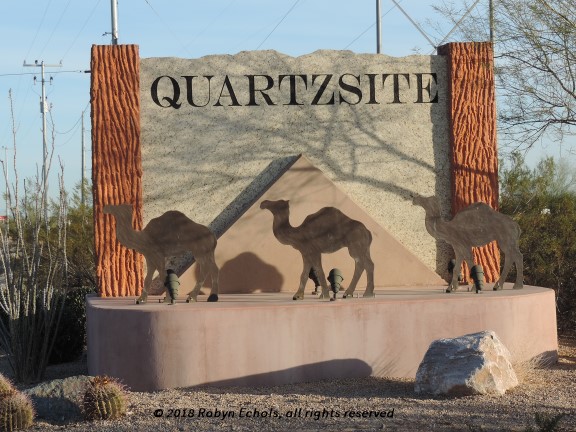
Quartzsite also became associated with the camels that were turned loose in the region about the time of the Civil War after the U.S. Army abandoned their camel program. Many lived in the La Posa Valley for years.

Sources:
Wikipedia
http://www.ghosttownaz.info/old-fort-tyson.php


My Independence Day 1881 – Zina Abbott’s Sweethearts of Jubilee Springs is available both as an ebook and in print on Amazon. If you have a Kindle Unlimited account and have not yet read all three of my first three books, this book containing three novellas will count as one book on your KU queue. You may find the book description and purchase link by CLICKING HERE.

After you finished reading this book, please leave a review on Amazon and Goodreads.