Showing posts with label boom town. Show all posts

Monday, September 21, 2015

Historic Mining Town by Paty Jager

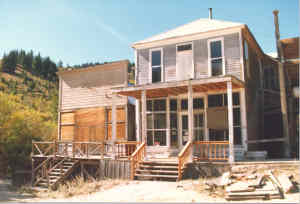
Mining town of Bourne, OR
I dug up this information to help me better understand the workings of a mining town for my current work in progress.

A booming mining town isn’t a quiet place.  The thud of the stamp mills could be heard for miles long before you rode into town. Mules wore bells, burros brayed, dogs barked. Planning mills worked to keep up with the demand for boards.

Dust in the streets when it’s dry, mud when it’s wet. Animal dung from horses, mules and oxen. Human refuse tossed in the streets.  And the fresh smell of pine from the new buildings constructed.

The thud of the stamp mill was the heartbeat of the town. As long as they heard the thud, thud, thud the mill was running and all was well. The mill only stopped in emergencies.

With the whisper of gold in an area, people and freight arrived daily.  Tents and crude cabins sprang up. There’s no running water. Water was drawn at a town well or pump. Each household had an outhouse
Mine in the side of the mountain
behind it.

Prospectors take up claims up and down the river if it’s placer mining or in the mountains if it’s hard rock mining.

First businesses sell needed items – a mercantile and a saloon. The mercantile provides the every day necessities and the saloon provides a place to visit, have a drink, and see a woman.  Most mining towns have few women and the respectable ones are treated like royalty. 

When wives arrived they would organize gatherings. A weekly dance with the women bringing baked food. There were so many men in a mining town all females as long as they were big enough to dance, danced every song.  On Thanksgiving, Christmas, Fourth of July, and Labor Day the whole mine would shut down, even the mills.  Everyone celebrated with food, games, horse races and boxing matches. They had drilling contests with one and two man teams. The winner was the person or team who could hand-drill the deepest hole in a granite block in a named length of time. Betting took place during the drilling. Men practiced for days ahead of a holiday and used their own special drill steels. Music was an essential at the gatherings. If you were a musician you were popular. 

Company boarding houses, housed the mine workers. It was usually two story with the office, dining hall, and kitchen on the bottom floor and the sleeping quarters upstairs. Built-in wooden bunks were shared by two people. Each person worked a different shift.  The miners weren’t clean either. After a shift they’d set wet boots around the wood stove and they didn’t wash often. The smell must have been enough to make nose hairs curl. Tobacco juice mixed with mud on the floors. Pack rats and flies were also part of a company boarding house.

The most important person in a mining camp was the cook. How well the men ate determined if they stayed on.  This was a typical day’s meals if the company was a good one:

Oatmeal or some other hot grain cereal
Two slabs of bacon or ham
Huge pans of fried potatoes
Large pans of biscuits, refilled again and again
Condensed milk in cans on the tbles, some diluted in pitchers
Stewed fruit(stewed dried fruit when fresh was unavailable)
Syrup
Preserves
Cookies
Coffee cake or doughnuts
Dozens and dozens of eggs, fried and boiled
Huge pots of coffee
Sugar and butter on each table
Lunch (or dinner as it was called back then) was the biggest meal of the day. The preparation started as soon as the men finished breakfast and that was cleaned up.
Soup
Meat and gravy
Potatoes
Vegetables
Hot homemade rolls
Twenty pies (more than a quarter pie per person)
Butter and preserves
Coffee
Supper was nearly the same as lunch but without soups and as big a meal as dinner.
Meat and gravy
Potatoes
Vegetables
Pan after pan of cornbread
Cakes, iced and decorated on special occasions
Butter and preserves
Coffee


Source: The Mining Camps Speak by Beth and Bill Sagstetter
Photos: Paty Jager

Thursday, January 26, 2012

Silver City, Idaho Territory: Rowdy, Raucous, & Rich

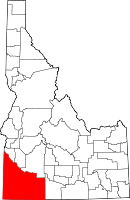
Current boundaries of Owyhee County, Idaho
Copyright © 2012 Jacquie Rogers
The Much Ado series and many of my other western historical romances are set in the Silver City area of Idaho, in Owyhee County, a large county in southwest Idaho with area about the same as New Jersey, but with one person per square mile.  The county was considerably larger in the 1880s, when my stories are set.  This remote county was a wild and wooly area of the West. 
The gold and silver strike sent prospectors, gamblers, painted ladies, merchants, Chinese miners and merchants, bankers, and newspapermen to Ruby City.  Problem is, the creek liked to flood there so the residents packed up the town, buildings and all and moved them to the Silver City site, where it still stands.
Historic Silver City Idaho writes:
During its "heydays", Silver City had about a dozen streets, seventy-five businesses, three hundred homes, a population of around 2,500, twelve ore-processing mills, and was the Owyhee County seat from 1866 to 1934. Some of the largest stage lines in the West operated in the area, and Silver City had the first telegraph and the first daily newspaper in the territory in 1874. Telephones were in use here at least by 1880, and the town was "electrified" in the 1890's.
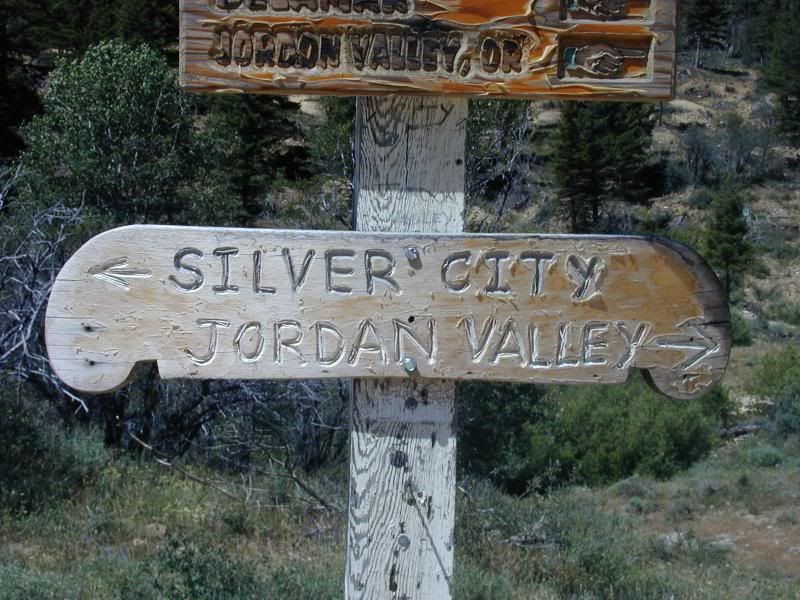
So let's take a tour.  On the right is the sign that tells you how to get there.  I'd advise not to miss the sign.  Oh, wait, there's only one road.  I'd advise you to stay on that road.  If you get lost, you have to pay Owhyee County to hunt for you.  They had to implement this because so many city people got themselves into fixes they couldn't get themselves out of.  Costs mounted and the budget just didn't have room for people's errors in judgment.
These pictures are all taken by my daughter, Mercedes Christesen.  Special thanks to her husband, Rodney, for using his day off to chase after pictures for his mother-in-law.  Yes, you get points for that.
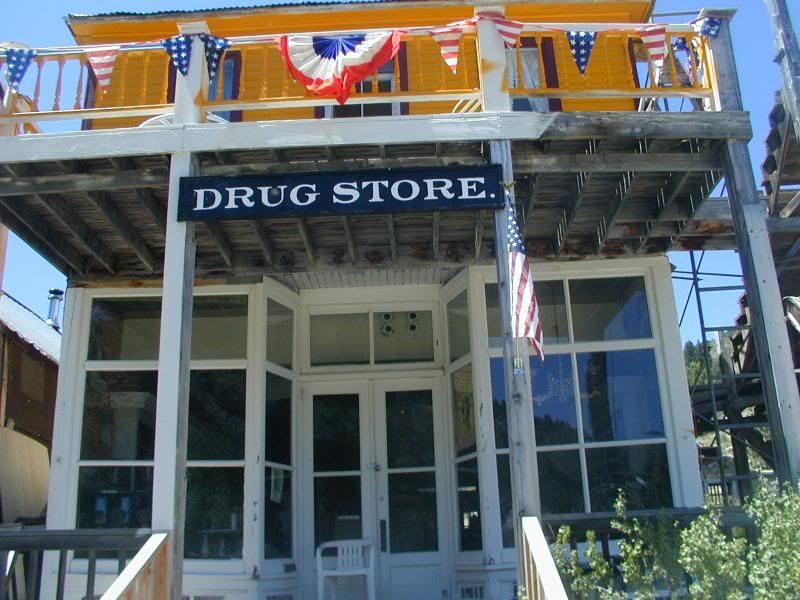
Drug Store
Here's the Drug Store.  She wasn't able to get any history on it, but it was either called the Knapp Drug Store or the Model Pharmacy.  Or maybe it was one and then the other.  I think it's just called the Drug Store now, and not open for business anymore.  It's currently a residence, as are so many former commercial buildings. 
There's an open house the weekend after Labor Day every year.  I've been there--really interesting, and I urge you to go if at all possible.  Make sure your car has decent ground clearance, though, and don't get too worried about the one-lane road (meaning room for only one car) because seldom does a vehicle come from the other direction.  And well, if that happens, someone will have to back up for a mile or two.  It's all fun.
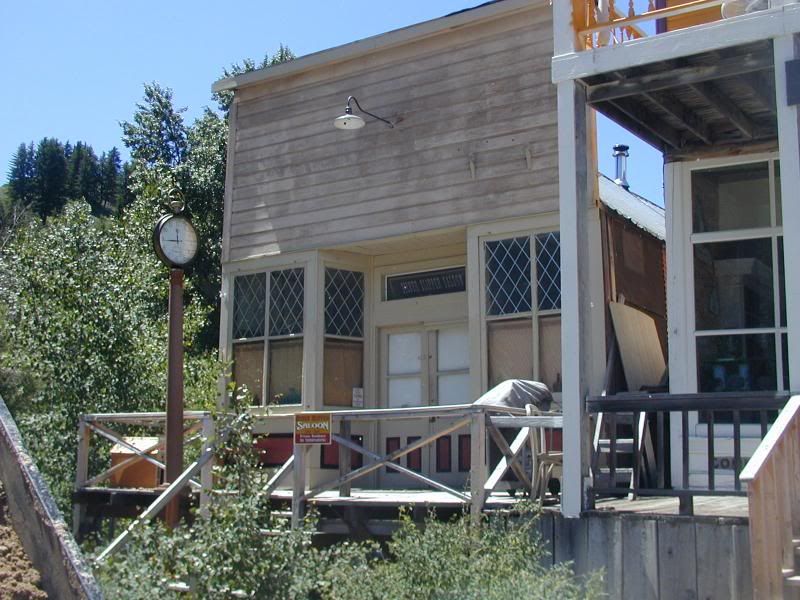
Silver Slipper Saloon
To the right is the Silver Slipper Saloon.  This is a 20th Century saloon, open from 1918 to the early 1940s but it still looks cool so I included it.  Silver City had many, many saloons and of course also had cribs and a street called Virgin Alley where ladies of ill-repute plied their trade.  On Ghosttowns.com, you can see an older photo of this saloon and the drug store above.
Oh yes, there were Cyprians--the ladies of the evening. Men out-numbered women at one point by 200 to 1 so every woman, no matter what her status, was highly regarded. The women, however were not so impressed with one another. From The Owyhee Avalanche, February 26, 1870:
FEMALE PUGLISTS One evening this week be observed two frail females in the vicinity of Catalow's stable, engaged in commintting assault and battery upon each other. For some time the fur flew in all directions. They finally sank down in the snow through sheer exhaustion. Jealousy was the cause of the muss.
Silver City Trivia:
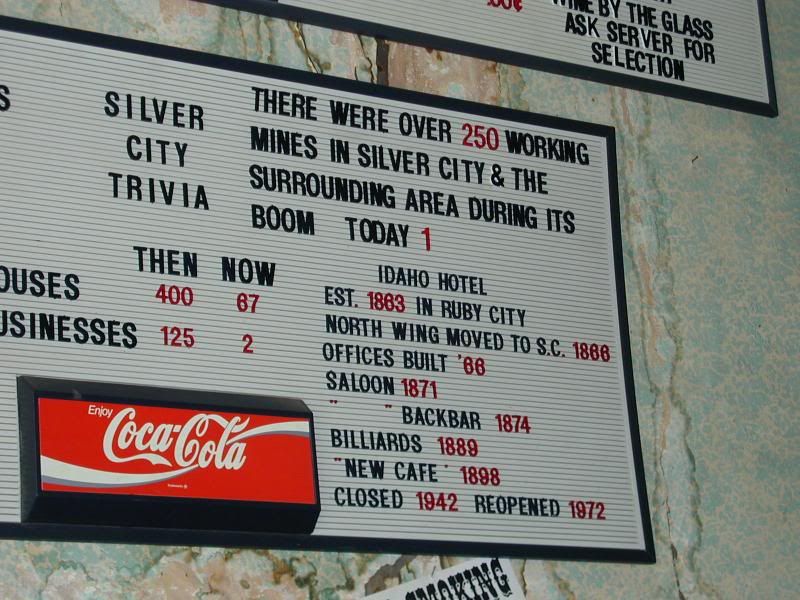
Houses at its peak, 400: now, 67.  Businesses at its peak, 125: now, 2.  Working mines at its peak, 250: now, 1.  This informaton comes from a sign on the menu at the Idaho Hotel.  The building was constructed in Ruby City and moved to Idaho City in 1866.
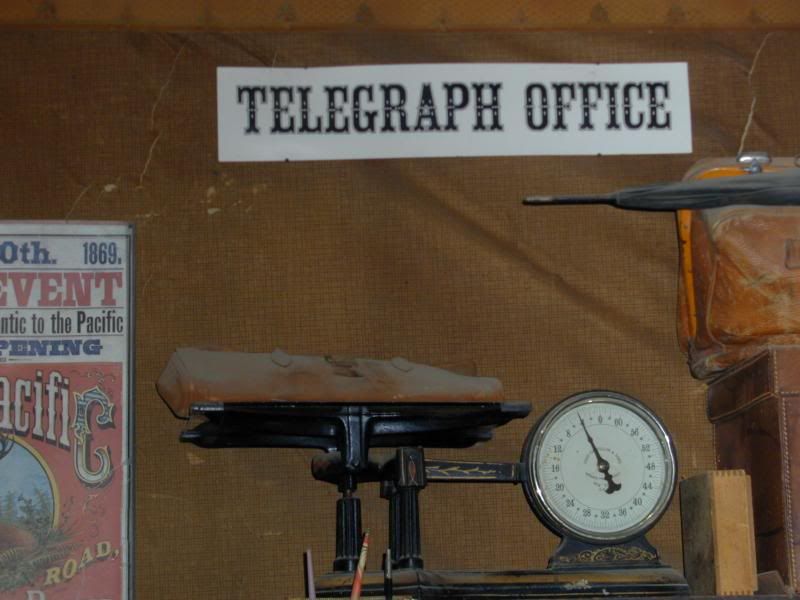
Even though Silver City had telephone service by 1880, the telegraph business thrived for longer distances.
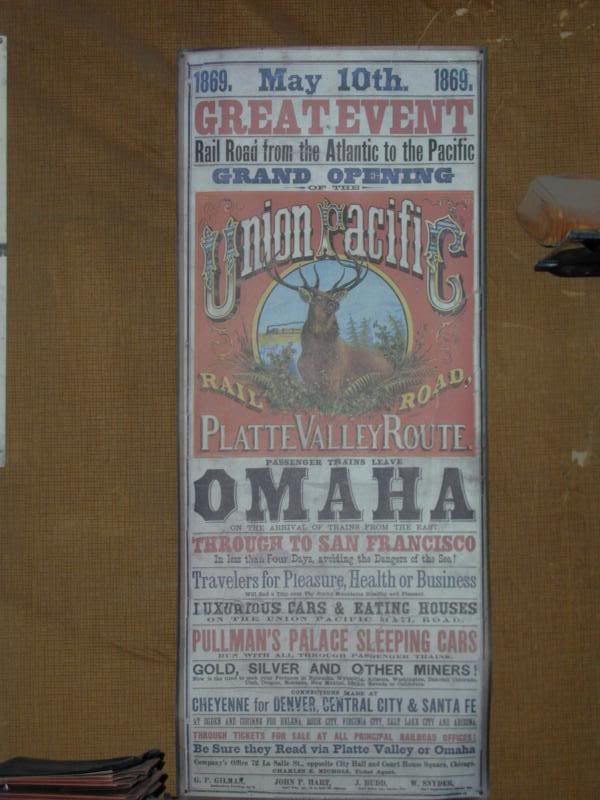
Silver City, Idaho Territory, never did have rail service, but the train service was within a stage ride.  Here's a Union Pacific train ticket:
May 10th. 1869
GREAT EVENT
Rail Road from the Atlantic to the Pacific
GRAND OPENING
of the
Union Pacific Rail Road
Platte Valley Route
Passenger trains leave
OMAHA
on the arrival of trains from the East
THROUGH TO SAN FRANCISCO
In Less than Four Days, avoiding the Dangers of the Sea!
Travelers for Pleasure, Health or Business
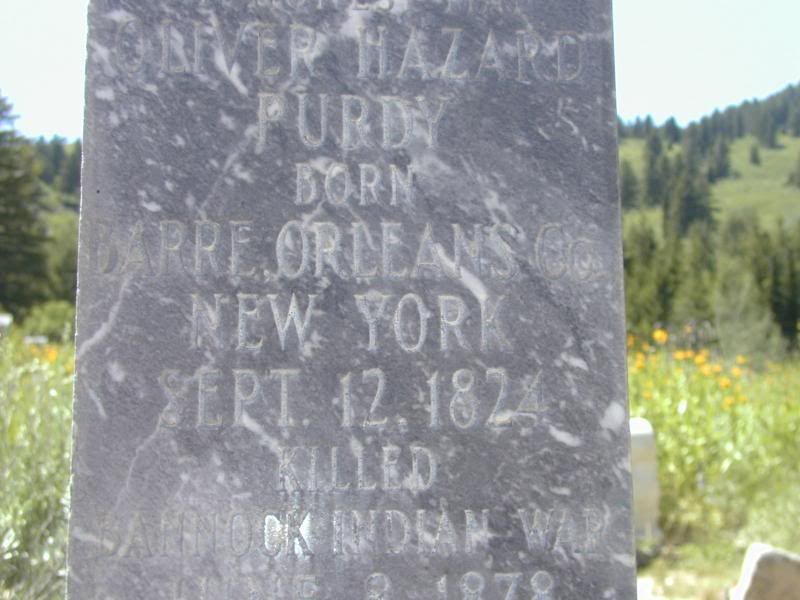
Life was hard in the Old West, especially when you're a couple hundred miles off the beaten path, at over 6,000 feet in elevation.  But this wasn't empty country. A long-standing population of Native Americans from the Bannock and Paiutes were not all that happy about Europeans coming in and ruining their livelihood and cultures.  The next photo is the gravestone of Oliver Hazard Purdy, born September 12, 1824, and killed during the Bannock Indian War in 1879.
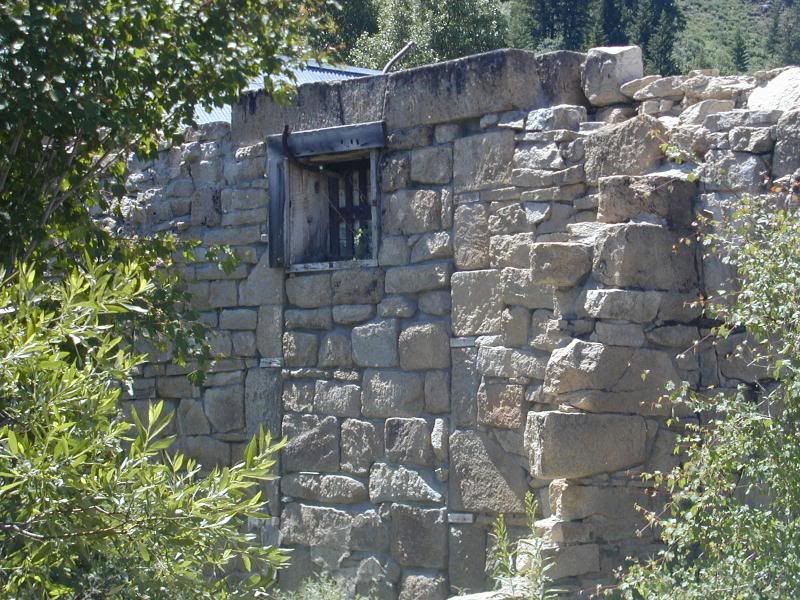
Sometimes bad things happen but instead of dying, the perpetrators were put in jail.  It looks as if this jail wouldn't be too secure these days, but it was formidible in its time.
For more cool photos and accompanying descriptions, I highly recommend EdnaPurviance.org and GhostTowns.com.  You can see the school and the church, too, where services are still held.  The Masonic Lodge is still in good condition and is in use as well.
I'll leave you with the coolest hotel ever.  I mean EVER.  This is the Idaho Hotel that I talked about above (menu board trivia).  Yes, you can still stay there--they have 13 rooms in service (and I've even heard that it's haunted!).  Go to the hotel's website for more cool history about Silver City.
Idaho Hotel, in Silver City, Idaho
The Much Ado series takes place in Owyhee County, and most books are set in or near Silver City because it was the county seat, the largest city in the county (maybe in the territory), and was the hub of activity for a couple decades.
Much Ado About Marshals takes place in Oreana, Idaho Territory, but the pre-story takes place right here in Silver City.  Stay tuned because another book in the Much Ado series, Much Ado About Madams (February 2012), is be set near Silver, in Dickshooter, Owyhee County, Idaho Territory.  No, I didn't make that name up, but I did move it closer to Silver City to suit the story purposes.  The third Much Ado book (June 2012) is set in Henderson Flats (modern day Marsing) and the fourth book, still in the planning stages, will be set in Silver City proper.
Several stories on my backlist are set there, too.  Owyhee County has a rich history and it's fun to share with others.
Where to find Jacquie Rogers:
Would you like to give Much Ado About Marshals a try?  One commenter wins a smashwords coupon for a free copy.  Be sure to include your email address in the comment.  Drawing will be held 19pm Pacific Time, January 31.  Good luck!