
You can't ride for the brand if you don't know what your brand is. Each outfit had a man who kept a brand book and who could identify brands from far and wide. Four-legged critters on the open range can mosey a long way. When identifying a brand, the speaker uses a particular jargon that readers and writers of Westerns innately understand, even if they can't identify those same brands themselves. So let's ride into the world of brands.
Exactly how were brands used?
For everything. We all know about roundups and have read about branding calves with the same brand as their mamas, but brands were also used on horses, mules, fence posts, saddles, and nearly anything belonging to the ranch. Brands were embroidered on saddle blankets, pillows, and hatbands. Now we wear Nike's and American Eagle's brands, but in those days, they were proud of their own ranch's brand. A brand constitutes ownership, the final arbiter. (We'll get to those dern rustlers a little later.)
Were American ranchers the first to brand their livestock?
 |
| Spanish-grant brand 1762 |
Brands were our nation's first trademark system, although branding is nothing new. Egyptian carvings show brands on oxen three millenia BCE. Throughout recorded history, livestock and slaves have been branded using a red-hot iron. The practice was brought to North America by the Spanish conquistadors and later the vaqueros to Texas, then spreading across the North American continent, and on to Australia. Spanish brands were quite a bit fancier than American brands, which used mostly letters numerals, bars, and circles or segments of circles.
How do you read a brand?
Brands are read left to right, top to botton, outside in. The brand of the hero's ranch in my next book, Much Ado About Mavericks (May 2012), is Bar E L, so would look like this
—EL
and read left to right. If the brand had been EL—, then you'd say E L Bar.
—EL
and read left to right. If the brand had been EL—, then you'd say E L Bar.
The heroine's ranch is the Circle J, with a J surrounded by a circle, so read from outside in. If there were two letters, say J O, it would be read Circle J O: outside in, left to right.
This is from Western Brands:
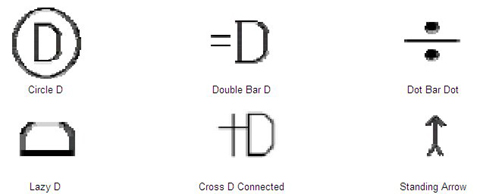
Lazy is a letter laid on its side to the left or right.
Crazy is an upside down letter. Reverse is a backwards letter.
Bar is a dash or line before, after, between, over or under the letters.
Combined is when 2 letters share a common side or upright. (You need a common upright for this one.)
Connected are when 2 letters touch.
Offset is when one letter is slightly lower and to the side of the other.
Hanging is when a letter is hanging from the bottom of another.
Rail is a back slash ( \ ).
Slash is a forward slash ( / ).
Quarter Circle is 1/4 of a circle above, right or left of letters.
Rocking is 1/4 of a circle below letters.
Swinging is 1/4 of a circle above and touching a letter.
Circle is a full circle around 1 letter.
Flying is a set of wings on either side of a letter.
Tumbling is when a letter is leaning left or right

My family's brand is no longer registered to us since none of us are in agriculture anymore, but just to show a typical brand, I made up a crude version it. We called it the Rocking J W, although it is actually a Rocking J W combined, since the J and the W share the same upright. The brand was applied on the left hip. We only branded cattle, not horses.
Some states have the registered brands posted online. Take a look at California or Kentucky. There might be more because I didn't look up all the states. Here are some examples of brands from Richard Beal's Blog:

String up those rustlers!
More than one famous rancher got his start by picking up a calf or two here and there for a long-term "borrow." It was a risky business. Many ranchers thought nothing of stealing cattle in Mexico and driving them north. Of course, the Mexican ranchers did the same thing.
Cattle thievery wasn't confined to the Mexican border, by any means. Men (and a few women) were hanged for rustling in every state in the West (probably in the East, too). Usually when we think of rustlers, it's the fellows who round up herds at night, brand the cattle, and sell them right away. You know—the bad guys.
 The tool of the rustling business was the running iron. This was a straight or slightly curved branding iron that could be used to alter an existing brand or used to make nearly any brand on an unmarked animal. The one pictured here has no handle, so don't get confused.
The running iron was heated and applied "on the fly," meaning the iron was used more to draw the brand on the animal rather than stamping it on. I've read different opinions on whether getting caught with a running iron in your possession would lead to an immediate hanging. Some sites say this tool had legitimate uses. Personally, I think it would be best to leave them home and use your own ranch's brand.
Some good sources:
String up those rustlers!
More than one famous rancher got his start by picking up a calf or two here and there for a long-term "borrow." It was a risky business. Many ranchers thought nothing of stealing cattle in Mexico and driving them north. Of course, the Mexican ranchers did the same thing.
Cattle thievery wasn't confined to the Mexican border, by any means. Men (and a few women) were hanged for rustling in every state in the West (probably in the East, too). Usually when we think of rustlers, it's the fellows who round up herds at night, brand the cattle, and sell them right away. You know—the bad guys.
The running iron was heated and applied "on the fly," meaning the iron was used more to draw the brand on the animal rather than stamping it on. I've read different opinions on whether getting caught with a running iron in your possession would lead to an immediate hanging. Some sites say this tool had legitimate uses. Personally, I think it would be best to leave them home and use your own ranch's brand.
Some good sources:
Eastern Oregon Brand Book (1890), but has 1950s regulations, so not sure when it was published. What's cool about this book is they have pictures of a bazillion brands. Malheur County abuts Owyhee County in Idaho, which is where my books are set, so these brands are especially useful to me.
May your saddle never slip!

♥ Hearts of
Coming soon: Much Ado About Mavericks