Showing posts with label wild west. Show all posts

Friday, September 5, 2025

1887-1961 Hesperia Hotel: Locomotives, Candlelit Nights, and Western Charm


Imagine rolling into the high desert of California on the Atchison, Topeka and Santa Fe Railway. You step off the train and there it is: a three-story, red adobe beauty—the brand-new Hesperia Hotel. With 28 rooms, running water (a serious luxury at the time), and desert views for miles, it must have seemed like an oasis in the middle of nowhere.

The hotel sat on the west side of the railroad tracks, surrounded by 35,000 acres of land that speculators were eager to sell. Newspapers went so far as to call Hesperia “The Denver of California.” Bold claim, right?


A Desert Dream—or Desert Scheme?

The masterminds were Judge Robert Widney and his brother Dr. Joseph Widney, along with Ontario developers George and William Chaffey. They bought up land, gave the settlement a poetic name (Hesperia meaning “western land”), and launched a massive promotion campaign.

The sales pitch promised a desert utopia: broad tree-lined boulevards, shady parks, fine schools, grand churches, healthy air that could cure whatever ailed you, and even riches from mining in the nearby mountains.

The reality? Well… let’s just say some of it was more illusion than fact.


Trickery in the Desert

One of the most famous “sales tactics” involved tricking eager easterners who couldn’t tell a yucca from an orange tree. The promoters literally trimmed up Joshua trees and stuck oranges on the ends of their bayonet-like spikes to give the illusion of flourishing citrus groves.

Still, the developers grand idea did put Hesperia on the map—and today, more than 100,000 people call it home.


The Hotel’s Heyday

Back in its prime, the Hesperia Hotel was more than just a place to sleep. Guests enjoyed modern marvels like hot water, flushing toilets, and speaking tubes for communication. The hotel boasted a spacious dining room complete with a bandstand, a piano bar, and fancy balls in middle of the Mojave.

Once the California Southern Railroad line pushed through the Cajon Pass in 1885, many settlers and tourists came by rail. Victor (later Victorville) became the major stop, but Hesperia snagged its own small depot, drawing curious travelers. By the way, this platform actually could be moved.


The Beginning of the End

For a time, the hotel thrived. But when Route 66 rerouted travelers away from Hesperia, the once-bustling stop faded. The hotel closed its doors in 1926 and, after decades of decline, was torn down in 1974.

Today, nearby Los Flores Ranch lands are filled with tract homes, and the once-grand hotel exists only in photographs and stories.


Why This Hotel Caught My Eye

As a local, I couldn’t resist bringing the Hesperia Hotel back to life in my western time travel novel, Time to Save a Cowboy. It struck me as the perfect meeting place for my time-traveling lovers, Mia and Dusty, before they headed off for the Los Flores Ranch.

For more information click here: https://www.amazon.com/Time-Cowboy-Western-Travel-Romance-ebook/dp/B07K62JGP7


Thursday, June 13, 2024

Western Saloons – More than just drinking dens

The flickering glow of oil lamps casts dim light on a long wooden bar and the faded advertisements hanging on the walls. Tobacco smoke forms crooked halos above the heads of men gathered around rough-hewn tables and mingles with the pungent odor of sweat and unwashed bodies. Ruggedness, camaraderie, and a hint of danger linger in the air.

That’s often what comes to mind when we picture a 19th century saloon, but the ambiance and appearance of saloons in the Old West could vary widely, depending on factors such as location, clientele, and the preferences of the owner. That said, they generally fell into two broad categories: relatively upscale (and even luxurious) or plain and utilitarian.

In larger cities with affluent populations, some saloons aimed for a classy atmosphere. These establishments often featured elegant furnishings, such as polished wood bars, brass fixtures, and plush seating. Decor could include ornate mirrors, elaborate chandeliers, and decorative wall hangings. Upscale saloons often invested in finer glassware and serving vessels and may have employed well-dressed bartenders and waitstaff to cater to a more discerning clientele.

In smaller towns and rural areas, saloons tended to be simpler and rustic in appearance. They were often housed in basic wooden buildings with little in the way of decoration. The bar might be a simple wooden counter. Lighting was typically provided by oil lamps or candles, contributing to a dim and sometimes smoky interior. These saloons prioritized function over form.

Regardless of their level of fanciness, cleanliness and hygiene standards in 19th-century saloons could vary widely. Some saloon owners took pride in maintaining a sanitary establishment, while others were less diligent in this regard. Factors, such as the availability of clean water, played a role in determining the cleanliness of a saloon.

Despite their differences in appearance, saloons of all kinds shared certain common characteristics. They were typically loud, bustling places filled with the sounds of conversation, laughter, and occasionally music. Smoke from cigars and pipes often hung in the air, contributing to the distinctive ambiance of the Old West saloon. Regardless, saloons were important social hubs where people from all walks of life came together to drink, socialize, and unwind.

Even though the primary function of a saloon was to serve alcohol, 19th-century saloons offered a wide range of services beyond just that. Saloon owners stocked a variety of drinks to cater to different tastes and preferences. Many also served food, ranging from simple bar snacks to more substantial fare, such as sandwiches, stews, and chili. While the quality of the food varied depending on the establishment, it provided patrons with sustenance to accompany their drinks.

Some saloons offered rooms for rent upstairs or in adjoining buildings. These accommodations were often basic, with little more than a bed and a wash basin, but they provided travelers with a place to rest for the night.

In the absence of formal banks in many frontier towns, saloons sometimes acted as makeshift financial institutions. Patrons could cash checks, exchange currency, or even secure loans from the saloon owner. Some saloons also offered safe deposit boxes where patrons could store valuables. Some saloons served as informal post offices or communication centers. Travelers passing through town could leave or pick up messages, letters, or packages there. Additionally, telegraph lines were sometimes connected to saloons, allowing for long-distance communication.

Saloons often doubled as meeting spaces for various community groups, such as fraternal organizations, political clubs, or business associations. These gatherings provided opportunities for networking, organizing, and socializing outside of regular business hours. Many were lively entertainment venues. Piano and guitar music were common, as were stage performances of singing, dancing, and comedy acts. Games, such as Faro, billiards and darts, were popular forms of entertainment.

Some saloons crossed the line from lively to dangerous. Take the Long Branch Saloon in Dodge City, Kansas. According to the Legends of America website, it lived up to the Wild West image. “Back in the 1870’s [around the time the saloon was built], Dodge City began to acquire its infamous stamp of lawlessness and gun-slinging. Without local or military law enforcement, buffalo hunters, railroad workers, drifters, cowboys, and soldiers scrapped and fought, leading to the shootings where men died with their boots on.”

Overall, saloons in the 19th century were multifunctional establishments that provided a range of services to their patrons, catering to their social, recreational, and practical needs. And they were surprisingly plentiful. In 1883, though it had only 3,000 residents, Livingston, Montana had 33 saloons!

Some Wild West saloons are still open for business today. 

Have you ever visited one?

###

I revealed the cover of my next book last week! Did you miss it?

If you don't follow my author blog or subscribe to my newsletter (you get a free book when you do), you likely did.  

To see it, click here.

Thanks for stopping by!


Monday, July 18, 2022

For the love of Romance

Once upon a time.....
 
That is how it all begins. We first fall in love with fairy tales and happily ever after. Our love for story telling grows into "it was a dark and stormy night". 
From fairy tales we branch out to our favorite genre. Mystery, Paranormal, Romance, and more. I fell in love with romance. Western romance specifically.


The very first romance book I read was Apachee Caress when I was about 12. Took it from my mom's shelf and snuck to my room to read it. Loved it. And I read the rest of Georgina Genty's Panorama of the West Series.


  Do you remember your first romance book? Share in the comments.

Then came Betty Brooks. I loved her books as well and read them all. (Exept one that I am searching for)

Then I discovered Victotia Thompson and Jodi Thomas. And my own desire to write took over. I was passionate about telling stories of strong people in the Wild West.


What I loved most about these authors and the way they wrote their books is that they all tie together in some way. Characters from other books appear throughout the series. Each title is a stand alone but reading them in order gives the sense of knowing the characters on a deeper level. Several authors added Paranormal elements to their books and I loved it. My books all tie together and many have paranormal elements.
    These amazing authors were my inspiration to start my own writing.
    I've read many, many books since those teenage years, but those books published over 30 years ago are still my favorite ones. I have every book of every series (except that one elusive Betty Brooks book) on my shelves in my office. A constant reminder of my original inspiration. 


      Outlaw’s Redemption is the first book in the Wild Love Series. The second generation of my Rimrock characters. The families of the Rimrock Series span three generations so far. I love the familiarity of the characters I’ve spent the last 25ish years writing about.


Tuesday, July 12, 2022

Luke Short, Wild West Bad Man?

 Post by Doris McCraw aka Angela Raines


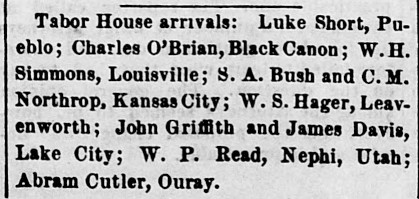
I've been reading "Famous Gunfighters of the Western Frontier" by W.B. (Bat) Masterson, written in 1907 as a series of articles for the 'Human Life Magazine'. One of the men he wrote about was Luke Short. Since Mr. Short had been in Colorado, I thought it might be interesting to share some of the articles the older newspapers shared about him. Below are three such pieces. 


The Gunnison Daily New-Democrat Jan 21, 1882
(Gunnison, CO)


The Meeker Herald July 3, 1886 (Meeker, CO)


Luke Short
photo from Wikipedia


The Herald Democrat December 25, 1890 (Leadville, CO)

What I find so fascinating is how these 'gunfighters' are portrayed. I can just imagine doing a biography and deciphering truth from fiction. 

Luke Short, in fact, died in 1893 from what would now be called nephritis, a kidney disease, at the age of 39. 

The one thing that is clear, Mr. Masterson seemed to think highly of Short and what he'd accomplished in his short lifetime. He was impressed with Short's change from a 'white Indian' as a young man to a well-educated, well-spoken man at the time of his passing. 

Until next time, happy reading and writing.


Doris McCraw


Monday, February 21, 2022

Welcome to Rimrock, Wyoming.


    Hello all, I hope everyone is having a fantastic February. We all know that February is best known for romance, and who can resist a good romance story. I never could. Though I loved reading, I had a desire to write my own love stories. So eventually I did.
    First, I needed a setting. Second, great characters. I randomly chose a name for the town, (I was around sixteen at the time) and it stuck. Rimrock is a fictional town set in the wilds of Wyoming and the people there all have a story to tell.
   After discovering romance books and falling in love with them, I wanted to start writing my own books. It started when I was a junior in high school with the idea for one book. Then three books. Then five books. Over the years, I fell in love with my characters and the supporting characters and decided that their stories needed to be told as well. There were three main families in the town that kept growing and growing. Soon I was writing books about their children and grandchildren.
    Rimrock itself started with a few settlers but over the years grew into a bustling town and a stop for the railroad. The train brought more interesting characters to the town, and they had their own story to tell. Each book is a standalone, but they have reoccurring characters.


The first two Rimrock books are finished and I'm excited to get more finished. This series is about the original settlers of Rimrock. Full of romance, fighting to survive on the harsh land, defending loved ones against danger, mystery, and even a little magic. 
The Wild Love Series is about the second generation of the Rimrock families. The first three books are finished, and I can't wait to get the rest finished. 
    

Connect with T.K. Conklin

Friday, February 12, 2021

The Wild Woman Sculptor of European Elite & Texas Heroes

Sculpting Austin and Houston in Texas

By Jacqui Nelson

Life can take us down many paths. How does a German stone carver's daughter go from sculpting the European elite to sculpting Texas heroes? First came tenacity, then talent, then tuberculosis. 

Around the turn of the 19th century, the tuberculosis death rate worldwide was estimated at 7 million people a year, so tuberculosis definitely could be a life-changer. Even though Elisabet Ney never had tuberculosis, it resulted in her leaving her birthplace of Germany and eventually living in Texas sculpting Stephen F. Austin and Sam Houston. 

Franzisca Bernadina Wilhelmina Elisabeth Ney
( born 1833 in Münster, Germany ) 

Elisbet Ney

Elisabet (the spelling without the "h" seems to be the name most often used when referring to her by one name) grew up assisting her father in his stone-carving business. When her parents later opposed her becoming a sculptor, she went on a hunger strike. That's tenacity. 

Statue of King Ludwig II of Bavaria
King Ludwig II
In 1852, Elisabet became the first female sculpture student at the Munich Academy of Art under professor Max von Widnmann. 

In 1857, she set up her own studio in Berlin and sculpted portraits of philosopher Arthur Schopenhauer, composer Richard Wagner, folklorist Jacob Grimm, Chancellor Otto von Bismarck, General Giuseppe Garibaldi, King George V of Hanover, and King Ludwig II of Bavaria. That seems like a dual talent: getting the job done and pleasing those elite figures.  

In 1853, Elisabet met Edmund Montgomery, a Scottish medical student, scientist, and philosopher. They kept in touch and, although she viewed the institution of marriage as a state of bondage for women, she married Edmund in 1863. 

Marriage did not change Elisabet's views on the role of women. She refused to take her husband's name, chose to wear trousers and a black artist frock coat, and rode horses astride. 

What changed Elisabet—at least as far as where she went next—was tuberculosis. The same year that she was married, her husband was diagnosed with the deadly disease. 

In 1871, Elisabet and Edmund immigrated to the United States to join a colony in Georgia that was promoted as a healing resort for those afflicted with tuberculosis. When that didn't work out, they searched for a new home. Elisabet traveled alone to Texas to see the Liendo Plantation in Waller County. When her husband was finally able to join her, they purchased the plantation. 

For the next ten years, Elisabet concentrated on running the plantation and raising a son while her husband focused on his research. Only in the early 1880s, did Elisabet restart her artistic career—after being invited to Austin by Governor Oran M. Roberts.

In 1891, the Chicago World's Fair Association's Board of Lady Managers commissioned Elisabet to create life-size marble figures of Sam Houston and Stephen F. Austin for the Woman's Building at the 1893 World's Columbian Exposition World's Fair. 

Austin & Houston sculptures
Stephen F. Austin and Sam Houston

Despite the supplement of $32,000 from the Texas state legislature, Elisabet missed her deadline and the Houston and Austin sculptures couldn't be shown at the Exhibition. They can now be seen in the Texas State Capitol in Austin and in the National Statuary Hall Collection in the U.S. Capitol in Washington, D.C.
 
Elisabet kept sculpting and died in her Texas studio in 1907. 

Elisabet Ney in her Texas studio
 
Elisabet Ney traveled far and immersed herself in several careers, but she always came back to sculpting. Writing, I think, is like sculpting or painting or any creative endeavor. People start with a blank page or block of stone and shape something (after heading down a creative path) that other people will hopefully connect with. 

If you'd like to see where my creative endeavors have taken me, head to MY BOOK PAGE on my website where you'll find links to read excerpts from (and view picture inspiration boards for) all of my stories. 

~ * ~

Jacqui's author photo
Download MY FREE STORY Rescuing Raven (Raven & Charlie's story in Deadwood 1876) 

Read more of my 
Join me on 
Follow me on 

Friday, January 8, 2021

The Wild Woman Sculptor of President Lincoln

The 17-year-old who Sculpted Abraham Lincoln
By Jacqui Nelson

Happy New Year...one week after the day! The start of a New Year (or even the start of a new month or week) is a great time to make resolutions or create lists of dreams/goals we want to achieve. I believe that planning how I will achieve my dreams/goals is essential. So is embracing (as much as I can without exhausting myself completely) the mindset of a go-getter. 

What or who is a go-getter? Well, I think Vinnie Ream definitely was one. Read on and be inspired (as I was) by the go-getter who was the daughter of a land surveyor but still found a way to sculpt Abraham Lincoln when she was only seventeen...

Lavinia Ellen "Vinnie" Ream
( born 1847 in Madison, Wisconsin ) 

As a child, Vinnie Ream moved frequently due to her father's job as a land surveyor. When she was seven, her family moved to Kansas, and she was sent to school in St. Joseph, Missouri. Three years later, she attended Christian College in Columbia, Missouri. In 1858, she rejoined her parents in Fort Smith, Arkansas. 

In 1861, her family moved to Washington, D.C. in search of new employment. As her father's health continued failing, Vinnie started working to support her family. 

She was one of the first women employed by the U.S. federal government. From 1862 to 1866, she processed undeliverable mail in the U.S. postal system's dead letter office. She also sang in church and in hospitals and spent the rest of her time studying statues at the U.S. Capitol and in public squares—while dreaming of becoming a sculptor.

Vinnie with her bust of Lincoln

In 1863, she used a contact from her Christian College days (who was now a U.S. Congressman) to gain an introduction to the sculptor Clark Mills. The following year, at the age of seventeen, she became an apprentice in Mills' studio.

That same year, President Lincoln agreed to model for her in the mornings for five months. During this time, she created a bust of Lincoln's figure and also (as a marketing strategy) sold photographs of herself and solicited newspaper attention.

A year later in 1865, she became the youngest artist and first woman to receive a commission from the U.S. government for a statue. She used her bust of Lincoln as her entry into the selection contest for a full-size statue of Lincoln. 

Significant debate ensued over her selection due to her inexperience and the slanderous accusations that she was a woman of questionable reputation—known for her beauty, conversational skills, and zest for public relations.

In 1871 when she was 23 years old, her Carrara marble statue of President Lincoln was unveiled in the U.S. Capitol rotunda. 

Vinnie and her Lincoln statue

In 1875, George Armstrong Custer sat with her for a portrait bust. In 1876, she exhibited at the Centennial Exposition. In 1877, she produced a model for a Lee statue in Richmond. And, after lobbying William Tecumseh Sherman and Mrs. Farragut, she won a competition to sculpt Admiral David G. Farragut. 

She designed the first free-standing statue of a Native American (Sequoyah, the inventor of the Cherokee alphabet) to be placed in Statuary Hall at the Capitol. The town of Vinita, Oklahoma (established by the Cherokee attorney and politician, Elias Cornelius Boudinot) was named in her honor. 

Yup, Vinnie Reams definitely is my idea of a go-getter. Of course, going after (and getting) what you want helps if you have the gift of the gab, which it sounds like Vinnie definitely had as well. 

I'd love to hear your dreams/goals for this year. Hope you'll share ❤️

Three of my dreams/goals for 2021 are... 

1) take a walk at least every second day, so that (if the world allows) I can go on the Kenya/Tanzania safari camping trip (I had to postpone last year) and be fit enough to really enjoy it 

2) let go of what I can't control (just say no to negative thoughts) 

3) keep my mind focused on finishing writing my story-in-progress, A Bride for Griffin ðŸ™‚

~ * ~

Jacqui's author photo
Download MY FREE STORY Rescuing Raven (Raven & Charlie's story in Deadwood 1876) 

Read more of my 
Join me on 
Follow me on 

Friday, August 14, 2020

The Wild Woman Lawyer who made history in Tombstone

 Practicing law in lawbreaking Tombstone. Wild Woman Lawyer

By Jacqui Nelson


Towns like Tombstone have histories full of gunfighters and gamblers, but what about lawyers? With all the lawbreaking going on, there must have been a few law practitioners. In fact, during its heyday, Tombstone had more attorneys than any other city in the Arizona Territory. 

One of them was Sarah Herring Sorin, a New York City native who traveled to Tombstone with the intention of becoming a teacher. She accomplished that swiftly and thoroughly. She taught in Tombstone for ten years. She also became the first woman admitted to the Arizona Territory Bar and the first woman to argue on her own before the U.S. Supreme Court. 

Sarah Herring Sorin  
( born 1861 in New York City, NY ) 

Sarah attended high school, earned her teaching credentials, and taught school in New York City. In 1882, she moved to Tombstone to join her family. 

Four years earlier, her father (who’d been a successful lawyer in New York) had traveled to Arizona to settle an estate but then stayed to try his hand at mining before finally settling on opening a law practice in Tombstone. 

Sarah’s father was Wyatt Earp's attorney during the trials for the 1881 shoot-out at the O.K. Corral. Earp was acquitted of murder, but due to the volatile and polarized atmosphere surrounding all of these events, Sarah's father had to be armed at all times (even in the courtroom) and was often under the protection of hired gunmen.

Sarah steered clear of the rowdy areas of Tombstone with saloons and entertainment businesses like the infamous Birdcage Theater (where Doc Holliday, Virgil Earp, Wyatt Earp, and Morgan Earp could be found). Instead, she focused on being the first woman schoolteacher in Tombstone. She taught here for ten years while also sometimes serving as the school librarian and principal. 

Sarah’s sister and brother worked at their father's law firm as an assistant and attorney respectively. Tombstone had more attorneys than any other city in the Arizona Territory. 

Tombstone around 1881

In 1886, the water levels in Tombstone's mines rose (due to seepage) and ruined their potential for mining. Many people left town, but Sarah's family stayed. She enjoyed teaching, and her father's law firm still thrived. 

In 1891, Sarah's brother died during a dental procedure at the age of 27. Sarah decided to take her brother’s place in her father’s law firm. Two years earlier, a census listed only 208 women in the U.S. as attorneys.

She applied for a license to practice law and unanimously passed her oral examination in open court. After being admitted to the Bar, she went to New York University's School of Law. NYU was one of the first law schools in the U.S. to actively recruit women. 

In 1894, Sarah graduated with an L.L.B. and a rank of fourth in her class of eighty-six graduates. She returned to Tombstone to practice law in her father's firm. 

In 1896, she represented a mining company in her first case before the Arizona Supreme Court and won. Ten years later, she became the 24th woman to be admitted to the U.S. Supreme Court. 

In 1913 during her fourth case before the U.S. Supreme Court, Sarah became the first woman to argue a case unassisted and unaccompanied by a male attorney. The written brief presented to the court was solely in her name. The final arguments were hers.

Sarah was admitted into the Arizona Women's Hall of Fame in 1985. And in 1999, the Arizona Women Lawyers Association created an annual award in her name. 

~ * ~

Sarah Herring Sorin was an inspiration both during her lifetime and afterward. She left an intriguing legacy for us to discover today. Stories like hers are one of the many reasons why I love history.

How about you? Got a favorite historical profession or person? Hope you’ll share with us because if we all share what inspires us, then we can inspire each other. 

~ * ~

Jacqui's author photo
Read more of my Cowboy Kisses Wild Women blog posts 

Join me on… 
Follow me on… 

Don't forget to download my FREE story Rescuing Raven (Raven & Charlie's story in Deadwood 1876) 

Friday, July 10, 2020

The Wild Woman who entered a burning building to save plants

Historic Adventures in Collecting and Cataloging with Alice Eastwood

By Jacqui Nelson

Prepare to get flowery or...plant-y! I love flowers, plants, trees, and— Well, maybe I should just say, I love botany. And I also love reading about real-life Wild Women of the West who pursued their love for botany ❤️

Alice Eastwood was one of those women. She lived in Canada, Colorado, and California...traveled from Alaska to Arizona to collect plants...and even entered a burning building to rescue her collection.

~ * ~

Alice Eastwood  
( born 1859 in Toronto, Canada ) 

Alice Eastwood in 1910
Alice in 1910
In 1873, Alice moved with her family from Canada to Denver, Colorado. Six years later, she graduated as valedictorian from Shawa Convent Catholic High School. For the next ten years, she taught students at Shawa instead of pursuing her own college education. During this time, she taught herself botany by reading publications such as Grey's Manual and The Flora of Colorado.

In 1887, her growing reputation in botany led to her being suggested as the only person in Denver who could competently guide Alfred Russel Wallace up Grays Peak to collect alpine flowers. Wallace was a seasoned explorer and talented naturalist from England who independently conceived the theory of evolution through natural selection and then jointly published it with Charles Darwin. 

Alice was a publishing powerhouse in her own right. She published over 310 scientific articles and authored 395 plant species names (the fourth-highest number of such names authored by any female scientist). Seventeen species are named for her as well as the genera Eastwoodia (in the sunflower family) and Aliciella (in the phlox family).

In San Francisco, Alice not only built the California Academy of Sciences’ botanical collection but saved it during the 1906 earthquake. Ignoring her era’s curatorial conventions, she stored her specimens by type and not scattered throughout the main collection. This system allowed her to enter a burning building and swiftly retrieve nearly 1500 of her specimens.

California Academy of Sciences in 2008

Alice continuously added to the California Academy of Sciences’ collection by going on numerous plant collecting vacations in Alaska, Arizona, Utah, and Idaho. From 1891 to 1894, she worked at the Academy as an assistant and then a joint curator. After 1894 and until her retirement in 1949, she served as its Head of the Department of Botany.

~ * ~

Wow! That’s a busy life. Tending the germanium “jungle” on my balcony (and strolling by the beautiful gardens in my neighborhood) is as much as I feel I’m capable of doing at the moment. But if I could go on a plant exploration trip with someone like Alice, I’d jump at the chance.

How about you? 
Would you venture far from home to collect plants? 

And if you know a present-day botanist like Alice (who likes to guide people to see plants), then let me know. One day soon, I'm hoping to go beyond my germanium “jungle” and explore the vast world of plants...like a Wild Woman of the West ðŸ¤ 

~ * ~

Jacqui's author photo
Read more of my Cowboy Kisses Wild Women blog posts 

Join me on… 
Follow me on… 

Don't forget to download my FREE story Rescuing Raven (Raven & Charlie's story in Deadwood 1876) 

Friday, June 12, 2020

The Wild Woman who made History with a Mountain, a Flower & More


By Jacqui Nelson

Can you imagine having a mountain named after you? Or being responsible for a flower becoming a state flower? Sara Plummer Lemmon accomplished both feats with no formal training in botany. Here's how she made history...

~ * ~

Sara Plummer Lemmon 
( born 1836 in New Gloucester, Maine ) 

Sara in 1865
Sara was educated at the Female College of Worcester in Massachusetts, taught art in New York City, and served as a nurse during the Civil War.

In 1869 (after becoming ill and hearing that California’s weather could help one’s health), she moved to Santa Barbara.

She established the Lending Library and Stationery Depot and charged $5 membership or 10 cents for borrowing books, sold art and music supplies, hosted lectures and exhibits, and while out walking acquired an interest in botany and began painting botanical illustrations.

In 1876, she met John Gill Lemmon (a Civil War veteran, former Andersonville prisoner, and fellow self-trained botanist) while he was giving a lecture.

In 1880, they married and honeymooned in Arizona’s Santa Catalina Mountains where they cataloged a number of species unique to the mountain. Sara was the first white woman to ascend the mountain's tallest peak and it was named Mount Lemmon in her honor.

Sara & John camping during their honeymoon on Mount Lemmon
(photo LocalWiki Contributors)

Mount Lemmon, Santa Catalina Mountains, Arizona

Sara and John continued traveling and cataloging botany but also developed the Lemmon Herbarium at their home in Oakland (which they later donated to UC Berkeley). 

In 1882, Sara discovered a new genus of plants called Plummera floribunda. From 1888–1892, she worked as the California State Board of Forestry’s official artist. In 1893, she lectured on forest conservation at the World’s Columbian Exposition in Chicago.

During the 1890s, she advocated for the adoption of the golden poppy as California’s state flower and wrote the bill eventually signed by the California Legislature in 1903.


I love California/golden poppies! ❤️ 

I see them everywhere here on British Columbia's southwest coast. I also remember them from the farm in Alberta where I grew up. They are an old and dear friend.


What's your favorite state or provincial flower?

Here are the lists of America's state flowers and Canada's provincial flowers (plus more).

I love the wild rose which is the provincial flower of Alberta and (which I've just learned while researching this blog) is the state flower of North Dakota and Iowa too!

Although, scientifically I guess they are different...or at least they would be to a botanist like Sara who'd call them Rosa arkansana and Rosa acicularis. Attention to details like this is probably why she got a mountain named after her 🙂

~ * ~

Jacqui's author photo
Read more of my Cowboy Kisses Wild Women blog posts 

Join me on… 
Follow me on… 

Don't forget to download my FREE story Rescuing Raven (Raven & Charlie's story in Deadwood 1876)