by Patti Sherry-Crews
"Deliver us from the evils of the dress!" --Annie Jeanness-Miller
 |
| Union Suit |
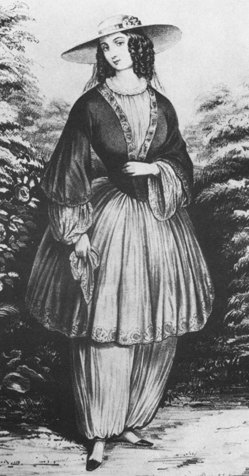
Have you ever looked at photographs of Victorian-era women climbing mountains and wondered how in the world did they manage such strenuous activity wearing those clothes? As ridiculous as those outfits look to us today, the attire available to the active women in the mid 19th century was far less cumbersome than previously, thanks to Annie Jeanness-Miller and other pioneers of the Dress Reform movement.


To put the call for dress reform in context, let's first look at what women were expected to wear earlier. Desired silhouettes changed from time to time, but in the early part of the 19th century, the ideal woman had a teeny, tiny waist and full hips. What nature did not provide, artfully constructed clothing did. Women's undergarments were so many and complicated that a lady sometimes needed assistance to dress herself. The first layer of clothing were bloomers. Next came the chemise. So far not so bad. But then the fashion victim had to be squeezed into a corset which laced in the back (we all have that scene in our heads right now of Scarlett O'Hara, who has been starving herself all morning in preparation for the big party, holding on to a bedpost while Mammy stands behind her lacing her corset--admit it, that's what you were thinking of).

Bloomers, chemise, and corset, but that's not all. We're not dressed yet. Before she could slip into her dress, the lady still had to put on a crinoline to hold the shape of a hoop skirt, and over that were several petticoats. And when it was in fashion, the bustle gave the lady the desired S-shaped profile. Now, go climb that mountain, girl!
Then out of the White Mountains of New Hampshire came Annie Jeanness-Miller, and she was having none of it. Annie, who was related to Oliver Wendell Holmes, was a lecturer and a so-called Women in Letters of the time. In addition to dress reform for women she educated the public on other topics such as social justice and the prevention of disease by using proper hygiene.
Annie felt that restrictive clothing, including enormous hats, put women in a subservient position to men. Her goal was to emancipate the waist! To accomplish this, she published a magazine called Dress and sold patterns for more sensible outfits. Outfits a woman could climb a mountain in. Or go yachting--or play a game of lawn tennis. She even designed a business suit and patented athletic wear for women.
Earlier attempts at dress reform weren't successful but what Jeanness-Miller got right was to stay within the norms of contemporary fashion, so in outward appearance there was nothing radical in her designs. She also included beautiful touches like eyelet lace and ribbons, so her line still had feminine appeal.
The first strike in her war against the corset was the Union Suit (different from Long Johns which are comprised of separate top and bottom. Union Suit meaning the union of top and bottom), and yes it had the "trapdoor." The garment fitted to a women's natural shape and could be made from various material like silk or wool depending on the season. This undergarment eliminated bulky fabric, allowing for more natural movement.
"With the Union Suit all of this is obviated, and a woman becomes a dainty object where formerly she looked as if wrapped in yards of meaningless stuff."--Annie Jeanness-Miller
Next, the Chemilette was worn over the Union Suit to replace the corset.
 |
| Chemilette |
And finally came the Model Bodice and the Turkish Leglettes. Notice the exotic names she called her pieces. Annie had quite the flair for marketing.
 |
| Turkish Leglettes and Model Bodice |
Of the Turkish Leglettes she reasoned, "Why not a divided garment for clothing women's legs as well as a man's? Nothing in their anatomical construction would suggest any other conclusions; and why, then, clothe them differently when by so clothing them, freedom and grace of movement are both sacrificed."
And furthermore, "The Turkish Leglettes are a great improvement over the petticoat, because they are designed with special regard for the legs. They clothe each separately, and for this reason are much warmer than the petticoat, under which the air circulates freely. Each leg lifts its own weight in walking, so that very great resistance at the ankle and knee from the petticoat is gotten rid of, and in wet weather they do not get dragged and soiled as do the petticoats."
The Union Suit proved to be such a practical garment that men picked up on it. Picked it up to such an extent that now when we think of the Union Suit, we generally picture a rugged manly type chopped down a tree or something in red long underwear. Red, by the way, became and still is the most popular color. Why red? Because if a man were to find himself in some distress out in the wild he could strip down to your alarm-red underwear for better visibility.
In my historical novels I like the get my heroines out of their corsets as soon as possible.
Here is an excerpt from my upcoming historical western romance, His Unexpected Companion.
Excerpt:
Forget about leaving town at an early hour. He spotted an alley he knew would lead him to the hotel by way of a shortcut. If the store had delivered his supplies and the livery stable had brought around his horse, he could be on his way in a short time.
At last things were falling into place and it looked like a perfect day for traveling...except that woman kept intruding on his thoughts. He worried about her survival in the wild, and that was assuming she could even get out of town unmolested.
Turning down the alley his heart leaped into this throat. There half way down the alley, crumpled into a ball by piles of trash was a sight familiar to him. Green dress! Oh, my lord, no!
He raced down the length of the alley to the form on the ground. As he reached it, something brushed by his shoulder and landed on the ground. A corset!
Looking up, he caught a quick flash of a person...a person who appeared to be not wearing clothes. The figure reappeared again, and he recognized the woman. She waved something out the window and a pair of bloomers floated down toward him. At his feet sat a growing pile of clothes, including the dress she wore last night. He tilted his head back again to be met with the sight of her, half crouched below the window, her mouth frozen into a perfect “O”. She slunk back inside but he heard laughter.
Completely scandalized, he walked away quickly but with dignity.
This woman was clearly insane.
<><><><><><><>
Olivia had to laugh at the expression on his face. She left him with a puzzle today!
Too bad he was such an old fuddy duddy because he was a good-looking man. Just her sort, really. Tall and lean with lovely auburn hair. The first time she saw him sitting in the restaurant with his hair carefully combed back with pomade, he arrested her attention. He had the kind of hair she liked to muss up and see flopping over his forehead.
Of course, she didn’t have to throw her clothes out of the window. But she sure wasn’t going to take up valuable room in her saddle bags with dresses she had no use of. Besides, she hated them. Watching the garments land in the alley had been the most fun she’d had in months. Picked out for her and bought by somebody else and now so much trash.
Shedding her skin as it were, she now stood naked as the day she was born. Time to grow a new skin. She gathered her purchases from today and slipped into her new clothes.
The image reflected back to her in the mirror pleased her. The men’s clothing didn’t exactly hide her womanhood but it helped. And wearing pants was so much more comfortable. Nothing more restrictive than lady clothes. It had been especially good to get shot of that device of torture known as a corset. She took in a deep breath, enjoying the way her body expanded to its natural boundaries.
She swung her long hair over her shoulder and plaited it into one braid, which she coiled on top of her head and fixed with pins.
Before leaving her room for the last time, she crammed the hat over her head and judged the effect in the mirror again. Unrecognizable. Anyone coming after her would have their work cut out for them.
About His Unexpected Companion:
Kit Traver, dissatisfied with his life practicing law in Boston, is returning home to Leadville, Colorado and looking forward to a simpler life--where he's all but formally engaged to a girl back home he's been corresponding with. Olivia Darling has found living on the run with an outlaw is not what she imagined. All she wants now is to return to her family's ranch.
When both Kit and Olivia find themselves on the same trail heading to their respective homes, the unlikely duo join forces. Kit fights his growing attraction to Olivia who has her own reasons for inciting his passion. When she pushes him too far, the two end their journey on a sour note.
Back in Leadville, Kit finds things much the same. Only he finds he's the one whose changed. Olivia returns to the ranch to find home for her as altered forever. Kit can't stop thinking about the unconventional woman he met on the trail and sets out to find her. But will he be too late?
His Unexpected Companion is set for release through Prairie Rose Publications in June of 2020.