by Shanna Hatfield
I often include candy in the stories I write partly because
it’s fun to research the history and partly because I have such a sweet
tooth, I pass that malady along to some of my characters.
We’ve probably all read stories that include someone in an
old West setting enjoying a peppermint, lemon drop, candy stick, chewing gum,
or perhaps a licorice whip.
Today, I’d thought it might be fun to highlight a few other
vintage candies...
Jelly beans
Legend has it that jelly beans are a combination of the soft
Middle Eastern treat called Turkish Delight (around for thousands of years) and
the hard candy shell of Jordan Almonds (popular since the 17th century). The
earliest recorded reference to jelly beans is from Boston candy maker William
Schrafft. He urged people to send his jelly beans to Union soldiers fighting in
the Civil War. Jelly beans became wide-spread in America by the turn of the
century and sold with other penny candies. It wasn’t until the 1930s that jelly
beans became firmly entrenched as a must-have for Easter.
Gumdrops
Although the origin of the gumdrop remains a mystery, the
term first appeared in print in 1860. The candy was described as a soft
gelatin-based candy that stretched like rubber when pulled. Some manufacturers
also used a potato-based less stretchy method of producing the sweet at a lower
cost. The candy became quite popular at the end of the 19th century. Ohio candy manufacturer Percy
Truesdell is credited with developing the modern gumdrop in 1915.
NECCO Wafers
During my years growing up on a farm, I can’t think of a
time when my dad didn’t have a roll of these candies around. He most often kept
a handful of them in his shirt pocket, but they could be found in his pickup,
the tractors, and sometimes even a stash of them in the shop. This was possible
thanks to a young English immigrant by the name of Oliver Chase who invented the
first American candy cutting machine in 1847- for lozenges. He and his brother
Silas Edwin founded Chase and Co., which became the pioneer member of the New
England Confectionary Company family. NECCO wafers were originally formulated
to give Union solders a burst of energy during the American Civil War. They
reportedly worked so well, they were still included in military rations during
World War II. The classic product contained 40 wafers in a roll with eight
original flavors: lemon, lime, orange, chocolate, cinnamon, licorice,
wintergreen, and clove.
Whitman Sampler
Stephen F. Whitman, a 19-year-old Quaker, set up a small
"confectionery and fruiterer shoppe" near the Philadelphia waterfront
in 1842. He included exotic ingredients brought to him by well-traveled sailors
and his candies quickly gained renown across the Northeast. Aware that
presentation could be as important to selling his chocolates as the taste, he
created beautiful packaging and advertised his sweets. Whitman’s Chocolates
became a familiar name through advertisements in newspapers and magazines as
early as 1857. His business thrived and expanded. In 1869, Horace Whitman
replaced his father as president of the company. He introduced America to
cellophane packaging - an astounding material that kept candy fresh, colorful,
and clean. By 1907, “better” drug stores carried the boxes of candy on their
shelves. In 1911, Walter Sharp took over as president and developed the Whitman's
Sampler®, an assortment of the
company's best-selling chocolates. Inspired by a cross-stitched sampler hanging
in his home, Sharp worked with an employee to create the sampler that's
reproduced on Sampler boxes to this day. By 1915, the Sampler had become
America's best-selling box of chocolates.

Candy Corn
George Renninger, a candymaker at the Wunderlee Candy
Company in Philadelphia, invented the revolutionary tri-color candy in the
1880s. The Goelitz Confectionery Company brought the candy to the masses
at the turn of the century.
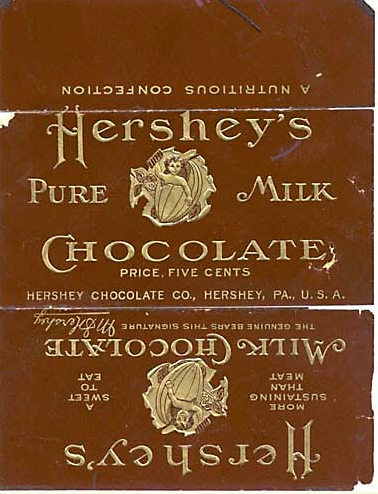
Hershey’s Chocolates
Candy manufacturer Milton Hershey made the decision to try
adding chocolate coating to his caramels in 1894. Calling this new enterprise
the Hershey Chocolate Company, the company began producing milk chocolate in
bars, wafers and other shapes in 1900. With mass production, Hershey was able
to lower the per-unit cost and make milk chocolate, once a luxury item for the
wealthy, affordable to all. In 1907, the company produced a flat-bottomed,
conical milk chocolate candy that Mr. Hershey named Hershey’s Kisses Chocolates.
At first, they were individually wrapped in little squares of silver foil, but
in 1921 machine wrapping took over that job. Hershey provided milk chocolate
bars to American doughboys in the first war. By the end of World War II, more
than a billion Ration D bars had been produced and the company had earned no
less than five Army-Navy “E” Production Awards for its exceptional
contributions to the war effort. In fact, the company’s machine shop even
turned out parts for the Navy’s antiaircraft guns.

Tootsie Rolls
In 1896, Leo Hirschfield invented the Tootsie Roll and named
it for his daughter, Tootsie. His new hand-rolled candy sold for one penny. By 1905,
the candy production moved to a four-story New York City candy manufacturing plant and deliveries were made by horse and buggy.
Lollipops
The beginnings of lollipops go all the way back to the stone
age when sticks were inserted into hives and the honey was eaten from the sticks.
Fast forward to the 17th century when sugar became more plentiful. The English
enjoyed boiled sugar candy treats, inserted on sticks to make it easier to eat.
The word lollipop first appeared in print in 1784, referring to a sweet in
general, not specifically candy on a stick. Even Charles Dickens included the
term in his writings. Reportedly, the term “lolly pop” literally means “tongue slap.” The
word for “tongue” is “lolly” in Northern England and “pop” means “slap.” It is
thought London street vendors coined this term as they peddled the treat. In the decade leading up to the Civil War, supposedly the ends of pencils were dipped in candy for children to enjoy while they wrote. (It wasn't until 1858 that pencils were manufactured with erasers on the end). Around the turn of the century, the Bradley Smith Company, the
McAviney Candy Company, and the Racine Confectionary Machine
Company were all manufacturing candy on sticks. It wasn’t until 1931
when the Bradley Smith Company patented the name “lollipop” for their version of candy on a
stick.

In my new release,
Lacy, (Pendleton Petticoats, Book 5) Lacy Williams has never had much opportunity to enjoy candy. Grant Hill decides to give her a sampling of the variety of sweets available.
Here's a little excerpt from their story:
“Do you really not enjoy candy?”
He opened the box of chocolates and held it out to her.
“I never said that.” Lacy accepted
a piece and took a small bite, savoring the creamy, smooth confection. “It’s
just that I’ve never had much candy.”
“That’s because you were too busy
eating ancient blood-sucking fish and venomous reptiles.”
Lacy frowned at him as she
finished the bite of candy in her mouth. “When you say it like that, it sounds
positively horrendous. As I mentioned at the store, Father most often purchased
NECCO wafers, so we could each have one. Once in a great while, we might get a
lemon drop or a peppermint from a visitor. Tony brought Grandmother a box of
chocolates once. It was divine.”
“Personally, I much prefer
chocolates or even licorice whips to snakes and rodents.” Grant hid a sarcastic
smile by studying the candy in the box he still held. After selecting a piece,
he held it out to Lacy. “Here, try this one. It’s my favorite.”
She started to take it from his
hand, but he refused to relinquish it, holding it up to her lips. “Take a
bite.”
After she did, he popped the
remainder into his mouth and gave her a roguish grin. “That’s the sweetest it’s
ever tasted.”
Pink suffused her cheeks at his
comment and the heated look he gave her. “For an upstanding citizen and
respected banker in this town, I think you could be quite scandalous, given the
opportunity.”
Grant winked at her and popped a
peppermint into his mouth. “Only with the right girl. I wouldn’t scandalize
just anyone, you know.”
What's your favorite type of candy (vintage or otherwise)?


A
hopeless romantic with a bit of sarcasm thrown in for good measure,
Shanna Hatfield is a bestselling author of sweet romantic fiction
written with a healthy dose of humor. In addition to blogging and eating
too much chocolate, she is completely smitten with her husband,
lovingly known as Captain Cavedweller.
Shanna creates character-driven romances with realistic heroes and
heroines. Her historical westerns have been described as “reminiscent of
the era captured by Bonanza and The Virginian” while her contemporary
works have been called “laugh-out-loud funny, and a little heart-pumping
sexy without being explicit in any way.”
She is a member of Western Writers of America, Women Writing the West, and Romance Writers of America.
Find Shanna’s books at:
Amazon |
Amazon UK |
Barnes & Noble |
Smashwords |
Apple
Shanna loves to hear from readers! Follow her online:
ShannaHatfield |
Facebook |
Pinterest |
Goodreads |
You Tube |
Twitter