A year ago, I released Love on Target, a sweet and wholesome romance that is part of the Pink Pistol Series presented by the authors of Petticoats and Pistols.
I am incredibly honored and excited to be named as a Spur Award Winner from the Western Writers of America. Love on Target tied for first place in the Best Western Romance Novel category with The Heart Beneath the Badge, by George T. Arnold. Love on Target is the story of a young woman who paves her own way, even taking on a job most men were hesitant to do back in the 1890s. Thank you so much, Western Writers of America, for this wonderful honor!
Right now, you’ll find Love on Target, as well as the rest of the Pink Pistol series on sale for just 99 cents!
Check out the series page on Amazon and be sure to snag all those fun reads tied together with a traveling pink pistol while they are on sale for just 99 pennies!
USA Today bestselling author Shanna Hatfield is a farm girl who loves to write. Her sweet historical and contemporary romances are filled with heart, humor, hope, and hunky heroes. When Shanna isn’t dreaming up unforgettable characters, twisting plots, or covertly seeking dark, decadent chocolate, she hangs out with her beloved husband, Captain Cavedweller. Shanna loves to hear from readers. Follow her online at: ShannaHatfield
Every summer, the sleepy little town closest to our farm would burst to life for four days with the biggest event of the year – the 4th of July celebration. I can’t even tell you how old I was before I figured out the 4th of July was supposed to represent a single day, not a time of year.
Some towns might go all out for Christmas or Halloween, maybe even Easter. But our small town had the 4th of July.
I happened to find this vintage photo by Russell Lee of Vale’s 4th of July. See that sign on the left for “Drugs”? The town’s drugstore is still on that corner.
Apparently, going all out for Independence Day is something they’ve done for a long, long time.
The four days of fun included four nights of rodeo, games and activities in the park, and a parade. Fireworks generally took place the night of the 4th. There was also a Suicide Race, most often right before the second night of the rodeo.
Vale boasted a saddle shop owned by a wonderful, kind man who also tended to enjoy a good joke from time to time. When I was four, my dad took me to Leroy’s shop to get a new belt for the rodeo. I remember walking inside, holding tightly to Daddy’s hand as the rich scent of leather filled my nose.
While Dad and Leroy talked, I wandered around the store, looking at saddles and boots, running my little fingers over the smooth leather of bridles and the rough texture of new ropes. Then I spied the belts.
Dad let me pick the one I wanted – a floral stamped leather belt with a silver buckle. On the center of the buckle was a little gold saddle. I still have that belt today and whenever I look at it, I smile, recalling fond memories from both going to town with my dad and going to the rodeo.
Anyway, my family was big into the 4th of July celebration. We usually went to the rodeo at least once, sometimes twice. Quite often one or more of us would be in the parade. My oldest brother and some of his family often rode their horses or drove a wagon in the parade. My other brother frequently entered one of his antique cars. I remember one year Mom helped me make an early 1900s costume so I could ride with him. I played In the Good Old Summertime on the piano about fifty times in a row and recorded it on our tape player, then we blasted that from a boom box in the car as as we drove down the street (yep, that was back before you could loop songs on your smart phone!).
Back in those days, my oldest brother and one or more of my cousins would ride in the Suicide Race. If you’ve never seen or heard of one, in a nutshell, a group of riders with more courage than I could ever muster race down a harrowing trail to see who makes it to the bottom first. The Vale Suicide Race starts at the top of a butte with a blast of dynamite and ends in the rodeo arena across the river. It’s a 2-mile course down the hill, across the highway, through the river and into the arena. If a rider makes it off the butte, many of them end up taking a swim in the river.
Sometimes it was more entertaining to watch my mom than the race because she’d get so tense about my brother racing, we’d place bets on whether she might hyperventilate before he made it off the butte.
Eventually my brother stopped racing and his kids took over as competitors. My niece was the first girl to race, starting when she was just 16. She rode five years, and won it twice.
Here's a video of the race from a rider’s perspective. Skip ahead two minutes (they are just waiting for the dynamite blast to signal the start).
This one is from a spectator. Having been a spectator many, many times, it can be hard to see with thousands of spectators lining the river and road, straining to get a glimpse of the riders. (You might want to mute this one – it gets kind of loud with the cheering.)
As you can see from the videos, the race is right before the rodeo starts. Way back when, the rodeo was a PRCA sanctioned event and drew in some very talented competitors as well as awesome entertainment.
In fact, when I used to work for a daily newspaper, I always volunteered to cover the 4th of July celebration. However, I learned very quickly, you just don’t march behind the chutes before the rodeo to take photos. I made that mistake my first year and had two adolescent boys along as my sidekicks. They thought it was hilarious when we walked back there and found a few dozen men in various stages of undress getting ready to ride. It was one of those moments I wanted the ground to open up and swallow me whole. Since I tried to block the traumatic experience from my mind, all I recall is a sea of tidy whities and a bunch of surprised faces. After that, I stuck to taking photos from the front of chutes.
Up until we moved away, we never missed a 4th of July celebration. Admittedly, I miss those days and all the excitement that went along with the holiday.
Do you have any fond or fun memories of 4th of July celebrations from your childhood. Any traditions?
Now that I’ve worked myself into a bit of nostalgia, I’ll just wish you all a wonderful, safe, and very Happy 4th of July.
USA Today bestselling author Shanna Hatfield is a farm girl who loves to
write. Her sweet historical and contemporary romances are filled with sarcasm,
humor, hope, and hunky heroes. When Shanna isn’t dreaming up unforgettable
characters, twisting plots, or covertly seeking dark, decadent chocolate, she
hangs out with her beloved husband, Captain Cavedweller.
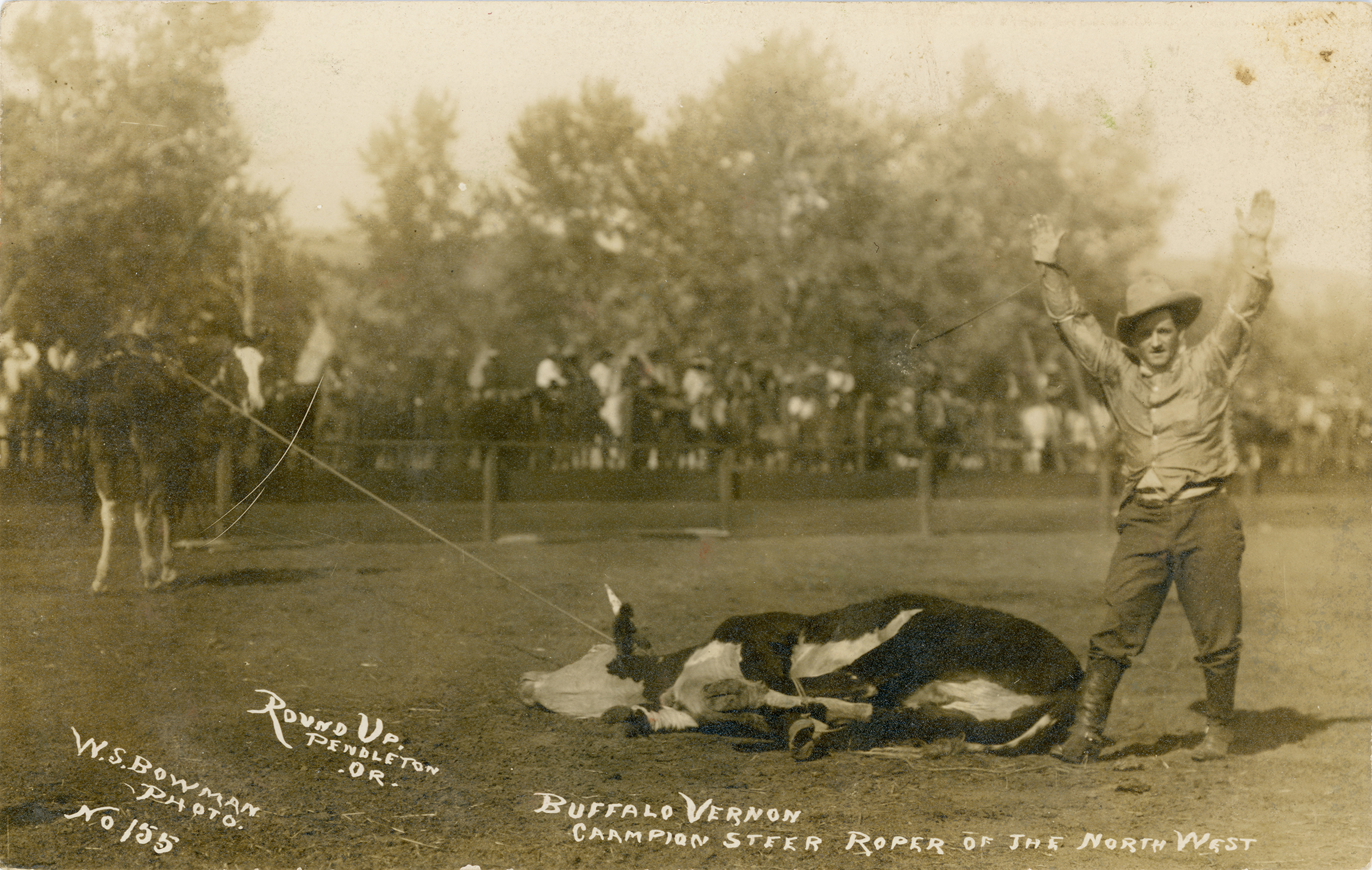
In my recent research for a book set in 1912, I happened across a few articles in an old newspaper that mentioned a "champion cowboy" by the name of Buffalo Vernon.
In 1910, Buffalo Vernon wowed the crowds at the very first Pendleton Round-Up. The articles in the newspaper touted him as the "champion of the world" at bulldogging and claimed his appearance was "hailed with delight."
Following the tradition started by Bill Pickett, Vernon would "bulldog" a steer by jumping from a racing horse, wresting a steer to the ground and biting it on the lip to keep it down. (We can be ever so grateful bulldogging gave way to steer wrestling and eliminated the lip bite!).
Vernon was also a champion steer roper and trick roper, delighting crowds from Cheyenne, Wyoming, to Sacramento, California.
Postcard from early Pendleton Round-Up
At the 1910 Cheyenne rodeo where former president Teddy Roosevelt happened to be in attendance, Roosevelt was quoted as saying, "Then there was Buffalo Vernon. I noticed that when he went out ot bulldog the steer he wore a leather bandage around his wrist. I asked him why he wore it and he said he had broken his wrist the day before. Now, it is a pretty hard job for a man with every bone sound to bulldog a steer. Buffalo Vernon did it with a broken wrist."
Buffalo Vernon was actually Jess Shisler, born in 1884 in Canada. The family farm was reportedly just across the river from Buffalo, New York. Around the time he was twelve, he and a brother went to Buffalo to stay with a sister and ended up changing his last name to Vernon.
He eventually claimed he was from Texas, and embraced his Buffalo Vernon persona.
In 1911, he was one of the star attractions at "Pioneer Day" during the Cheyenne rodeo, performing with top names such as Annie Oakley and Ambrose Means who was known as a "daredevil American."
Buff, as he was known to his friends, went on to perform with some of the top Wild West shows of the day, traveling across North America, Europe and the Orient. He even performed for the King of Belgium.
Then one day he was gored by a bull and sustained a "hernia wound" that wouldn't heal, ending his cowboy career. When he disappeared from the rodeo and Wild West scene, people speculated what had happened to him, including everything from being incarcerated to getting shot.
With his cowboy days behind him, Vernon turned his attention and efforts to working in a mine in Nevada where he remained until his death in 1939.
Oddly, a number of letters from Buffalo Vernon appeared in the early 1960s, claiming to be from Buff.
Through the years, a man named Tom Vernon attempted to steal Buffalo Vernon's identity and was at it again. Tom Vernon, a horse-thief, train-robber, convicted felon, and all-around bad guy, even used a copy of a real photograph of Buff to try to authenticate his proof as the well-loved cowboy. Not known for telling the truth, Tom Vernon also claimed to be one of two children born to Cattle Kate ( a fact that was never proved, particularly since she reportedly had no children).
In spite of spending around three decades serving a sentence in Folsom Prison, Tom Vernon clung to the claim he was the real Buffalo Vernon. He tried to convince reporters he was raised by Indians after his mother died and was given the name because he could ride a saddle bison. He said he worked with Buffalo Billy Cody's Wild West show and was a ward of Annie Oakley, among various other fictitious claims.
It's rather sad to think of identity theft being a problem way back then, but at least the truth eventually came out and Buffalo Vernon remains one of the early champion cowboys of the rodeo and Wild West performing world.
You can read a wonderful article about Buffalo Vernon that was published in 1963 in True West Magazine here.
~*~
Convinced everyone deserves a
happy ending, USA Today best-selling
author Shanna Hatfield is out to make it happen, one story at a time. Her sweet
historical and contemporary romances combine humor and heart-pumping moments with
relatable characters. When this hopeless romantic isn’t
writing or indulging in rich, decadent chocolate, Shanna hangs out with her
husband, lovingly known as Captain Cavedweller.
Shanna loves to hear from readers. Follow her online at: