Showing posts with label Continental Divide. Show all posts

Wednesday, August 1, 2018

Leadville, Colorado Historical Buildings

 
Early Leadville
Sitting at 10,152ft above sea level, Leadville, Colorado is a small town known for its importance in 1800’s silver mining. Folks looking to ‘strike it rich’ flocked to the Continental Divide with picks and shovels, and before long the town was booming with business. Even the railroad eventually made its way to Leadville. With striking views of the peaks along the Continental Divide, two of the buildings from the 1800’s boom are still in existence and use today.   

D
Delaware Hotel 
elaware Hotel: Originally from the state of Delaware, William, George and John Callaway left the east coast and settled in Denver as ware merchants. The brothers decided to expand their business and chose Leadville for their next venture. They built the 2-story Callaway Block on the corner of Sixth and Harrison in the mid 1880’s. The Callaway burned and the brothers turned their attention to building the Delaware as a tribute to their home state. The Delaware opened in 1886, with the ground floor home to several shops. The second and third floors housed fifty furnished rooms for use as offices or bedrooms. The hotel had steam heat, hot and cold water, gas lighting, and six bathrooms. William and George eventually went back to Denver, leaving John in charge of the hotel. The brothers retired in 1890, wealthy from their business ventures and investments.      

Today, 
A gust room at the Delaware
The Delaware is Leadville’s only remaining hotel from the mining era. The hotel features a museum, gallery, and Victorian style rooms. The hotel is decorated with American and European antiques, with each bedroom telling a story relating to Leadville’s history.


The
Tabor Opera House
Tabor Opera House:
Born in Vermont in 1830, Horace Tabor was a stone cutter. He moved to Leadville in 1850 with his wife, August, and mined what is known as California Gulch. That mine didn’t net him riches, so he sold it and became a Leadville merchant. During this time, e gave supplies to two men in exchange for 1/3 of their mining claim. Lucky for Tabor, the men struck silver, making Tabor rich. He used his wealth to start several other mining companies, making even wealthier. But Tabor was also a reckless spender, of which his wife didn’t approve. He eventually divorced August and married his mistress, Elizabeth McCourt, a.k.a. Baby Doe. Horace and Baby Doe continued to spend their wealth in a reckless manner, and when the silver market crashed in 1893, they were poor. Horace died in 1899 with the notion his mines would become profitable again, but he was wrong.

As
Interior of Tabor Opera House, circa 1800's
 a prominent historic figure in Leadville’s history, Tabor’s house is now a museum and open to the public. His other famous legacy is the Tabor Opera House. Before Tabor came to Leadville, Denver had a difficult time acquiring opera singers to come to the city and perform. Out of the way and off the beaten path, opera companies thought Denver unworthy of their time, as getting to and leaving the city meant the loss of other dates and revenue. After Tabor came to Leadville, he opened a small opera house, and later decided to build an even bigger one that Denver, ‘Queen City of the Plains’ deserved. Construction began during the summer months, with Tabor sparing no expense for the finest opera house in the west. Constructed of cherry wood from Japan and mahogany from Honduras, the house was furnished with paintings from Europe, silk plush chairs, tapestry and carpeting. Opening night was September 6, 1881, with Tabor securing Emma Abbott and her Grand English Opera Company to christen the house. The house was a success for a few years until the Broadway Theater opened on 16th Street and took away most of the opera house’s business. Tabor had to sell his opera house in 1896, after he went bankrupt.       

The
Tabor Opera House today
Tabor Opera House still stands today and is undergoing major renovation, which is expected to last several years and is paid for in part by the town of Leadville. Improvements have been made to the roof and to structural support due to water seeping through the bricks and causing major problems from freezing and then thawing. Electrical work, plumbing, and the brick exterior also need to be improved as well as the heating. Currently the opera house is only open for performance during the summer because the building does not have heat.

**** To learn more about Leadville, or for directions and aaccomodations, Google offers several great links. 


Wednesday, August 5, 2015

Buena Vista, CO


When I began drafting Bring Me Luck, I wrestled with the decision of where to set the story. My original thought had been Idaho, but in further thinking, the territory was too far away from the origins of the series and wasn’t a solid basis for the plot I had formulated. I needed my secondary characters and heroine to be closer to her family’s home, but far enough away where they couldn’t be found easily. I began narrowing my search to smaller Colorado towns. Gunnison and Montrose were favorites. I’ve been to both, but much wasn’t written on either for the timeframe of the story, other than the different Tribes belonging to the area. I narrowed the search even more and settled upon Buena Vista. By my calculations, Buena Vista was about a week’s ride on horseback from fictional Coyote and a perfect fit for the plot. 

Buena Vista courtesy of .buenavistacolorado.org
Buena Vista borders the Arkansas River. The foothills and the Continental Divide are directly to the west. Leadville is north and Salida is south. Founded in 1864 after the discovery of gold outside Denver, Buena Vista originally held the name of Cottonwood. Later, it was changed to Mahonville after the Mahon family (this is the name I use in Bring Me Luck) and finally, local woman of German heritage Alsina Dearheimer named the town Buena Vista, Spanish for Beautiful View. 

James Mahon home courtesty of Chaffee County Times
Four brothers of the McMahon family settled in Leadville and worked in the mines. Two of them eventually moved on and James and Hugh came to Buena Vista to ranch and farm. James filed for homestead rights on Cottonwood Creek land and changed his name to Mahon because of immigration requirements. Hugh settled on land near the river and also changed his name to Mahon. The brothers had a stage stop and a post office on their land. They also donated land to the town, helped build a Catholic church and the first school; hence the reasons the town was once named after them.   
   
Buena Vista was incorporated as a town in 1879. A vote was taken in 1880 to have the county seat moved from Granite, Colorado to Buena Vista. Buena Vista won the vote, but Granite didn’t welcome the move and went so far as to not release the county records. A few men from Buena Vista confiscated a railroad car and went to Granite. They broke into the Courthouse, stole all of the county records and nearly demolished the place. Hearing the commotion and going to investigate, sheriff John Mear and his wife were held at gunpoint during the thievery. The men took the documents back to Buena Vista, where they were kept in businesses safes and the stable until a courthouse could be built. The day after the theft Granite officials had to travel to Buena Vista to conduct business.    
  
Courthouse courtesy of buenavistacolorado.org
Building for a courthouse and jail in Buena Vista began in June of 1882. The dedication was held in May 1883. Between the years 1880 – 1885, three railroads went through town; the Denver, South Park and Pacific, the Denver & Rio Grande and then the Midland. Electricity arrived in 1888 and the telephone in 1893. A correctional facility was built in 1889 and remains in use today, providing many jobs to the community. Buena Vista is also a big farming community and was once known as the head lettuce capital of the United States. The lettuce industry boomed for several decades, with farmers earning up to $500 per acre. Ice from Ice Lake made shipping via boxcars easy, but in 1948, the refrigerator car gave west coast rivals the same ease to ship as the ice from Ice Lake gave Buena Vista’s farmers.
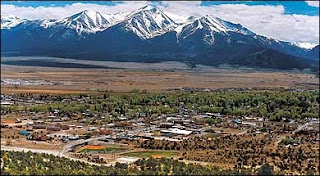
Aerial view of Buena Vista courtesy of http://fairtradecampaigns.org
Today, residents and visitors enjoy white-water rafting on the Arkansas, fly fishing, and four-wheeling, not to mention the breathtaking views of the Continental Divide’s several 14,000ft. peaks. 

Bring Me Luck is available here for purchase: 
www.amazon.com/dp/B00OP5PT2U