Showing posts with label Colorado. Show all posts

Tuesday, January 13, 2026

A250-C150

Post (C) Doris McCraw

aka Angela Raines

From the History Colorado Website

2026 is the 250th year since the Declaration of Independence and the 150th year since Colorado became a state. Over the next year, I am planning to write about the journey of Colorado to statehood, the people involved, and the historic connections between the two events across the various platforms I write for. I hope you will join me on this journey. It's history, so I know I am going to be very happy doing the research.  

The state is planning a number of celebrations, and for those interested, you can access them through History Colorado https://www.historycolorado.org/colorado-150 , and https://peakradar.com/categories/am250co150/

For those who may not know, Colorado became the 38th state on August 1, 1876, earning the nickname "The Centennial State", hence the name of the James Michner book "Centennial" about Colorado. President Ulysses S. Grant was the one who made the proclamation.

Until next time,

Doris


Wednesday, October 1, 2025

Emma Crawford and the Coffin Races ~ Julie Lence


Manitou Springs/Pikes Peak
 At the base of Pikes Peak (America’s Mountain in Colorado Springs, Colorado) sits the small town of Manitou Springs. Restaurants ranging from 5 Star dining to a candy & hotdog stand line the streets. Shops hawking anything from Christmas baubles to cowboy décor entertain tourists almost year round, and locals know the hot springs put Manitou on the map. While I won’t say for sure that many come to town for a dip in the springs today, I can say there is one attraction that draws the crowds, both locals and tourists alike, every year and that is the Emma Crawford Coffin Races.


Born March 24, 1863 in Massachusetts, Emma Crawford realized her talent for music at a young age. Her mother was a pianist and music teacher and is credited with helping Emma nurture her talent. By the age of 12, Emma was giving her own piano lessons and public recitals. By 15, she rendered the music of great masters with perfection and was also skilled in playing the violin, viola, cello and the mandolin. But all wasn’t sunshine and happiness for Emma. She developed an illness believed to be tuberculosis before the age of seven, and in 1889, she and her mother moved to Manitou Springs in the hopes the mountain air and hot springs would benefit Emma’s condition. At the time, Emma was engaged to New York engineer, William Hildebrand, who was working on the Pikes Peak Cog Railroad.

Nature was Emma’s second greatest interest, with spirituality close on its heels. Reports indicate Emma (wearing a red dress) climbed Red Mountain, which she nicknamed Red Chief to honor the American Indians, Like other spiritualists in her day, she believed a spirit guide from the Indian world would protect her and that a spirit guide had the power to heal her health problems. Most didn’t believe that in her condition she could climb the mountain, but she swore she did and even left her scarf tied to a small pine tree at the summit. Her friend Bill Crosby is reported to have climbed the mountain the following day to find Emma’s scarf footprints.


Emma succumbed to her health problems on December 4, 1891. Before that, she made it clear she wished to be buried on the mountain’s summit.  William Hildebrand tried to get a deed for the burial site but was denied. Emma was buried on the mountain only in a different location. Afterward, her grave was moved to the west side of the mountain and covered with a concrete slab; this was during the time Red Mountain incline built a power house and depot on the summit. Over time, the slope eroded and Emma’s coffin slid down the mountain into the canyon. In August 1929, human remains and a handle to a coffin were found. It was later determined the remains were Emma. At this time, the authorities were unable to locate any of Emma’s relatives, so Bill Crosby took responsibility for her. She was buried in an unmarked grave. In 2004, Historic Manitou Springs, Inc. finally erected a headstone near the unmarked grave.


In 1994, Manitou Springs was looking for new ways to promote tours and decided to incorporate Emma into their Halloween promotions, thus the coffin races began. Held on a Saturday close to Halloween, a parade kicks off the race. Teams consisting of five members (Emma and 4 mourners in costume), have to push a coffin down the street, all vying for ‘Coffin Race Winner’,  ‘Best Emma’, ‘Best Coffin’, ‘Best Entourage’, and the recently added, ‘Coffin Cup’.  The event is a lot of fun and one I hope to someday attend.

Monday, June 6, 2022

Counterfeiting U.S. Currency in the 1800’s


By Kristy McCaffrey

In the 1800’s, money in the United States came in many different forms, from gold and silver coins to fractional paper currency (denominations less than a dollar), Treasury notes, and postal currency used for redeeming postage stamps. The first paper currency was issued during the Civil War in the form of “greenbacks.” Individual banks also issued their own currency, called banknotes, in varying denominations, but their value fluctuated depending on the solidity of the bank.


Dealing with these banks was risky for most Americans since there was no insurance on the deposits or government control over how the banks did business. Because of this, banks and paper currency were greatly distrusted. Only gold and silver retained their value, so most people tended to hoard these metals.


Enter the counterfeiters. By the 1860’s, nearly one-third of the currency in circulation was counterfeit. Retailers subscribed to weekly papers showing drawings of the latest counterfeits. Printers of the fake money would sell them to passers, who exchanged them for real currency or goods.


Detecting the counterfeit money was fairly easy, but it was harder to catch the printers. Prior to the Civil War, the Treasury Department used the U.S. Marshal Service to track down the perpetrators. In 1865, the Secret Service was established as a bureau in the Treasury Department to suppress widespread counterfeiting. (Informal part-time protection of the President of the United States—Grover Cleveland—began in 1894. By 1902 the Secret Service assumed full-time responsibility for the safety of the President.)

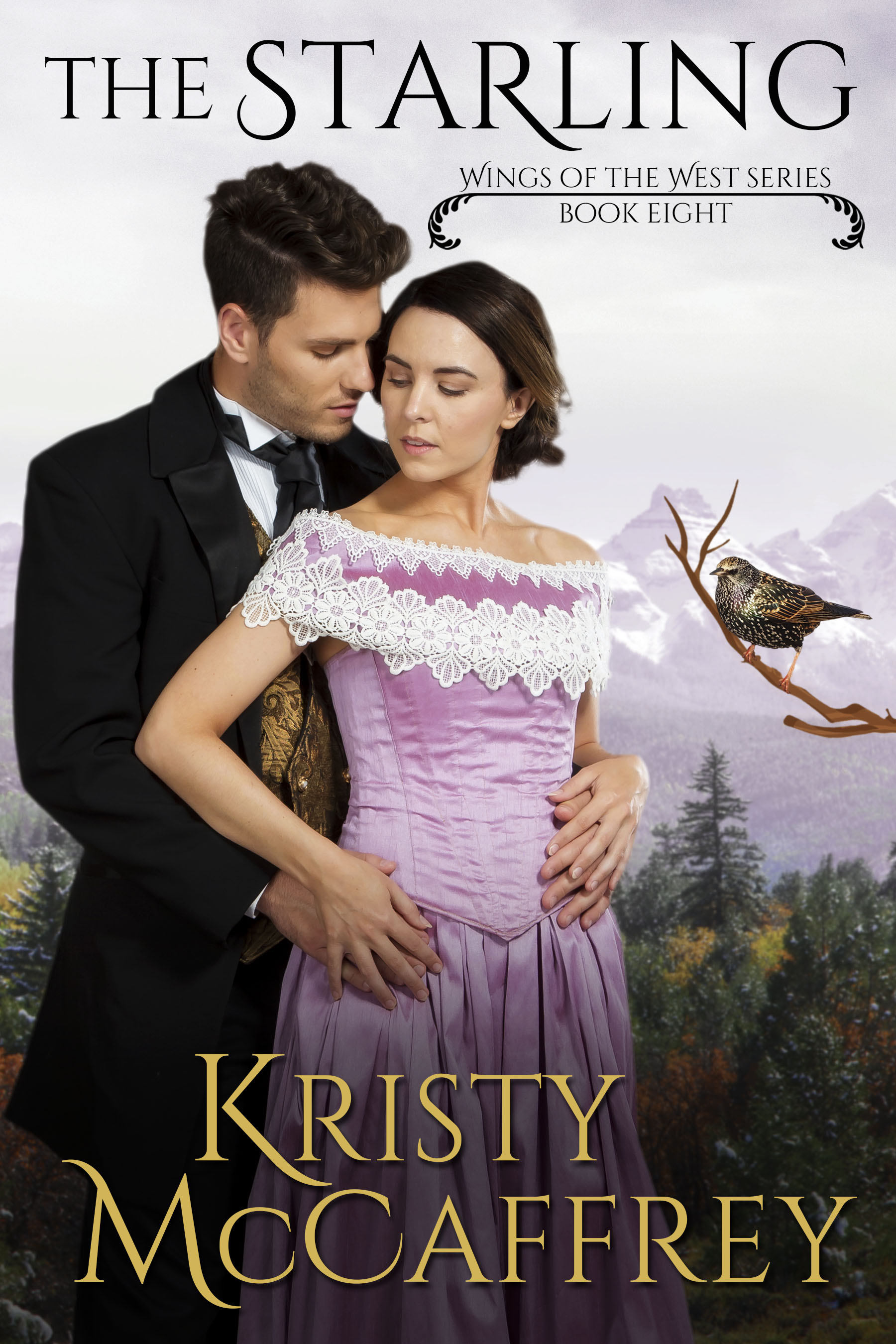
In my upcoming release THE STARLING, Pinkerton Detectives Henry Maguire and Kate Ryan have been hired to uncover a counterfeiting scheme in Trinidad, Colorado, in 1899.

* * *

Colorado 1899 

Kate Ryan has always had a streak of justice in her. When she decides to apply to the Pinkerton Detective Agency, nothing will stand in her way. Initially hired in a clerical position, she quickly works her way up to field agent with the help of her mentor, Louise Foster. When Louise is injured, Kate gets her first assignment and the opportunity of a lifetime. 

Henry Maguire has been undercover in the household of wealthy entrepreneur Arthur Wingate. Employed as a ghostwriter to pen the man’s memoir, Henry is also searching for clues to a lucrative counterfeiting scheme. When Henry’s “wife” shows up, he’s taken aback by the attractive woman who isn’t Louise. Now he must work with a female agent he doesn’t know and doesn’t necessarily trust. And because he has another reason for coming into Wingate’s world, Kate Ryan is unavoidably in his way.

Kate Ryan is the daughter of Matt and Molly from THE WREN, and THE STARLING is the first of five novels featuring the second generation of Ryans in the Wings of the West series.

* * *

Coming August 2, 2022

Pre-Order Now

Excerpt from The Starling

 “Your wife has arrived, sir.”

My wife ….

What the hell? Louise was here? Now?

Jonesy had agreed that Louise Foster would be summoned when Henry sent word. And he hadn’t sent word. Dammit.

“Of course,” Henry replied. “Thank you.”

“Please follow me, sir.”

Henry thought of abandoning the drink he’d been nursing for the last hour, but instead kept it as he followed the valet through clusters of people and the low din of talking and laughing. In fact, he took a large gulp as he walked, to soothe his nerves. Sometimes his own rules needed to be amended. This wasn’t a disaster, he reminded himself. Louise was a good field agent, one he’d worked with more than once, and he respected her abilities. She was also his friend, one of the very few along with Jonesy. If she were here now, there must be a good reason. While his cover had included a wife, Henry rather liked working alone, and he’d told Jonesy that Louise could join him when it seemed necessary. And it hadn’t been necessary … yet. But apparently Edgar Jones had pulled rank, thinking differently.

As Henry entered the foyer, his gaze landed on a young woman in a stunning blue gown, curls of dark brown hair accenting her oval face, her figure lithe and youthful. Her reserved countenance indicated her discomfort as she conversed with Arthur’s wife, Lottie, near the front entrance, and Henry couldn’t help but feel sympathy for her. Lottie Wingate had been mostly unwelcoming to him.

The young woman’s poise drew his eye and for a moment, Henry considered what it would be like if he weren’t working, if he could simply pursue a conversation with an attractive woman. He had purposely not set down roots. His work made it impossible. Well, not impossible. He’d simply never met a woman who could turn his attention from his job.

And hell if that didn’t remind him that he was more like his old man every day.

He pushed aside the memories of the last time he’d seen his father, of the terrible fight they’d had, of the anger that had pulsed white hot within Henry.

Instead, he focused once more on the alluring distraction of the woman in blue, and then, reluctantly, he peeled his eyes from her and searched the foyer for Louise, but she was nowhere to be seen.

“She must have stepped into another room,” Henry said to the valet.

“No, sir.” The young man stopped and gave a nod toward Mrs. Wingate and the striking woman beside her.

Henry endured a brief state of confusion, an unnatural occurrence since he kept everything in his life compartmentalized and in order.

Recovering quickly, he said, “Of course, thank you. I must need my spectacles this evening.” He left the valet before he was forced to converse further, giving even more opportunities for a slip up. He walked slowly to the two women, since he wasn’t certain what he should say. Clearly, the valet had been misinformed.

Henry glanced over his shoulder, confirming the man had left the foyer. With the all-clear, Henry shifted his path to miss the two conversing women, although a twinge of regret flared. A small part of him wondered what would happen if he struck up a conversation with the woman who drew his gaze with such ease. But now wasn’t the time for personal interests. Just as he passed within three feet of the women, a voice rang out, “Gilbert! Darling!”

Henry stopped and faced the woman who had in a brief span sparked such an intense interest in him. She’d used his alias. It all became clear in an instant.

She was his wife.


Tuesday, February 8, 2022

Valentines, Anyone?

 Post by Doris McCraw

writing as Angela Raines


Do you remember giving Valentine cards when you were younger? I remember those little cards that we would give each other. But where did the whole thing start? According to History.com there are three possible origin stories. All had the name of Valentine or Valentinus. All were men of the cloth. One defied the emperor Claudius decree that young men could not marry. One was a bishop who also defied the emperor. The third was believed to be helping prisoners to escape Roman prisons. All were killed for their actions.

As we move forward, the story of these men caught the imagination of many for their actions. In the middle 1400s written 'Valentines' began. 

Fast forward to 1847 when Esther Howland began to mass-produce embossed paper lace valentines. The story is, she was inspired by a card she received from a business associate of her father, who owned a book and stationery store in Worchester, Massachusetts. From there the rest is history. 

I thought perhaps you'd like to see how it was in Colorado in the 1800s. Below are some pieces from Colorado papers.

The Brush Lariat, February 14,  1885 


The Durango Wage Earner
February 9, 1899


The Colorado Daily Chieftain, February 5, 1896

However you celebrate Valentine's Day, may it be filled with love and some great romance books.


Friday, December 10, 2021

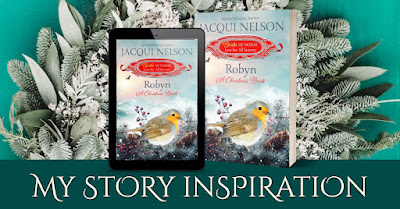
My Story Inspiration for Robyn a Christmas Bride

My Story Inspiration
   
By Jacqui Nelson

The spirit of gift-giving is an inspiration and as an author, I love pondering what inspires people and what might inspire my characters. 

When writing my second Christmas story, I asked myself...how can a gift be so special that it inspires the transformation of a relationship and launches a grand love affair? Words like priceless and selfless sprang to mind and became part of not only my story, Robyn: A Christmas Bride, but its Story Inspiration page (a page I've included in the back of all of my books). Here's that page...

Robyn A Christmas Bride book cover

ROBYN: A CHRISTMAS BRIDE


Story Inspiration page ~ from the back of the book

When I started pondering a plot for my Christmas story, my first question was, what should the theme be? Is there a classic Christmas tale with an uplifting theme that many people might recognize or at least relate to? The Gift of the Magi became my first inspiration when writing Robyn: A Christmas Bride. 


The Gift of the Magi (written by O. Henry and published in 1905) features the themes of selfless gift-giving and how the gift of love is priceless. In that story, a husband and wife each sell their most valuable possession, but they are items that can be grown again (hair) or can be bought back again (a watch). I wondered what if the thing you valued most was sustaining a way of life that you’d struggled a long time to create and that now defined your entire self-worth? Could you give that up if it meant ensuring the happiness of a loved one? That might be the ultimate selfless gift to give.


My next thought was having a heroine who was a trouser-wearing tomboy who loved driving wagons in 1877, a time when society wasn’t very accommodating about women’s appearances and occupations that strayed from the norm. So…what if my heroine decided she needed to do something drastic to win the heart of the man she loved? Changing yourself to please another person (even if they haven’t asked you to) might be considered another selfless gift. So…what is a classic transformation story? My Fair Lady and its heroine Eliza Doolittle were my next inspiration. 


My Fair Lady (released in 1964 as a movie starring Audrey Hepburn) focuses on speech lessons, but Eliza’s transform also includes her appearance—her clothing, hair, the way she carries herself, and more. It’s a life-changing transformation that is difficult for Eliza and takes hard work and sacrifice—for her own good (a chance at better job prospects) but also, as time goes on, to please her instructors. 


So…selfless giving and self-sacrifice. Ready. Set. Go. Write a Christmas story. 

I hope you enjoyed Robyn: A Christmas Bride as much as I enjoyed not only writing the story but also giving Robyn Llewellyn and Max Peregrine their hard-won and well-deserved Christmas gifts.

Hello Robyn

ROBYN: A CHRISTMAS BRIDE


Noelle, Colorado –  Christmas 1877

Who’s the perfect match for a flame-haired Welsh tomboy who loves driving wagons?

 by three free-spirited older brothers, Robyn Llewellyn has learned to fight for what she wants—and now she wants to transform her boss and best friend, Max Peregrine, into a lifelong partner. Determined to become the image of what a marriage-minded man wants, Robyn trades her trousers for a dress and heads to Max’s hometown of Noelle, Colorado. But changing who she is with the help of the now happily married Brides of Noelle puts her friendship with Max at risk.


Who’s the perfect match for a work-addicted Denver business owner who loves his independence?


Defying his brother and grandpa’s wishes for him to stay with them in Noelle, Max Peregrine has created his dream job—leading a highly successful branch of Peregrines’ Post and Freight while working beside Robyn, the only person who makes him smile every day. But when she leaves without a word, Max follows her to Noelle where the choices they both must face could make it impossible for them to stay together beyond Christmas Day.


Inspired by My Fair Lady, The Gift of the Magi, and the spirit of gift-giving, Robyn: A Christmas Bride is a classic Western historical love story set in a small town high in the mountains during Christmas 1877.


Meet Your Match in Noelle

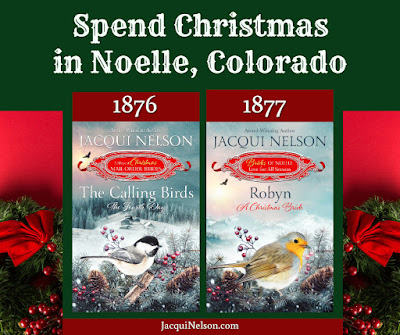
MY NOELLE, COLORADO, 

CHRISTMAS STORIES 


The Calling Birds - Christmas 1876
Robyn: A Christmas Bride - Christmas 1877

Spend Christmas in Noelle


Hope you enjoyed my writing inspiration and that your December is merry and brightand filled with all of your favorite gifts be they store-bought or homemade or (one of my favorites) the gift of time spent together ❤️🎄🎁🥂🎉

~ * ~

Jacqui's author photo

Join me on 

Follow me on 

Friday, November 12, 2021

My Story Inspiration for The Calling Birds

  My Story Inspiration
By Jacqui Nelson

What inspires a story? 

Christmas! And since Christmas is next month, it feels like it's the perfect time to share the Story Inspiration page (a page I included in the back of the book) for the first Christmas story that I wrote...

The Calling Birds book cover

THE CALLING BIRDS 


Story Inspiration page ~ from the back of the book

When asked, which day of Christmas would you like to write? I immediately chose The Fourth Day because with the title The Calling Birds, I could use the name Jack Peregrine. His name was inspired by Inspector Jack Robinson from the Miss Fisher’s Murder Mysteries novels & TV series and the Miss Peregrine’s Home for Peculiar Children novel & movie. Jack and then Birdie’s names came to me lightning quick, and might not have worked as well in more specifically titled 12 days stories such as the Hens, Doves, Geese, or Swans. 

So, I chose the more generic title and then, as seems to be my nature, I became really specific. Peregrines’ Post and Freight had to be the plural because it’s a family-run business. The word “post” had to come before “freight” because when shortened to Peregrines’ Post, it stood for not only a postal office but a post on which a bird might rest AND a place to make a final stand - while trying to keep a business alive and a family together. 

Next, I decided I needed four birds to form my family because it’s The Fourth Day, after all. Jack’s brother, Max, and Grandpa Gus came to life. Now I cannot imagine The Calling Birds without Gus. 

Jack and Gus’ banter was inspired by my relationship with my mom. She was great fun but also incredibly stubborn (to the point where I’d worry for her safety). It became our running joke where I’d call her determined, but I meant stubborn - and she knew it. She was never absentminded, though. That feature is mine but, like Gus, I’d rather find ways to get around my shortcomings instead of dwelling on them.

A wanted woman’s flight, a man in pursuit of honesty, not stolen gold.

THE CALLING BIRDS


Noelle, Colorado –  Christmas 1876

Many years have passed since Bernadette Bellamy fled the Cariboo Gold Rush and her reputation as the sister of a French-Canadian gang of thieves. Armed with only an honest talent for sewing and a willingness to lead a solitary life on the run, she stays one step ahead of everyone seeking her brothers’ last—and now lost—heist. Until a craving to settle down makes her reinvent herself as Birdie Bell, a dress shop owner. The arrival of an old foe combined with her desire to hold onto her treasure trove of fabrics has Birdie joining a wagonload of brides bound for a remote town.

After losing his leg and his wife, Jack Peregrine buries his pain under a mountain-high pile of work. He only agrees to sign up for a mail-order bride to save the town of Noelle, keep his freighting business, and care for his absentminded grandfather. But Jack’s request for a sturdy bride who won’t crumble under his burdens brings him a woman as tiny as she is troubled. Can two mismatched people band together to become the perfect match?


Book Review "captures your heart from the start."


MY NOELLE, COLORADO, 

CHRISTMAS STORIES 


The Calling Birds - Christmas 1876
Robyn: A Christmas Bride - Christmas 1877

*  Next month I'll share my inspiration for Robyn *

Spend Christmas in Noelle, Colorado. Join the Peregrine brothers and their brides.


Hope you enjoyed my writing inspiration and that your Friday and your November are...beginning to look a bit like Christmas but only in the best ways. 🎄❤️ I'm hoping I won't see any snow until Christmas Eve ❄️⛄

~ * ~

Jacqui's author photo

Join me on 

Follow me on 

Friday, October 8, 2021

My Story Inspiration for A Bride for Brynmor

 My Story Inspiration
By Jacqui Nelson

What inspires a story? Languages, my sad inability to speak more than one, my joy of imagining my characters can do so much more than I can, and my discovery of the Cree syllabic. 

Below is the Story Inspiration page (a page I've included in the back of all of my books) for A Bride for Brynmorthe first book in my Songbird Junction series about three Welsh brothers and three Irish-Cree Métis sisters (who use the Cree syllabic to secretly coordinate their escape from their cruel and controlling troupe manager)...

A Bride for Brynmor book cover


A BRIDE FOR BRYNMOR 


Story Inspiration page ~ from the back of the book

I have great difficulties speaking different languages, but I’ve discovered I love the story challenges/complications of including them in my books. I also love the opportunity to link language to a character’s past. 

- For my Quebec-born heroine (Birdie Bell aka Bernadette Bellamy), I added French in The Calling Birds. 


- For my American-born heroine (Robyn Llewellyn whose ancestors came from Monmouth, Wales), I added Welsh in Robyn: A Christmas Bride.


- For my Canadian-born Irish-Cree Métis heroines (Lark, Oriole, and Wren who came from the Qu’Appelle Valley in present-day Saskatchewan), I added Cree syllabics in A Bride for Brynmor.

The Métis are specific cultural communities who trace their descent from First Nations (Native American) women and European (first French, then later Scottish, English, and Irish) men who came together with the fur trade in Canada and the United States. 

Their unions were often called marriage à la façon du pays which meant “according to the custom of the country.” Written with a lowercase m, métis is the French word for “mixed.”

The Qu’Appelle Valley got its name from a Cree legend about a spirit that traveled up and down the river. The Cree told the fur traders they often heard a voice calling, “Kâ-têpwêt?” When the Cree responded to the call, it would echo back. 

In French, “Kâ-têpwêt?” means “Qui appelle?” And in English, that’s “Who is calling?” Which is the perfect echo/call back to my story The Calling Birds. 


Cree syllabics are a script used to write the Cree language. They were first recorded in the 1800s and include nine glyph shapes. Today in Canada, it’s estimated that over 70,000 Algonquian-speaking people use the script.

To read more about Cree syllabics and how they inspired my story, visit my website at www.JacquiNelson.com/the-cree-syllabic.

Welcome Songbird Junction where Welsh meets West in Colorado 1878.

A BRIDE FOR BRYNMOR

Songbird Junction Series, Book 1

Denver, Colorado
 – January 1878

Can a sister who’s lived only for others find freedom with one man?

Family has always come first—for both of them. He’s never forgiven himself for letting her go. She’s never forgiven herself for almost getting him killed.

When Lark and her songbird sisters are separated fleeing their cruel and controlling troupe manager, only Brynmor Llewellyn can help Lark save her sisters and escape to the far west. But Lark wants more. And so does Brynmor. When they’re stranded in a spot as difficult to guard as it is to leave—a rustic cabin at a train junction between Denver and the mountain town of Noelle, Colorado—they find themselves fighting not only for survival but for redemption, forgiveness, and a second chance for their love.

Will the frontier train stop of Songbird Junction be Lark and Brynmor’s salvation? Or their downfall when her manager—a con artist who calls himself her uncle but cherishes only his own fame and fortune—demands a debt no one can pay?


Will the frontier train stop of Songbird Junction be their salvation or their downfall?


THE SONGBIRD JUNCTION SERIES 

A Bride for Brynmor, book 1
A Bride for Heddwyn, book 2
A Bride for Griffin, book 3 (coming soon)

Welcome to Songbird Junction, where Welsh meets West in Colorado 1878. The journey to find a forever home and more starts here… 


Brynmor, Heddwyn, and Griffin Llewellyn are three Welsh brothers bound by blood and a passion for hauling freight—in Denver, where hard work pays. 

Lark, Oriole, and Wren are three Irish-Cree Métis sisters-of-the-heart bound by choice and a talent for singing—in any place that pays. 


Fall in Love in Songbird Junction


Hope you enjoyed my writing inspiration and that your Friday and October are...full of fabulous autumn color and fun 🌈❤️

~ * ~

Jacqui's author photo

Join me on 

Follow me on 

Tuesday, February 9, 2021

ROSITA - "Little Rose' of Colorado

 Post by Doris McCraw writing as Angela Raines

The area near the Wet Mountain Valley
Photo property of the author

There is a 'ghost' town in the Wet Mountain Valley known as Rosita. While there is not much left of the town now, in the early days of the Valley it was The Rose. 

Author Helen (Hunt) Jackson wrote of this town in her book "Nelly's Silver Mine". Jackson, who had moved to Colorado in 1873 had visited the area and used that knowledge in her description of the area. Below is the description Jackson wrote of March families arrival in the area:

You go down a steep hill, just as you come into the town of Rosita. On the top of this hill, Mr. March called out to his wife to stop. She was driving box and pumpkinseed; and he was following behind with the mules. He jumped out, and came up to the side of her wagon.

"There, Sarah!" He said, "did you ever see anything in your life so beautiful as this?"

Mrs. March did not speak; both she and Nelly and even Rob were struck down by the beauty of the picture. They looked right down into the little village. It was cuddled in the ravine as if it had gone to sleep there. The sides of the hills were dotted with pine trees; and most of the little houses were built of bright yellow pine boards: they showed in the sun. Just beyond the village they could see a bit of the most beautiful Green Valley; and, beyond that, great high mountains, half covered with snow.

Photo from Amazon

The town was the county seat from 1878 to 1886. The area originally was ranchland, but with the discovery of silver, the town grew to a population of around 1500 in 1878. According to some accounts, the town had numerous hotels, a saloon, a weekly newspaper, a cheese factory, and a brewery.

As the silver mines in the area declined so did the town. The 1958 movie "Saddle the Wind" with Robert Taylor, Julie London, and John Cassavetes, plus screenplay by Rod Sterling was partially filmed in Rosita.

If you ever visit the beautiful Wet Mountain Valley in Colorado be sure to stop by the townsite of Rosita. Who knows, you may hear the music and voices of the people who inhabited the area all those years ago.

IMDb movie information

Western Mining History link

The Wet Mountain Valley and Rosita are the inspiration for my current WIP as yet to be titled. Here is a sneak peek:

"You fool, Drake, you had no more to do with that fire, than the moon in the sky," Pauline mumbled. Reliving last night, her hands begin to shake, the cup she was holding fell to the floor, shattering. What if whoever had started the fire tried again? What would she do without Drake's strength to lean on?

Standing straighter, Pauline looked out the window, saying, as if to the world,"I will not be driven away."

When her husband had died, she’d been shunned as she continued to pursue her dreams of being a doctor. There were even some in town who said she’d killed Thomas for his money to pay for her unnatural dream. When Caleb had come home crying about what the children said as they repeated the words their parents wee saying, she packed up and moved. Now, she’d found a place where Caleb could grow and learn. She was determined to stay.

Doris Gardner-McCraw -
Author, Speaker, Historian-specializing in
Colorado and Women's History
Angela Raines - author: Telling Stories Where Love & History Meet


Friday, December 11, 2020

Finding the Christmas Spirit in Robyn: A Christmas Bride

Christmas Inspiration in Noelle, Colorado, 1877

By Jacqui Nelson

When I first started pondering a plot for my second Christmas story, Robyn: A Christmas Bride, my first questions were... 

What should the theme be? Is there a classic Christmas tale with an uplifting spiritual theme that many people might recognize or at least relate to? 

The Gift of the Magi - my first inspiration when writing Robyn: A Christmas Bride

The Gift of Love is Priceless

The Gift of the Magi (written by O. Henry and published in 1905) features the themes of selfless gift-giving and how the gift of love is priceless. In that story, a husband and wife each sell their most valuable possession, but they are items that can be grown again (hair) or can be bought back again (a watch). 

I wondered what if the thing you valued most was sustaining a way of life that you’d struggled a long time to create and that now defined your entire self-worth? Could you give that up if it meant ensuring the happiness of a loved one? That might be the ultimate selfless gift to give.

My next thought was having a heroine who was a trouser-wearing tomboy who loved driving wagons in a time, 1877, when society wasn’t very accommodating about women’s appearances and occupations that strayed from the norm. 

So…what if my heroine decided she needed to do something drastic to win the heart of the man she loved? Changing yourself to please another person (even if they haven’t asked you to) might be considered another selfless gift. So…what is a classic transformation story? 

My Fair Lady and its heroine Eliza Doolittle were my next inspiration

My Fair Lady (released in 1964 as a movie starring Audrey Hepburn) focuses on speech lessons, but Eliza’s transform also includes her appearance—her clothing, hair, the way she carries herself, and more. It’s a life-changing transformation that is difficult for Eliza and takes hard work and sacrifice—for her own good (a chance at better job prospects) but also, as time goes on, to please her instructors.

So…selfless giving and self-sacrifice. Ready. Set. Go. Write a Christmas story!

I hope you enjoy Robyn: A Christmas Bride as much as I enjoyed not only writing the story but also giving Robyn Llewellyn and Max Peregrine their hard-won and well-deserved Christmas gifts.

Here’s a teaser graphic from Robyn: A Christmas Bride about gift-giving and friendship because the man whose heart Robyn wishes to win is her best friend, Max.

Some friendships were doomed from the start. But even if friendships couldn’t last,  they could still be enjoyed—in the moment.  Happiness was a gift.  One that could be received or given… or even better shared.

CLICK HERE to read an excerpt from Robyn: A Christmas Bride.

Or CLICK HERE to read an excerpt from my 1st Christmas story The Calling Birds - which happens also in the small mountain mining town of Noelle, Colorado, but one year earlier during Christmas 1876. 

Spend Christmas in Noelle, Colorado, 1876 & 1877

Wishing you the best Christmas possible during the challenging year of 2020! 


I hope we all find - and give - an abundance of love in our real and virtual stockings this year ❤️🎁 

~ * ~

Jacqui's author photo
Download MY FREE STORY Rescuing Raven (Raven & Charlie's story in Deadwood 1876) 

Read more of my 
Join me on 
Follow me on 

Wednesday, October 7, 2020

Female Outlaw Pearl Hart By: Julie Lence

Pearl Hart was born in 1871 in Canada, with the birth name of Pearl Taylor. One of several children, and her parents of French descent, she was raised in a middle class home and sent to boarding school when she was 16. While at school, she met smooth talker Frank Hart, who filled her head with romantic tales of an exciting life in the wild west. In reality, he was nothing more than an abusive drunk, but Pearl fell in love with him and married him. The two left Canada and eventually landed in Chicago.
Women's Bldg at the Fair, Pinterest
Chicago was a changing point for Pearl. She attended the 1893 World’s Fair, featuring a Women’s Pavilion. A large array of females spoke on the Women’s Suffrage topic and Pearl took to heart that she could be more than just a wife, as her upbringing taught her. She also attended a Wild West show featuring Annie Oakley. Pearl was in awe of Annie’s shooting skills, and accompanied with the what she learned at the fair, she got up the gumption and left her abusive, unable-to-hold-a-job husband. She landed in Trinidad, Colorado, but soon found out she was pregnant and went back to Canada. After giving birth, she realized the lure of the west still beckoned and lit out for the states, leaving her son with her parents.
Pearl met up with her husband again and took him back on his promise that he was a changed man and capable of holding a job. For a while he held a maintained the positions of bartender and manager at a hotel, but all too soon, he and Pearl began partying, with Pearl learning to drink and smoke and use drugs. Problems arose between them again, and Frank left shortly after she gave birth to their daughter and joined Roosevelt’s Rough Riders, stating home life wasn’t for him. Pearl traveled back to Canada again and left her second child with her parents.
Courtesy of American Cowboy 
She found her way to Arizona and worked the mining camps as a cook, taking up drinking and opium use and not finding the romance and excitement of the west she longed for. Rumors suggested she tried to commit suicide several times, but was always saved by the miners, one of whom she formed a partnership with. Joe Boot was from German descent and he and Pearl began working their own claim when Pearl received a letter that her mother was gravely ill and needed money for the doctor’s bills. To acquire the money, Pearl and Joe thought to rob a train but decided to rob a stagecoach instead. Pearl cut her hair, dressed in Joe’s clothes, and together, they held up a stage. They came away with over $400 and the guard’s revolver and took off on their horses. But not knowing the land, they rode for two days then made camp and fell asleep, and woke to a posse surrounding them.
Courtesy of Pinterest
In Jail, Pearl became an instant celebrity. A lady bandit was rare. Remembering everything she learned from the Women’s Suffragette talks in Chicago, she began spouting she wouldn’t be tried in a court of law under rules men made and not women. Signing autographs and posing for pictures from her cell, the press loved her, and so did civilians. Ed Hogan was so smitten with her, he helped break her out of jail. She was found and brought back, and eventually went to trail. The jury found her innocent, especially after her defense lawyer brought into play she’d never been in trouble in the past and the only reason she robbed the stage was because of her mother’s health. The judge was furious with the decision and tried her on charges of stealing the guard’s gun and unlawfully carrying of a weapon. She was found guilty and sentenced to 5 years in Yuma. Joe received a 30 year sentence to Yuma.
Pearl became an even bigger celebrity and legend while in Yuma, earning the nickname Lady Bandit. The warden liked her and gave her a larger cell, and she again posed for pictures and signed autographs. She was released after serving 18 months and moved to Kansas City. Her sister wrote a production based on Pearl’s ‘Lady Bandit’ persona of which Pearl was to star in, but it never really caught on and Pearl disappeared from the public eye. A few years later, she was arrested for purchasing a stolen can of food. After that, she disappeared again and surfaced in 1924 at the Arizona courthouse she was tried in. She remarked to the attendant that nothing had changed since her last visit. He asked who she was and she replied, Pearl Hart, the lady bandit.
Rumors have abounded as to what happened to Pearl after this. Some say she died in Kansas City after operating a cigar shop. Others hint she lived in San Francisco until her death in 1952. A third suggests she married a rancher in Arizona and died under the name Pearl Bywater in 1956. She is wrongly credited with being the last person to rob a stage. The last stagecoach robbery was in 1916 in Jarbridge, Nevada. She is also not the only woman to ever rob a stage. Jane Kirkham was killed robbing a stage between Leadville and Buena Vista, Colorado in March 1879.
Such and interesting woman, and such a hard life Pearl led. 

Wednesday, September 2, 2020

Colorado Attractions


The ‘wild west’ isn’t just limited to days gone by. There is so much for current generations to see and explore this side of the Mississippi, and Colorado has something for everyone. Whether you prefer driving in a car, sitting in the saddle, or hiking, explore the  Centennial State and have a rip-roaring good time!   

Pikes Peak courtesy of Wikipedia
Pikes Peak: Towering above Colorado Springs at 14,115 ft., Pikes Peak is one of the most famous mountains in the United States. Home to Santa’s Workshop and the Pikes Peak Auto Hill Climb, outdoor enthusiasts can hike to the top. The AdAmAn club hikes to the summit every December 30th to shoot off fireworks New Year’s Eve. Not a fan of hiking, travel by car on a paved road. Along the way, stop at one of the lakes to fish or enjoy a picnic lunch and be sure to visit the gift shops. Currently, the famed donut at the top isn’t open. It’s been torn down and a new one is currently being built.

Garden of the Gods, Wikipedia
Garden of the Gods: Not a fan of heights but love to hike or horseback ride, then this park is the perfect place for you. With several trails to walk or ride from the comfort of a saddle, explore the red rock formations, catch sight of a variety of wildlife , including deer and bighorn sheep, and visit the gift shops located at each end of the park for hidden treasures and lunch. Garden of the Gods Park is open all year round and truly the best place to spend a morning in Colorado Springs.

Royal Gorge Bridge, Wikipedia
Royal Gorge Bridge: Suspended over the Royal Gorge, the Arkansas River flowing along train tracks still in use today, the Royal Gorge Bridge is definitely not for those who have a fear of heights or for those who suffer from motion sickness. But if you don’t, get out in the middle and soak up nature’s beauty. The gorge is truly something amazing to see, and the bridge itself is awesome. Constructed in 1929, when a wildfire tore through the park and surrounding area, the bridge remained intact. Other buildings in the park perished, as did Buckskin Joe’s Western Town before the park entrance. While Buckskin Joe’s didn’t rebuild, the park did, and even added a zipline. With an abundance of wildlife, helicopter tours over the gorge, and camping areas, Royal Gorge is definitely a must-see on your visit to Colorado.

Hidden Lake; Continental Divide (My pic) 
The Continental Divide: Small towns to tour and shop (Leadville, Buena Vista, Salida), plenty of lakes to fish, camping, rafting on the Arkansas River, horseback riding, hiking and skiing Monarch Mountain, the divide offers something for everyone. The scenery is breathtaking, and if you’re wanting to hike some of the 14-teeners (what we locals call the peaks over 14,000 ft.) or drive over them to the western side of the state, do so while the weather permits. Independence Pass and other areas close for the season. Many times the date depends on the weather itself. Autumn along the divide is the prettiest time of year. With the Aspens in peak, the foothills are dotted in bright yellow and green, something worth viewing.  

Black Canyon (My pic)
Black Canyon, Gunnison National Park: Are you a fan of  the Grand Canyon? If so, this is the place for you. Gunnison National Park’s Black Canyon is a deep gorge with breathtaking views of the rock formations and water at the bottom. The south end of the park, located just outside Montrose, Colorado, offers a paved road for cars and bicyclists, places to pull camp, parking areas with trails leading to the gorge, and a visitor’s center to learn about the creation of the gorge and the wildlife that is native to the park. There is also a paved road leading to the bottom of the gorge, where you can park and walk along the water. After viewing this rim, get back in the car and travel about 0 minutes to the other rim, located just outside of Gunnison. Here you can fish, boat, or camp Blue Mesa Reservoir, hike along the sage dotted landscape, and tour this side of the canyon. As beautiful and breathtaking the Royal Gorge, I highly recommend spending time in Black Canyon.

Ouray (my pic) 
Ouray and Silverton: These 2 old mining towns are perfect for those who love the outdoors. Situated on the side of the mountains,(Ouray’s backyard is literally the side of the mountain, whose jagged peaks and crevices are breathtaking) and not too far from each other, folks can explore the mountains via hiking, bicycling, or on a Jeep tour. With plenty of places to shop or eat, these quaint western towns will quickly steal your heart.   

***Note*** I have been to all of these places. Each is spectacular and offers its own beauty to Colorado. Colorado is truly a wonderful place to visit, and if outdoor life isn’t for you, Colorado Springs, Denver and Pueblo offer plenty of activities that don’t involve hiking, fishing or camping. Enjoy!