Showing posts with label Hollywood. Show all posts

Friday, September 13, 2019

Wild Women Hotel Owners who became Millionaires


By Jacqui Nelson

A bold entrepreneurial spirit could lead to fame and fortune in the Wild West. Why be a guest in a hotel when you could own it and manage it exactly how it needed to be managed? Meet two historic hotel owners whose savvy business skills and passion for real estate development made them millionaires.

Sarah Horton Cockrell 

( born 1819 in Virginia ) 

In 1847, Sarah lived with her husband in a tent on Mountain Creek until they could purchase a headright along Texas’ Trinity River. Together they ran the Trinity River ferry service, operated a sawmill, and also worked in brickmaking and construction. Since Sarah's husband couldn't read or write, she handled the business records, correspondences, and money.

When her husband was killed in a gunfight in 1858, she continued managing her family's businesses (which then had three hotels) with the assistance from her son and son-in-law. In 1859, she opened the St. Nicholas Hotel which was destroyed in the 1860 Dallas fire. That didn’t stop her. She kept building and opened the Dallas Hotel, the St. Charles, a private residential subdivision, and also a multi-story office building.

In 1870, she formed the Dallas Bridge Company through which she built an iron suspension bridge over the Trinity River, connecting Dallas with North Texas. For the next ten years, she managed and collected the toll on the bridge.

When she died in 1892, she was said to have owned a quarter of what was then downtown Dallas and had become one of Texas' first millionaires.

Margaret Jane Boag Anderson

( born 1859 in Iowa ) 

In 1889, Margaret married a man who worked at one of California’s early orange orchards. He was 19 years her senior and some say he died leaving Margaret a widow with two young children. Others say he remarried eight years after he married Margaret.

Margaret began her hotel career working with Almira Parker Hershey (a hotel proprietor and property developer who'd gotten into business by working for her father, a lumber and farming magnate).

By 1903, Margaret and her son Stanley were managing Almira’s Hotel Hollywood. Despite the hotel's growth (expanding from 16 rooms to 250 and becoming one of the best-known hotels in the area), Margaret and Almira’s manager-owner relationship was quarrelsome. In 1909, both parties filed lawsuits that lasted two years.

Their prolonged public dispute led the Rodeo Land and Water Company to form a partnership with Margaret. The company wanted a flagship hotel to spur development and Margaret wanted ownership of land, something she’d been unable to secure from Almira.

In 1912, Margaret achieved her victory over Almira when she told everyone at the Hollywood Hotel that she’d resigned and the hotel was closed until new management could be hired. She then offered jobs to the staff and rooms to the guests at her new hotel, the Beverly Hills Hotel. She relocated everyone before Almira heard the news.

Margaret didn’t stop there. By 1914, she had the patronage of Douglas Fairbanks and Mary Pickford, the top film-star couple of their era. Margaret’s Beverly Hills Hotel (built for $500,000) became the top celebrity playhouse where she indulged her guests while maintaining an ironclad policy of guarding their privacy.

If you could own a hotel, which hotel would it be? Or if you could build a brand-new hotel, where is your dream location? 

My choice would be...a hotel in a forest (far from the city) or on a beach (far from the city). Okay, there's a pattern! I'd want my hotel to be a quiet sanctuary surrounded by nature :)

~ * ~

CLICK HERE to read more Cowboy Kisses Wild Women blog posts *

Read about my stories on my 

Hope you'll join me on… 
Or follow me on… 

Don't forget to download my FREE story Rescuing Raven (Raven & Charlie's story in Deadwood 1876) 

Wednesday, April 1, 2015

Old West Lingo


Writing a book requires discipline and dedication. And when writing a certain genre, research often comes into play. Such is the case for writing western historical romance. 

As the author, I want my story to be as true to the old west as possible. It’s easy for me to envision the outward appearance of a cowboy; Stetson, denims, chaps and spurs. And thanks to Hollywood movies, I have a vivid concept of the towns and saloons they frequented and the ranches they lived and worked on. Even mannerisms come easy to me. Some are the strong, silent type. Others are the quick-tempered, fist-throwing type. But when it comes to the lingo and the slang from their era, that’s where I sometimes draw a blank. But I have a wonderful reference book at my hands to help with this problem, Everyday Life in the 1800’s.  Below are some of the terminology I consider unique and funny:  

Cowboy Phrases:
Barking at a knot—wasting time
Could follow a woodtick on a solid rock—refers to one adept at tracking or following a trail
Doesn’t use up all his kindlin’ to make a fire—someone who doesn’t waste words on small talk
Don’t go wakin’ snakes—don’t make waves (I have used this one)
Loosened his hinges—someone thrown from a horse
Seven by nine—something or someone of inferior or common quality (I have used this one)

Terms:
Coffin varnish—bad coffee
Collar and hames—a stiff collar and necktie
Decorate a cottonwood—to be hung
Grass freight—goods shipped by a team of bulls
Lady broke—a very gentle horse
Muleys—hornless cattle
Parlor gun—another name for a derringer
Pull foot—leave in a hurry
Soaplock—a rowdy
Underwears—cowboy’s contemptuous name for sheep

Crime:
Bedchamber sneak—a thief’s assistant
Bloke buzzer—a pickpocket who specializes in picking the pockets of men only
Calaboose or hoosegow—prison
Kick—code word used by pickpockets to communicate which pocket a wallet is in
Necktie sociable—a hanging (I use this one frequently)
Pettifogger—an unscrupulous lawyer
Rounder—a habitual offender
Scratcher—a forger
Touching a jug—thieves language for robbing a bank

Wednesday, March 4, 2015

Two of my Favorite Television Cowboys


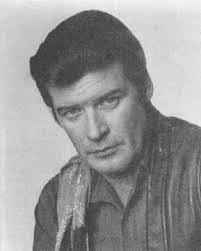
When I was young, Sunday afternoon television instilled in me a great love for old Hollywood musicals and westerns. While Gene Kelly danced his way across the screen, John Wayne rode horses and frequently sparred with Maureen O’Hara. To this day, Gene Kelly is still my favorite male dancer, and John Wayne… his grit and swagger find their way into some of the characters I create. To me, he is the ultimate cowboy. Running a close second to him are Peter Breck and Cameron Mitchell.    

Joseph Peter Breck was born on March 13, 1929 in Haverhill, Massachusetts. He is best known for playing Nick Barkley on The Big Valley. Breck’s father was a jazz musician who played with legends such as Fats Waller and Billie Holiday. As a child, Breck often traveled with his parents until they decided he needed a more stable home life and sent him to live with his grandparents. During this time, his parent divorced and he went to live with his mother in Rochester. She later married Al Weber, the sports writer for the Rochester Times Union.         
Upon graduating high school, Breck enlisted in the Navy. After his tour, he moved to Houston and centered his attention on education. He enrolled in the University of Houston and studied drama and English. It was there he got his start in acting, performing at Houston’s Alley Theatre. Stalag 17 was one of the productions he appeared in before moving to Washington D.C.’s theater district. Actor Robert Mitchum discovered Breck in the stage production of George Bernard Shaw’s The Man of Destiny and cast him in an unbilled role in the film, Thunder Road. Mitchum later brought Breck to Hollywood and helped to launch Breck’s acting career.
Breck appeared in several movies, portraying a variety of characters, before being cast to play Nick Barkley in 1965. The Big Valley is where I know Breck best, as I loved his character. Tall, dark and handsome, Nick Barkley was rough around the edges and had a warm heart. He could ride, rope and shoot, was quick to lose his temper and throw his fists, but at the end of the day, family and honesty mattered most to him. As with John Wayne, I model a lot of my cowboys after Nick Barkley.
Breck later moved to Canada with his wife and son. He founded an acting academy in Vancouver, The Breck Academy, and managed it for ten years. Sadly, his son died at a young age after suffering a long bout with acute myeloid leukemia. Breck laid low after the tragedy, but eventually went on to guest star on several television shows. He died on February 6, 2012 from dementia. I will always remember him as Nick Barkley, the rough-and-tumble, sweet-as-pie cowboy from my childhood.


Cameron McDowell Mitzell was born November 4, 1918 in Dallastown, Pennsylvania. (He later changed his name to Cameron Mitchell at actress Lynn Fontanne’s urging.) Mitchell is the 4th of seven children. His father and mother were both ministers of the Reformed Lutheran Church. Several other men in his family were also ministers, and Mitchell’s father hoped Cameron would follow the same path, but early on Cameron had a love for acting. With the help of a high school teacher, he enrolled in a New York City dramatic school. During his time in the city, he held a variety of jobs while acting on Broadway and writing letters to producers, agents and other actors to further his career. It wasn’t until he criticized a performance of Alfred Hunt did he receive a reply from Hunt offering him an audition.
Mitchell served in World War II as an Air Force bombardier. He made his film debut in 1945, appearing in What Next, Corporal Hargrove? Afterward, he continued with stage and film, gaining recognition twice for his portrayal of Happy in the stage and screen productions of Death of A Salesman. Mitchell continued with roles in westerns, establishing himself as a character actor. He met producer David Dohort when Dohort produced one of Mitchell’s first short-lived television series.  Later on, when Dohort was casting for High Chaparral, his first choice to play Buck Cannon was Cameron Mitchell.        
As with Peter Breck’s Nick Barkley, Buck Cannon became Mitchell’s signature role. This is where I know Mitchell best. His portrayal of Uncle Buck captivated me at a young age. Buck was strong, determined, loyal to family and funny. I model some of Buck’s grit and humor in my own writing.
Mitchell’s love for acting wasn’t his only love. He also had a love for golf, traveling and gambling on the dogs, though by his own words he didn’t gamble often. He loved golf too much for that. Married three times, he sometimes found himself broke, even though, according to him, he made 1,000’s from residuals. Mitchell passed away on July 6, 1994. He was survived by his children and grandchildren, some of which have found their way into acting. To me, he will always be Uncle Buck, that larger-than-life figure on the television screen.