Showing posts with label Idaho. Show all posts

Wednesday, August 21, 2019

STRANGE CRATERS OF THE MOON By Julie Weston

This month I’m pleased to have fellow Women Writing the West colleague, Julie Weston, here to tell you a bit about the setting for her latest book, Moonscape. Julie grew up in Idaho and practiced law for many years in Seattle. Her first book was a memoir of place: The Good Times Are All Gone Now: Life, Death and Rebirth in an Idaho Mining Town (University of Oklahoma Press, 2009). It received honorable mention in the 2009 Idaho Book of the Year Award. Basque Moon was Winner of the WILLA Literary Award for Historical Fiction, and Moonshadows was a finalist for the May Sarton Literary Award. 
            Julie's mysteries are available on Indiebound, at Amazon, and Barnes and Noble in hardback and ebooks.       www.julieweston.com
                                                                        --Andrea Downing

            “Strange and mysterious.” “Like walking on broken dishware.” “a giant’s frying pan of thick gravy frozen instantaneously.” These are some of the phrases used by Two-Gun Bob, Robert Limbert, when he explored Craters of the Moon in Idaho in 1920 and wrote an article about it in 1924, published in National Geographic. Cold lava covers over 700,000 acres of Craters of the Moon in central Idaho, a rare natural phenomenon and now a National Monument and Preserve, originally named by Calvin Coolidge, thanks in part to Limbert’s article. The earliest lava flows, not volcanic explosions, occurred around 15,000 years ago. Since then, lava belched up from the ground an average of every 2,000 years. Craters is overdue for another layer of lava.

            Limbert spent 17 days traveling 50 miles from south to north in the lava fields, accompanied by an Airedale dog and a friend with a horse. He visited more than once, exploring caves, spatter cones, deep pits, and craters along a Great Rift of flows. Two kinds of lava—pahoehoe and a’a—named after volcanic flows in Hawaii greeted him. The a’a flows hampered travel and cut the dog’s paws. Pahoehoe, ropy flows, made for easier exploration. Based on his journal, “strange and mysterious” was almost the least of his discoveries. He jumped into a crater to explore bones and found he could not get out without stacking piles of rocks to make an exit. Lava “bombs” littered the ground near the spatter cones he described as miniature volcanoes. A large lava flow was a brilliant blue, which he called Blue Dragon Flow, partly to reflect the many cracks resembling reptile scales. The party found bear tracks aplenty, but Limbert hoped to find albino grizzlies, rumored to roam the valleys and swales, chasms and buttes, in the area. He did not.  He thought the lava had flowed up until 400 years previously because it looked so shiny and fresh. Traces of the Shoshone-Bannock Indian tribes remained in cairns, rock circles, and dusty trails, but by and large, no others had explored the area to any extent. “Unexplored” and “unknown” marked maps of the area until he drew his own map.
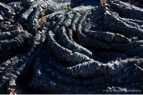
            Because I write mysteries set in the 1920s, Craters of the Moon presented itself as a perfect setting for murderous doings. My husband Gerry and I have explored the area numerous times, including in all seasons. In spring, flowers flourish in abundance—bitterroot, buckwheat, larkspur, tiny monkflowers, and others. The caves in particular drew my attention for mysterious goings-on.  Limbert describes a number of caves, naming some of them, and other physical aspects of Craters. Only five caves remain open, but I felt free to use what he discovered in my mystery, MOONSCAPE.
            My heroine in this third novel of a series is Nellie Burns, photographer, along with her black Labrador dog, Moonshine. They accompany the Basque sheriff, who also plays a leading role, into Craters in search of missing visitors who came to do self-described “God’s work” in the lava fields. Nell, the sheriff, and Moonshine clamber over the ups and downs and explore the caves. They find local cowboys and disturbing scenes among the craters and lava flows. When they camp out under the stars, they talk of their backgrounds, this Idaho sheriff and Chicago photographer. They view the stars and the Milky Way as well as the magic and silence of night in central Idaho. During the day, they search for water and people who have lost their way.

(All photos courtesy of Gerry Morrison.)

Excerpt:
The drive to the lava fields didn’t take long—about two hours. Along the way, the landscape changed from sagebrush and rabbitbrush, some of which was still in yellow bloom, to harvested fields with golden stubble and a few farm buildings. They left the mountains around Hailey and motored along flatter and flatter country. Lower hills bare of trees and wrinkled like army blankets served as a backdrop to the sage. Buttes dotted the landscape as they neared the lava, which indeed was black rock that lay twisted and humped like an imagined moonscape. Black stacks stood out like chimneys from an underground world. Foot travel looked to be strenuous and time-consuming, but, worse, painful.
            Just as the sheriff said, a man in an auto waited. “Two women and a man left Arco, saying they’d be back in two days,” the man told them as he stepped out. “That was five days ago. We don’t know if they went away in another direction, but I thought I should report them gone to the marshal. This area is about to become a national monument, so I figgered that was the right place to call.”
            “And who are you?” Nellie asked.
            “I’m the mayor, I guess you’d say. Mayor Tom. Someone had to take the job. Soon as I find another fool, I’ll quit.”
            “What are we here to see?” The sheriff gestured toward the inky landscape.
            “First off, you should see their auto. It’s down the wagon trail a ways. Then, thought I’d show you some caves. That’s what the folks said they wanted to see. I showed ’em a map. It’s a bit of a walk and darned easy to get lost.” He scratched his head full of ginger hair, grabbed a hat, and closed the auto door. He eyed the dog. “On an expedition through here a couple years ago, the dog we took hurt its feet real bad.”
            Nellie looked at Moonie, glanced at the sheriff and back at the dog, who sat waiting on the ground. Wrong decision.  The sheriff opened the boot.             Nellie pulled out her pack and donned the straps so the pack was carried on her back. The sheriff went to take it, but she shook her head. Her camera, her pack. “Ready.”
            They walked first along a rough wagon road where the parties’ auto sat tilted in a rut. The men looked it over, and then the three of them and Moonshine trudged up and down lava flows, picking their way. It was like walking over broken dishware half the time, slipping and sliding on rock or cinders, as if they were hiking along a coal bin, and the other half on an easier surface, but one with hills and slopes and treacherous footing. The sheriff and Mayor Tom conversed as the sheriff asked questions about the missing trio. The mayor didn’t know much, only that one woman’s name was Effie and they were religious, but he didn’t know what religion. “Could be a regular one or an irregular one,” he said. “We got lots of both around.”
            Nellie spent most of her time being careful where she placed her boots. She regretted not permitting the sheriff to take her pack and regretted bringing Moonshine. So far, though, he seemed to move across the lava better than the three humans. After almost two hours from where they left the autos, the mayor stopped. He stepped off the narrow trail they had been following and led them to what appeared to be a cave entrance in the lava. A rock fall led to the opening, and climbing down across the chunks looked difficult but not impossible. Moonshine circled the opening and tentatively stepped down a few of the rocks. He sniffed and then barked.
            “That’s it?” she asked. “That’s a cave?”
            “Don’t look like much, do it? Still, once you get in there, it opens up.”  Mayor Tom stepped carefully around rocks and brush. He ducked to go in but turned his head back. “Kinda smelly down here.”
            “Tie Moonshine to the boulder over there,” the sheriff said. “We do not know what we will find here.”
            Nellie did as instructed. The sheriff followed the mayor readily, but Nellie wasn’t so sure. The rocks leading to the dark hole suggested heavy going to her, even with boots on.
            The air was dry, and a moldy, dank basement smell hung around the entrance. Mayor Tom had a flashlight, as did the sheriff. Their lights helped to dispel Nellie’s nervousness. The mayor crouched low under a rocky overhang and waddled forward and then disappeared. Sheriff Azgo took Nellie’s hand and said, “Hang on to my belt.” He crouched, as did Nellie, and both squat-walked past the overhang. Around a sharp corner, they stepped into a large space lit close around them by Mayor Tom’s flashlight, but midnight dark around the edges. They cast huge shadows and could stand upright. The smell worsened and hung like fog in the cave.
            It was then Nellie saw a bundle of clothes at the rocky, dark edge. It moved as she watched. She screamed—not loud and long, but still a scream. The sheriff looked to where she pointed. He and Mayor Tom strode to the bundle. The sheriff turned it over, and a small creature dashed away. There lay a body, its shadowed face eaten half away, and dried, black blood clamped its neck.

Friday, December 12, 2014

Champagne, #Christmas, and Fossils in the Old West by @JacquieRogers #western


December in the Old West
by Jacquie Rogers

Winter months in Owyhee County in Idaho Territory brought plenty of inclement weather and the citizens couldn’t do much in the way of prospecting or farming. Nevertheless, they kept themselves busy, and the Christmas season brought plenty of opportunity, which The Owyhee Avalanche took great delight in reporting. The following articles all came from December issues.

December 14, 1867
SOCIAL BALL. We had the pleasure of attending a Social Ball given at the Mechanics hall on Tuesday evening last. A general invitation was extended and a large number were present, who appeared to enjoy themselves hugely. There was good music, and the new Hall is certainly a splendid place in which to “twist your heel around.” One of the best features of the arrangement was the magnificent supper prepared and eaten at the Idaho Hotel, the proprietors of which can’t be excelled in their line of business. We return thanks for complimentary tickets.

I think it would be rather painful to “twist your heel around,” but it is a colorful term for dancing. Besides the larger events, plenty of spirit found its way to smaller venues, such as the Avalanche office.

December 21, 1867
Thanks to Messrs. Chase & Brooker of the Owyhee Exchange for a liberal supply of champagne. “Fenian dew drop,” and a box of fragrant Havana’s. The boys use everybody first rate—give them a call.

Another article on the same day shows that the people of the Old West had a variety of interests besides finding the next big strike, drinking, and gambling.

FOSSIL RESEARCH. There is an extensive and interesting field for geological research on and in the vicinity of Sinker Creek, commencing at its junction with Snake River and extending several miles up the creek. Mr. J.C. Holgate of this place, who is quite a practical geologist has recently made of some interesting discoveries in that section, showing abundant evidence of its having been densely populated by animals that existed during the Cretaceous period of the Reptilian age. Among other things of interest that were shown us by Mr. H were a number of bones that from their size and appearance, unmistakably have belonged to the Microgigarous, long before a man’s appearance on the earth. It is thought the entire skeleton in which these bones belong can be exhumed. In the collection we observed the head of a reptile, well preserved and almost entire somewhat resembling that of an alligator of the present day. It had fearful looking teeth and its jaws were firmly set as it was sealed by some great and sudden convulsion of nature. Marine shells and petrified rocks also abound. Facts like these, if investigated by Agassiz would form valuable to science. As it is, they exhibit one among the many interesting features of Owyhee County.

One thing about people—there have always been scammers. And so it went in Owyhee County, although they seemed to have good humor about it.

December 7, 1872
A HOAX. As referred to in our last issue the great diamond excitement has proved as complete a hoax as was the South Sea Bubble. Owyhee, too, has her diamonds, which can be gathered by the quart on Sinker Creek. Perhaps we can dig up old Caleb Lyons diamond, and get up another first-class excitement.

Nothing went to waste. People moved often and those who stayed or had just moved in were beneficiaries, either by gift or by sale.

December 7, 1872
THERE WILL BE AN AUCTION TODAY, commencing at 11 o’clock A.M. at the house recently occupied by W.D. Walbridge, near the Owyhee mill. Carpets, stoves, and household furniture of every description will be sold to the highest bidder. A conveyance will be in readiness to accommodate ladies who desire to attend the auction.

I’ve heard lots of talk lately about whether they had Christmas trees in the Old West. They did in Silver City.

December 21, 1872
THE CHRISTMAS TREE. The Christmas Tree Festival will be held in Jones & Bonney’s Hall. We will stake in addition to what was said in our last issue, that the Brass Band, composed at present of Messrs. Charles Leonard, Joe Gross, Benj. Davis, Rufus King, Ferd. W. Frost and E. Douglas, will perform some of their best pieces, which will add greatly to the pleasure of the occasion.

The singing, accompanied by the organ, will be done principally by young girls who have learned all the music they know in Silver City, and who by virtue of talent, industry and a good teaching have acquired, in our judgment, wonderful proficiency in the beautiful art over which the Muses preside. They are our little folks, and not imported singers, which will make it all the more interesting; that they will do their part in first-class style for their ages, we have not the least doubt, in fact, we know they will.

The tree will be a prolific one no doubt. The Argosy of Santa Claus, St. Nicholas, & Co. arrived at the port of San Francisco four days ago, as we are informed per telegram, and a large cargo of its merchandise is on its way up here, and will not fail to arrive in time.

In 1871, the livestock business was just taking hold.  The oldest ranch had been in business only five years. New stock, especially blooded animals, whether horses, cattle, or hogs, always made the news.

December 23, 1871
THOROUGH-BRED STOCK. We regard the man, who introduces an improved breed of horses, cattle, or hogs into our Territory, as a greater public benefactor than he who discovers a rich quartz mine. Messrs. Hoffer & Miller, well known, highly esteemed and enterprising citizens of this place, are taking steps in the right direction. Last summer they imported from Kentucky nine thorough-bred Durham bulls and two young Berkshire hogs—a bore and a sow. From some cause or the other one of the bulls died not long ago, but the remaining eight are doing finely. The hogs are beauties and can be seen at Sommercamp’s Brewery. Mr. Hopper started for Kentucky again last week after more stock, and will bring back with him in the spring several thorough-bred Durham heifers, some genuine White Chester hogs, and also a number of Durham bulls for Mr. W.F. Sommercamp, who intends to engage quite extensively in the business of stock raising... It costs no more to raise good stock than inferior, and it is vastly more profitable to the owners after getting rightly started in the business. Although they will have expanded a large amount of money, before they can hope for an return, yet they are certain to reap the substantial benefits that their energy and enterprise so well deserve.

The editor of The Owyhee Avalanche reported something about the suffragist movement in nearly every issue. It appears as though he’s amused by the whole idea of women voting, and I doubt he thought such a thing would ever come about.

December 14, 1872
COLONEL SUSAN B. ANTHONY and fourteen other strong-minded females have been arrested in New York for voting. Col. Susan has long been anxious to have her action at law against the State for depriving her of the elective franchise; now has her lawsuit, but the State is a plaintiff. This is pilling on the outrage. Susan went to one of the registrars in the city of Rochester and demanded registration; like a man of gallant and chivalrous disposition, he said “Yea, yea,” and now the lady must fight the word “male” in the State Constitution. Susan’s constitution is by far the strongest.

I’ve seen this next item on the internet several times, although never in a contemporaneous newspaper. But here it is, the language of handkerchiefs. Saratoga is in New York, so I’m not quite sure what this article had to do with the local citizens, especially when there weren’t enough ladies to go around as it was.

December 14, 1872
THE HANDKERCHIEF LANGUAGE.—The young ladies at Saratoga are so closely watched by their parents that they can’t flirt half as well as they used to. The fellows complain that they can’t get five minutes talk with a young lady alone, and that accounts for so few engagements this year. They say they don’t want to propose before the young ladies’ mothers. To foil the fathers and mothers, some of the fellows have invented the following language of the handkerchief. Thus they can set an talk for hours, and the savage and Kroll parent can’t understand a word. This is the new handkerchief language:
Drying a cross the lips—Desirous of acquaintance.
Handing it to mother—Mother objects.
Putting it in the pocket—Meet me at the spring.
Letting it rest on the right cheek—Yes.
Letting it rest on the left cheek—No.
Drawing it across the eyes—I am sorry.
Taking by center—You are too willing.
Dropping—We will be friends.
Twirling in both hands—Indifference.
Drawing it across the cheek—I love you.
Drawing through the hands—I hate you.

You can just imagine the poor editor scrambling for anything he could find to fill the pages during the slow months. Here’s the very definition of a slow news day—he reported a man’s dream. Not kidding. Here it is.

December 16, 1871
ED. SMITH’S DREAM. A comical genius, of War Eagle Mountain, named Ed. Smith, relates that he dreamed of dying the other night and going to heaven, or at least to the gate of the celestial city whose streets are said to be paved with gold. Knocking at the portal, Smith was confronted by St. Peter who told him he must cut 15 cords of dry tamarack wood, or take a ticket for “the other place.” He took the ax, and after performing the task imposed, returned to the gate, where he was somewhat surprised to meet his old friend Ike Culp, of the Oro Fino saloon. St. Peter directed Ike to take the ax and cut 14 1/2 cords of dry tamarack as a preliminary to the right-of-way through the gate. Ike didn’t seem very well pleased with the idea and went off grumbling. In a short time he returned, threw down the ax, and told St. Peter he would take a through ticket for Pandemonium rather than cut the d.m.d wood. Ike’s boisterous manner and loud talk awoke Smith and thus ended the dream.

All those who wonder whether or not they cussed have it right there. I’m sure we all know what d.m.d means.

If you need to know about stage lines, this next tidbit could be useful:

December 24, 1870
CHANGED HANDS. Wells, Fargo, & Co. have sold out their stage line between Virginia and Reno to Hill Beachey. That was the last of W.F. & Co.’s stage lines.

And here’s a variety of local events and happenings collected from several issues:

  • Our old friend Fred Hibb is again driving stage from Silver City to the Sheep Ranch.
  • Crowley & Glynn have leased Maj. Brookey’s Restaurant, and will dish things up in tip-top shape. Their advertisement will appear next week.
  • There are some tattling busybodies in Silver City, who would do well to mind their own business instead of continuing meddling with that of others.
  • Andy Baker has taken the place of Charles Haybes in the management of the stage line from Boise City to Winnemucca. He is a clever, genial gentleman, and has the reputation of being a good stage man.
  • J.F. Dye, of MTN City, whose settlement of the Pacific Coast antedates old ‘49-ers 20 years, passed through Elko on Thursday last for San Francisco where he will spend a few weeks with his children, after which he contemplates a visit to Texas with a view of driving a band of cattle to Nevada. Mr. Dye is an old pioneer on this coast, and although aged 65 years, still has the vim and the enterprise of one in the prime of life.
  • We are informed that a gay deck of hardies will all arrive here this week.
  • Joe Short has just received an extensive stock of liquors, &c, from San Francisco.
  • Another an effort has been made to get a Governor for Idaho, the President having nominated a carpet bagger named A.H. Connors.
  • Yesterday we noticed a large quantity of goods being brought into town. We understand that our townsman G.W. Grayson, Esq., has gone into merchandising and will do business in the building formerly occupied by Creed & Bro.
  • Every time that Thos. Ewing & Co. make a big sale of goods they consider the printers and send us a bottle or two of something nice to take. They have made it rather lively for us during the last two weeks.


December Events

  • December 18, 1860: Texas Ranger Sul Ross found Cynthia Ann Parker during the Battle of Pease River, in Foard County. She’d been captured in 1839 and married Peta Nocona. 
  • December 3, 1864: Gold was discovered near Confederate Gulch in Montana Territory. 
  • December 3, 1866: Nelson Story and his cowboys drive his herd of a thousand cattle into Gallatin Valley in Montana Territory. This was the first cattle drive from Texas to Montana, a distance of 2,500 miles. 
  • December 9, 1867: Denver becomes the capital of Colorado, taking the honor from Golden.
  • December 11, 1869: About 65 vigilantes lynched the Reno brothers, who’d been jailed for the country’s first train robbery (Ohio and Mississippi Railway, Indiana) in 1866. 
  • December 25, 1869: In Towash, Texas, John Wesley Harding got his reputation as the fastest gun in the West when he out-drew Jim Bradley. (This event is reported as occurring Jan. 5, 1870, at some sites, including Wikipedia.)
  • December 10, 1871: Lots go on sale for the first time in Phoenix, Arizona.
  • December 8, 1874: Lt. Lewis Warrington III attacked a Comanche camp in the Mushaqua Valley, Texas, while on a scouting mission during the Red River War. He was awarded the Medal of Honor. 
  • December 4, 1876: Jack McCall’s second trial for the murder of Wild Bill Hickock begins in Yankton, Dakota Territory. He was convicted on December 6. 
  • December 10, 1878: Henry Wells, of Wells, Fargo, & Co., died.
  • December 15, 1890: Lakota police officers shot and killed Sitting Bull, saying he resisted arrest. 
  • December 24, 1894: Harvey Logan (Wild Bunch) shot and killed deputy sheriff Pike Landusky at a party in Jew Jake’s Saloon. 

 May your saddle never slip.


Hearts of Owyhee