

Julie's mysteries are available on Indiebound, at Amazon, and Barnes
and Noble in hardback and ebooks. www.julieweston.com
--Andrea Downing
“Strange
and mysterious.” “Like walking on broken dishware.” “a giant’s frying pan of
thick gravy frozen instantaneously.” These are some of the phrases used by
Two-Gun Bob, Robert Limbert, when he explored Craters of the Moon in Idaho in
1920 and wrote an article about it in 1924, published in National Geographic.
Cold lava covers over 700,000 acres of Craters of the Moon in central Idaho, a
rare natural phenomenon and now a National Monument and Preserve, originally
named by Calvin Coolidge, thanks in part to Limbert’s article. The earliest
lava flows, not volcanic explosions, occurred around 15,000 years ago. Since
then, lava belched up from the ground an average of every 2,000 years. Craters
is overdue for another layer of lava.

Limbert
spent 17 days traveling 50 miles from south to north in the lava fields, accompanied
by an Airedale dog and a friend with a horse. He visited more than once,
exploring caves, spatter cones, deep pits, and craters along a Great Rift of
flows. Two kinds of lava—pahoehoe and a’a—named after volcanic flows in Hawaii greeted
him. The a’a flows hampered travel and cut the dog’s paws. Pahoehoe, ropy
flows, made for easier exploration. Based on his journal, “strange and
mysterious” was almost the least of his discoveries. He
jumped into a crater to explore bones and found he could not get out without
stacking piles of rocks to make an exit. Lava “bombs” littered the ground near
the spatter cones he described as miniature volcanoes. A large lava flow was a
brilliant blue, which he called Blue Dragon Flow, partly to reflect the many
cracks resembling reptile scales. The party found bear tracks aplenty, but
Limbert hoped to find albino grizzlies, rumored to roam the valleys and swales,
chasms and buttes, in the area. He did not.
He thought the lava had flowed up until 400 years previously because it
looked so shiny and fresh. Traces of the Shoshone-Bannock Indian tribes
remained in cairns, rock circles, and dusty trails, but by and large, no others
had explored the area to any extent. “Unexplored” and “unknown” marked maps of
the area until he drew his own map.
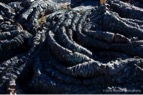
Because I
write mysteries set in the 1920s, Craters of the Moon presented itself as a
perfect setting for murderous doings. My husband Gerry and I have explored the
area numerous times, including in all seasons. In spring, flowers flourish in
abundance—bitterroot, buckwheat, larkspur, tiny monkflowers, and others. The
caves in particular drew my attention for mysterious goings-on. Limbert describes a number of caves, naming
some of them, and other physical aspects of Craters. Only five caves remain
open, but I felt free to use what he discovered in my mystery, MOONSCAPE.
My heroine
in this third novel of a series is Nellie Burns, photographer, along with her
black Labrador dog, Moonshine. They accompany the Basque sheriff, who also
plays a leading role, into Craters in search of missing visitors who came to do
self-described “God’s work” in the lava fields. Nell, the sheriff, and Moonshine
clamber over the ups and downs and explore the caves. They find local cowboys
and disturbing scenes among the craters and lava flows. When they camp out
under the stars, they talk of their backgrounds, this Idaho sheriff and Chicago
photographer. They view the stars and the Milky Way as well as the magic and
silence of night in central Idaho. During the day, they search for water and
people who have lost their way.

(All photos courtesy of Gerry Morrison.)

Excerpt:
The drive to the lava fields didn’t take long—about two
hours. Along the way, the landscape changed from sagebrush and rabbitbrush,
some of which was still in yellow bloom, to harvested fields with golden
stubble and a few farm buildings. They left the mountains around Hailey and
motored along flatter and flatter country. Lower hills bare of trees and wrinkled
like army blankets served as a backdrop to the sage. Buttes dotted the
landscape as they neared the lava, which indeed was black rock that lay twisted
and humped like an imagined moonscape. Black stacks stood out like chimneys
from an underground world. Foot travel looked to be strenuous and
time-consuming, but, worse, painful.
Just as
the sheriff said, a man in an auto waited. “Two women and a man left Arco,
saying they’d be back in two days,” the man told them as he stepped out. “That
was five days ago. We don’t know if they went away in another direction, but I
thought I should report them gone to the marshal. This area is about to become
a national monument, so I figgered that was the right place to call.”
“And who
are you?” Nellie asked.
“I’m the
mayor, I guess you’d say. Mayor Tom. Someone had to take the job. Soon as I
find another fool, I’ll quit.”
“What
are we here to see?” The sheriff gestured toward the inky landscape.
“First
off, you should see their auto. It’s down the wagon trail a ways. Then, thought
I’d show you some caves. That’s what the folks said they wanted to see. I
showed ’em a map. It’s a bit of a walk and darned easy to get lost.” He
scratched his head full of ginger hair, grabbed a hat, and closed the auto
door. He eyed the dog. “On an expedition through here a couple years ago, the
dog we took hurt its feet real bad.”
Nellie
looked at Moonie, glanced at the sheriff and back at the dog, who sat waiting
on the ground. Wrong decision. The
sheriff opened the boot. Nellie
pulled out her pack and donned the straps so the pack was carried on her back.
The sheriff went to take it, but she shook her head. Her camera, her pack.
“Ready.”
They
walked first along a rough wagon road where the parties’ auto sat tilted in a
rut. The men looked it over, and then the three of them and Moonshine trudged
up and down lava flows, picking their way. It was like walking over broken
dishware half the time, slipping and sliding on rock or cinders, as if they
were hiking along a coal bin, and the other half on an easier surface, but one
with hills and slopes and treacherous footing. The sheriff and Mayor Tom
conversed as the sheriff asked questions about the missing trio. The mayor
didn’t know much, only that one woman’s name was Effie and they were religious,
but he didn’t know what religion. “Could be a regular one or an irregular one,”
he said. “We got lots of both around.”
Nellie
spent most of her time being careful where she placed her boots. She regretted
not permitting the sheriff to take her pack and regretted bringing Moonshine.
So far, though, he seemed to move across the lava better than the three humans.
After almost two hours from where they left the autos, the mayor stopped. He
stepped off the narrow trail they had been following and led them to what
appeared to be a cave entrance in the lava. A rock fall led to the opening, and
climbing down across the chunks looked difficult but not impossible. Moonshine
circled the opening and tentatively stepped down a few of the rocks. He sniffed
and then barked.
“That’s
it?” she asked. “That’s a cave?”
“Don’t
look like much, do it? Still, once you get in there, it opens up.” Mayor Tom stepped carefully around rocks and
brush. He ducked to go in but turned his head back. “Kinda smelly down here.”
“Tie
Moonshine to the boulder over there,” the sheriff said. “We do not know what we
will find here.”
Nellie
did as instructed. The sheriff followed the mayor readily, but Nellie wasn’t so
sure. The rocks leading to the dark hole suggested heavy going to her, even
with boots on.
The air
was dry, and a moldy, dank basement smell hung around the entrance. Mayor Tom
had a flashlight, as did the sheriff. Their lights helped to dispel Nellie’s
nervousness. The mayor crouched low under a rocky overhang and waddled forward
and then disappeared. Sheriff Azgo took Nellie’s hand and said, “Hang on to my
belt.” He crouched, as did Nellie, and both squat-walked past the overhang.
Around a sharp corner, they stepped into a large space lit close around them by
Mayor Tom’s flashlight, but midnight dark around the edges. They cast huge
shadows and could stand upright. The smell worsened and hung like fog in the
cave.
It was
then Nellie saw a bundle of clothes at the rocky, dark edge. It moved as she
watched. She screamed—not loud and long, but still a scream. The sheriff looked
to where she pointed. He and Mayor Tom strode to the bundle. The sheriff turned
it over, and a small creature dashed away. There lay a body, its shadowed face
eaten half away, and dried, black blood clamped its neck.


