
Hi everybody and welcome to August 23rd.
Gosh where has the time gone.
Most everybody has kids going back to school already and I have to say i'm a bit jealous. I still have 2 more weeks with my kiddos.
It's a bittersweet year for me though. My oldest graduated high school in June and in just 3 days, i will be transplanting her into her new dorm room at college.
I feel so old :( and I'm sad. She and I are very close so it'll be hard for both of us i'm afraid. Feel free to send positive thoughts that this emotional mama keeps it together :)
Anywho, when i was researching info for my blog day, i ran across an interesting fact that i didn't know.
Does everyone know who Annie Oakley is?

Well on this day, August 23rd in 1876, she married
traveling show marksman Frank E. Butler
and below are 11 interesting facts about Annie !
1. She made her first shot at 8 years old.
Born on August 13, 1860 in a rural part of western Ohio,
Phoebe Ann Moses grew up poor. Her father’s death in 1866 meant that she had to
contribute to help her family survive, so she trapped small animals such as
quail for food. At eight years old, she made her first shot when she killed a
squirrel outside her house. “It was a wonderful shot, going right through the
head from side to side. My mother was so frightened when she learned that I had
taken down the loaded gun and shot it that I was forbidden to touch it again
for eight months,” she later said.
2. She used her shooting skills to pay off her moms mortgage.
 Despite Oakley’s top-notch shooting skills, her widowed
mother struggled to make ends meet. She sent Oakley to work for another family
in exchange for her daughter getting an education. As a teenager, Oakley
returned home (after working as a servant for an abusive family) and continued
to hunt animals. She sold the meat to an Ohio grocery store, earning enough
money to pay her mom’s $200 mortgage. She later wrote:
"Oh, how my heart leaped with joy as I handed the money to mother and told
her that I had saved enough to pay it off!"
Despite Oakley’s top-notch shooting skills, her widowed
mother struggled to make ends meet. She sent Oakley to work for another family
in exchange for her daughter getting an education. As a teenager, Oakley
returned home (after working as a servant for an abusive family) and continued
to hunt animals. She sold the meat to an Ohio grocery store, earning enough
money to pay her mom’s $200 mortgage. She later wrote:
"Oh, how my heart leaped with joy as I handed the money to mother and told
her that I had saved enough to pay it off!"
3. She beat her future husband in a shooting match.
At 15 years old, Oakley participated in a shooting match on
Thanksgiving with Frank Butler, an Irish-American professional marksman. The
match, which happened in Cincinnati, was a doozy. To Butler’s surprise, the
teenage girl outshot him by one clay pigeon, and he lost the $100 bet he had placed.
Rather than feel embarrassed or emasculated by his loss, Butler was impressed
and interested, and the two married the following year.

4. Despite her profession, she emphasized her femininity.
At the end of the 19th century, shooting was a predominantly
male activity, and Oakley certainly stood out. But rather than dress or behave
like a man to fit in, she emphasized her femininity. She wore her own
homemade costumes on stage, behaved modestly, and engaged in
"proper" female activities such as embroidery in her spare time.
5. She was only 5 feet tall. (I feel her pain lol)
In addition to Oakley’s gender, her diminutive stature made
her stand out in the world of sharpshooting. In 1884, the Sioux chieftain
Sitting Bull befriended Oakley when the two performers were traveling across
the country. Acknowledging both her height and her shooting skill, Sitting Bull
nicknamed Oakley Watanya Cicillia (English translation: Little
Sure Shot). The American Indian warrior liked Oakley so much that he gave her
his special moccasins to "adopt" her as his daughter.
6. She performed for Kings and Queens in Europe.

Although the concept of the Wild West is firmly rooted in
Americana, Oakley showed off her shooting skills across Europe as part of
Buffalo Bill’s Wild West show. In 1887, she performed for Queen Victoria at the
American Exposition in London, and the queen reportedly told
Oakley that she was a "very clever little girl." In 1889, Oakley
performed at the Paris Exposition and traveled to Italy and Spain. The press
loved her, the king of Senegal wanted her to come help control the tiger
population in his country, and Italy’s King Umberto I was a fan.
7. She offered to lead female shoots in World War I.
Wanting
to use her shooting skills to serve her country, Oakley wrote a letter to
President McKinley in 1898. She offered to provide 50 female sharpshooters
(with their own arms and ammunition) to fight for the United States in the Spanish-American
War, but she never got a response. Similarly, in 1917, she contacted the U.S.
Secretary of War to offer her expertise to teach an army unit of women shooters
to fight in World War I. She didn’t hear back, so she visited army camps,
raised money for the Red Cross, and volunteered with military charities instead
8. She sued the press for publicizing her (non-existent) drug addiction.
In August 1903, two of William Randolph Hearst’s newspapers
in Chicago reported that Oakley was a cocaine addict who was arrested for stealing a black man’s pants. Other newspapers ran the
story, and Oakley—who was neither a drug addict nor a thief—was horrified.
"The terrible piece … nearly killed me … The only thing that kept me alive
was the desire to purge my character," she said.
The woman who had been arrested in Chicago was a burlesque performer whose
stage name was Any Oakley. Most newspapers published retractions, but Hearst
didn’t. He (unsuccessfully) hired a private investigator to uncover anything
sordid about Oakley. Oakley sued 55 newspapers for libel, ultimately winning or
settling 54 of them by 1910. Despite winning money from Hearst and other
newspapers, costly legal expenses meant that she ultimately lost money to clear
her name.
9. Thanks to Thomas Edison, she became a film actress.
 In 1888, Oakley acted in Deadwood Dick, a financially unsuccessful play. At the Paris Exposition the next year, though, she met Buffalo Bill Cody’s friend Thomas Edison. In 1894, Oakley visited Edison in New Jersey and showed off her shooting skills for the inventor’s Kinetoscope. The resulting film, called The Little Sure Shot of the Wild West, featured Oakley shooting a rifle to break glass balls. Although she didn’t continue acting in film, she did act in The Western Girl, a play in which she portrayed a sharpshooter, in 1902 and 1903.
10. Two serious accidents halted her career.
In 1901, Oakley was
injured in a train accident while traveling between North Carolina and Virginia
for a performance. Although reports differ about the severity of her injuries,
we do know that she took a year off from performing after the accident. Two
decades later, Oakley was injured in a car accident in Florida. Her hip and
ankle were fractured, and she wore a leg brace until 1926, when she passed away
from pernicious anemia in Ohio at age 66. Frank Butler, her
husband of 50 years, died 18 days later.
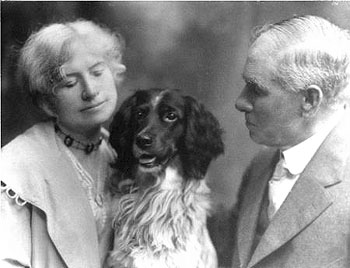
11. Her name became an idiomatic expression.
You know you’ve made
it when your name becomes an idiom. Because of her shooting skills, the phrase
"Annie Oakley" acquired a meaning of a free ticket to an event.
Performing with Buffalo Bill’s Wild West show, Oakley shot holes in tiny
objects, making targets out of everything from playing cards to a dime to a
cigar dangling out of her husband’s mouth. Because free admission tickets for
theatrical shows had holes punched in them (so they wouldn’t be sold to someone
else), these tickets came to be called "Annie Oakleys."
Thanks for visiting and have a great day !!
***
Krista Ames was born and raised in Indiana. She now resides
in
Northern Michigan with the love of her life and their 4 children.
She is a full time stay-at-home mom and pursues her writing career
when she's
not chasing kids, cooking or doing laundry.
Krista would love to
hear from you any time via krista@kristaames.com
and can be found at any of these places !
Website:
http://www.kristsaames.com
Review Blog:
http://www.fallintoreadingreviews.blogspot.com
Paranormal Blog:
http://bittenshiftednotnormalbooks.blogspot.com
Author Promotions
Blog: http://www.bridgingthegappromotions.blogspot.com
Twitter:
https://twitter.com/kristaames
Pinterest:
http://www.pinterest.com/kristaames/
Goodreads: https://goo.gl/LoYf7K
Amazon Author Page:
https://goo.gl/7/DeooR
Book Gorilla:
http://www.bookgorilla.com/author/B004FLQ9XM/krista-ames
Roane Publishing
Author Page: http://www.roanepublishing.com/krista-ames.html
RB4U Author Page:
http://www.romancebooks4us.com/Krista_Ames.html
Cowboy Kisses
Author Page: http://cowboykisses.blogspot.com/p/krista-ames.html
Manic Readers:
https://www.manicreaders.com/KristaAmes/




.jpg)
