Showing posts with label Oklahoma. Show all posts

Monday, May 5, 2025

Arbuckle Mountains


By Kristy McCaffrey

The Arbuckle Mountains, located in the southern part of Oklahoma, are the oldest known formations in the United States between the Appalachian and Rocky Mountains. They were named for General Matthew Arbuckle (1778-1851), based on a nearby Fort Arbuckle that had been christened in his honor.

The mountains were part of the Chickasaw Nation within the Indian Territory until 1907 when the Twin Territories (Indian and Oklahoma) were combined under the jurisdiction of the U.S. Federal government to form the state of Oklahoma. Prior to that, the Chickasaw Nation had governed itself.

Arbuckle Mountains

There is a major lake in the region, Lake Arbuckle, as well as the Washita River. The Arbuckles are an important mining region for limestone and dolomite, although early settlers were mainly subsistence farmers and ranchers.

Arbuckle Mountains

In my upcoming release THE SWAN, the setting is Conleyville, a fictitious town in the Chickasaw Nation at the base of the Arbuckle Mountains.

Pre-Order THE SWAN


(it will also be available at Kobo and in paperback on release day)

Oklahoma Territory
November 1899 

Dr. Anna Ryan has been spurned by the Dallas medical community for the simple reason of being a woman. Wanting more than a rural practice alongside her mother, also a doctor, Anna accepts an invitation from a mentor to join a private hospital for disabled children in Oklahoma City. But when she falls in with a band of women attempting to liberate a town of innocents, she’ll need more than her medical training to survive.

Malcolm Hardy has skirted the line between lawlessness and justice since escaping the mean streak of his father and his no-good half-siblings a decade ago. In Oklahoma Territory he created enough distance from his family name to find a quiet purpose to his days. But then Anna Ryan walks back into his life, and his hard-won peace is in jeopardy.

The last time Malcolm saw Anna, she had been a determined girl he couldn’t help but admire. Now she was a compelling woman who needed his help to find The Swan, a mysterious figure with a questionable reputation. But one thing was clear—Anna’s life path was on a trajectory for the remarkable while Malcolm’s was not. Surrendering to temptation would only end in heartbreak.

Anna is the eldest daughter of Logan and Claire from THE DOVE. 

The Wings of the West Series Reading Order
Book One: The Wren
Book Two: The Dove
Book Three: The Sparrow
Book Four: The Blackbird
Book Five: The Bluebird
Book Six: The Songbird (Novella)
Book Seven: Echo of the Plains (Short Story)
Book Eight: The Starling
Book Nine: The Canary
Book Ten: The Nighthawk
Book Eleven: The Swan (Coming Soon) 

Connect with Kristy


Friday, June 24, 2022

Formation of Oklahoma Territory by Zina Abbott


The formation of Oklahoma Territory came about almost opposite of how most of the other territories in the United States were formed. Usually, starting at the end of the Revolutionary War, the nation acquired large tracts of land through some form of purchase agreement or other acquisition. An example is the Northwest Territory formed by the Ordinance of 1781, officially titled "An Ordinance for the Government of the Territory of the United States North West of the River Ohio."


These large land acquisitions were later broken down into smaller territories until population and other factors led to individual territories being organized into states. By looking at the above map of the Northwest Territory, it is possible to see the states that were formed from it.

Original Five Civilized Tribes Territory

Not so Oklahoma Territory. Originally part of the Louisiana Purchase of 1803, in 1830, it was set aside as Indian Territory for the purpose of removing what are known as the Five Civilized Tribes off of their territory east of the Mississippi River to the West. It was to be their land for forever.


1834 map of Indian Country

With the Indian Intercourse Act of 1834, the U.S. Congress set aside land for Native Americans. At the time, that land was unorganized territory that consisted of the federal land "west of the Mississippi and not within the states of Missouri and Louisiana, or the territory of Arkansas..." That lasted until pressure to remove tribes from the Mississippi and Missouri River basins prompted the U.S. government to send several of these tribes to reservations in Indian Territory that originally were assigned to one of the original five tribes.

There was also a push to open the land in Kansas and Nebraska Territories for white settlement. In 1854, the government pressured many tribes to “sell” their land, including, in some cases, reservation land previously granted. Some tribes in both those territories also ended up being given land in Indian Territory. By 1856, the territory had been reduced to approximately the modern-day borders of the state of Oklahoma, except for the Oklahoma Panhandle and Old Greer County.

Next, the American Civil War happened. Although there were notable bands of the Cherokee who fought for the Union, many slave-holding bands of the five original tribes threw their lot in with the Confederacy. Once the war ended, all bets were off as far as treaties promising large tracts of land. In 1866, the U.S. government required new treaties which forced them into land and other concessions. The Five Civilized Tribes were required to emancipate their slaves and offer them full citizenship in the tribes if they wanted to stay in the Nations.


Arrow shows Unassigned Territory-Note reservations added since Civil War

The government also forced the cession of some 2,000,000 acres of land in the center of the Indian Nation Territory—what became known as Unassigned Territory—the first target of those who wanted the land opened to white settlement.

A land run or land rush was an event in which previously restricted land of the United States was opened to homestead on a first-arrival basis. Lands were opened and sold first-come or by bid, or won by lottery, or by means other than a run. The settlers, no matter how the settlers acquired occupancy, purchased the land from the United States Land Office.


There were five land runs in Oklahoma Territory (former Indian reservation land) between 1889 and 1895.

The Oklahoma Land Rush of 1889 on the Unassigned Territory—land held by the U.S. government that has not been assigned to any tribe as a reservation—was the most prominent of the land runs. For over a decade, Boomer groups had been agitating for settlement of this land called “Oklahoma Land” by illegally entering it until escorted out by federal Army troops, tried in Judge Isaac Parker’s court at Fort Smith, Arkansas, and ordered to pay a fine. “Oklahoma” is a Choctaw word meaning “red people.” It is derived from the words for people (okla) and red (humma). This white settlement of the unassigned territory became the nucleus of what would become Oklahoma Territory.

During the year between the April 22, 1889—the date of the first land run—and May 2, 1890, the people of what became Oklahoma Territory were semi-autonomous. Federal military troops provided law enforcement since there was no local law enforcement. The United States District Court for the Western District of Arkansas under federal judge Isaac Parker was the only form of criminal and civil jurisdictions.

1890 Oklahoma and Indian Territories

On May 2, 1890, Congress passed the Oklahoma Organic Act organizing the western half of Indian Territory into Oklahoma Territory.

Congress included in Oklahoma Territory the strip of country known as “No Man's Land”—what many today refer to as the Oklahoma Panhandle—which became Beaver County. Greer County, which had for years been disputed territory between Texas and Indian Territory was brought into Oklahoma Territory.

The eastern half of the former Indian Territory remained Indian Territory under Indian rule, mostly the Five Civilized Tribes.

The other land runs involved territory assigned to various tribes for reservations. For former Indian lands, the Land Office distributed the sales funds to the tribal entities, according to previously negotiated terms.

The 1891 Land Run held September 22nd  opened the unassigned plots in the former Iowa, Sac and Fox, Potawatomi, and Shawnee reservation lands.

The Land Run on April 19, 1892 opened settlement on the former Cheyenne and Arapaho reservation lands.

The 1893 Land Run known as the Cherokee Strip run, but in actuality involved all of the Cherokee Outlet land sold by the Cherokee tribe to the U.S. government, was the largest. It was held September 16th.

The opening of the former Kickapoo area held on May 3, 1895 was the last use of a land run in the present area of Oklahoma. It was also the smallest run.


After that, the U.S. government decided land runs were not the most efficient or safest way to distribute land. (Quite a few people in the 1893 land run alone died due to gunshot wounds, being burned to death, heat stroke, and accidents involving animals and wagons or carriages.)

On August 6, 1901 claims for available homesteads on the Wichita-Caddo and Comanche, Kiowa and Apache lands were determined by means of a land lottery. With 2,080,000 acres available, nearly 170,000 people registered at the El Reno and Fort Sill land offices between July 9 and July 28. The 6,500 names first drawn between July 29 and August 5 won the claims.

Between December 3 and 15, 1906, the United States Land Office accepted sealed bids for quarter sections of land in what was called the ‘Big Pasture’ in Oklahoma Territory. It continued until all the quarter sections were sold. Successful bidders were required to live on the land for five years. They could pay in installments during their residency.

When it came time to consider statehood, the tribes in Indian Territory sought to become a separate state from Oklahoma. They believed doing so would give them greater autonomy in managing tribal affairs. However, the U.S. government insisted on combining Oklahoma Territory with Indian Territory. The two together were brought in as the state of Oklahoma on November 16, 1907.

-o0o-


My most recently published book, Joshua’s Bride, is the first book in the Land Run Mail Order Brides series. It is set during the 1893 Land Run in the Cherokee Outlet. It is available as an ebook for purchase or at no additional cost with your Kindle Unlimited subscription. It is also available as a paperback.

To find the book description and purchase options, please CLICK HERE


 Sources:

https://en.wikipedia.org/wiki/Oklahoma_Territory

https://nationalcowboymuseum.org/explore/rushes-statehood-oklahoma-land-runs/

https://www.loc.gov/rr/program//bib/ourdocs/northwest.html

Wikipedia – Land Run


Wednesday, June 25, 2014

The Trail of Tears by Ginger Simpson

http://questgarden.com/
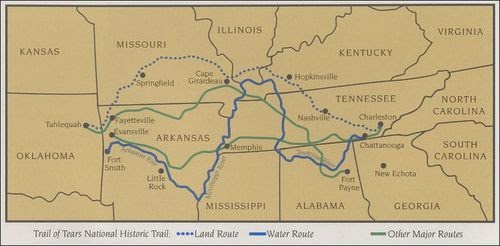
The Trail of Tears is a sad testament of the greed displayed against Native Americans in the 1800s.  In order to achieve land and build states, the Native American tribes were forced to leave the lands they occupied, and moved against their will.  Although those who wanted to stay were allowed to remain and assimilate into society, there is no doubt they were not treated well as white men didn't look favorably upon those with red skin.

Oklahoma, not yet formed was the home of the Choctaw Nation, later named Indian Territory. The government's aim to achieve their personal goal was to relocate Native Americans to the west.  The Indian Removal At of 1830 allowed President Andrew Jackson to enact treaties allowing the removal of all tribes living east of the Mississippi.  For the most part, the removal of the Choctaw was peaceful, but those who resisted were eventually forced to leave if they didn't wish to assimilate into society.
The Creek refused to move, but in good faith, signed a treaty in March 1832 to surrender a large portion of their land as long as the remaining lands were afforded protection.  The US failed to deliver, and in 1837, the military forcibly removed the tribe without benefit of a treaty this time.
The Chickasaw realized they had no other alternative, and and signed a treaty in 1832 to include their protection until their move. The Chickasaws were forced to move earlier than expected as a result of white settlers.  The war department refused to intercede.
A small group of Seminoles signed a relocation treaty, but the majority of the tribe rebuked the agreement.. After resulting in what is known as the Second and Third Seminole Wars, those who survived were paid to move west.. 
www.seerandolphcounty.com
In 1833, the Treaty of New Echota provided two years for the Cherokees in the state of Georgia to move west or face a forced exit.. By the deadline, only a small number of Cherokees had migrated westward and sixteen thousand remained steadfast on their land. As a result, the US sent seven thousand soldiers to enforce the treaty, not even giving the tribe time to gather their belongings.  The escorted march westward became known as the Trail of Tears because four thousand people died along the way.
The thousand-mile march began In the winter of 1838, many Cherokee covered only with skimpy clothing, most on feet without shoes/moccasins.  Beginning in Red Clay, Tennessee, the tribe crossed Tennessee and Kentucky, never allowed to step foot into any towns or villages because of the fear of disease.  Having to bypass these places added miles to their journey, but when they finally arrived at the Ohio River in Southern Illinois around December 3, 1838, they were subjected to a dollar per person toll to use Berry's Ferry.  The traditional charge was twelve cents per head, and the Indians were not allowed to cross until all others were served.  During their wait, as many of the tribe as possible sought shelter under "Mantle Rock," a  bluff on the Kentucky side of the river.  While huddled together, many died from exposure. Several Cherokee were murdered by locals.
The marchers reached southern Illinois on December 26.  An agent for the detachment wrote, "There is the coldest weather in Illinois I ever experienced anywhere.  The streams are all frozen over...  We are compelled to cut through the ice to get water... It snows here every two or three days...we are now camped in Mississippi swamp 4 miles from the river, and there is no possible chance of crossing the river... We have only traveled sixty-five miles in the last month, including the time spent at this place, which has been about three weeks.  It is unknown when we shall cross the river...."

"I fought through the War Between the States and have seen many men shot, but the Cherokee Removal was the cruelest work I ever knew.".
—- Georgia soldier who participated in the removal
The Trail of Tears
Historical information for the blog was gleaned from Wikipedia, including the map above.  Other photographs have been given attribution.

Wednesday, October 2, 2013

The Mercantile

When I began creating the Revolving Point, Texas series, I actually wanted the series set in a different town and state. I had read an article several years before about a nowhere town tucked away in Oklahoma. Outlaws hid there, providing the perfect setting for my outlaws to be outlaws, to win the hearts of the women they love and to redeem themselves at the end of each story. I had planned to begin with Buck and have him become sheriff of this town, but this place wasn't in existence during the timeframe of my story. So, I went back to fictional Revolving Point, which I had created in Luck of the Draw, the notorious town along the Rio Grande known for its lawlessness, card sharps and soiled doves. To make the series more interesting, I destroyed most of the town with a fire and conveyed through the three books the rebuilding of Revolving Point. The businesses I chose to keep were the jail, the boardinghouse, the telegraph and mail and Miller's saloon. All played important roles throughout the series, but it was the rebirth and further usage of the mercantile that gave me the most trouble.    

Zanna's Outlaw is the first book in the series. As the story opens, a newcomer has arrived and builds a new mercantile with his own money. For reasons I won't spoil, Buck runs this person out of town and Debra takes over managing the store. I didn't have a problem with her acting as proprietor in the second book, but when it came to the third book, Debra's Bandit, with Debra as the heroine, I found myself aggravated with Debra and the mercantile. I knew who she was, but I couldn't quite translate onto paper her true character and mannerisms. And then, it hit me as to why. Where I could move her hero around town and showcase his personality to readers through his actions, I couldn't with Debra. She was stuck inside that store.
 
I thought long and hard about Debra and the mercantile, on how to make both shine. I came up with the idea of giving Debra a helper, enabling her to leave the store and interact with other characters in different locales. But something else kept nagging at me. Finally, I realized the scenes with Debra inside the mercantile were wrong, even boring, because I wasn't using both properly. 
 
When I think of a mercantile, shelves of canned goods, sacks of flour and sugar and a back wall housing tools, guns and bullets come to mind. There's a counter with an old-fashioned cash register, maybe a glass jar with peppermint sticks and a potbellied stove in the corner. But the mercantile wasn't just a place to purchase dry goods. It was also a place where townsfolk and neighboring farmers and ranchers gathered to hear the latest news pertaining to the goings-on in town and cities both near and far. In essence, it was today's internet and telephone.
 
Once I was able to wrap my mind around the importance of the mercantile, I was able to make the store and my heroine shine. At heart, Debra is kind and caring. She's also the mom-and-pop business of yesterday. Her customers' needs for flour and coffee are important to her, but more important are the people themselves. Her eagerness to help others shines in the way she greets her customers, in how she takes the time to inquire after them and their families, in how she strives to ensure that everyone who walks through her door feels special and appreciated, which is true of today's mom-and-pop businesses. Now when I think of a mercantile, I imagine people who, like Debra, provided the community with more than just a hammer. I see a building and the person giving the townsfolk what they needed most--communication and a sense of belonging.